The Lumberjack


Students Serving The Cal Poly Humboldt Campus and Community Since 1929

Day: September 25, 2018

  • Forest awakens with music

    Forest awakens with music

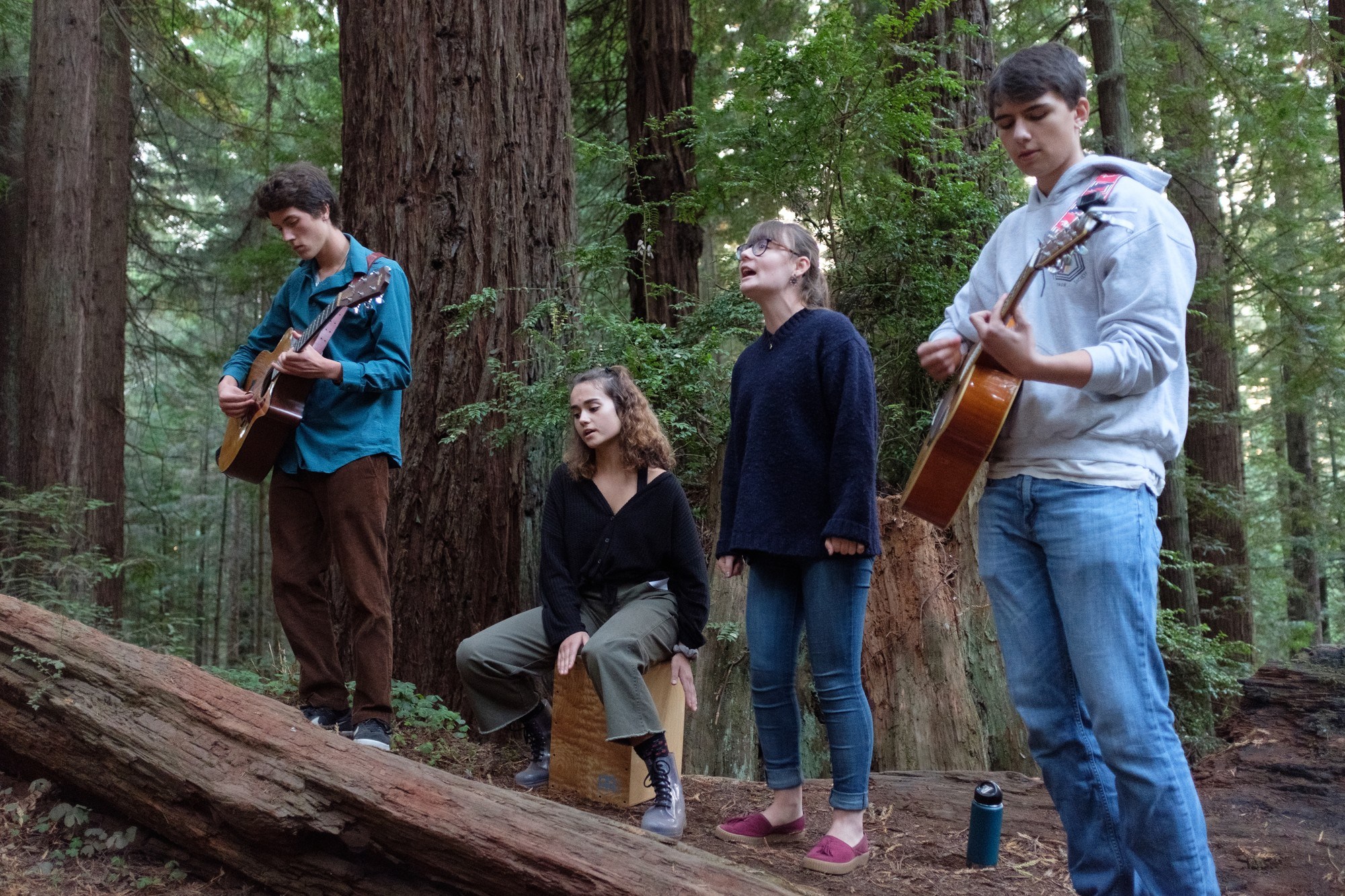
    Petty Education was formed only two weeks ago, and now they’re the closing performance for a community forest show smack dab in the middle of the forest.

    After the audience found their seats within the brush, the dead quiet forest became filled with sounds of the band’s guitars, drum and vocals.

    180923-173340.jpg
    The audience for the community forest show on Sept. 9 in Arcata, CA. | Photo by Michael Weber

    “Bringing music to the forest lets people appreciate it more,” Zelda Geren said, a member of Petty Education. “It’s open, natural and comforting.”

    Petty Education is one of the four bands that performed in Breakfast All Day Collective’s Community Forest Show in Redwood Park on Sept. 23.

    They performed in the show along with the singer duo Allison Kinney and Hannah Rosecrans and the bands Cowtown Serenaders and Bandemonium.

    The format of the show involves moving through four different locations in the forest where each band would play at. At the end of each performance, the audience gets up and moves to the next stop.

    180923-165956.jpg
    The audience for the community forest show on Sept. 9 in Arcata, CA make their way up to the next stop of the trail. This is one of the four stops that the audience will go through. | Photo by Michael Weber

    Jackie Stuber, an organizer from the Breakfast All Day Collective, said the show is based on people enjoying music in the outdoor environment.

    “It’s the forest,” Stuber said. “It brings people out.”

    This is the ninth installment of the community forest show, which started three years ago and Stuber said the turnout has been increasing.

    Stuber began the event by setting ground rules for respect towards the forest and other people. An audience of more than 50 people and musicians attended the show.

    The first to play on the musical march were Kinney and Rosecrans. They sang three duets for the audience.

    Next, the Cowtown Serenaders performed composed songs and musical poetry.

    The third to play was Bandemonium, an open ensemble made from artists in the community. They played modern songs including a mashup of two Eminem songs.

    Finally, Petty Education closed the show at the end of the walk. They are from the Arcata Arts Institute, Geren said, and wrote three songs to perform for the audience in the mere two weeks after their formation.

    “It’s a really magical idea to have music here,” singer Hannah Rosecrans said.

  • Confusion on the airwaves

    Confusion on the airwaves

    KHSU CAB members requested to halt further meetings

    Humboldt State University president, Lisa Rossbacher, has recently requested KHSU’s community advisory board cease further meetings until individual and private communication takes place.

    A community advisory board letter sent to Rossbacher on June 29 left her confused on the decisions made during their June meeting. The letter addressed to HSU administration states that the community advisory board voted a ‘no confidence’ towards general manager Peter Fretwell and have requested his termination.

    “I have become aware of confusion and disagreement about whether the advisory board’s action last June was intended to communicate feedback that the CAB had received from some members of the public or to reflect a formal vote of no confidence by the CAB itself in KHSU general manager Peter Fretwell,” Rossbacher wrote in a letter on Sep. 17.

    The minutes report, which is the written record of the meeting that took place, states under ‘New Business’: “Discussion of the CAB response to the community’s call for a vote of no confidence.”

    Frank Whitlatch, assistant vice president of marketing and communications at HSU, said Rossbacher is asking for clarity involving who made the decision at the meeting.

    Whitlatch said the initial reporting of the advisory group made a ‘no confidence’ vote on general manger, Peter Fretwell, but later on in the meeting the minutes said it was a community decision.

    “Did the board make the vote or the community?” Whitlatch said.

    Whitlatch said the story was incorrectly reported by Mad River Union and the Lost Coast Journal but since has been revised and that has furthered rumors suggesting Rossbacher has banned the community advisory board from meeting together.

    “They can meet if they want, they’re grown ups,” Whitlatch said. ‘The president just wants to speak individually to clear up confusion on the decision.

    To further tension between HSU administration and KHSU, the program, Thursday Night Talk, was recently cancelled by Fretwell when four community advisory board members were supposed to be guests.

    Whitlatch said Fretwell has the final say of all editorial content at KHSU, and it was his decision alone.

    There is a firewall blocking editorial content between KHSU and HSU management. Fretwell didn’t believe KHSU could be objective and report on itself.

    “I do not have the ability to call KHSU and tell them what to produce on the air,” Whitlatch said. “No administrator does.”

    KHSU development director David Reed was one of three staff members who attended the community advisory board June meeting. Reed said the last few months 25 to 100 people have showed up and 100 to 160 people in May, June, and July, a higher number than in the past.

    The meetings have been getting more community involvement since the firing of Katie Whiteside. Reed said three percent, about 120 out of the 3000 station’s donors have left along with four supporting brand or organization underwriters.

    “There was a lot of public comment at the meeting, it was an unusual one,” Reed said of the June meeting.

    Reed said he did not know about the vote confusion and it never occurred to him at the meeting. Ultimately it would have to be to the community advisory board to answer that question.

    A CSU revisory team has been looking at the operations of KHSU. Rossbacher requested in a July 19 letter to vice chancellor of California State University system Larry Mandel, asking advisory services to evaluate “operations, administration, oversight, review of accounts payable processes, communications among staff between KHSU and HSU, oversight FCCC broadcast station licenses, volunteer engagement and training processes and suggestions on whether voluntary compliance audits should be requested from the California Broadcasters Association,” at KHSU.

    “It’s hard to manage opinions at KHSU,” Whitlatch said. “Disagreements and opinions have been stifled.”


  • Fisheries hatches more than fish

    Fisheries hatches more than fish

    During the Great Depression a small college in Humboldt County built a fish hatchery. The hatchery’s popularity among students gave rise to a blossoming natural resources program.

    Today, Humboldt State is known for its natural resource and science programs, according to the California State University website. This wasn’t always the case.

    In Richard Ridenhour’s book “Natural resources at Humboldt State College: the first 30 years” the author wrote that in 1939 Humboldt State College had under 300 students and had no natural resource classes.

    After the construction of the campus fish hatchery in 1940 Humboldt State was the first college in the nation to have a fish hatchery on campus and that success and popularity of hatchery classes led to the expansion of other natural resource and science programs.

    Andrew Kinziger is the current chair of the Department of Fisheries Biology at Humboldt State. According to Kinziger there aren’t many universities that have a fish hatchery that can provide hands on instruction and experience.

    “It’s one of the keystone facilities for the university,” Kinziger said. “It’s a wonderful resource and we’re fortunate to have it.”

    Kinziger said that Fisheries department students and faculty interact with the hatchery on a daily basis.

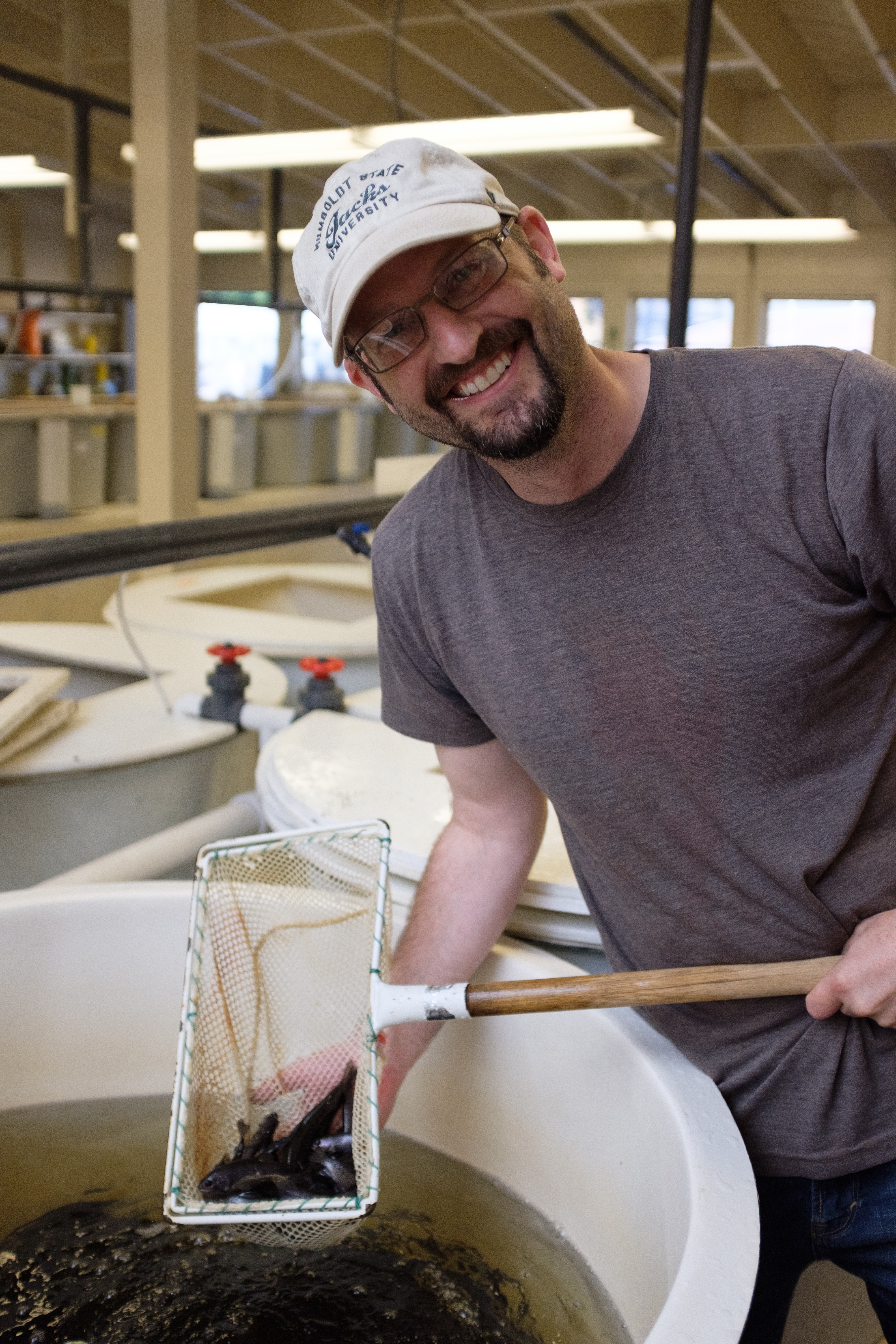
    Patrick Nero has been the hatchery manager at the facility for about 11 months. Nero said the hatchery raises native steelhead and native coastal cutthroat trout. According to Nero, fish from the hatchery are used purely for research and aren’t eaten or stocked.

    Nero said that the hatchery recently implemented an aquaponics project on the facility. Nero’s goal is to produce something valuable with water discharged from the fish system. The discharged water is full of fish by-product, including lots of nitrogen, and acts as a fertilizer.

    Currently the hatchery is growing lettuce, and marigold to transplant in other areas of the campus with discharged water from the hatchery.

    “We’re finding ways to use the discharge,” Nero said. “It’s been successful so far.”

    Michael Academia, a Fisheries Biology major, is a student employee at the hatchery and has worked there since April. Some of Academia’s responsibilities at the facility include feeding the fish, checking the water quality and back flushing the system, which involves pumping in fresh water to hatchery fish tanks.

    Academia said over the summer Nero had asked him to look into ways to work with the Humboldt Energy Independence Fund to improve the facility’s energy efficiency.

    According to the student run Humboldt Energy Independence Fund website their mission is to create a more sustainable campus by promoting energy independence. Notable projects from the organization include the solar panel array on top of Music A building and the relighting of the Redwood Bowl with efficient bulbs.

    The Humboldt Energy Independence Fund is funded with a small portion of student’s tuition each semester. According to their website, about $13 from each student per semester goes to the organization to be implemented on renewable energy projects on campus.

    Academia said initially he was looking at adding solar panels to the hatchery facility but students from the Humboldt Energy Independence Fund said that the hatchery’s energy costs were too high and that inefficient energy draws on the facility should be addressed first.

    This led Academia to look at alternative ways at maximizing facility energy efficiency. Academia worked with a Building Engineer from Facilities Management, Jeff Robison, to conduct an energy analysis on the facility.

    The analysis concluded that replacing dated facility equipment could reduce energy usage by 50 percent and save over $14,000 per year.

    Academia’s proposed project would replace the existing water pumps and electric motor system with new energy efficient models.

    Currently water flow control for the hatchery system is manually controlled and requires two pump motors to run at full capacity for 24 hours a day. The updated pump motors along with an intelligent variable control system, which will automatically control the flow of water through the system would cut energy usage roughly by half.

    “We’re trying to integrate more than fish,” Academia said.

    Academia’s project is in the beginning stages of the approval process by the Humboldt Energy Independence Fund. The organization is currently looking at the feasibility of the project to see if the project can be done.

    “We’re trying to be green pioneers of raising fish,” Academia said.

  • Program tackles STD stigmas

    Program tackles STD stigmas

    Peer to Peer addresses nationwide increase of STD rates 

    Helping to fight the cultural stigmas that surround the rise of sexually transmitted diseases and testing is the new program at Humboldt State University, Peer to Peer.

    Mira Friedman, lead of health education and medical clinic support services, started Peer to Peer as her Master’s program at HSU. Friedman said she started the program because she wanted to fulfill students’ needs and offer access to reproductive services.

    “There isn’t a lack of education in college but an inaccuracy in sex education,” Friedman said.

    The program is unique in that students get help provided by other students. There are four medically trained students who run Peer to Peer giving consultations as well as no hassle access to STD testing and birth control. The idea is, it is easier for students to seek help from their peers.

    According to St. Joseph Health, the United States hit an all-time high in sexually transmitted diseases and Humboldt County is no different. Over 2 million cases throughout the country according to Centers for Disease Control and Prevention.

    Public health nurse of the communicable disease program at the Department of Human and Health Services (DHHS), Hava Phillips, said Humboldt county is following both the national and statewide trend of increase in STD’s. The numbers across the board are all the same and differences between populated and rural makes no difference.

    “It’s something we are worried about,” Phillips said.

    The most common STD is Chlamydia. Not far behind is Gonorrhea and at a far distant third is Syphilis, which can pose the greatest health risk if left untreated because it has more potential to cause damage.

    According to Humboldt County Public Health syphilis in Humboldt county is up 172 percent. There have also been 665 reported cases of Chlamydia in Humboldt in 2017.

    According to the California Department of Public Health 218,728 cases of Chlamydia cases were reported in 2017 statewide. Over half of them were younger than the age of 25. Gonorrhea amounted to 75,372 cases with 33 percent younger than 25. Both diseases were the highest since the numbers began to get reported. Syphilis cases reached 13,719. This has been the highest since 1987.

    “Stigmas contribute discomfort for people to get tested,” Phillips said.

    The cultural stigmas surrounding STD’s and getting tested create extra dilemmas for people seeking services. Phillips said there is a huge need for educating people to get tested for STD’s and to treat it like anything else. Anyone sexually active is at risk of getting an STD just like someone breathing is at risk of getting the flu.

    “They need to be just another normal thing you get tested for,” Phillips said.

    There are lots of theories as to why there is an increase, but nothing concrete. The highest risks are unprotected sexual activity, individual anonymous sex and sex with multiple partners.

    Celene Lopez worked as a peer educator as an undergrad with Planned Parenthood before returning to HSU to earn her masters in counseling psychology. She knows the challenges posed on people who aren’t seeking help. On college campuses information is everywhere but in the general public it’s harder to be reminded.

    “Lots of people think they’ll just know if they have contracted an STD or not, and really they don’t know,” Lopez said, “the most common symptom is no symptom.”

    Both Chlamydia and Gonorrhea usually have no symptoms. People who have contracted these diseases go untreated and in turn spread them to more people. Lopez believes the increase of STD’s is because of services lacking education as well as lacking health care.

    “People don’t know where to go, they don’t know where to get help,” Lopez said.

    Lopez is also well aware of the cultural stigmas that surround STD’s which makes it difficult for people to feel comfortable enough to get tested. To combat these stigmas Lopez suggests creating safe environments for people to get confidential health care, like what Peer to Peer is doing.

    “We need to change the culture of sexual health,” Lopez said.

    This includes the demonizing of people for having sex and to show people there is no judgments. Easy access to resources, like Peer to Peer, helps minimize long waiting periods of being seen by health services and allows doctors to see patients who have symptoms.

    Lopez compares STD’s to the flu, we don’t shame people for getting the flu yet when it comes to STD’s people are shamed all the time.

    “People don’t know what to expect. They feel the stigma, they feel dirty, but we’re here because we care. No one is here to judge,” Lopez said.

    For questions or to book an appointment Peer Health Educators can be reached at 707-826-3146 or hsuphe@humboldt.edu.

    The Clinical Peer Health Educators office is located in RWC 127.


  • Rent repeal

    Rent repeal

    Party of socialism and liberation club host workshop on affordable housing proposition

    Nathaniel McGuigan, a Humboldt State University senior in biology and minister of communications for the HSU Party of Socialism and Liberation branch, invited special guest Gloria La Riva to Humboldt State University on Sept. 21 to direct a workshop on Proposition 10.

    “The party is growing and workshops like the one on Prop. 10 are for reaching out to community members,” McGuigan said.

    McGuigan said the reason for the workshop was to bring awareness of social issues to the growing working class because it affects them the most.

    Proposition 10 supports the Affordable Housing Act. According to the proposition, approval would restore the rights of communities in California to pass stronger rent control by repealing the Costa-Hawkins Rental Housing Act, a law that has given landlords and developers unlimited power.

    Gloria La Riva, once a presidential candidate for the Party of Socialism and Liberation, directed the workshop on the rent control measure. Room 206 of Nelson Hall became homebase for socialist discussion on activism and renters rights.

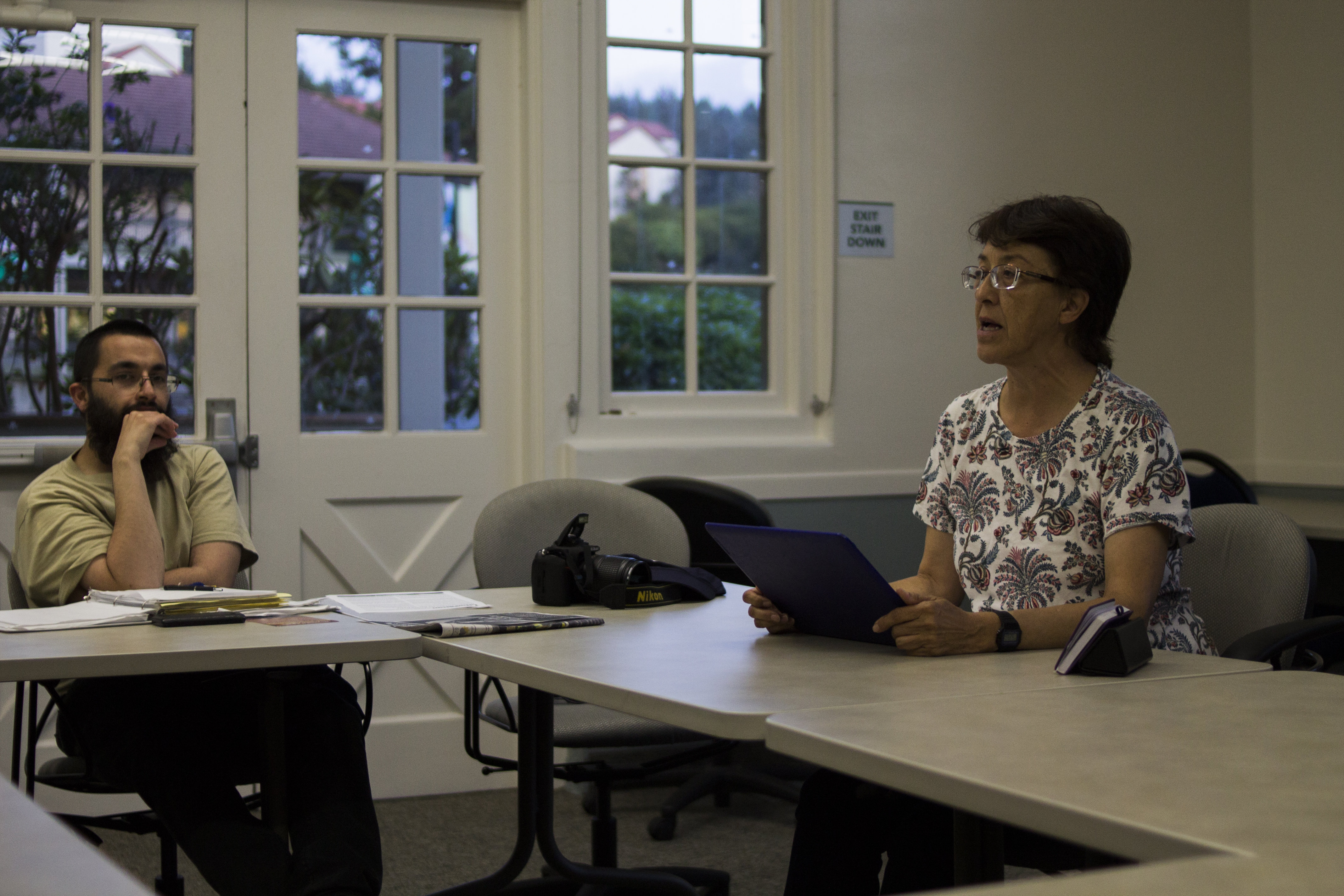
    The workshop started five minutes late due to lack of attendance, but soon there were five sitting at the table’s rectangular set up which eventually filled to nine. Eight interested students and an eager La Riva, enough for a revolution.

    “No working class people can pay what landlords are wanting to charge,” La Riva said.

    In an hour and a half La Riva discussed the different laws pertaining landlords and renters that have been passed, personal experiences of travelling the world as an activist, and a brief history of rent control, not only in the United States but other countries as well. This isn’t your typical tedious history class though, it is filled with entertainment, compassion and challenges that don’t make normal media coverage.

    La Riva said people in power like city officials and councils don’t want rent control to pass. When she was running against Diane Feinstein for mayor of San Francisco in the 80s, Feinstein was promising vacancy control, which is regulation of rent levels and evictions of tenants. Feinstein never fulfilled her promise, La Riva said that was because Feinstein’s husband is a landlord with lots of properties, something typical with people in office.

    At some point a student asked La Riva why she was hopeful that this proposition would be successful when others in the past have failed.

    “We have to keep fighting. We have to keep doing,” La Riva said.

    The night went into heavy depth of socialism, the myths of socialism and what it means to be socialist. Under socialism everything is built by the workers, so everything that is done is for the collective of the community.

    In a capitalist society, La Riva said, “There is only a handful of people at the top who own everything while everyone below builds everything and stays poor.”

    At 7:30 the table opened up for free discussion to the students who were mostly political science majors. It was mainly McGuigan and english senior, Max Hosford, that took up the rhetoric regarding solutions.

    “Once I decided Humboldt was going to be my new home, that’s when I started getting more serious about politics and researching these issues,” Hosford said.

    Hosford offered recent books and political podcasts such as ‘revolutionary left radio’ for others to listen to that discuss the topics that were talked about at the workshop.

    “Propagate, agitate, educate,” Mcguigan said on plans for the future. This includes their interest in the November election by focusing local and bringing awareness to issues like the removal of the McKinley statue and turning Arcata into a sanctuary city.

    The flyers that McGuigan made advertising Proposition 10 brought awareness to political science senior, Owen Donnell. Donnell heard about the proposition but wasn’t really sure what it was. He knew if it was about rent control it would be beneficial.

    “With how hard and unaffordable rent is, some reform is needed,” Donnell said.

    Having members from the community become informed is why McGuigan wanted to have the workshop. McGuigan said being a part of PSL is solidification to his own consciousness.

    The night ended after the discussion on solutions and everyone exchanged numbers. New ideas were shared and many were informed with new open ways to look at not only rent control but government parties.

    “Everything is made from social production,” La Riva said, “but those that own everything are getting smaller and smaller.”