The Lumberjack


Students Serving The Cal Poly Humboldt Campus and Community Since 1929

Day: March 10, 2022

  • Concrete masquerades as the moon in Bradshaw exhibit

    Concrete masquerades as the moon in Bradshaw exhibit

    by Nina Hufman

    “Photography as Material,” a photography exhibit featuring the work of Julia Bradshaw, is now open at Cal Poly Humboldt’s Reese Bullen Gallery. The exhibit will be featured in the gallery until March 26. Gallery hours are on Tuesday and Wednesday from 11 a.m. to 5 p.m. and Thursday and Friday from 1 to 6 p.m.

    Bradshaw’s work involves taking high resolution photos and then processing them through traditional darkroom and editing techniques as well as computer photo editing.

    “I’ve never seen anything high resolution like that, it’s almost an illusion,” said Isabela Acosta, a Cal Poly Humboldt art history major. “I want to touch it because it looks like it’s coming at you.”

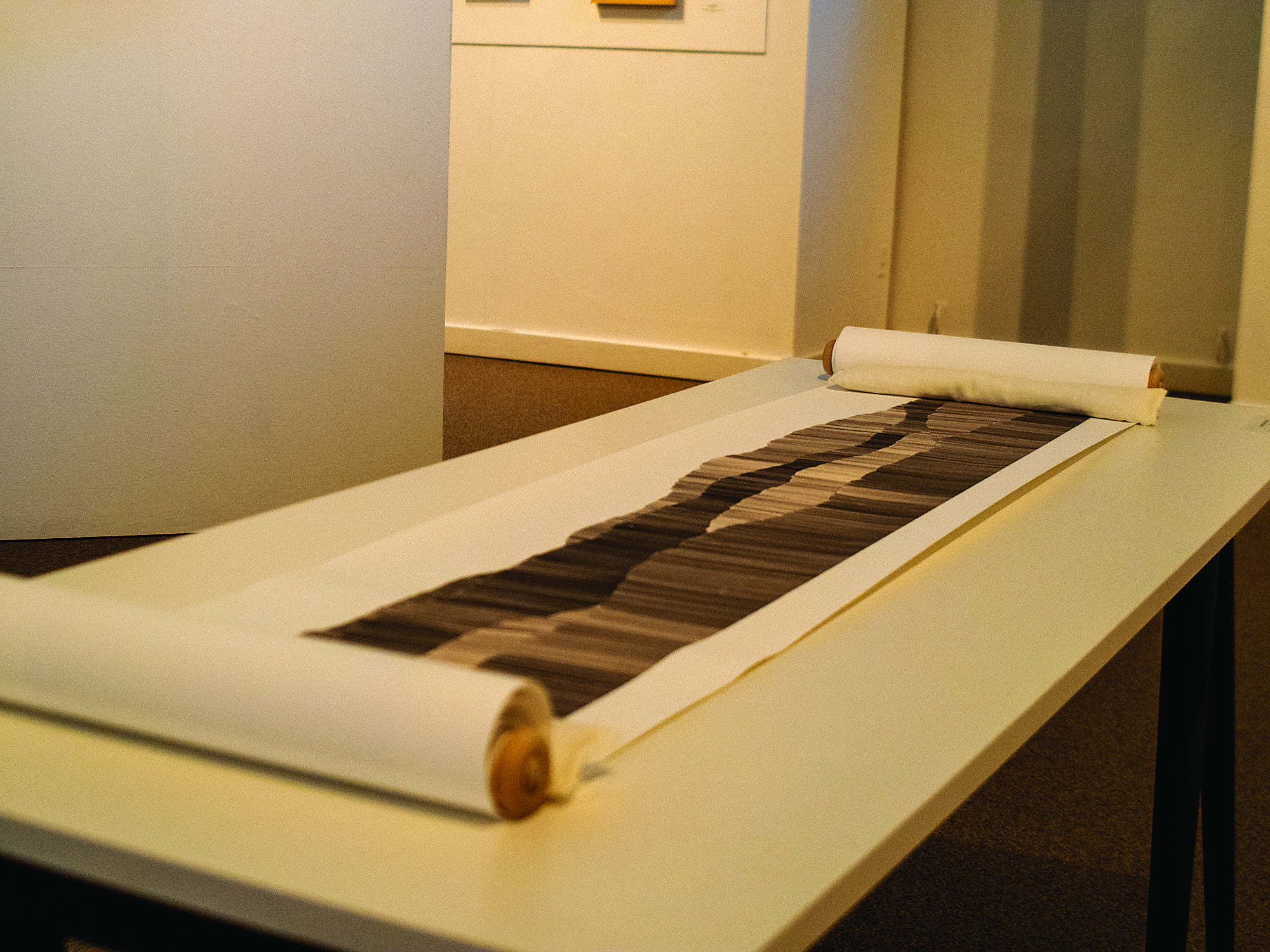
    The exhibition features two of Bradshaw’s bodies of work, “Stacks and Shapes” and “Survey.” “Stacks and Shapes” features manipulated images of paperback books. Photographs of books are arranged to create geometrical forms, some of which resemble landscapes. “Survey” includes images of concrete that resemble scientific photographs of the moon.

    Photo by Morgan Hancock | Julia Bradshaw’s “Survey” project inspired by early astrological photography.

    “All of those are concrete, that’s just concrete, but she’s making it look like images of the moon,” Acosta said. “She does that through different processes of developing films and taking things at a certain angle.”

    On her page on the Cal Poly Humboldt Department of Art website, Bradshaw says that the pieces included in “Survey” were inspired by scientific diagrams and notes. The photos were taken using a cardboard box and were edited using knives, inks, dyes, and other techniques.

    “The simplicity of the materials is a subtle poke at the vast gap between investment in science and investment in art,” Bradshaw wrote. “By pointing my camera at the most abundant of materials, I aim to empower imagination in conjunction with science.”

    Former Cal Poly Humboldt student and current faculty member at the Cultural Resources Facility in the anthropology department, Zedekiah Minkin, was impressed by Bradshaw’s moon-esque photos.

    “Compared to the real scientific images, it looks like it could be straight out of NASA,” Minkin said.

    Religious studies and art history major Cass Jensen also commented on the realism depicted in the photos. They also think that, by comparing concrete and the moon, Bradshaw is commenting on recurring patterns and themes throughout the universe.

    “I really like the collage work because it does look exactly like some sort of scientific model that you would see come from NASA,” Jensen said. “It helps elaborate how certain things can be very similar but very different all at the same time. It’s like how a lot of things that may look really far away and intangible are just, like, everywhere.”

    Jensen is a collage artist as well. They are inspired by how concisely Bradshaw is able to convey her message through her artwork.

    “I like the simplicity of it, it still makes a point without being too much,” Jensen said. “It’s not as complicated and overwhelming as sometimes my pieces come out to be.”

    Overall, the most striking quality of Bradshaw’s work is the illusion that she creates. The images are created to allow the viewer to see beyond just the materials used in each piece. The pieces do not necessarily resemble the materials that they are made of.

    “I get a raw sense,” Acosta said. “She’s just doing things from a different perspective.”
  • Sharing is caring… unless it’s propaganda: The Russia-Ukraine Crisis

    by Kris Nagel

    Everyone has an impact on someone’s perspective of the world. Almost anything we do or say affects someone in some way. The same holds true for the things we post on social media. We are all influenced by the people around us. When the subject of our virtual discourse is something as poignant as international conflict, our sympathies can be weaponized without us even knowing it.

    Roughly half of Americans regularly get their news from social media, according to a 2021 study from the Pew Research Center. The information we share online can challenge our belief system but oftentimes reinforces it. Al Tompkins, a journalist with the Poynter Institute, says that truth gets little consideration when the content we share aligns with our worldview.

    “We tend to support those things that agree with your position on anything,” Tompkins said. “Whether it’s the designated hitter in baseball or invading Ukraine, we tend to repeat and share things that we agree with.”

    The internet has changed the way information is spread through society. It’s easier than ever to produce fake information.

    “The other piece of it is this,” Tompkins said. “Disinformation is a very powerful weapon. The Russians know it but, let’s face it, the Americans know it too. The American government, particularly through the CIA, has done lots of disinformation over the years. You would expect that they do, it’s kind of part of what they do.”

    Understanding that misleading content is built into our news feed requires us to take a critical look at what we share before we share it. Tompkins’ approach asks four questions:

    What do I know?

    What do I need to know?

    How does that source know what that source claims to know?

    And is there any other way to look at this other than the way that source is telling me?

    Vicky Sama saw the real-time effects of media coverage and propaganda in the several wars she covered during her career at CNN. Sama is now the department chair for Cal Poly Humboldt’s journalism and mass communications program.

    “So there’s two parts of war, usually,” Sama said. “You have the war, the actual war with fighting and then you have the information war, the propaganda war, and that is an essential part of what happens in war as well.”

    When we see things happening live, there isn’t an editing process that we can rely on to verify what we see. Live television, live broadcasting, and live streaming allow for that to happen. Now that consumers are a part of the distribution process, Sama argues they also need to be part of the editing process.

    “If everybody’s going to start considering themselves a journalist just because they have a cell phone, then they need to start doing the work of a journalist and start verifying the information before they put it out there as well,” Sama said.

    However, verifying everything we see is seldom an intuitive process. Kirby Moss, a Cal Poly Humboldt professor in the journalism department, teaches a range of media analysis classes. Moss said that the fundamental way to verify information is to look for other sources reporting on the subject.

    “I tell students, if you find some information that you’re researching on, try to cross-check it with at least three sources if you can,” Moss said. “And then they find out sometimes like, ‘Well I went to one source but the other source says something else, the other says something else,’ and so then they begin to question that message.”

    It takes familiarity to be confident that the information you get is credible. That is not to say that there aren’t tools we can use to check the things we share. Vicky Sama is working on adding a media literacy course for freshmen to the department catalog. In the meantime, JMC 309: Analyzing Mass Media Messages will be open for registration near the end of the semester. Online courses on media literacy are also available to everyone through the Poynter Institute.

    [DISCLAIMER: The Lumberjack rarely uses journalism department faculty as sources for stories. However, an exception was made for this story due to the expertise our professors have on this particular subject. Vicky Sama and Kirby Moss do not exercise editorial oversight on the content The Lumberjack publishes.]

  • Cal Poly Humboldt’s Library Cafe sees the light of day

    Cal Poly Humboldt’s Library Cafe sees the light of day

    by Lex Valtenbergs

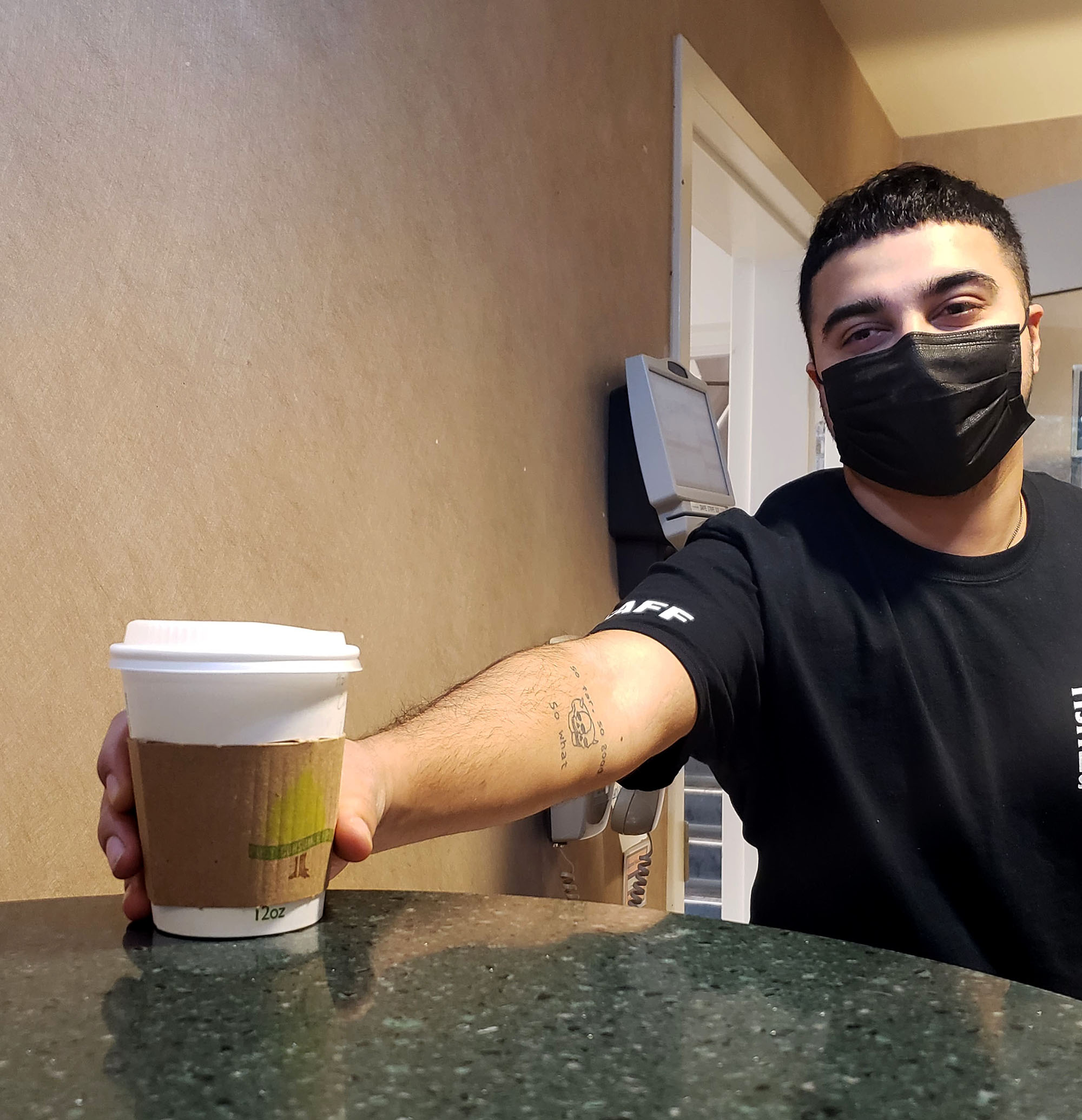
    The Library Cafe lifted its shutters for the first time in several years on Friday, Feb. 26. The cafe serves delicious coffee blends from Muddy Waters Coffee Co. as well as pastries, veggie wraps, drinks, and more.

    Recent biology graduate Kate Mendoza was just hired by the private company Chartwells Higher Ed to work at the newly reopened cafe.

    “Chartwells is really awesome,” Mendoza said. “Honestly, they work really well with students from what I’ve seen.”

    Mendoza’s go-to drink is the cappuccino.

    “I usually like to do the cappuccino,” Mendoza said. “It’s just espresso, steamed milk, and a lot of foam. I think the foam is my favorite part.”

    Mendoza’s coworker Ahmad Shah, a senior majoring in communication, recommended the hazelnut mocha.

    “I like a hazelnut mocha,” Shah said. “Sometimes coffee is a little bit bitter. The sweetness helps balance the bitterness of the espresso.”

    Communication senior and Learning Center academic peer coach Kas Colwell ordered a vanilla latte with two espresso shots from the Library Cafe on March 3.

    “I’m so glad y’all are open again,” Colwell said to Mendoza while ordering. “It’s exponentially improved my quality of life.”

    After getting her drink, Colwell sat down at a nearby table in the dining area. As a library employee, she appreciates how easy it is to get to the cafe.

    “It’s the convenience because I literally work in the library, so it’s on my regular route,” Colwell said. “I don’t have to go walking somewhere else to get coffee.”

    The Library Cafe is available to all Cal Poly Humboldt students and faculty and is currently open on weekdays from 7:30 a.m. to 5 p.m.