The Lumberjack


Students Serving The Cal Poly Humboldt Campus and Community Since 1929

Month: March 2024

  • Bitch n’ Stitch in the Makerspace

    By Jasmin Shirazian

    Whether it’s due to the rise of fast-fashion or the misogyny surrounding what is traditionally considered “women’s work,” sewing is often overlooked as a valuable life skill. Nonetheless, the opportunities that come with understanding the basics of sewing are endless. 

    Studio art major Sawyer Armitage is the host of the Sew Easy event held every Monday at the Makerspace in the library. They walked me through my very first fully finished sewing project: an itty-bitty, stuffed piece of pie. 

    Armitage has been working as a student assistant at the Makerspace since Dec. 2022. They only recently began hosting the sewing circle this semester, having learned the basics over winter break. 

    “I love to make tiny [things],” Armitage said. “I was lucky to have someone throughout my whole life who knew how to sew and was willing to teach me, and I wish I [had] taken them up on it. It’s been super empowering to learn, not only small alterations, but also to teach people how to hand-sew, to use the Singer sewing machine for the first time, hem their clothes, create new designs… it’s genuinely a good, functioning life tool.” 

    Armitage started me off by handing me a piece of felt, a pen and a set of shapes to trace onto the fabric. Afterwards, they handed me a needle and some embroidery thread. The endless struggle of getting the thinnest piece of string through the narrowest eye of the needle followed me throughout the entire sewing process.

    Emerald Dowd, a wildlife major, joined us halfway through the first hour and almost immediately began crocheting a flower with the prettiest yellow yarn. By the time it took me to finish cutting out my pieces out of the felt, she was halfway through the first layer of her flower. I spent some time trying to figure out if she was fast or if I was just slow. 

    As we sat and worked on our projects, we talked about all different aspects of our lives and personalities. Different people joined and left us throughout our two hours together, some coming to work on unrelated projects, others just stopping by to chat or borrow supplies. As Armitage, with the occasional help from Dowd, showed me how to do a blanket stitch, we all shared our favorite musicals, what got us into sewing, Armitage’s new band that they’re songwriting for and everything in between. Sitting and engaging with each other, in what Armitage called parallel play, filled a sense of community that I didn’t know I was missing. 

    Nova Presley is an environmental management major who utilizes the Makerspace not only for resources, but for getting independent work done.

    “I have really bad issues with getting myself to do tasks that I want to do unless somebody else is also doing [something] next to me,” Presley said. “The Makerspace is really helpful because, like, I’m not even here for sewing right now, I’m here for a different thing that’s graphic design. As long as everyone else in the area is working on something creative, it’s a lot easier for me to hangout and do something creative.”

    Presley has found the Makerspace to be a good source of forming friendships on campus.

    “It’s a very like-minded space, it’s fun to meet people outside of the typical avenues,” Presley said. “It’s hard to find people in Humboldt to hang out with.”

    Learning to make and mend clothing is also environmentally and financially sustainable. Instead of having to buy an entirely new garment when something tears or a zipper breaks, you can fix it yourself – or better yet, create something out of quality materials. 

    “When you don’t have a lot of money, whether you’re a person crafting or a higher institution that doesn’t have a huge budget, you have to figure out how to make things work with what you have,” Armitage said. “Being able to change what you have, or make it fit something new, that’s what sewing is a lot of the time.”

    Dowd sews for many reasons, starting with the love of creating and altering clothes. 

    “It’s a creative outlet, that you can then wear around and be like, ‘This is who I am, and this is what I like,’” Dowd said. “It’s this way of expressing yourself.” 

    Dowd comes to the Makerspace at least once a week for the Monday sewing circle. Otherwise, they often make use of the many resources that are offered, such as the communal sewing machine or the 3D printer. 

    “It’s a stitch-n-bitch,” Dowd said. “It’s a place for community; a place for people with similar interests to join together and to help each other out. If you’re just learning, and you’re like, ‘Hey, I don’t know how to do this yet,’ the people who are into sewing and into crafting are like, ‘I will indoctrinate you.’”

  • Humboldt gamer enters the competitive scene

    Humboldt gamer enters the competitive scene

    By Mario Orozco

    Competitive gaming and esports have risen to the mainstream with audiences captivated by the elite gameplay and competitive events. This rise in popularity has birthed thousands of professional gamers all competing for the top spot in their respective games. One of these competitive gamers is here at Cal Poly Humboldt, taking his talents for Super Smash Bros. to the competitive scene. 

    Deven Teixeira, a communication major at Cal Poly Humboldt, recently competed in GENESIS, an annual tournament held in Oakland and San Jose. GENESIS is considered to be one of the premiere tournaments with thousands of players competing for the top spot in the event. Teixeira was driven to compete in the tournament to test his skills after winning some smaller competitions.

    “What inspired me is that I won a decent amount of online [tournaments] and some locals in Central California,” Teixeira said.

    A tournament of this size and importance calls for different types of preparation. Apart from just gameplay, Teixeira typically prepares both his body and mind to ensure he’s at his best.

    “I usually get good sleep and eat very healthy meals, not greasy or saturated in fat meals,” Teixeira said. “Meditation through breathing exercises is a staple to my prep as well.”

    This journey into esports started with a healthy rivalry between Teixeira and his high school best friend. The two began by competing against one another in a modded version of Super Smash Bros. Brawl called “Project M” while in their freshman year of high school. This mod made the game more like the former Super Smash Bros. Melee and after some time they decided to test their skills and compete in some local Project M tournaments. They eventually found they were no longer satisfied with the modded game and wanted the real thing, putting together some money to buy two copies of Melee. This led to them attending their first major tournament, with Teixeira crediting his best friend for being one of the main reasons he competes to this day.

    While not placing first in tournament, being eliminated from the bracket going 3-2 and ranking 513th out of around 2000 participants, Teixeira isn’t upset about his placing in the tournament. He views the experience as beneficial and inspiring.

    “I’m not upset with my placing,” Teixeira said. “I’m more inspired to do more majors and try to do even better each time.”

    Competitive gaming is a difficult task that requires a lot of time and practice. Teixera offers advice to any students who are looking to step foot into the competitive gaming scene.

    “My advice is to challenge yourself,” Teixeira said. “If things bring you discomfort in gaming, use that discomfort as a threshold for learning. Reach out to me. I’m easily accessible and I can help people get to top level quick if they want to do that grind.”

    Teixera hopes that Melee becomes more prominent locally. He wants to revive the game on campus and see the competitive scene flourish once again. 

    “Revive Melee in Humboldt,” Teixeira said.

  • LOGGING THEIR HOURS ‘JACKS SHARPEN THEIR AXES        

    LOGGING THEIR HOURS ‘JACKS SHARPEN THEIR AXES        

    By Alex Anderson

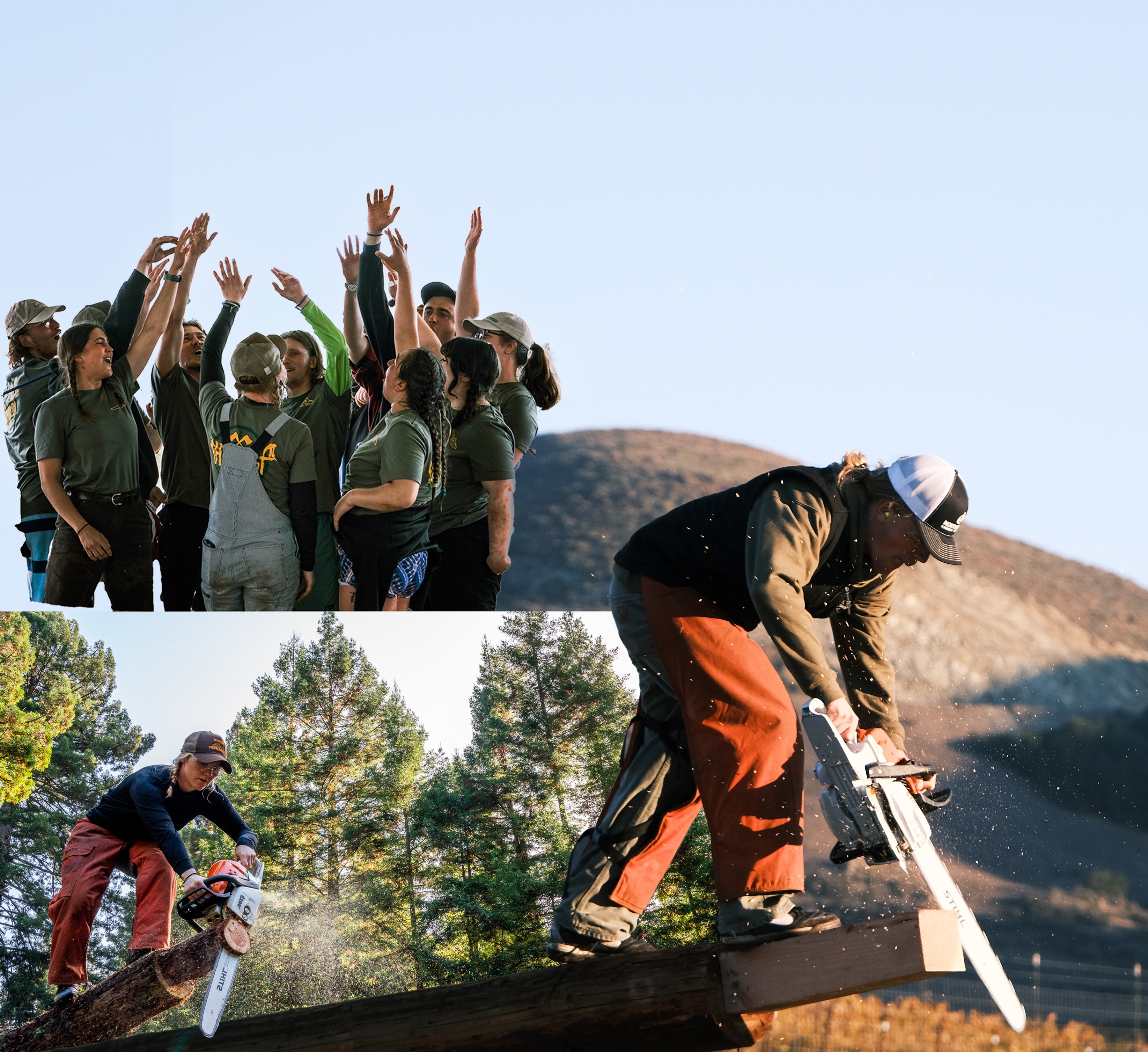
    Over 150 logging competitors will soon descend upon Humboldt swinging axes, climbing trees and firing up their saws. They’re coming to compete at the 84th Annual Association of Western Forestry Clubs (AWFC) competition, a special opportunity to showcase what makes Humboldt logging sports unique. 

    After about a year of planning, Cal Poly Humboldt’s logging sports team is excited to host the AWFC competition for the first time in 10 years, in conjunction with the Redwoods Region Logging Conference (RRLC). The competition is free and open to the public, taking place at Redwood Acres Fairgrounds on March 13 through March 16. Zoey Cardoza, president and captain of Cal Poly Humboldt’s logging sports team, is excited for the team to host the event this year. 

    “We’re expecting over 180 competitors coming from 10 western schools,” Cardoza said. “We’re bringing 31 students to compete, which is wild, and it’s gonna be really fun. I just want them to have the same opportunities that I’ve had and be able to compete in a competition that everybody else has strong passions for, learn something new about themselves and hopefully about the sport too.” 

    Logging sports is far from any typical sports club seen on university campuses. Deeply intertwined into the history of Cal Poly Humboldt and surrounding community, logging sports keeps the tradition alive. The team strives to open their doors to everyone with interest, not limiting themselves to forestry majors. Cardoza aims to create a safe space for people to try something new with logging sports. 

    “I think a lot of people assume that, you know, we’re logging sports, we’re all foresters,” Cardoza said. “We’re not. We have economics majors, psychology majors, and English majors. We welcome any and all walks of life. I think that’s what makes us unique too, is that you don’t have to be a certain shape, size or have a certain passion. If you want to try it, come out and try it.”

    While the club is open to all educational backgrounds, the team does serve a vital role in preparing students who are interested in forestry careers following school. Ed Laskey, a forestry student and second year logging sports competitor, explained how being on the team also provides an essential space for learning safe practices with modern and traditional logging skills. 

    “I would say just practicing valuable working skills using the axes, the cross cuts and chainsaws because I’ve worked with chainsaws before and it’s good to have a big group of people that you can learn from to do safe operation,” Laskey said. “And help others to learn how to use these tools in a safe way.” 

    Cameron Wallace, a forestry student at Cal Poly Humboldt and logging sports competitor, explained what sets logging sports apart from other sports on campus. 

    “It’s more niche,” Wallace said. “There’s a little more inherent risk. It really lets me get involved with my friends in forestry and in a way that I wouldn’t normally be able to… at the end of the week you’re tired, you’re done with sitting in the library all week and you’re just [ready to] go out into the woods with your friends to use chainsaws and axes. Do what we’re learning about in a natural environment with your friends, and it’s a good way to get outdoors, that’s part of the fun.” 

    Humboldt’s logging team is another place where students find a supportive community. Team members look forward to showcasing their skills and comradery at upcoming competitions.

    “I would say it’s special because you meet a lot of cool people,” Laskey said. “The friendships that you make are really cool. Whenever you’re at a competition and you’re competing in an event, you have the whole team, because usually it’s only one thing going on at a time. So the whole team is able to go there and watch you and cheer for you. That’s super special.”