The Lumberjack


Students Serving The Cal Poly Humboldt Campus and Community Since 1929

Day: April 24, 2024

  • Campus recycling: the good, the bad, and the ugly

    Campus recycling: the good, the bad, and the ugly

    By Christina Mehr and Brad Butterfield

    Eventually, each plastic jug of vodka enjoyed the night before a midterm and recycled in a blue bin on Cal Poly Humbodlt campus grounds will be on a freightliner traversing the great Atlantic ocean, en route to a recycling facility in Southeast Asia. From there, it is processed and turned into Amazon packaging and may end up right back on your doorstep. The nearly 6,000 Lumberjacks on campus produced 169 tons of recycling in 2023. While the sheer tonnage is impressive, it signals a marked improvement compared to years past and has contributed to the university’s new bronze level Plastics Reduction Partner award from the National Wildlife Federation (NWF). 

    The NWF website explains the badge as, “[An] introductory badge, your university is newer to the plastics reduction space, and trying to get the word out about the need for change.”  

    Only one other university has achieved the bronze level certification, and no university has yet achieved silver or green levels of certification. To obtain the award, the university undertook action items which propel towards less overall plastic usage, for which they were awarded points by the NWF. Under the direction of Morgan King, lead climate analyst, the university engaged the campus community in outreach/education events, banned single-use plastics on campus, increased water bottle fill stations on campus, and worked with Chartwells Higher Ed to reduce unrecyclable materials used in the campus food service. Chartwells Higher Ed did not respond to an interview request.

    “Over the past year, myself and Katie [Koscielak] in the sustainability office have been working with some people in dining services to identify alternatives to single use plastics, such as utensils,” King said. 

    The sustainability office’s efforts have had notable success, with a large increase in the number of locally compostable plates, utensils, and containers used across campus. An area that still needs improvement is the university’s purchasing of goods with packaging that is not recyclable, according to King.

    “We can put some pressure to require that the packaging is either returnable or is made of a reusable, recyclable or compostable product,” King said. “So, that’s something that we need to start. We haven’t done much around that yet.”

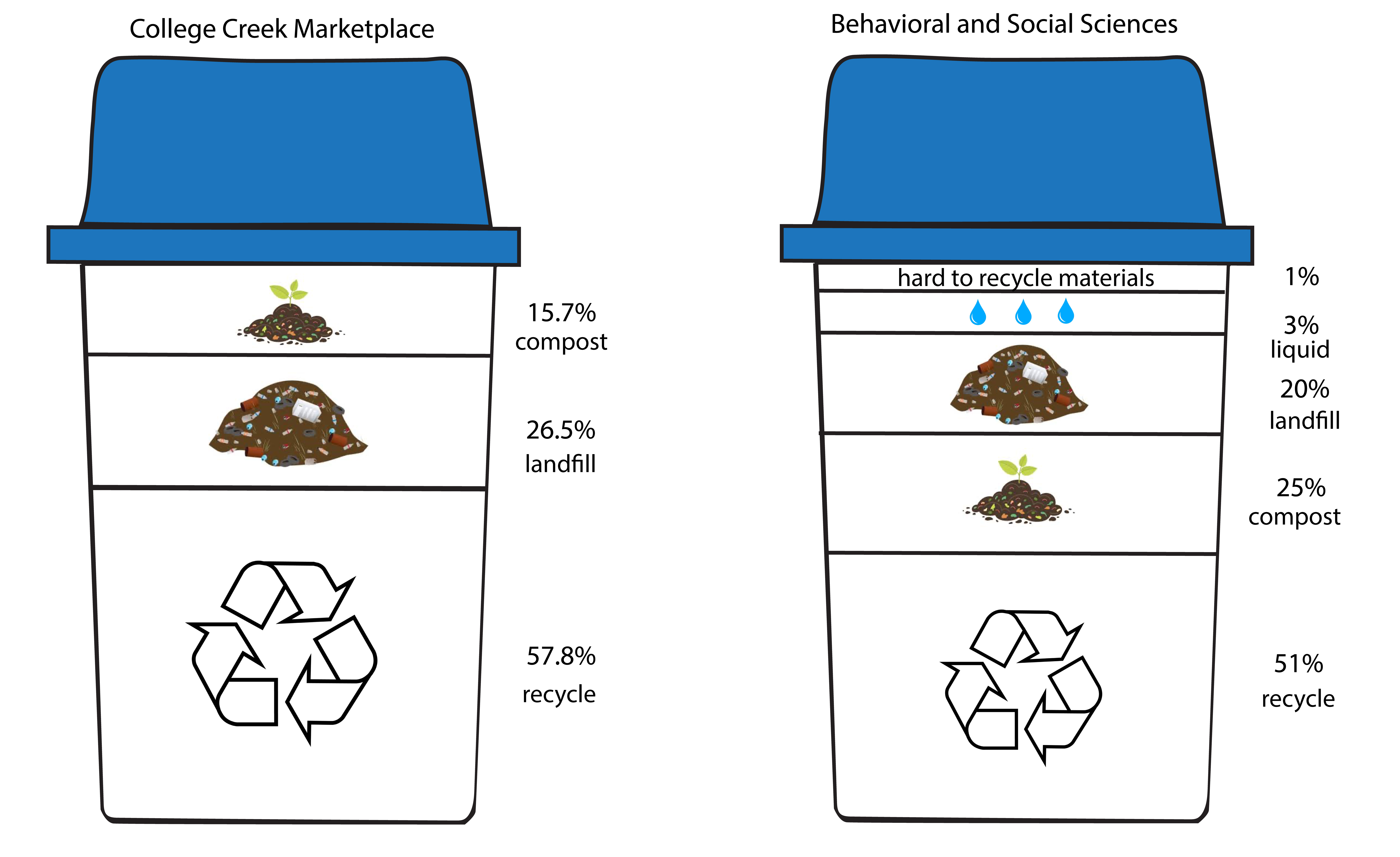
    Liz Whitchurch, Director of Facilities Operations shared that the  university’s current mixed recycling contamination rate is between 14 and 16%. Using other local municipalities as benchmarks, this is a relatively low rate of contamination, according to both Whitchurch and Frank Nelson, assistant general manager at Recology. A Dec. 2023 study conducted by Harrison Chubb and Morgan King found that a recycling bin outside of the College Creek Marketplace contained (by volume) 57.8% recyclables, 15.7% compostables, and 26.5% landfill waste. A separate study led by King in Feb. measured the contents of recycling bins outside of the Behavioral and Social Sciences building after a one week collection period and found (by volume): 51% recyclables, 20% landfill waste, 25% compostables, 3% liquids, and 1% ‘hard to recycle’ (HTR) items.

     In an effort to lower the contamination rate, the university is working to color coordinate all recycle bins across campus, as well as continuing to improve signage, according to Whitchurch.

    As most consumers are aware, it is far from straightforward to understand whether or not your trash is recyclable. Like many of us, King can struggle at times with what bin to toss waste into.

    “It’s extremely challenging,” King said. “I would consider myself pretty well versed. In recycling, but even I don’t know some of the items that are out there and whether or not they can actually be recycled.”

    To add to the confusion, many technically recyclable items, like plastic berry containers and plastic cups (referred to as clamshell plastics), are eventually put into the landfill, as the cost of recycling the item outweighs the end value of the product.

    “They’re not a commodity that can be sold,” Nelson said. “It costs more to process them than you can sell them for.”

    Pizza boxes require preparation before they are considered recyclable. The wax paper, box support, and pizza leftovers must be removed before tossing into a blue recycling bin.

    On campus, the massive task of sorting waste is done by just four individuals, according to Whitchurch, who added that she is looking to hire another person to tackle the widespread contamination issue.

    “We try to pull out contamination,” Whitchurch said. “Our guys jump in and dumpster dive sometimes if they see something [obvious], like a big bag of garbage that someone put in the recycling dumpster instead of into the garbage dumpster.” 

    Realistically though, the responsibility of sorting waste into the proper bin is up to the campus community.

    “Nowhere in the process do we pour everything out and sift through it and figure out what goes where,” said Whitchurch. “That’s just not a service that the university is equipped or staffed to do.” 

    Acknowledging the difficulty of proper recycling informed King’s ultimate goal for campus waste, plastics in particular: avoid generating or bringing these items onto campus in the first place. Paradoxically, this may be both the simplest solution and the toughest to implement, as it involves changing the behavior and consumption norms of an entire campus. 

    One successful example on this front is the university’s reusable water bottle fill stations located in nearly every campus building. Recently, the university has begun posting a Water Quality Report, accessible via QR code at water fill stations. King hopes this will build confidence in the campus community that the tap water being dispensed is high quality. Likewise, starting in 2013, the school’s dining hall, the J, began participating in the PlanetOZZI reusable boxes. These to-go boxes aim to reduce the amount of disposable to-go containers. The final cost of the OZZI box implementation in 2014 was $35,450. 

    While great strides are being taken towards a more sustainable campus, King acknowledges that the university is far from its overall grand green goals.

    The tons of recycling generated by the university is eventually sorted by hand by 21 recology workers at Recology Humboldt County in Samoa. Humboldt County doesn’t have the high tech sorting machines that bigger cities like San Francisco and Santa Rosa do. 

    “We don’t have photo-eye technology,” Nelson said. “You’re not gonna get the latest technologies, because there’s not a lot of people in this area that are actually trained to install or fix [the machine].”

    After the waste is hand-sorted, the glass is shipped to the Bay area and is eventually used to make insulation. Glass is one of the few full-circle products that is both recycled in California and then eventually sold again in the Golden State. Unfortunately, according to Nelson, aluminum, paper, cardboard, and plastic typically embark on much longer journeys to either pulp mills on the West Coast or to East and Southeast Asia. Once abroad, the waste is processed and turned into items like Amazon boxes. Nelson mentioned that pulp milling used to be done largely within California, but is mostly shipped across oceans to foreign countries currently.

    “Through successive environmental regulations, we’ve reduced our ability to do what’s best for the environment, unfortunately, in California,” Nelson said. “I’ve got to load a container full of paper and send it to Southeast Asia. Even though they’re gonna be doing it ethically and responsibly, for me it’s like, why can’t we do it here?” 

    In any case, the university is making significant and methodical efforts to reduce waste of all kinds on campus, an achievement that is well worth celebrating.

    “Cal Poly Humboldt’s certification is a truly significant achievement,” Kristy Jones, Director of Higher Education programs at NWF said. “With plastic pollution at an all-time high, the need for solutions has never been more pressing. Humboldt is showing firsthand that progress is possible, offering a blueprint for other colleges and universities across the country to follow. Kudos to the entire Lumberjack community for their hard work and demonstrated commitment to sustainability.” 

    A concerted, committed community wide effort is needed to reduce plastic use and recycling contamination across campus. Sustainability leaders like King and Whitchurch are giving the campus community a road map for success, but the protection of our ecosystem relies upon the participation of all.

    “We don’t exist in a vacuum, we exist in an ecosystem,” Whitchurch said. “A very large ecosystem that has inputs and outputs within the system, but we are a closed system. We are one planet with limited resources, limited space.”
  • Mar’s Gaming Garage: Buddy Simulator 1984

    Mar’s Gaming Garage: Buddy Simulator 1984

    By Mario Orozco

    Independent developers have created many hidden gems in gaming, and this week’s game is one of them. “Buddy Simulator 1984” was recommended to me by a liberal studies elementary education major and was one the best indie-horror games I have ever played.

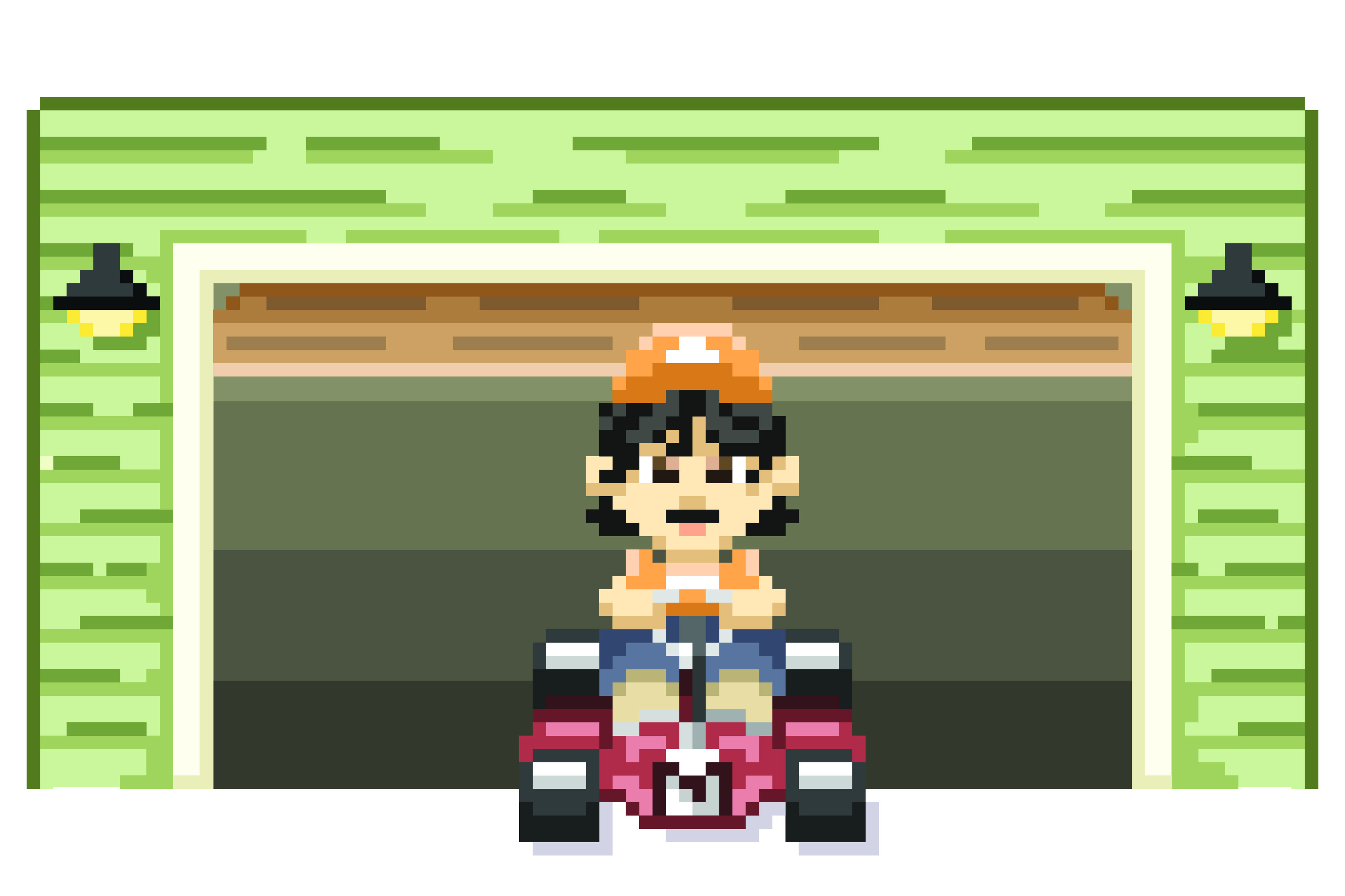
    “Buddy Simulator 1984” is one of those games that kept me thinking even after I completed it. This game was a psychological adventure that I can’t say I have experienced from very many games. The first main aspect of this game that I really enjoyed was the progression of quality that the game undergoes as you progress. The game is played from the perspective of an old 1984 computer and it starts off as a simple text based role-play game (RPG) that has been created for us by our new AI buddy. As our buddy learns and evolves, so does the game, with the graphics becoming 2D and eventually 3D as the story continues. Despite the increase in quality over time, it still keeps that nostalgic pixelated design, continuing the feel of an older game.

    The next aspect of “Buddy Simulator 1984” that elevates this game to a whole new level is the way your buddy becomes more mentally unstable as the game progresses. It obsesses over being your only friend and making you happy to the point that it becomes terrifying. Multiple creepy glitches occur throughout the game whenever something causes it to feel negative. These glitches ranged from uncomfortable text filling the screen to seemingly being inside your buddies mind viewing its overwhelming thoughts. Depending on the way you play the game, your buddy gets increasingly hostile towards you for disobeying its directions and “ruining the game” that it worked so hard to create for you. Witnessing the buddy’s codependency drive it to the point of insanity was spine-chilling, yet sad.

    The underlying plot of this game is the final aspect that made it so great. There are multiple “glitches” that occur throughout the playthrough that give the impression that your buddy may not have full control. Characters appear where they shouldn’t and interacting with them causes the game to become distorted. A few times when interacting with characters, they can be seen calling you a different name that immediately glitches back to the correct name. This implies you aren’t the first person this has happened to, and gives insight into the insecurities that your buddy has about losing you. 

    There are only two minor complaints that I have with this game. The first is the length. The game is super short, and I wish there was more content, because it was genuinely such a unique experience. However, there are multiple endings to the game that can help extend the playthrough. The other complaint I have is the fact that the game only autosaves, so after completion, you have to play through the entirety of the game again to get a new ending instead of being able to access a specific save point. 

    Overall, “Buddy Simulator 1984” was one of my favorite indie-horror games that I have ever played. It took me a total of 6 hours and 12 minutes to complete and was a joy throughout. I rate this game 4.4 out of 5, it is definitely worth playing and I recommend it to anyone who enjoys glitch-horror.

    If you have any games you would like me to review, you can email marsgaminggarage@gmail.com.

  • Community member arrested during Cal Poly Humboldt protest for Palestine

    by Jasmin Shirazian

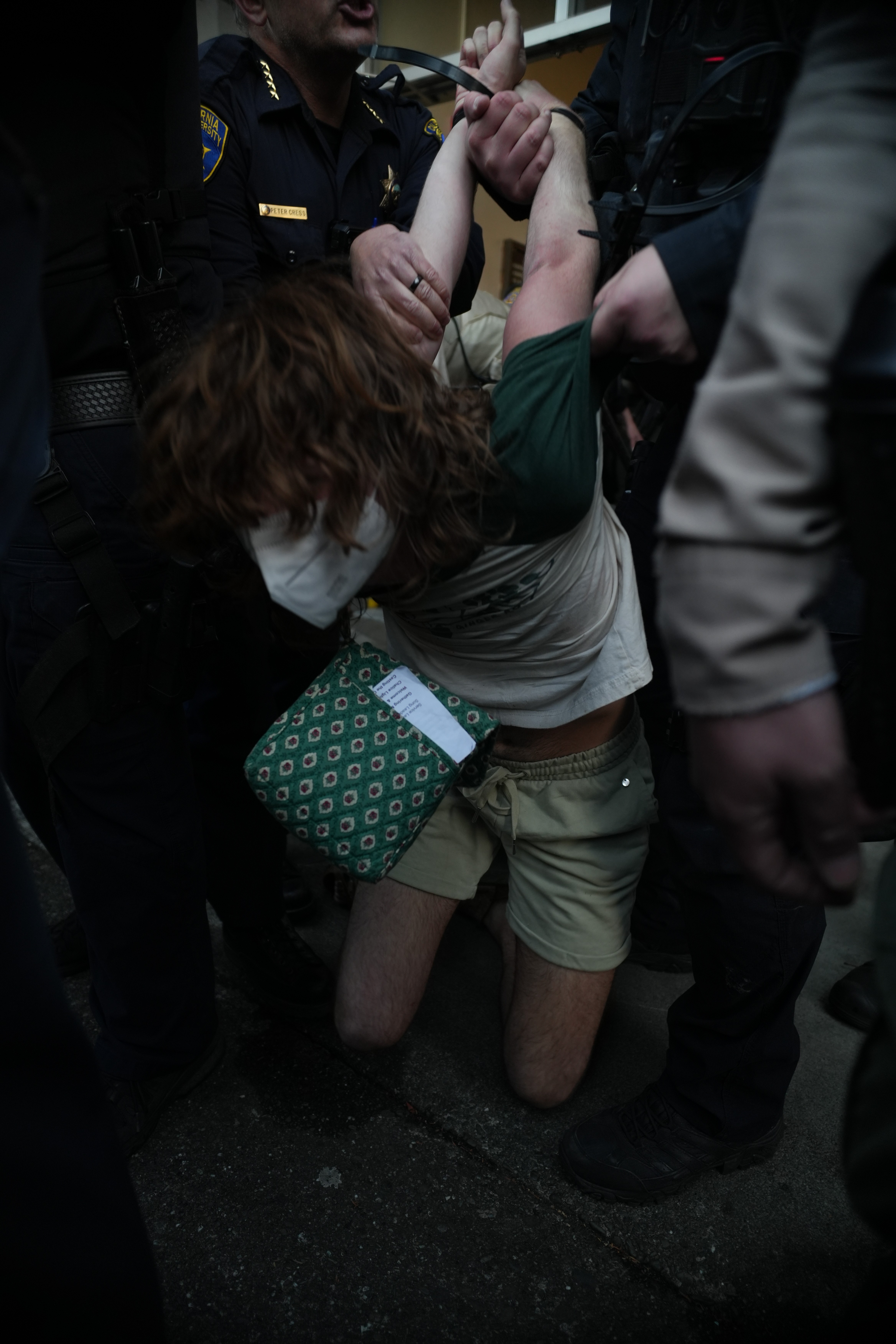
    Alice Finen, an elementary school teacher and artist in the Humboldt community, was charged with trespassing and obstructing and resisting a public officer during the April 22 protest. 

    Finen joined Humboldt student activists outside of Siemens Hall after hearing about students needing support. She said she was concerned for their safety.

    “I was trying to do whatever I could to stop them from hurting the students,” Finen said. “It was just instinct for me to not move, and tell the cops that they were hurting me and that I couldn’t move. They continued to push onto me and use their baton to push into me, pushing my neck and my chest.”

    Finen does not recall exactly what happened, but suddenly she was on the ground with zip ties around her wrists. Finen is an alum of the university, and is disturbed by the reaction from the school. 

    “It’s unbelievable,” Finen said. “I graduated from Humboldt in the early 2000s. It makes me sick that the students were treated that way on their own campus and that I was arrested for trespassing on my alma mater.”

    Police records show that Finen was the only person to be booked during the protests, but she recalls seeing other students being detained as well. Finen hopes that her arrest inspires students to continue their activism and show their support for the things they care about. 

    “I just want people to speak up and use their voice and to really think about what’s been happening to the Palestinians for so long,” Finen said. “This whole settler colonialism has to end. I would love for people to be inspired to speak up and speak out; to support student activism, because these people are putting themselves on the line.”

  • Student protestors barricade themselves inside Siemens Hall, demand end to war in Gaza

    Student protestors barricade themselves inside Siemens Hall, demand end to war in Gaza

    by Dezmond Remington

    Dozens of students barricaded themselves in Siemens Hall and hundreds more swarmed the UC quad to protest the war in Gaza and to demand Humboldt stop associating with Israeli organizations.

    At least one person, local teacher Alice Rose Finen, was arrested by the University Police Department. She was released on Monday night. 

    The protest started at around 5 p.m. on April 22, when a few protestors showed up to Siemens Hall. They piled chairs and tables up in front of entrances. The five classes being taught in Siemens were evacuated. Police arrived soon after, as did a California Highway Patrol helicopter.

    As of publication, the protest is still ongoing. Dozens of students occupy Siemens, and doors have mounds of office furniture blocking them. Though there’s no consensus, they plan on staying until their demands are met or they are forcibly removed. Several occupiers broke into university president Tom Jackson’s office by shattering the window on the door. Siemens Hall is covered in graffiti, as is the outside of the Van Duzer theatre. The American and Californian flags were taken off of the flagpole in front of the library by a man with climbing gear. 

    For hours, student activists inside Siemens Hall were only a few feet away from the police on the other side of the main entrance on the second floor. Cops showed up from all over Humboldt, including the California Highway Patrol, Humboldt County Sheriff’s Office, and even some officers from as far away as Rio Dell. At one point, police scanner traffic indicated riot control police from Redding were coming to campus, but they never showed up.

    Police left at 11 p.m. on April 22, and those inside tore the barricades down. Over 100 students entered the top floor, walked to the end of the hallway, turned around, and left. After that, the protest dwindled to less than 100 people, most of them outside. People played music and barbecued. 

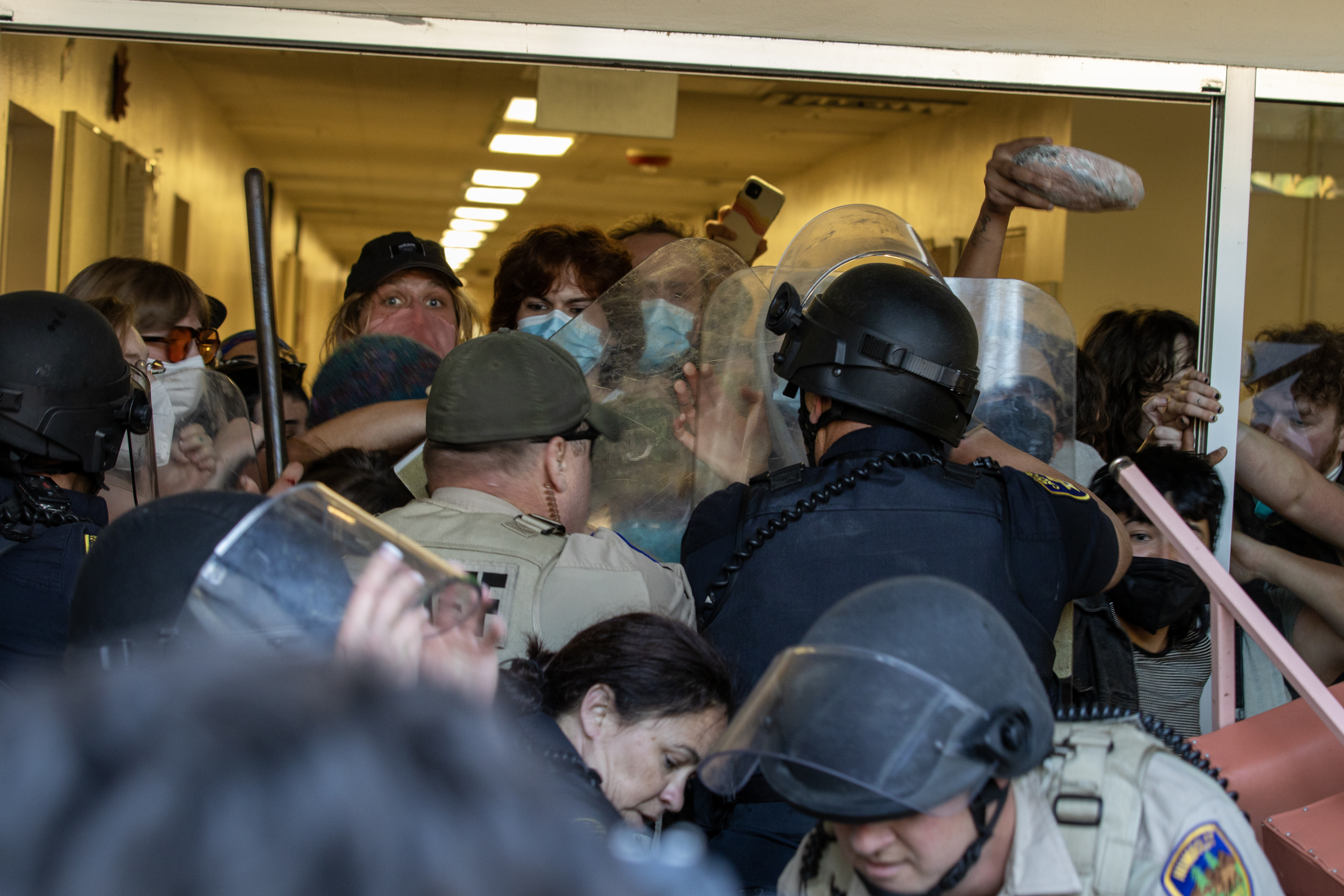
    The occupation had been generally peaceful, but violence broke out at around 7 p.m. when police tore down the barricade and entered Siemens Hall. A line of law enforcement with riot shields and a crowd of activists crushed together, and a protester inside hit an officer with an empty water jug. At least one officer retaliated by bludgeoning a protester with a baton. Other reports of students being batoned are circulating, but unconfirmed. 

    The main demands of the protestors are: to end the war in Palestine, for the university to disclose any dealings with Israeli companies or the Israeli government (and end those relationships if they exist), cut all ties with Israeli universities, and for the university to end prosecution of student activists. Many of the same demands student activists all over the nation are demanding at universities such as Columbia and UC Berkeley.

    “We’re doing this out of principle and righteous rage for our comrades,” said Casey, one of the protestors who was inside the building before the police left. “We want to make this happen at other universities across the nation.”

    Another one of the protestors, who asked to be identified as “Bum,” was one of the first to blockade inside the hall. They decided they would join their friends the day before the protest was planned. 

    “When the homies started talking, I was like, ‘Yeah, dog,’” Bum said. “It’s time to fight genocide in general. It’s time to stand up with our Indigenous homies. [We’re occupying the building because] trying to dialogue with the oppressors doesn’t work well.”

    Cal Poly Humboldt has not responded to a request for comment on its ties to Israeli institutions.

    Some of the people at the protest weren’t there to demonstrate. Students thronged the balconies of the Student Activities Center and crowded around the main cluster of activists in front of Siemens Hall to watch the action, many of them on their way home from class. The helicopter hovering overhead attracted many sightseers.

    “Nothing ever happens in Arcata,” said Shawn Rogan, a curious student. “It’s novel for a small campus, and [the war in Gaza] is a cause worth protesting.”

    One of the biggest concerns the protestors had was the heavy police presence. Before they left, those barricaded inside the building said they would negotiate once the police were gone. One protester blockaded inside who asked that he only be identified as “Joe” said he would stay there until he was fought off by law enforcement.

    “I’m going to resist,” Joe said. “If they beat me, they beat me.”

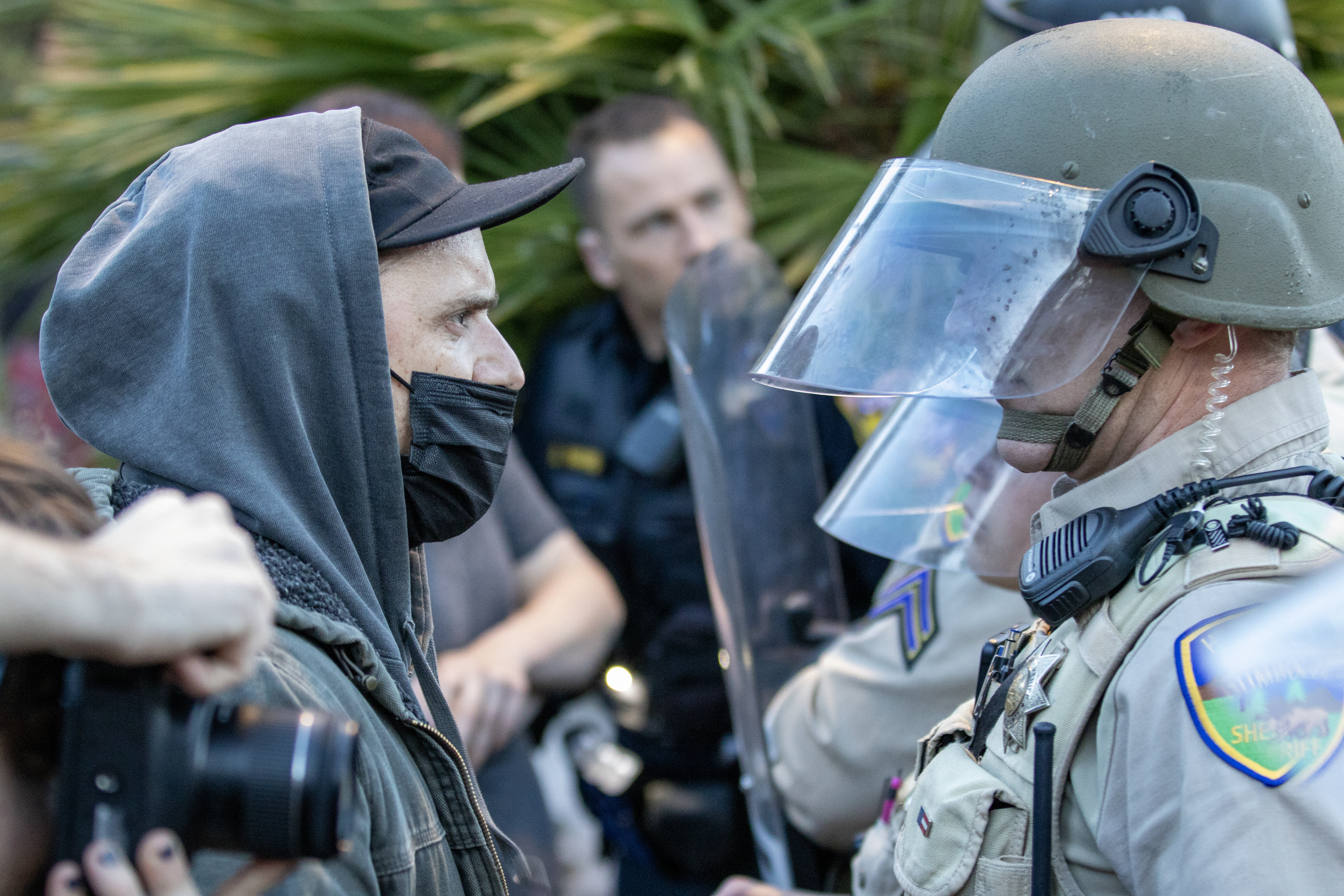
    Protestors chanted anti-police slogans at law enforcement to try to get them to leave, and many of them tried to talk some officers into leaving. Communications professor Aaron Donaldson argued with Rio Dell’s Chief of Police Greg Allen and two other officers outside of Siemens Hall for over half an hour. Donaldson attempted to make the case that they could decide to leave. Allen disagreed. 

    Cal Poly Humboldt has made it clear they want protestors to leave Siemens Hall and to return home. As of April 23, graduation is still planned to happen on May 11.

    “The University supports free speech through open dialogue that is respectful and constructive, but will not tolerate endangering people, destroying property, and disrupting campus,” read an alert published on April 23. “As a community, we are committed to keeping our students, staff, and faculty safe and fostering a learning and working environment where the campus community can feel safe, included, and respected.” 

  • Cal Poly Humboldt faculty criticize administration for policing pro-Palestine protest

    Cal Poly Humboldt faculty criticize administration for policing pro-Palestine protest

    by Alana Hackman

    Cal Poly Humboldt students, faculty, and community members joined a virtual University Senate meeting on Tuesday, April 23. 

    “There is considerable interest in engaging with the open forum today. More than is likely to be possible, given due to time constraints,” meeting leader James Woglom said. “Given that, we’re going to prioritize guests. If you are a senator and we are unable to get to you today, I do apologize.”  

    Woglom then continued to introduce senators present in the meeting that evening, including Provost Jenn Capps and Chief of Staff, Mark Johnson, who would be present on behalf of the university president, Tom Jackson.

    Senator and graduate coordinator of the sociology department Mary Virnoche proposed the upcoming agenda be edited. Virnoche proposed a discussion item to be inserted into the agenda to receive an update on the campus response to the current protestors occupying Siemens Hall. No senate members objected. 

    Woglom began the discussion by citing their own experience observing the protest last night. They mentioned speaking with other individuals earlier in the day to discuss how they can make progress to meet the needs and demands of those occupying Siemens Hall. 

    Woglom then called for any member of the campus faculty or community to share any up-to-date information they may have regarding the current occupation. Each speaker was allocated a three-minute time limit.

    “I had a meeting with [Chrissy Holliday] right before this and it seems the current concern is that there [are] confidential documents in Siemens Hall,” Parker said. “So far, no one has made an attempt to reach those. If that continues, it sounds like they’ll be fairly hands off.”

    The open forum discussing the current state of the Siemen Hall occupation continued with Jamela Hashim, a social work student who was currently joining from a smartphone with other senate meeting attendees, Gabi Kirk of the geology department, and Janet Winston of the English department. All mentioned they were currently outside of Siemens Hall.

    Hashim urged meeting attendees that it was vital to address that internet services have been cut off within Siemens Hall so nobody inside would be able to comment. 

    “That seems like a bias that should be addressed in some way,” Hashim said. 

    Wolgom acknowledged the statement and encouraged protestors inside of the hall should text outside sources information they would like to be relayed during the meeting. 

    The proposed discussion by Virnoche lasted until about 4:12 p.m., until it was cut off to discuss the UPRC budget, CR/NC deadline, and Faculty Awards. 

    As the discussion unfolded many faculty, students, and community members spoke up about supporting the student protestors’ requested demands and urging for a ceasefire. 

    “Here at Cal Poly Humboldt, we pride ourselves on being student-centered and guiding our students’ academic journeys towards careers that will usher in a brighter and more empathetic world grounded in values of justice, diversity, equity, and inclusion,” said Kelly Fortner, Community-based learning faculty. “If we want to hold true to those values, as a university and campus community, we need to meet the demands of our students and make a stand against genocide.” 

    On the frontlines of the sit-in, Kirk and Winston used their three-minute speech slots to read a three-page letter collectively written by faculty deploring the University administration for the use of police force, and standing in solidarity with student protestors. As of now, the letter has 164 signatures from staff, students, and community members. 

    “We call on Cal Poly Humboldt to reflect on the real harm this crackdown on free speech inflicts,” the letter states. “And the message it sends to current and future students, their parents, faculty, and staff, and our communities within and beyond Humboldt”

    Following that, Chief of Staff Mark Johnson made a statement on behalf of the university and President Tom Jackson. Johnson encouraged meeting attendees to share possible ways they can move forward from the current events of possibly 40 to 60 protestors currently occupying Siemen Hall.

    Johnson explained that the students inside Siemens Hall were offered on several occasions to exit the building and protest in the quad or somewhere else suitable for them. He then explains that their denial to do so then equates to trespassing on public property. 

    “They refused that offer and insisted on occupying and effectively shutting down the nerve center of the campus,” Johnson said. “I think all of you understand what happened yesterday as we went through actions to try to remove those protestors who were effectively trespassing in the building.” 

    Johnson also commented that the police force was removed after the realization it was inflaming the situation rather than aiding it. Johnson mentions there are planning efforts moving forward to communicate with the protestors inside the building and provide a more peaceful and secure environment to the other students on campus. Johnson then opened the floor for constructive criticism on how to move forward with current events after reiterating that the police force involved was once again a result of the students refusing to protest in a content-neutral way. 

    “The president’s administrative team and President Jackson are making operational decisions based on real-time information about what is happening around voting and on campus,” Johnson said.

    California Faculty Association (CFA) president Marisol Ruiz laid out recommendations for moving forward on behalf of the CFA. Her requests included not prosecuting anyone involved, showing support for students’ organized efforts for Gaza, and rejecting the use of force and policing. Ruiz also called for a statement from Tom Jackson and Jenn Capps. 

    “The lesson should not be in the sacrifices that have to be made for advocacy but about the possibilities we find there for solutions,” Ruiz said.

    Geology professor Jim Graham followed Ruiz’s statement with a request for possible outside sourcing of an arbitrator to speak to the current protestors. Graham also reflected on the student sit-in in 2015 in regards to Native American Studies professor, Jacquelyn Bowman’s termination. Giving student protestors credit for their organizational abilities and dedication during that event.  

    Another attendee, Katie Koscielak the sustainability analyst at Cal Poly Humboldt then questioned if any of the student protestors’ demands were being met. A list of the demands had been circulating around social media. 

    Woglom spoke before Johnson stating that they are currently working with the students to make their demands more concise. Woglom and Johnson mentioned specifying the investments within the demands of the university can make them more achievable. 

    “The investments at the system level, at the state level, are not under our control in any way shape, or form,” Johnson said. “We do have some investments as part of the endowment and to add to James’ point we are looking into those investments, those portfolios to make certain that we understand what if, if any, percentage of those investments are already in better, broad terms, defense contractors.” 

    Johnson continued to state that President Jackson would not be making any statements in support of or against any political opinions or subjects. 

    “With regard to having a war or causing a ceasefire, causing the United States to divest in broader terms, those are things really outside of the control of anybody here on campus, and therefore are not actionable or realistic for the university to consider as demands to be met,” Johnson said. 

    After Johnson’s final comment, concerned community members shared their thoughts on the University’s handling of the student protestors. Concerns were made surrounding words used to villainize the protestors, hygiene following campus closures, and the overall prioritization of property safety over people. 

    One community member Genevieve Ameduri shared a strong message of disdain of the university’s call for policing the student protestors. Ameduri explained that she and her husband have recently moved to Arcata and adopted three Palestinian children who are hopeful to attend Cal Poly Humboldt in the future. She explains seeing a student hit over the head by police in riot gear in the first fifteen minutes of attending the protest was extremely upsetting and made her question the University’s priorities. 

    “Our children have the decency and the heart to stand up and we put them in violent outcomes, it’s unacceptable,” Ameduri said. “I am ashamed of all of you who have not spoken up and stood with them.” 

  • Behind the Barricades: Inside Siemens Hall

    Behind the Barricades: Inside Siemens Hall

    by Andres Felix Romero and Jasmin Shirazian

    Due to potential ramifications, some individuals interviewed for this article are only identified with pseudonyms.

    By the afternoon of April 23, President Tom Jackson’s personal porcelain throne was up for free use by the pro-Palestine protesters occupying Siemens Hall after a broken window allowed occupants access to the presidential suite.

    After the police had withdrawn from the entrances of Siemens Hall around 11 p.m. on April 22, the protestors opened the doors and barricades to embrace their compatriots outside. Once the students committed to staying the night, they got to work building barricades around the building entrances. Despite the action not being organized by a specific individual or organization within 24 hours, protesters such as Naomi Chambers felt compelled to act in support of Palestine.

    “[This action] was loosely organized,” Chambers said. “This has been six months of boiling rage. [This action is run by] like-minded youth that want to see Palestine liberated.”

    With law enforcement gone, the protestors got to work around Siemens hall to secure themselves inside out of fear of another clash with police. Protestors sealed the doors with chains, locks, and fire hoses. The occupants then gathered chairs and desks throughout the building and barricaded each of the entrances. Doors were removed from hinges and bulletin boards from walls to be recruited into the barricades. The staircases leading to the second floor of the hall was barricaded as well. 

    What was meant to be a sit-in protest had turned into a full-on occupation of Siemens hall following the clash between protestors inside the hall and the multi-departmental police force including agencies from Arcata, Eureka, Ferndale, Fortuna, California Highway Patrol, and Cal Fire. Students who clashed with the police, such as Friend UU, felt frustrated about the police’s action during a prayer circle led by an indigenous student. According to UU, it was officers in tan uniforms at the front lines against the protesters in Siemens Hall.

    “We were just chanting and [law enforcement] weren’t doing anything,” UU said. “But then, the second Indigenous students [began to pray], that was the moment they started pushing. I mean, how evil is that?”

    Meanwhile, protestors outside of Siemens Hall erected barricades at the entrances. Some also slept or stood guard outside of the hall, behind the outdoor barricades. 

    Jasmine Jolly, a child development and family relations major, was one of the student protesters outside. 

    “I’m really showing up as support,” Jolly said. “I have been trying my best to hold it down outside so that people inside know they are supported and that they have allies backing them up, and if necessary, blocking the entrances.”

    Jolly was at the protest from 8:30 p.m. on April 22 to 3:00 p.m. April 23. They carried a black megaphone that amplified their voice for the crowd. 

    “I was leading some chants last night, but I was not the only one by a longshot,” Jolly said. “It was very organic. When someone’s voice started to give in, another person’s voice would take over. It was like a community.”

    According to Jolly, the community came together to ensure the safety of protestors. There was not a single leader, but rather a collection of voices.  

    “This is a group of people really working together to try to get voices heard,” Jolly said. “This was a community showing up in support of those inside, and even people inside, there’s not a ‘single’ leadership.”

    After the building was secured, the occupiers settled in. Supporters outside of the building found ways to smuggle supplies such as food, water, medicine, hygiene products, and blankets into the building. 

    Students slept where they could. The occupants set up a sleeping area by the elevator, and a few students were able to erect tents in the hallways outside of the provost’s office. Some students chose to lay out sleeping bags in the hallway, while others found rest on the floors of empty classrooms left open. 

    The protesters began to create posters to hang on the windows as well as scrawled messages on the hallways throughout the building. One poster was created using bloodied bandages from an injured protestor. Messages in support of Gaza as well as condemning the police’s actions were scrawled on hallways, done with marker or spray paint. One protestor, Casey O’Connor, drew a mural depicting police striking their friend who was also protesting. 

    “I felt the need to convey what happened in a visual medium,” O’Connor said. “So that admin can not ignore the fact that students were bloodied in this building.”

    By the end of Siemens Hall rearrangement, the building felt surreal and almost out of a war zone. Doors were boarded up and students were camping underneath their written messages surrounded by supplies.

    The first night was spent resting, taking shifts watching the barricades for other potential law enforcement action, and strategizing next moves. There was a mix of emotions amongst the group such as anxiety, uncertainty, and exhaustion. However, the more prevailing emotions were a sense of pride and community. The protestors knew the odds may not be perfect, but they were emboldened by law enforcement withdrawing. 

    “I feel exhilarated,” Chambers said. “Everything in this world tells us [resistance] is impossible.”

    As the sun rose after the first night, some activists took more drastic measures to get a point across to campus leadership. At some point in the afternoon on April 23, an unknown individual gained access to Tom Jackson’s presidential suite through a door window and protesters entered the suite.

    Jackson’s suite had files looked through, wine taken, his desk left a mess, and as with the hallways, messages were written on the walls. Some of them noted the disgust they felt in their writings.

    “DO YOU CARE?” One message wrote. “Seeing this office made me sick. Students, Palestinians, so many people are in pain and struggling, while you have an empty office full of amenities. DO BETTER.”

    The protestors have vowed to remain occupying Siemens Hall until demands have been met. Despite the chaotic and stressful possibilities with this protest, the occupants are hopeful that the situation will be peaceful with its ending.

    “I was expecting to get arrested.” Chambers said. “I was prepared for everything to go wrong, but I was also prepared for everything to go right for us. I’m determined to hold onto that [hope].”

  • Day 3: Students occupy Siemens Hall

    Today, campus officials announced that campus will be closed through Sunday due to student protesters occupying Siemens Hall.

    Ongoing coverage of the student-led pro-Palestinian protest on the Cal Poly Humboldt campus @humboldtlumberjack on Instagram https://www.instagram.com/humboldtlumberjack/ and @ellenadornews https://www.instagram.com/ellenadornews/?hl=en

    Listen to live ongoing coverage streaming at KRFH-FM student radio: http://www.krfh.net/

  • Cal Poly Humboldt’s queer community comes together at the Trans Resource Expo

    By Alexandra Berrocal and Mia Costales

    Pink, white, and blue streamers, pride flags, and the familiar sound of students and community members mingling filled the Great Hall this past Saturday, thanks to the Trans Resource Expo (TREXPO) put on by the Eric Rofes Multicultural Queer Resource Center (ERC). TREXPO is one of the biggest events put on by the ERC and aims to provide queer resources and a safe and inclusive space for trans and queer people.  

    According to the Cal Poly Humboldt website, the ERC’s mission is to, “shift public opinion of the queer community on campus and in the local area from tolerance to acceptance.”

    They also provide services such as their Queer Library and Gender Affirming Clothing Closet, both located in the Nelson Hall West, and the Queer Community Garden located at CCAT. 

    At the event, there were several tables representing organizations such as Queer Humboldt, Planned Parenthood, and Open Door, where attendees could learn about local resources and other events being held by these groups. There were also activities like button making, Dungeons and Dragons, and queer trivia. Most importantly, TREXPO provided a safe space for trans, queer, and closeted people to connect with each other and learn more about how the community serves them. 

    Isabelle Dushane, the ERC Events Director, shared their intent with putting on this event.

    “The overall goal of the event is to connect the trans community in Humboldt/the university to local resources, information about transitioning, and information about gender affirming care,” DuShane said. “We also hold events for people within the LGBTQ community to connect over shared experiences and meet new people.”

    While the goal of the event was to provide students and community members with trans and queer resources, TREXPO also fostered an inclusive hangout for everyone who attended. Organizers provided food and drinks while music by queer artists blasted through the speakers throughout the night. People could be found perusing stations showcasing queer-made zines and pamphlets, the raffle with prizes including albums by artists like Mitski, and the rack filled with gender affirming clothing.

    The turnout for the night was solid, resources and activities were plentiful, and above all people of all types of backgrounds were able to come together for a night of comradery and connection. 

    Sky Smith, a Cal Poly student who attended the event, was content with how the TREXPO turned out.

    “I wasn’t exactly sure what to expect, but I can’t really think about what more I could ask for in terms of resources,” Smith said. “This kind of thing could be turned into a progressively bigger and bigger event for people who already have a lot of their resources lined up, but are just looking for a community.”