Senate Chair’s Report for the Week of May 7th, 2024
From Senate Chair James Woglom:
This week’s Senate Chair report outlines my experiences in the role of Senate Chair and General Faculty President between the evening of Monday April, 22nd and the night of Monday, April 29th/early morning of April 30th, the duration of the occupation of Siemens Hall. My memory is imperfect, so there is the potential that I have omitted or misreported aspects of this narrative, but I have done my best throughout to be truthful and thorough in my representation of the week. I have further tried to be unbiased and impartial in my description of events, but have retained some description of my reactions and mindset to help to contextualize (not rationalize or soften the perception of) my decisions and actions. I acknowledge that I have made mistakes throughout this week, and though I welcome feedback and critique, please know that no one is more critical of my actions than I am. I have refrained from attempting to summarize broad takeaways from these events, as several wiser others have suggested that conclusion and healing cannot be pursued until a full accounting has taken place. This is my attempt at as full an account as possible from my limited perspective.
I have removed names where it seems prudent to have done so, and retained them where I think it is important to know who did what.
We have a lot of work to do. Take care of yourselves and each other.
jim
Monday, April, 22nd
I attended a 4-5 PM Zoom meeting scheduled to discuss logic models for an in-progress update of the University’s Strategic Plan. The meeting included Cal Poly Humboldt’s Chief of Staff and three staff members. While the meeting was in progress there was considerable noise in the background, and the Chief of Staff walked away from the camera on a number of occasions and muted himself at several points to communicate with someone off camera. All four of the other attendees on the call were in Siemens Hall, and one of the staff members in attendance said that the noise was the product of a protest regarding the ongoing violence in Gaza that was occurring in the building. The Chief of Staff left the meeting before its scheduled end. Slightly concerned, but assuming that this event was in keeping with the four other protests that occurred on campus earlier this year, I walked home after this meeting at 5pm.
I soon received texts from several faculty members that there was a police action of some sort in Siemens Hall. I texted the Chief of Staff and Provost to see if they were ok and they both confirmed they were. I messaged the Vice President of Administrative Affairs asking how I could help, but received no response. I felt I should know what was going on to inform my Senate leadership role, but other faculty I spoke with had no factual information to share. I headed down to campus at some point after 9:30 PM.
Walking onto campus, I was surprised to see long lines of police vehicles from all the surrounding communities: Rio Dell, Eureka, McKinleyville, Fortuna, and Arcata, beyond the University Police Department. Others estimated that there were as many as a hundred officers present, and while I can’t confirm that, it does not seem unrealistic based on my memory of the scene. The officers were loaded down with what seemed like an excessive amount of weaponry to engage with a student protest.
As I approached the Guttswurak Quad I saw a group of likely hundreds of students massed incredibly close to the lines of police surrounding the front entrance to Siemens Hall. On the other side of that entrance, visible through the entance’s front windows, several students who had barricaded themselves inside the building were waving signs through the window at the protestors. Many of the police at the front of the building were dressed in what I would uninformedly describe as riot gear, and many were holding clubs and shields.
The situation was more restrained at the other entrances but largely mirrored the front. I took several laps around the building trying to make sense of what was happening. Eventually, I saw and talked to a faculty member who had been present for most of the night. He informed me that two students had been hurt through interaction with the police (distributed video later showed police striking students with clubs and a student striking police with a water cooler jug). Three students had been arrested. A faculty member had been hit in the abdomen, but was reported to be ok. I was informed by the Chief of Staff during our call the next morning that police officers had been injured as well. After these injuries, things had escalated to a standoff. The faculty member I was speaking with said about a dozen students were still inside the building. I saw two other faculty members I knew as well, present and engaging in conversation with students and police.
Students were yelling at the police, and as rhetoric became more heated, the facial expressions of the police were becoming more irritated. In some instances, students yelled profanity in their faces, and law enforcement officers’ hands were on or near weapons. The standoff was tense and loud, and I was certain that at any moment further violence would occur. I felt a very deep fear that someone was going to get shot.
I texted Provost Capps and she asked that faculty do anything they could to deescalate the situation and encourage students to leave the building peacefully. As stated, there were a couple of faculty on-site, but not nearly enough to be heard or followed in that context, and though I talked to a few students about how things seemed to be getting out of hand, few seemed to care about my presence or thoughts.
At one point I saw Interim Academic Personnel Services Lead Kim White and Provost Capps walking away from Siemens Hall. I later heard that they had entered the building to talk to student demonstrators on two separate occasions, so this might have been one of those attempts to communicate, but I can’t be sure and I didn’t do a time check.
At around 10:50 PM, police slowly walked away from the building. The tension of the crowd abated considerably. Students ran in through the now unguarded doors to Siemens Hall. The front entrance remained barricaded, but at this point none of the other doors had been obstructed and protestors moved freely around the interior and exterior of the building. I remember giggling when I heard one protestor ask another where they should go to eat. At around 11:30 PM, I decided that things had relaxed and the crowd would likely dissipate overnight, and so I went home.
Tuesday, April 23rd
I woke early intending to go down and check things out at the scene of Monday night’s protest event before a 9 AM meeting on campus. At 8:20 AM, the Chief of Staff texted asking me to call him. We talked about the incident at Siemens, and he gave an account of what had happened that was not factually dissimilar from what the faculty member had shared with me the prior night. We agreed that we should address it during that afternoon’s Senate Meeting. Faculty had similarly emailed requesting a discussion of the proportionality of the University’s response to the protest, so I was glad he was amenable to the idea. I read the University’s message that the classes were canceled in my email. I walked to campus thinking it was important to be present, and that the class cancellation was just meant to allow an opportunity to clean up and reset after the protest.
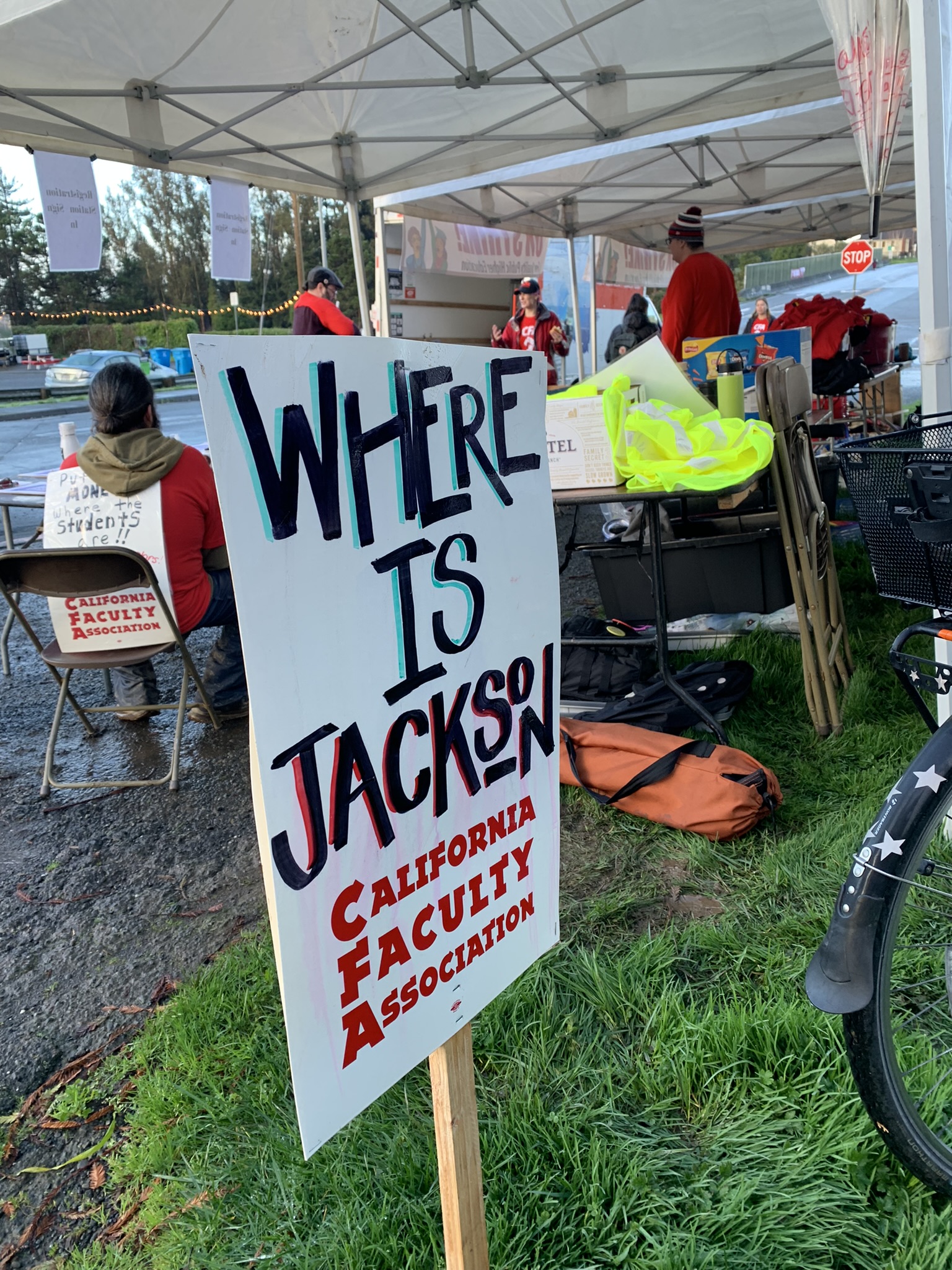
Walking towards the center of campus, I was surprised to see that there had been considerable change to the site overnight. There were makeshift barricades erected at many entrance points to the center of campus, constructed using dumpsters, chairs, and other such objects. Many buildings had spray-painted slogans and messages on them, some related to the violence in Gaza and others pointed more towards the University’s administration. Students slept in tents encircling the building. Pop-up party tents had been erected at the front entrance of Siemens Hall and were staged as first aid, supply, and makeshift kitchen zone.
There has been considerable discussion about protesters slipping into antisemitic messaging throughout campus conversations and corresponding media. I saw little evidence of this. There was a cardboard sign that said “Fuck Israel” amongst an array of such signs outside Siemens Hall, and I saw two students argue about whether that constituted antisemitism. They decided it did and discarded the sign. It seemed overtly antisemitic to me, but that was the only example of unambiguously concerning rhetoric I remember seeing, and I was encouraged to see that protestors were self-policing in regards to it.
There has also been considerable talk about dangerous or lawless behavior by student protesters during this period. I’ll comfortably say there was a lot of graffiti on buildings and damaged furniture, to be sure, and the barricades closing off the building had to break some sort of University policy or fire code, but to be honest, during this time students were just cooking food and talking about politics. It had the feel of a camp at a music festival.
Chairing the University Senate largely consists of being present at myriad committee meetings, so my schedule during this Academic Year had been packed from at least 9AM to 5PM on most weekdays. On this day, all of my meetings for the day were canceled in succession by other parties. With newfound freedom in my calendar, I thought a good use of my time would be to talk to student protestors. One, who later became the person I talked to most consistently, and who became a spokesperson for the group in Siemens, told me that their demands were derived from a Boycott, Divestment, Sanctions (BDS) website, and were available on a related Instagram account. I was not familiar with the BDS group, and the demands on the Instagram account were very broad, so I tried to get more clarity on the students’ needs and demands as a local group so that I could bring them to the Senate meeting at 3:00 PM that afternoon. This was not particularly successful; there was little agreement on the specifics of the demands amongst the students at the Kitchen Zone in front of Siemens Hall.
At 11:58 AM I texted the Chief of Staff and told him that I had been talking to student protesters about their demands, and asked that he call me to talk about them. I outlined their platform as I had come to understand it. He talked to me about divestiture and a couple of the other topics raised, and though he seemed skeptical about meeting those demands, he didn’t wholly come out against my continued engagement with the protest collective to draft achievable demands. He asked me to make sure they know that they are in trouble, but they will be in much more trouble if this occupancy continues, or something to that effect. I stayed with the students, prying them for further information until about 2 PM when both my laptop and phone died. I ran home to charge them and use stronger wifi than what was available on the quad for that day’s Senate Meeting.
During my time in the quad, from about 8 AM to 2 PM, I saw the Dean of Students walking around the site. I saw the Dean of the College of Professional Studies and APS Lead do a couple of laps of the area. I saw four or five faculty come and drop off supplies and check in on students. I saw a couple of staff seemingly assessing the facilities implications. These were the only University employees I saw during this time. I was not omnipresent, but the front door area of Siemens Hall was obviously the central communication space at this time, and no one from the President’s Administrative Team, besides those listed above, approached it.
The Senate meeting, which regularly occurs between 3-5 PM on alternating Tuesdays, began with an information item about the protest, per the Chief of Staff and my earlier discussion and the faculty’s request for further information. Over 130 persons were in attendance at this meeting, far above the usual attendance of University Senate Meetings. Administrators ran late to this meeting, so the only real information at the time of the new agenda item was what little I had derived from my discussion with the students. I remember looking down at the Google doc I had worked on all morning through conversation with student protestors and realizing there was not a lot of intelligible substance to it. We held our usual 3:15 PM open forum and several students and a couple faculty spoke regarding the protest. I was, at this point, hoping to discuss some of the closing business of the Senate year, especially as there were, at that time and in that context, pressing matters to address, including the annual budget recommendation, so I was initially strict with the time of the open forum. But as other folx began expressing a need to ask questions and talk, we continued allowing speakers for about 45 minutes.
During this time, the Chief of Staff arrived and gave a speech that notably forefronted the injuries of police officers and destruction of property over students, and thus agitated the group broadly, and further upset students in the quad who were communicating with me through direct messages to the Senate’s Administrative Support Coordinator. During this speech the Chief of Staff introduced the notion that decisions were being made by the Emergency Operations Center (EOC), an anonymous group of staff and administrators who advised the President.
After the discussion of the protest ended, we moved to other University Senate Business. It wasn’t clear at that time what more could be said or done regarding the protest, and given it was the next to last Senate meeting of the year, the body was inclined to address the business on the agenda. The meeting ran over its allotted time frame by 30 minutes. At the close of the meeting, my feeling was that things would begin to move towards resolution through continued communication and engagement between all parties.
After the meeting, the Provost and I talked by phone, per her request. She was out of town but would be returning to campus the following day. I advocated for her to encourage more engagement between faculty and the EOC regarding both decision-making and transparent information sharing, and she agreed. We planned for a meeting of all faculty at 4 PM on Wednesday, April 24th, and we agreed to keep in touch as things developed. At 6:32 PM, The California Faculty Association sent out an email announcing that they would be holding a Teach-In on the Gutswurruck Quad from 12-2 PM on Wednesday as well.
Wednesday, April 24th
I went up to the campus at 8 AM and stayed until just before the planned 4 PM faculty meeting with the Provost. The Provost was heading back to campus with a projected time of arrival of about noon.
Faculty contacted me via text and email with recommendations for third party mediators, which I passed on to administrative contacts. It was conveyed to me that one suggested mediator was out of town, and another rejected an offer to take on the project. Faculty continued to offer suggestions that I conveyed throughout the day. To my knowledge, no professional mediator was hired.
Faculty also asked that there be more committed movement on students’ demands. I continued to work with a graduate student who was working with the protest collective on what they understood to be the student’s core desires. We talked about them and worked on a document for much of the morning. During this time, considerably more faculty were coming to the quad, and at one point another faculty member joined the grad student and I during our demand-writing/discussion session, more as a show of solidarity than as a co-author, but did engage in our conversation.
The California Faculty Association’s Teach-In began promptly at 12 PM, as announced. There were hundreds of students and faculty in attendance, and there was a sense of community and solidarity between folx present. There were lectures on history and philosophy, on the traditions of non-violent protest. At one point there was a yoga lesson. Folx sat around and talked. A band played. With the exception of the knowledge of the students occupying Siemens, it was a peaceful and comforting scene.
The Provost committed to making a brief appearance on the quad prior to the community meeting at 4 PM. I saw her walk onto the quad a little after 2 PM and went and talked to her.
She left soon thereafter, saying she had to talk to administrators prior to the 4 PM meeting.
My partner picked me up on campus so I could use our home wifi for the faculty meeting. During the 4 PM meeting between the faculty and Provost Capps, the Provost started with a presentation that included commentary by Kim White regarding concerns that faculty and staff personnel files had been breached and student protestors might damage the files or make them public. This framing was poorly received by many participants in the meeting who felt that paperwork and property were being forefronted over the safety of our students. The chat function had been on when we entered the Zoom Meeting, but the rhetoric in the chat became heated and had to be turned off at the request of those present. Prior to that happening, someone in the chat let us know that the meeting was being broadcast on KRFH. The Dean of the College of Arts Humanities and Social Sciences (CAHSS) explained that the radio station had been picking up the audio from the quad, where someone had been sent the link and was broadcasting the meeting to the students gathered on the quad through a PA system.
At 4:45PM, the Dean of Students asked me, through the Google Message app, to help connect him to the student protest leaders I had been talking to. After the community meeting concluded, at 5:32 PM, I emailed two student contacts with the protest collective and asked if the protesters would be willing to meet with administrators. One asked “Do you have any sort of action plan that can be shared? They want to see what steps you are thinking about taking before considering meeting anyone.” This seemed backwards to me at the time, as it seemed that they should be framing their expectations for the negotiation, and I said so, gently. I said that I had been working on the demands doc with some of them earlier in the morning, and asked if they could elaborate on what an action plan would look like. They replied:
We won’t meet with admin until there is tangible evidence that change is happening. That means an action plan so there is proof that action will be taken and admin isn’t just trying to provide lip service to get occupiers to shut up and leave. This might mean making a plan for short and long term commitments. Long term might be working with CSU to divest from where we receive/put funds. Short term could be academic and consumer boycott. At the very least we need written, signed confirmation that protesters will not face any disciplinary action (academic, legal, physical).
Examples of short term actions:
– Removing Haifa university from the list of schools we do an exchange with.
– A written, signed commitment to stop selling products from Coca Cola or Sabra. Here is the official BDS list and if we have any association with companies on it we want them cut. https://bdsmovement.net/Act-Now-Against-These-Companies-Profiting-From-Genocide
– Commitment to review and change the time & place policy including creating an article to no longer request police presence for student protests.
Some stakes & donors that we want more info/disclosure on (not a comprehensive list):
BAFWX
PFPWX
DODFX
CGBIX
When we see meaningful actions being taken we will revisit setting up a meeting. Know that I’m also in talks with folks who have more direct experience with BDS than I do. So, as usual, this list is not comprehensive. Just a starting point.
This was the most comprehensible and seemingly actionable version of a demands list I had received up to this point, so I was pretty excited. I copied and pasted this message into another email to protect the student protester’s identity and forwarded it to Provost Capps and Mitch Mitchell.
Later in the evening, at the suggestion of several faculty members, I asked that faculty be appointed to the Emergency Operations Center (EOC) through texts to Provost Capps. She replied that this would not be possible “due to being represented” (I think this may have been a typo, as it doesn’t make sense as a sentence). I then asked that an advisory panel of faculty be assigned to engage with EOC regarding decision-making, and gained some traction there, with a promise to ask. I was informed that faculty have historically been included on the EOC by a colleague with historical knowledge, and that this would be important given the standoff between administrators and students.
At this point in the week I was pretty stressed out. I did not sleep that night.
Thursday, April 25th
A Zoom meeting link was sent to me at 10:16 PM on Wednesday night with the title “Team Peace Plan”. I likely wouldn’t have seen the invite for a 6:45 AM meeting if I had slept that night. I joined the meeting and was greeted by a group of University leaders and members of the Emergency Operations Center who informed me that the decision to forcibly vacate the building had been made, and there was no plan to negotiate or pursue peaceful solutions, regardless of the injuries that occurred on campus on Monday, and that the timeline, though unconfirmed, was likely about 72 hours until the action. I was told the “ink was dry on the paper”. No details were given to me regarding the agencies that would be involved.
I was horrified and immediately furious. I don’t think I’ve ever experienced such a physical reaction to a piece of information. At this point, there were reports (unsubstantiated, but plausible) of as many as 50 students in Siemens Hall, and any forced extraction would, in my mind, lead to further student injury. I ranted to the EOC members present in the Zoom call about going to the press and enacting a vote of no confidence in the President, but was told that those actions would only speed the decision or “pour fuel on the fire”. I offered melodramatic plans to get faculty to surround the building and protect the students inside, but was told this would only escalate and expand the number who could be hurt. I said I would reach out to the Governor and Chancellor’s Office, but it was implied that my concerns would fall on deaf ears in those contexts.
I asked the administrators what I could do, and was directed to collect a list of trusted faculty to engage students in dialogue and any possible negotiation that could lead to the withdrawal of lives from the building before the forced extraction action. I was also told that I should start telling students how to be arrested safely. I told this group that I would have to bring on some other faculty to consider next steps, and we closed the call so that they could attend their next meeting.
At about 8:15 AM, I convened a Zoom meeting of the last five Senate Chairs of Cal Poly Humboldt’s University Senate to advise me and help me to work the problem. They gave me considerable advice and support over the next week and began reaching out to their respective contacts on their own. I can’t thank them enough for their efforts and unerring support during this time.
Concurrently, Dean of the College of Arts Humanities and Social Sciences gathered a group of faculty members who he knew were respected amongst the protesting students as potential mediators. This group did amazing work talking to and caring for our students over the course of this week. I appreciate their efforts so much.
At about 9:00 AM, I went to campus and began working on improving or addressing the demands document that I received overnight from the student contact. My hope was to engage students in this process with renewed immediacy, but they were mostly asleep, and many had become wary of my presence and repeated, probably manic-seeming attempts to converse with their leaders. I received conflicting messages from different protest collective members regarding whether the students would be willing to talk to administrators.
The Provost and I maintained text contact starting at 8:25 AM through the rest of the day. I requested that the Provost come join me on campus. She did, and we were told by members of the protest collective to wait in the Art Quad for a representative to meet us. The Vice Provost and Dean of Students joined us soon thereafter. We were led by the promised representative to a group who agreed to meet with faculty later in the day. At the same time, representatives of the Dean’s faculty team had met with students to arrange the space, time, and framework for the initial meeting.
We met with members of the protest collective, faculty, the Dean of CAHSS, Provost, and DoS at 1 PM, first at the North End of B Street, but then moving under the awning of the Theater Building to avoid the rain that persisted through that day. Demands were discussed, and students gave accounts of the attacks by the police on the initial protestors, at times crying. One student showed the blood stains on their clothing from another student having been clubbed in the head. Dean Crane facilitated a dialogue that pointed to potential paths forward, through regular meetings and safety checks through the night. One student asked that we try to ensure that there were faculty present at all times.
At one point during this meeting, four uniformed law enforcement professionals approached the group, and while and the Provost went to send the police away, the faculty present stood between the student protesters and police. The students looked terrified.
The broad takeaway we derived from this meeting was that the entire protest collective, including those occupying Siemens Hall, was committed and entrenched and unlikely to feel satisfied by any deviation from their expressed demands. In a debrief meeting that followed, the faculty and administrators present determined that the best course of action, then, was to meet as many of those demands as quickly as possible to show commitment to the students’ needs. As such, some worked on studying and replying to the demands list received through staff and faculty support, while faculty Senators began to work on a call for a Vote of No Confidence in the President and Chief of Staff before a 4 PM meeting that we planned between faculty and student protestors. Our thinking was that this was the biggest thing we could deliver for the students in that time frame of about 1:45-4:00 PM.
Though hesitant when asked to call a vote of no confidence earlier in the week, I was, personally, very ready to pursue it at this point. The University was, as far as was being conveyed to me, heading towards a likely violent police action against students without so much as a message from the President or Chief of Staff to our campus community outside of boilerplate emergency alert missives. The dereliction of duty suggested by the President, having already decided to engage in force without having once tried to talk to a single student, was maddening to me.
By contrast, the Provost was doing her damnedest to build trust, and faculty and deans were engaging student protestors as best they could, but there was no evidence of material or informational support for those actions from other members of the President’s Administrative Team. We were all flailing in a vacuum of leadership.
It has since been suggested that it was unkind to call this vote of no confidence without informing either of these men that this was coming. I have had a professional relationship with both, and it is certainly a betrayal of their trust. I had also been asked not to pursue this tact by the folx on the EOC who had brought me information earlier that morning, and I apologize for that breach. I just honestly didn’t know what else we could do, and the folx that I trusted most agreed that this was our best option to send a clear message to the students that the faculty did not support the police action that occurred on April 22nd.
I went and sat in front of Siemens in a camp chair and typed and sent emails and made phone calls. At around 2:11 PM student protesters became upset that there was a police officer on the roof of the library, so I texted the Provost and she committed to taking care of it. The officer left the roof soon thereafter.
The official voting members of the Senate Executive Committee were asked via email to vote to hold a General Faculty Meeting, which would allow us to forego the necessity of a three-day agendized notice, per the General Faculty Bylaws, and we received a majority of 7 Aye votes and 1 Abstention from Senate Leaders to hold the meeting. I appreciate all of y’all for showing up for this impromptu request in a compressed time frame.
With SenEx confirmation achieved, some folx in my support network worked on making sure we followed University Policy explicitly, while others worked to write the resolution conveying no confidence and demanding immediate resignation. I asked CFA members and chairs to mobilize their membership for a 3:00 PM vote. We successfully achieved quorum (at least one-third of the General Faculty’s 437 members, or 146 people), with 203 eligible voters in attendance or having conveyed proxies. 193 out of those 203 eligible voters voted in the affirmative, 3 voted in the negative, and 7 abstained. The motion passed by a 95% margin.
We announced the tentative result of our vote (there was a need to accurately confirm the roll call vote before officially announcing results) at our 4 PM meeting with student protesters. I was informed that the Lost Coast Outpost had received an inaccurate announcement of the vote and its result from representatives of the CFA and asked them to retract the story, and they did.
Though some students were impressed by this achievement, others sort of scoffed at it as performative. This was crushing to me; I had very quickly done something that would likely weigh on me for the rest of my professional life in hopes that it would lead to peaceful resolution of the building occupation, and it was met with general indifference. There was further discussion of demands that had been put forward by the protest collective, and University responses to many of them were proffered as a paper handout to students. Like the vote of no confidence, these responses, too, seemed insufficient, and though the meeting was seemingly a meaningful step, few commitments were agreed upon by either the students or the administrators present, and my concern that the timeline for students to exit the building was becoming much too long to avoid the police action. Things were moving way too slowly, and many students did not seem to grasp the gravity of the situation as I understood it, with some suggesting at several points that talking with administrators was not a meaningful use of their time.
After the meeting, I intended to leave campus, feeling dejected. The Dean of Students walked up to me as I was exiting Nelson Hall and said, “walk with me”. I followed him briskly from Nelson Hall to Founders Hall (I was tired, and those stairs nearly did me in), where we talked to four uniformed police officers who were inside that building. They claimed that they had come to check that the doors were locked, and had entered the building in order to use the bathroom inside. Dr. Mitchell explained that their presence was agitating students, and asked them to leave. They seemed incredulous but promptly left. As we walked back down the steps, I thanked Mitch for having done that, and he said, “I’m responsible for the safety of all our students.”
My intention earlier on this day was to stay physically on the quad until we had gotten the students out of the building. In order to allow me time to sleep and eat, incredible colleagues in the Art + Film Department offered to hang out in my stead for the rest of the night, in keeping with student protesters’ request for folx to help ensure their safety. My art friends sat in the cold so I didn’t have to, so I could get some sleep, and I can’t talk about it without crying a good bit.
A student I care about was amongst the leadership contingent of the protestors. Eating dinner before the 9 PM safety meeting that had been agreed upon by the protesters, I told my partner, Jenny, that I wish I could just tell the student that when action happens, they should “run, or submit to peaceful arrest”. A version of this message, along with requests for nonviolent protest training, had been suggested to me several times that day but hadn’t been affected, and one day of what I understood to be a three-day window was over. We talked about it for a while and then she said, “Maybe you should just do that.”
After the proposed 9 PM safety meeting was put off due to scheduling confusion, I circled Siemens Hall and delivered my “run, or submit to peaceful arrest” message to about five groups of students (at first those I recognized, and then just groups bunched together in the rain). Two of the protestors sought clarification regarding my intent, and it was communicated on a student protester text message chain that I was just giving advice and that the threat of force was not immediately imminent. This should have been my first indication that the protesters’ text chain was prone towards inaccurate messaging, but it didn’t sink in. A faculty member called to tell me that my message had been received poorly and that it was anxiety-inducing. I replied that “this was a dangerous context, and that they should be more anxious,” and then slept, content that I had done all I could do, for about 8 hours.
Friday, April 26th
I woke early and headed to campus with my camp chair and the intention of calling legislators and the Chancellor’s Office all morning to ask them to persuade President Jackson not to initiate a police action that day. When I arrived and sat near Siemens Hall, around 9 AM, a group of students were gathered for a meeting nearby. The first discussion during this meeting was an assertion that what I had done the prior night was fear-mongering. I don’t think they knew I was there, but it was emotionally impactful. I had not thought of this potential read of my actions, at all. I honestly was shocked the students were not thinking about the threat of force as very real, that it was something I was making up to scare them; they were sort of reveling in the joyful freedom of the space they had structured, rather than considering conclusion scenarios.
Several speeches from faculty and protest collective members followed, but I was near the kitchen area where there was considerable noise related to food preparation, so rather than follow those presentations, I began to call contact numbers that had been provided to me by various faculty. The first of these calls was with an individual who had some access to or relationship with the Chancellor’s office.
This representative told me that all they knew was that there had been advocacy to discourage forced entry into the building until at least the end of day, but that this had not been agreed to at the time of our call. This heightened my anxieties considerably: the implications I took, but that wouldn’t be confirmed, were that the best we were getting was delayed action until the end of the day, but even that was not met with a firm ‘yes’. Concurrently, in the kitchen next to me, students were audibly discussing what band was going to play on the quad that night. My brain broke.
I began to tell everyone I saw, including students, faculty, and community members, that “The threat of force was real, the threat of force was imminent, and folx should either run away from armed people or submit to peaceful arrest.” My choice of phrase meant to be alarming, in hopes that it might change as many minds as possible in as short a time as possible, but it came off as histrionic, and in retrospect, it certainly raised tensions on the quad.
Luckily, two of the people I told that there was imminent danger and that they should be prepared to leave quickly were our Ombudspeople. Shouting nonsense at Suzanne and John was probably one of the best moves I made on this day. The Ombuds worked thoughtfully, committedly, and far more wisely than myself throughout this day and those that followed to affect peace. They acted as impartial support for all parties, as negotiators and confidantes, assisting in planning potential solutions, and generally listening to people. All the while they were kind, took people seriously, and never gave up. At this point, they were able to contact members of the EOC and Chancellor’s office to confirm that there was no confirmed timeline for forced entry, but that forced entry was a foregone conclusion if students didn’t exit the building.
Around this point, I had my first phone call with the Chief of Staff since hearing about the extraction plan. I was angry, and thus it was not as productive a conversation as it could have been. His concern was that it was irresponsible to tell people as much as I was, that it was escalatory to talk about potential force, and that my insistence on continued negotiation was unrealistic. I remember using the nonsensical metaphor that we should try to “turn orange to purple if it kept students safe.” I’m not sure what I meant by that. I insisted that students’ safety should be prioritized over all other considerations. He said he was concerned with students’ safety, too, but that telling students to leave at this point was not helpful..
He asked how he had earned the dubious distinction of being the only Chief of Staff at Cal Poly Humboldt to ever receive a vote of no confidence. I said, “You didn’t even try to talk to the students on Tuesday.” He said he was dealing with the fact that officers had been injured on Monday night. I don’t know what was intended by that explanation, but I was too frustrated to continue, conveyed that I doubted we would ever agree on this point, and hung up.
Dean Crane asked that we move our 4 PM meeting between the protest collective and faculty up to 1 PM via email. This, too, raised my internal tension considerably, as I knew he was as worried as I was about the impending threat of violence. It was still well before 1, but during this time the tensions I had raised amongst the protestors, along with other factors, led to a long meeting in Goodwin Forum that I was asked not to attend. The faculty member who had been the main agent of communication between the protestors and other faculty and administrators, emailed to inform us that the students were no longer willing to meet as they had lost trust due to lack of action on their demands since the meeting of the preceding evening. I replied via email:
If they don’t meet, it will speed escalation. This is not a threat or fear mongering, it is a real and timely fear. The statement read last night has been distributed and posted on websites, there was a vote of no confidence and call for resignation for the president, and I will literally do anything you ask me to, but good faith meetings are imperative. Advising otherwise is knowingly putting students in danger.
This message was, again, likely more dramatic than necessary, and probably did not improve trust.
Around this time, there was a campus-wide email and alert that communicated that the campus would be closed through May 10th. The faculty member in the meeting in Goodwin Forum communicated that this message had been catastrophic in the efforts to bring students back to the table. Opening campus back up was one of their major concerns, as they felt they were being blamed for the disruption of other students’ education.
Meanwhile, another faculty member received information that there was going to be a sort of offer of amnesty to students at the 1 PM meeting. They texted this information to the faculty member who was inside the students’ circle of trust, and my understanding is that it was sufficient to bring the protestors back to the table. Thanks are due to both of these faculty members for achieving this.
At the 1 PM meeting between faculty, students, staff, and administrators, students opened with a speech in which they expressed their incorrect understanding that there was a brief amnesty period underway (that was nearing conclusion), that there was an ultimatum regarding physical violence being made by admin, and that we had attempted to undermine their demonstration through threats and fear-mongering, and that all of these were damaging to the negotiation process. I realized through context clues that I had made things much worse this morning. While I did not use the phrase ultimatum in any of my communications with people, I can see how those conclusions occurred. I apologized during that meeting to the protesters, and I apologize for it again, to all of you readers, profusely.
Following this, students and faculty spoke, and Dean of CAHSS, the Provost, and Dean of Students outlined a student checkout system that would be set up at the library circle where students could volunteer to identify themselves and leave the campus with slightly minimized repercussions. I understand a copy of this offer is available in emails to students who had been identified as participants in the protest. It was not well received. At the conclusion of this meeting, students were told that the period for exiting would be between 2-4 PM, a window which was later extended to 5 PM. Four staff from the Dean of Students office were posted at folding tables with paperwork to fill out near Library Circle. I was told by the Dean of Students and Vice President of Enrollment Management that few students pursued this offer, but I didn’t follow up on the totals.
I stayed on campus until 3 PM to talk to faculty. At this point, students had made it clear they were not comfortable with me around, with one calling me “that faculty member that observes us.” I grew tired and depressed, so my partner asked that I go home and regroup for an hour. While at home I received news that the Siemens Hall had been opened and that protesters had left the building.
I returned to campus later in the evening to check to see how things were going. I brought the remnants of a pair of CostCo Sheet Cakes we had left over from a School of Education event that had occurred that day. The space was now completely relaxed and students were outside the building, with the front doors to Siemens Hall wide open. Faculty were hanging out and observing. It was so serenely, surreally calm. I felt extremely relieved, and, feeling I had exhausted all of the actions I was capable of, and that I had burnt through all the goodwill I had amongst the various constituencies of the University, I left campus. A colleague forwarded me an interview in the Times-Standard with the University President, but I didn’t want to read it.
Saturday, April 27th
I received notice from colleagues that the President’s interview, which described the protestors as criminals and claimed/threatened that all potential actions were on the table, had agitated the crowd on campus overnight. Students had reentered and re-barricaded Siemens Hall. Provost Jenn Capps and Dean Crane had been shouted off campus with a chant of “Admin go home!” The work of the last few days had been reversed, seemingly through more tone-deaf, uncoordinated messaging.
I have lived with clinical depression for much of my life. These messages, paired with days of stress and little sleep, were damaging. I needed to take a step back to preserve and repair my own mental health. I communicated to the Provost and other colleagues that I was not well and could no longer engage on campus. I stopped reading emails and tried to focus on doing anything else.
I was told at some point that there had been an announcement of a “Hard Closure” of campus.
Sunday, April 28th
I further removed myself from communication and engagement. I tried to avoid leaving my house or reading updates.
Monday, April 29th/Tuesday, April 30th
I reengaged on this day, working on emails and phone calls in response to students, faculty, staff, and administrators. I did not return to campus.
Past Senate Chairs and I met with Provost Capps at Cafe Brio in downtown Arcata at 1:45 PM at her request. We provided feedback and guidance, and discussed next steps. I had trouble keeping my cool on a couple of occasions, still feeling a little raw. We were seated outside, and a helicopter circled overhead.
Later that night my partner told me that there was a live stream of the campus showing that protesters had been ordered to disperse. I was told that police entered the quad and arrested those present at around 2 AM. I couldn’t watch.
Editor’s note: This document was amended at the request of the original author on May 8, 2024.