
The Lumberjack


Students Serving The Cal Poly Humboldt Campus and Community Since 1929

Tag: Africa

  • This week in stem

    This week in stem

    By | Bryan Donoghue


    Ancient feathered ostrich-like dinosaurs laid clutches of blue-green eggs just like the traits of robins from today. The eggs are thought to have camouflaged themselves in forested environments, and they were in open nests dug into the ground. Using chemical analyses, scientists were able to detect traces of two pigments, biliverdin and protoporphyrin, which are commonly found in modern bird eggs. According to David Varricchio, expert on dinosaur reproduction at Montana State University, “The discovery highlights how much our thinking has changed about dinosaur preservation and how much more we can learn about the original animal.”


    Source: National Geographic


    Known as the “cradle of humanity”, Africa is from where our earliest human ancestors spread across the rest of the world some 50,000 years ago. Africa is also where people—ancient and modern—are most genetically diverse. Harvard University evolutionary geneticist Pontus Skoglund and his colleagues obtained DNA from 15 ancient Africans from between 500 and 6000 years ago and found ancient genomes and evolutionary adaptations. This has been the first big effort to sequence ancient African DNA and reveal how early humans swept across the continent.

    Source: Science Magazine


    For a long time, scientists have been left wondering if jellyfish can fall asleep. Three Caltech graduate students found that at least one group of jellyfish, the Cassiopeia xamachana or upside-down jellyfish, does get some shut eye. To prove that jellyfish sleep, the students had to demonstrate that they fulfill three behavioral criteria. First, the animals must undergo a period of diminished activity. Second, the animals must show decreased responsiveness to stimuli while sleeping. Three, the animals must show an increased need for sleep if they are kept from it. The upside-down jellyfish fit all these criteria, and thus can be considered sleepy. In addition, the researchers also demonstrated that jellyfish get sleepy when exposed to melatonin, just as humans do.

    Source: New York Times


    High energetic particles called cosmic rays were found by scientists to come from outside of our Milky Way Galaxy. The ray’s journey possibly starts from a black hole in the center of a distant galaxy. Trying to identify which galaxies and seeing if there is any pattern linking them are the next steps for researchers. That research could help narrow down the processes that can accelerate cosmic rays.

    Source: Science News
  • Former HSU athlete comes to U.S. From Mali for education

    Former HSU athlete comes to U.S. From Mali for education

    By | Danny Dunn

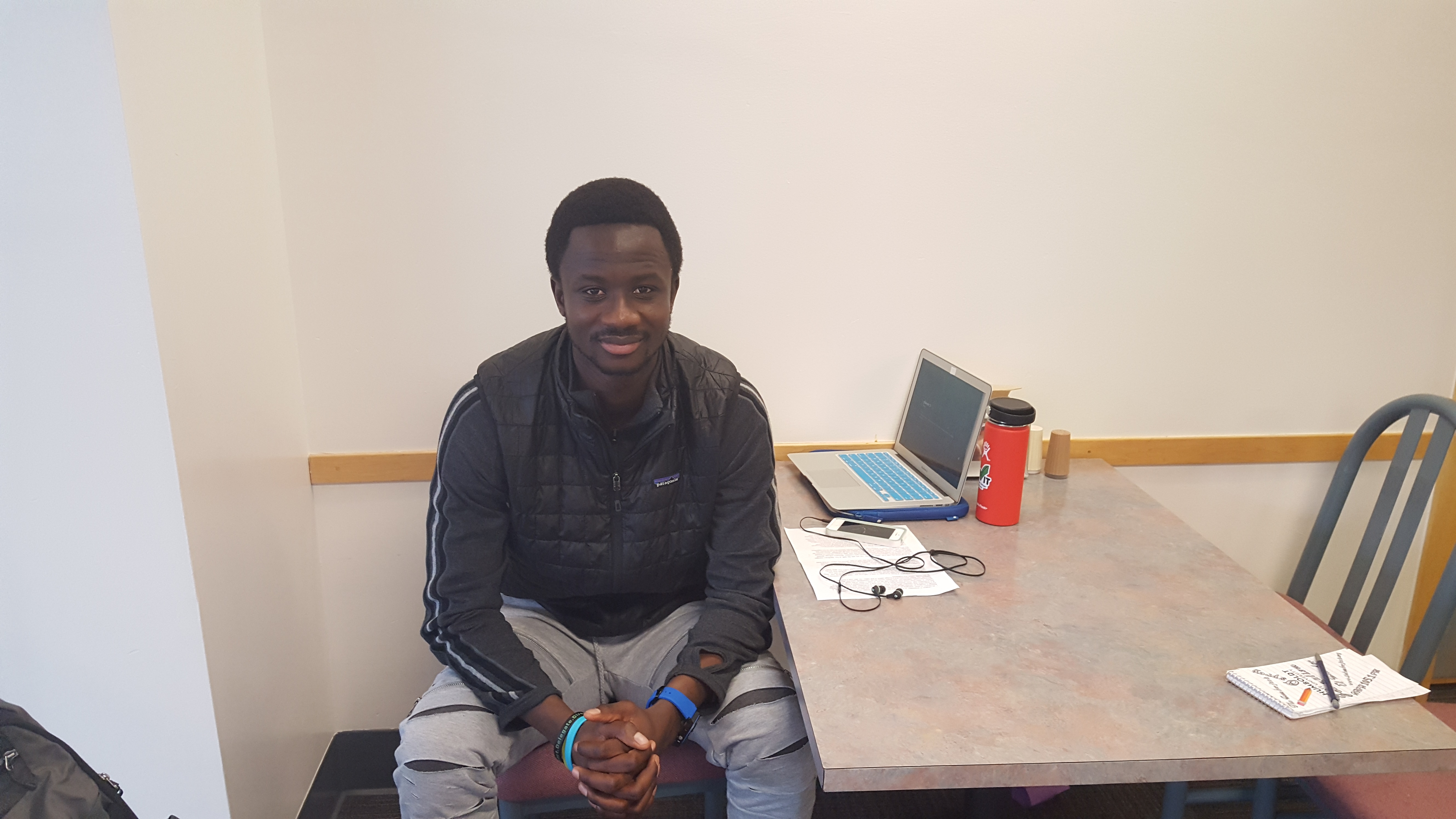
    Moussa Sy is a 21-year-old junior at HSU, majoring in environmental science. Sy moved from the country Mali, located in West Africa, to Ojai, California in 2011 at the age of 16.

    Every year scholarships are given to African students, to give them the opportunity to come to America and study. The scholarship is good for three years.

    Sy was awarded this scholarship and began attending a boarding school in Ojai, where he was determined to learn English.

    One of the toughest things for Sy was learning English once he came to the United States. Back home in Mali, he grew up speaking French and a mix of other African dialects.

    It took Sy about a year to learn the language, he would study night and day trying to master it, while taking an English as a Second Language course at his boarding school.

    Humboldt State was not Sy’s first choice when he thought about college. Sy had hopes of playing Division two, or Division three basketball before an injury hindered his plans. Sy broke his leg during his senior year of high school, which lead him to start considering other options in college besides playing basketball.

    Humboldt State’s Environmental Science program caught Sy’s attention, and with a combination of the program and the Humboldt scenery Sy chose to attend HSU.

    Upon arrival at HSU Sy attempted to join the Humboldt basketball team, however lingering injuries prevented him from playing.

    This did not deter Sy from playing sports. In the fall of 2016 Sy joined the HSU soccer team and played the position of center guard. Sy felt welcomed by the guys on the squad from the very first day of practice. Sy admitted it was a little strange being the new guy, but his teammates helped him make an easy transition to team.

    Sy was forced to stop playing after only one semester do to a heavy school and work load. Sy is currently enrolled in 15 units and works 20 hours per week on campus.

    “I would wake up at 5 a.m. every day to get to the 6 a.m. soccer practice. I would not get home until 10 p.m. which left no time for studying or doing homework, just go straight to bed to wake up for practice the next morning,” Sy said. “ It was just too much to handle.”  

    Thinking back on his first week at HSU, Sy recalled it being an interesting environment.

    “The smell, and people were so different here at HSU, it was a little overwhelming seeing all the people,” Sy said. “The redwood forest stuck out the most though, that and the air was more pure than city air.”

    Due to financial issues Sy has been unable to return to his home in Mali to see his family, specifically his mother who was Sy’s hero growing up. Sy’s father would travel a lot for work while Sy was growing up, so his mother acted as head of the household.

    Back home Sy would play or watch soccer every day, his favorite team is Manchester United. Sy knew that in America soccer was not the most popular sport, but had to admit he was still shocked that people here really do not follow as much as back home in Mali.

    Sy’s plan for after graduation is to stay in America for awhile, perhaps around Santa Barbara, California, and gain some experience in the working world. Once he returns home, Sy hopes to help the underprivileged children of Africa.

    “Children are the future, and I would like to one day build my own orphanage to help the children of Africa,” Sy said.