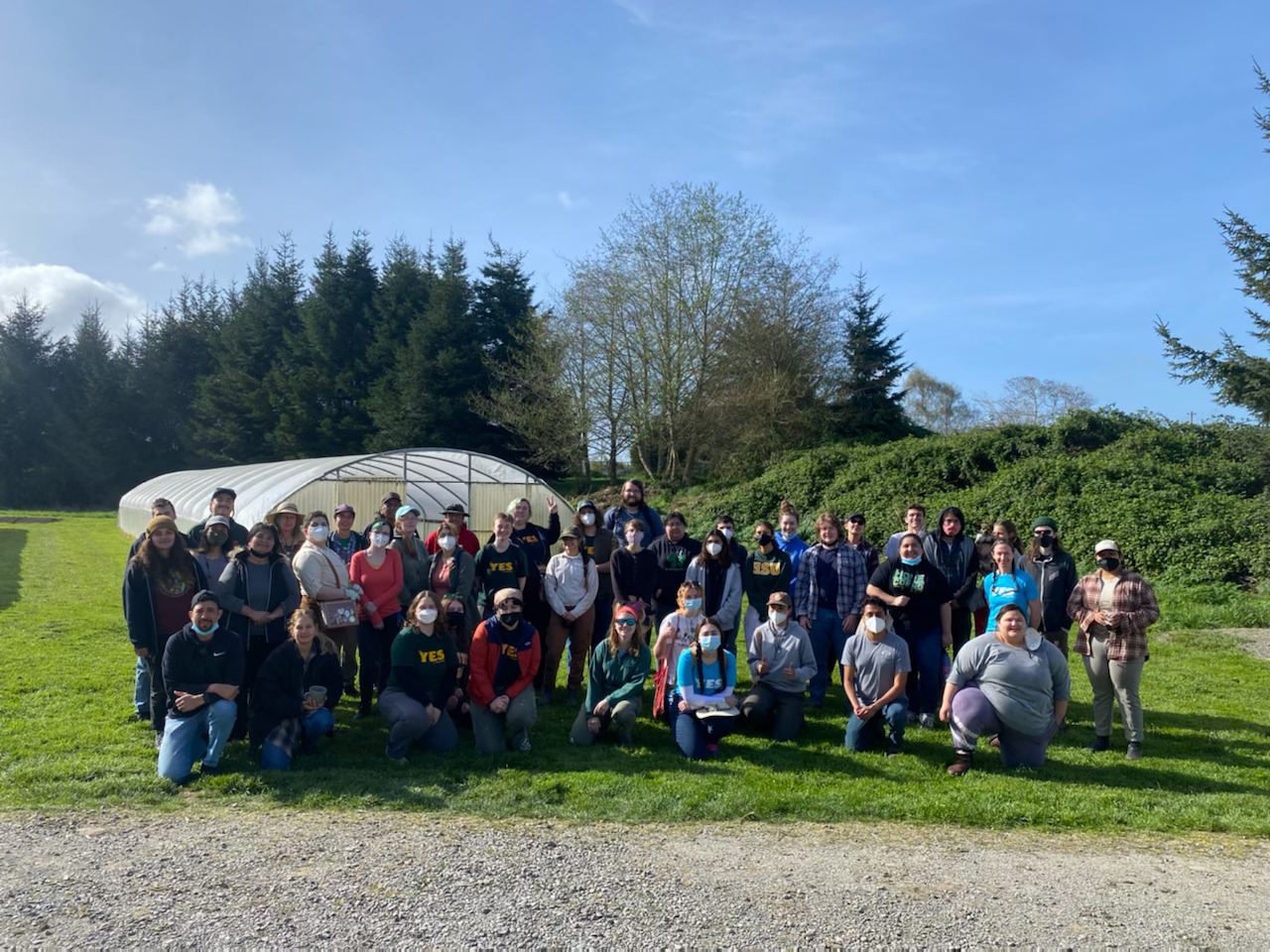
In honor of César Chavez Day, the YES program hosted a volunteer event at the Potawot Community Food Garden in Arcata. It had an amazing turnout with a whopping 40 volunteers in attendance, caressed by the sunny blue skies and the refreshing Humboldt breeze.
We were assigned tasks by being divided into five groups. I was grateful to be a part of a group that planted beds of squash. We did everything from scratch, laying out layers of black cover material across the four rows to keep the weeds from robbing the plants of their nutrients. We also covered the tops of the rows with white cloth.
Gardening skills have practical value in my daily life. Prior to this experience, I had been a volunteer at Potawot through a program called the Intertribal Agriculture Council. Potawat’s head gardener Ed Mata gave me a handbook about gardening and I was mentored by a professional development specialist named Elaini Vargas.
Maybe I was a little rusty on the terminology, but basic knowledge about soil health has since been ingrained into the recesses of my brain. I learned in a soils class that if you live in a mild climate, it’s estimated that it took 200 to 400 years for 1 centimeter of the soil to form. Vargas’ and Mata’s teachings directly impacted the mindset I had going into the YES serve-a-thon on César Chavez Day.
Youth Educational Services (YES) is a collective on campus that provides students with opportunities to volunteer at local school and community sites. One of their goals is to connect hands-on service and in-class learning with awareness of the injustices and oppressions experienced by those they serve. Actions sometimes speak louder than words. Making donations and saying nice things about a cause is totally different from donating your time and bodily energy to a cause.
According to mentalhealth.org, helping others can possibly help make you happier as a person. Through volunteering, I was able to make temporary connections through teamwork and group communication. This gave me a sense of community and made me feel like I belonged to a noble cause.
If you want to see change in your self-esteem, you might want to consider doing good deeds, so we can manifest the world into a better place. Indeed, an outward reflection of finding happiness can in turn make you a happy person.
Students learn how agriculture and water intersect, and how water can be impacted from outside sources
Agriculture is the foundation of modern society. California’s Central Valley keeps millions of people fed from its acres of cultivation, but that much land, and work, requires a lot of water.
Matthew Lotakoon, the president of the Water Resources Club at Humboldt State University, worked as a youth leader with the Tulare County Farm Bureau. The program provided local students with agricultural work in Tulare County and sometimes across the state of California. Lotakoon said his big take away was that agriculture is the economic backbone of the state.
“No other industry in California matches agriculture’s economic productivity,” Lotakoon said. “There is a complex environmental solution to maintain biodiversity and economic livelihood.”
Lotakoon said that the landscape of the Central Valley changed throughout its history. Most of the Central Valley has been soaked with water flowing off the Sierra Nevada mountain range. Since then, the agriculture industry has worked to serve the need for reliable food, a need that has been persistent and dominant.
“No other industry in California matches agriculture’s economic productivity. There is a complex environmental solution to maintain biodiversity and economic livelihood.”
Matthew Lotakoon
“Historically, the Central Valley has been very productive,” Lotakoon said. “Most of the Central Valley was riparian areas, lots of swamps and reoccurring wetlands. Vast herds of elk and pronghorn lived on the landscape. And now, little towns like Porterville and Tulare have appeared and agriculture fields are everywhere.”
To support a growing population of people, cities and roads were built on land that had previously been underwater, or at least waterlogged. The fertile ground was ideal for the agriculture industry. A decision was made in the 19th century to develop the Central Valley into a bread basket. A thirsty bread basket.
“For the limited amount of water we have, we have to consider how to use it to preserve biodiversity while farmers are trying to maintain their livelihood,” Lotakoon said. “The farmers are good people, it is water policy in the Central Valley that is the challenge. Once partisan politics gets involved, it gets very messy.”
Sustainable agriculture practices are the North Coast’s solution for feeding people in an appropriate way. To farm sustainably, resources including water, land and feed are used responsibly to prevent them from being depleted. The goal is to produce food forever. But farmers have to be conscious of where they get their water from, to avoid polluted crops.
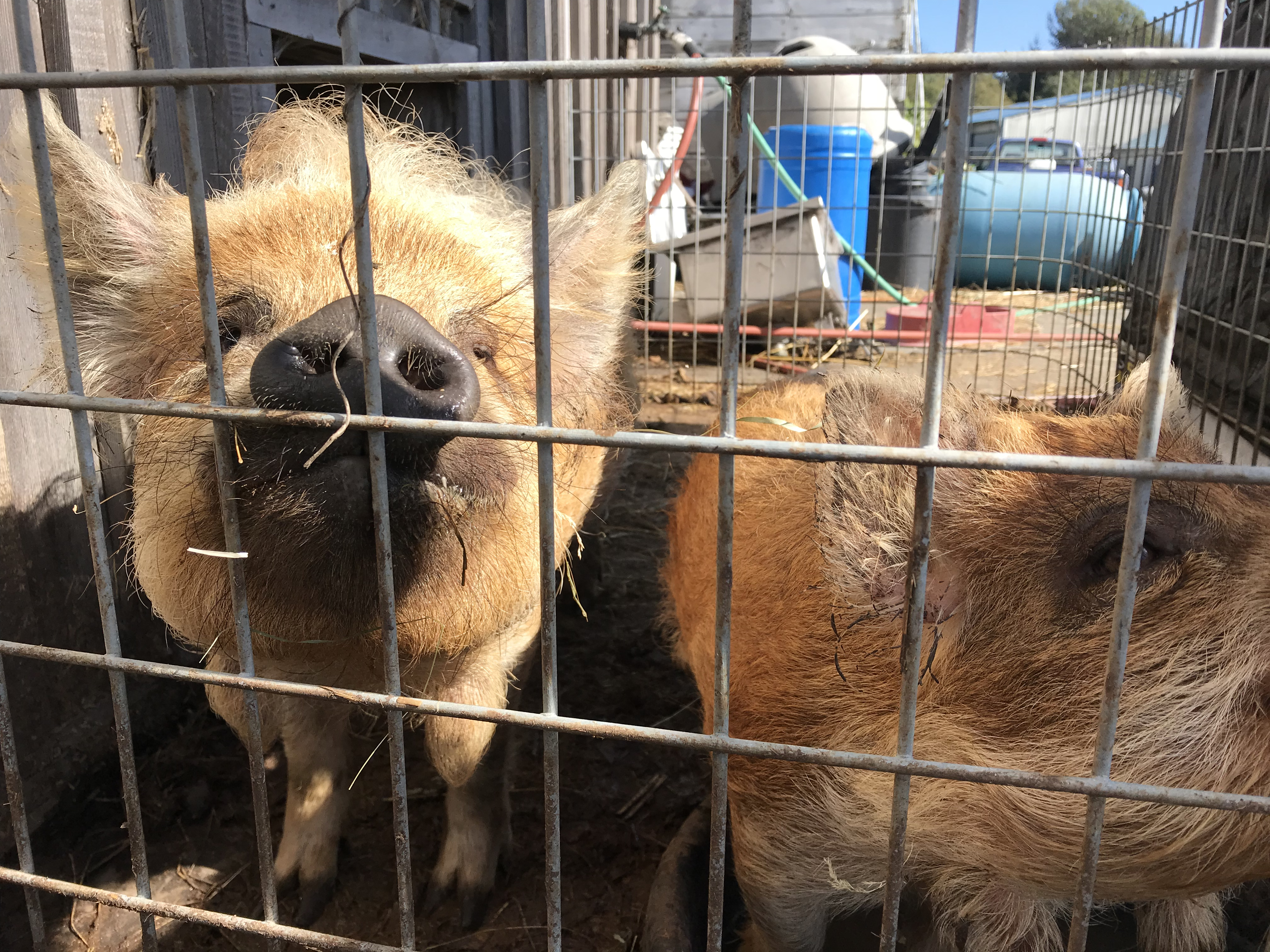
Shail Pec-Crouse feeds her kunekune pigs. Pec-Crouse owns and manages a farm which practices sustainable farming, meaning she will be able to farm how she does today, forever. | Photo by August Davidson
Shail Pec-Crouse owns Tule Fog Farm, a sustainable animal farm in the bottoms of Arcata. Her 22-acre property is home to pigs, sheep, turkeys and cows raised in a way that won’t damage the land they live on. Her operation is not very resource-intensive, although she did say working on the farm is a full-time job.
At the moment, Pec-Crouse’s farm is hooked up to the municipal water system. It is an expensive alternative, but considering the local Sun Valley Floral Farm uses the herbicide RoundUp on nearby fields to prepare them for growing flowers, it is a safe alternative.
“The field will be green one day,” Pec-Crouse said. “And orange the next.”
It isn’t unreasonable to believe the toxic herbicides infiltrate the soil and work down into the groundwater. Infiltrationis when soil absorbs water that falls on its surface. The water fills in crevices and pores between soil particles to create something of an underground lake called an aquifer. Depending on the chemical, infiltrating water can carry toxins into the aquifer.
Watershed professor Joe Seney said groundwater contamination is a big management challenge. The use of herbicides, industrial waste, poorly constructed septic systems and urban runoff often pollute groundwater. Pollution poisons drinking water, destroys local ecosystems and can cause land to be infertile.
Emma Flewell is studying environmental policy and planning at Humboldt State and worked with Ahtna Facilities Services to clean up a former Naval petroleum reserve in Bakersfield. The oil field contaminated a nearby aquifer and will take decades to clean up. The groundwater in the aquifer was used as tap water by a nearby neighborhood until people started getting sick.
“The farmers are good people, it is water policy in the Central Valley that is the challenge. Once partisan politics gets involved, it gets very messy.”
Matthew Lotakoon
“There are a lot of aquifers that have the potential to be used for municipal water, but it’s sad because some of them are polluted,” Flewell said. “Being in environmental science and management, cleanup jobs are common. There have to be people who clean up the messes we make.”
Flewell said there should have been legislation long ago to prevent aquifer pollution. She said it would be less expensive to not pollute in the first place than pay for the cleanup. Since the process to restore toxic sites takes years, the work needs to start as soon as possible.
The Tule Fog Farm is an example of how a polluted landscape can be restored to be productive again. The farm is a remediation site, which means the ground the farm is on was once polluted but has since been restored. It takes knowledge and technology to restore land, and it should be an inspiration for future remediation.
Lotakoon said consultation and collaboration with farmers is important moving forward. He stressed nobody is evil and it’s important to accommodate people and consider cultural differences and mannerisms.
“Farmers are decent people trying their best to do good,” Lotakoon said.
This website uses cookies to improve your experience. We'll assume you're ok with this, but you can opt-out if you wish. Cookie settingsACCEPT
Privacy & Cookies Policy
Privacy Overview
This website uses cookies to improve your experience while you navigate through the website. Out of these cookies, the cookies that are categorized as necessary are stored on your browser as they are essential for the working of basic functionalities of the website. We also use third-party cookies that help us analyze and understand how you use this website. These cookies will be stored in your browser only with your consent. You also have the option to opt-out of these cookies. But opting out of some of these cookies may have an effect on your browsing experience.
Necessary cookies are absolutely essential for the website to function properly. This category only includes cookies that ensures basic functionalities and security features of the website. These cookies do not store any personal information.
Any cookies that may not be particularly necessary for the website to function and is used specifically to collect user personal data via analytics, ads, other embedded contents are termed as non-necessary cookies. It is mandatory to procure user consent prior to running these cookies on your website.