The Lumberjack


Students Serving The Cal Poly Humboldt Campus and Community Since 1929

Tag: Alison holmes

  • Feelin’ the Funk at International Education Week

    Feelin’ the Funk at International Education Week

    Breaking down the power and importance of global funk music

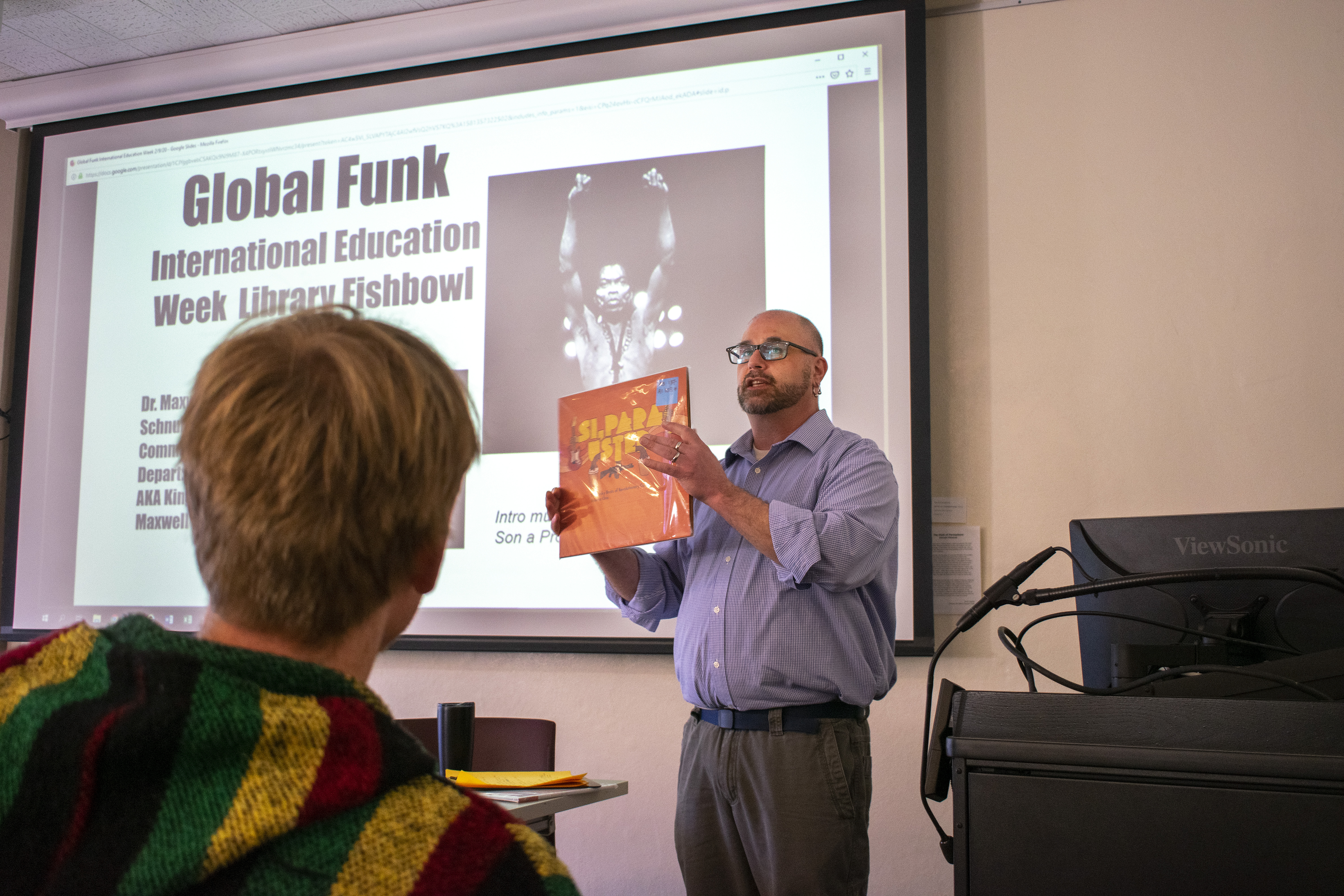
    A few minutes into his talk on global funk music, local DJ and Humboldt State University Communication Department Chair Maxwell Schnurer stumbled into a definition of funk.

    “If you want my definition of funk, that might be it: revolutionary praxis with a desire to get down,” he said.

    Schnurer’s talk on Feb. 10 flowed quickly. His enthusiasm for the tracks he played trickled into the audience of about 20 students, who nodded and laughed along. But Schnurer later gave a more serious definition.

    “I find global funk to be ethical, significant and real,” he said.

    Alison Holmes, associate professor and the lead of the international studies program at HSU, facilitated the event. Holmes eagerly offered context to the presentation as part of HSU’s 20th Annual International Education Week. Schnurer’s talk was just one of 45 scheduled hours of material that over 1,000 students and staff were expected to attend.

    “It’s a showcase for all the global things we do in the community,” Holmes said.

    “I think that funk has a certain feeling. It makes you move and it makes you dance and it makes you feel all of these different things, but if you actually listen to it, the things that are being said are of importance.”

    Skye Freitas, communication major and film minor

    Near the end of Schnurer’s talk, he gave the audience a take-home message. Most music artists, he said, have been historically ripped off—especially artists of color. He urged students to pay artists for their work.

    “Does that make sense? That ethically, as we move forward, we try to be aware of the politics of power,” Schnurer said. “And that often times means that we are going to have to pay up for information.”

    After the presentation, Skye Freitas, a communication major and film minor, said she loved Schnurer’s presentation—Schnurer is her adviser—and gave a surprisingly passionate explanation of the importance of music.

    “I think that funk has a certain feeling,” Freitas said. “It makes you move and it makes you dance and it makes you feel all of these different things, but if you actually listen to it, the things that are being said are of importance.”

    Schnurer skipped across the globe with audio clips to give the audience a taste of different funk styles. The first stop: Nigeria and Afrobeat pioneer Fela Kuti’s song, “Pansa Pansa.”

    “He hexes and challenges the Nigerian government at this level while being—literally at various points—a revolutionary and also a candidate for president of Nigeria,” Schnurer said.

    “Honestly, this could be like an hour-long, three-unit course.”

    Maxwell Schnurer, local DJ and communication department chair

    The next stop on the funky foray was Brazil and the music of Tim Maia. In describing the Brazilian funk scene, Schnurer explained the underground spiritual game—or the use of funk music by artists to express their spiritual selves.

    Schnurer called Maia’s album perhaps the greatest Brazilian funk album ever, but only after noting its joint inspirations of a heavy dose of LSD and a cult pamphlet.

    “You know, those things I would maybe not be inspired by or take away from the Tim Maia story,” he said.

    Schnurer flew the room to Japan to meet Haruko Kuwana, and then to India with a soundtrack from a compilation album, Pysch Funk Sa-Re-Ga! Schnurer said many funk tracks remain hidden as instrumental movie soundtracks. He finished with a short profile video on El Rego, a funk artist from Benin in West Africa.

    Schnurer paused midway through the talk.

    “Honestly, this could be like an hour-long, three-unit course,” he said. “If I were to criticize my own lecture I would say that there is something kind of disrespectful about name-dropping dozens of interesting global musicians without giving them all musical space.”

    Rachael Thacker, another communication major, hadn’t taken any classes with Schnurer, but admitted she would attend just about anything he does for his interesting takes. Thacker knew little about funk.

    “Just my first impression was that you can groove to it, you can dance to it and you can relax to it,” she said.

    Thacker planned to ask Amazon’s Alexa to play some funk later.

    A hand sprang up when the talk ended.

    “Will you teach a class on this?” a student asked.

    The group chuckled and Schnurer hemmed and hawed. He wasn’t sure.

    While he pondered making a class out of the talk, Schnurer left the audience with an appropriately funky anecdote.

    “Let me encourage that maybe it’s time to buy the like Thai funk box set for your brother for Christmas from Mike in the attic,” he said.

  • Professor Ponders California’s Independent Future

    Professor Ponders California’s Independent Future

    Alison Holmes, Ph.D. spent her sabbatical researching whether California acts as its own nation

    California has the means to be its own nation. It’s big, it’s wealthy and it’s been disrupting the status quo by acting internationally.

    “California has been acting outside the box,” Humboldt State University Associate Professor and International Studies program leader Alison Holmes said. “They’ve been going and doing stuff with China, Mexico and Canada. It’s like, ‘Wait, you’re not supposed to do that. That’s not what international relations theory says, it’s not what the U.S. Constitution says, it’s not what all kinds of other rules suggest.’ So how are they doing that?”

    Holmes spent her sabbatical last school year researching California and talking with state officials and those the state has dealt with.

    In August, Holmes presented her research to the Center for California Studies at Sacramento State University in a presentation called, “California as a Nation-State: Innovative or Inevitable?”

    In her research, Holmes found that cities and industries within California may act internationally, but the state itself doesn’t typically act as its own nation.

    “We do things internationally but we don’t do them in a coordinated fashion,” Holmes said.

    Holmes grew up in Oklahoma, but she moved to the United Kingdom after volunteering in Belfast during college. Holmes lived in the United Kingdom for 25 years, where, among other things, she worked for and advised the Liberal Democrats and worked as the Deputy Head of Corporate Communication Strategy for the BBC.

    In 2005, Holmes completed her doctorate in London and then became a speechwriter for Ambassador Robert Tuttle.

    “When I worked for the ambassador, I became very interested in international relations and diplomacy,” Holmes said.

    California likes to think that it’s an innovator. We’re really big and proud about how we do stuff. And actually we’re not at the front of that innovation edge; a lot of other places in the world have been doing this for a long time.”

    Alison Holmes, Ph.D.

    When Holmes moved to California, she saw a perfect opportunity for research.

    “California makes an excellent case-study, because it is the fifth largest economy in the world,” Holmes said. “But it is a sub-national unit of a huge, hegemonic, vast, largest-nation power.

    Holmes said California’s international actions are part of a larger globalization trend.

    “What a lot of international relations theory will tell you is that globalization has meant a bunch of people who aren’t nation-states have started to do things on the international stage,” Holmes said.

    With this in mind, Holmes said that while California might be innovative for the United States, it isn’t elsewhere.

    “California likes to think that it’s an innovator,” Holmes said. “We’re really big and proud about how we do stuff. And actually we’re not at the front of that innovation edge; a lot of other places in the world have been doing this for a long time.”

    Holmes also said non-state entities acting internationally brings up questions about the very nature of sovereignty.

    “When does a sovereign not have sovereignty?” Holmes said. “At what point do state relations at the international level become a foreign policy? My point here is that our traditional ideas of sovereignty are ill-equipped to describe what we see in the real world.”

    Holmes says there are three future goals for California: the establishment of an agency focused on international policy, the honoring of tribal relations and the inclusion of tribes in international policy, and the coordination of city and county international efforts with state efforts.

    Holmes ended her research presentation with an urge to take advantage of California’s diversity across all of its communities.

    “That is the only way to create a robust local-global citizenship and to turn California’s state-nation vision of unity from diversity into a reality,” Holmes said.

    Locally, Holmes said Humboldt is more global than it might think. Holmes urged Humboldt residents to connect local actions with outside, global forces.

    “I worry that Humboldt is a little too proud of being the Lost Coast or being behind the Redwood Curtain,” Holmes said. “Privileging what they perceive to be the local over the global, to the point of seeking to disconnect from rather than engage with the world outside.”

    Holmes said ignoring global events has consequences.

    “If you don’t understand these things, you’re not really paying attention to what’s happening, how you can take advantage of that, how you can be a part of that and how it doesn’t have to roll over you like a steamroller,” Holmes said. “Because otherwise it will.”

    However, Holmes cautioned that connecting local issues with the rest of the globe doesn’t mean people should start blaming external forces for all local problems.

    “Trying to understand it is not the same as trying to find somebody else to blame,” Holmes said.

    Holmes suggested that freshmen coming to HSU would likely benefit from learning intercultural communication strategies that international studies students use.

    “There is culture shock,” Holmes said of new HSU students. “There is intercultural communication issues between the different groups of people who turn up here.”

    While HSU politics professor and international relations teacher Noah Zerbe said Holmes’ work goes beyond the scope of his expertise, he did agree with the importance of paying attention to the rest of the globe.

    “Stuff that happens globally affects us everywhere,” Zerbe said. “It affects us here as well.”

    California’s prowess has led some to believe that California should secede from the United States.

    Marcus Ruiz Evans, president of Yes California, the largest organization dedicated to California’s secession, said he believes California would be better off on its own.

    “The basic idea is that California is held back financially because it’s part of America,” Ruiz Evans said over the phone.

    “The basic idea is that California is held back financially because it’s part of America.”

    Marcus Ruiz Evans

    Ruiz Evans said Yes California and the #CalExit movement started back in 2011. Since then, it has seen significant growth, especially following the election of Donald Trump.

    However, Ruiz Evans said that the movement’s growth led to a divide in its supporters that left the movement momentarily stagnant.

    “With success came civil divorce,” Ruiz Evans said.

    Nevertheless, Ruiz Evans said he firmly believes California should secede. Ruiz Evans said that California, on its own, wouldn’t have to fight with the president or the rest of the country, wouldn’t have to fight with federal immigration laws and would save billions of dollars.

    Ruiz Evans also said California is held back politically and financially, and that he believes a split is only logical.

    “We think it’s inevitable,” Ruiz Evans said.

    Yet, when asked, Holmes put a damper on such enthusiasm.

    “I am not sure ‘doing it alone’ is ever a great idea,” Holmes said. “I think while California is rich by many standards, if they had to pay for all the things that the federal government currently does, our situation would change rapidly. California could go that route, but revolutions rarely end well or the way the instigators intended. Be careful what you wish for.”