The Lumberjack


Students Serving The Cal Poly Humboldt Campus and Community Since 1929

Tag: alternative living

  • Two complaints were the basis for evicting over one dozen homeless Cal Poly Humboldt students

    Two complaints were the basis for evicting over one dozen homeless Cal Poly Humboldt students

    by Jasmin Shirazian

    Alleged complaints regarding unsanitary conditions created by students living in vehicles on campus didn’t exist when university administrators forced students living in their vehicles off-campus in November. 

    Aileen Yoo, Director of News and Information for Cal Poly Humboldt Marketing and Communications, was unable to find any formally filed complaints against alternative living students. 

    “There were no formal complaints filed with the University Police Department but there were informal complaints to UPD, Parking Services, and Facilities Management,” Yoo said in a Jan. 16 email. The italics are hers.

    After informing Yoo of the existing formal complaints and requesting any records of the alleged informal complaints, Lumberjack reporters did not receive a response.

    Cal Poly Humboldt released a campus-wide email stating the enforcement of parking regulations and ultimately the removal of students living within their vehicles on campus on Oct. 25, 2023.

    “There have been an increasing number of RVs and other vehicles parked long-term in University lots across campus,” Cal Poly Humboldt’s email read. “These vehicles are in permit-only parking spots, and have been parked in spaces overnight in violation of University policy that includes a prohibition on overnight camping on campus and overnight parking for anyone not living in University housing.”

    The email contained a statement that these students had received an unspecified amount of complaints regarding their living in on-campus parking.

    “Policy aside, overnight camping in University parking lots creates unsanitary and unsafe conditions for both those encamped and for our campus community at large,” the email read. “The University Police Department and other campus offices have taken calls from concerned members of the campus community expressing fear and frustration about the situation.”

    Only two formally filed complaints were made to UPD by the same people, listed only as RP and Pt, on Oct. 6 and Oct. 7, 2023. The complaints were obtained by The Lumberjack through a public records request 

    “RP owns the property at [redacted] and believes some of our houseless students are people associated with camping in the 14th and Union parking lots are jumping her fence to her unoccupied property at [redacted],” the Oct. 6 report states. “RP sent a photo of the subject who was unrecognizable.”

    The following day, UPD received another complaint from RP. This time, a person identified as Pt is mentioned in the same report, though their relation is unknown. 

    “RP calling back to report RV parked x 2 nights [across] the street from her residence,” the Oct. 7 report states. “Pt states there are ‘several men’ coming and going from the RV. RP is requesting a patrol check of the area. Subject contacted and they advise they will be moving RV.”

    The news of being removed from campus came as a shock to many alternative living students, who had recently formed a club to solidify the bond of their community. Some of these students even recall speaking to parking enforcement and housing administrators about their alternative housing plans prior to moving, to which they received no rejection or denial. 

    Carrie White, a biology major on a pre-medicine track, is one of the students who was pushed off campus by parking enforcement. 

    “Since I was forced to leave campus, I have continued to live in my vehicle, but I am parked in another parking lot,” White said. “I leave before dawn to avoid any potential issues occurring despite having permission to stay where I am. I stay away all day, moving between other street parking, lot parking and the coast line. I return later in the evening.” 

    White was already under tremendous stress when the university notified the students that they had to vacate the parking lots by Nov. 12, 2023, giving them two weeks to find accommodations. 

    “At the time, I had a friend that had just passed away, a sick grandfather, and finals,” White said. “There was a total lack of consideration of my humanity; I might have other things happening in my life besides living in my car, which is hard enough at times. It was a tone-deaf decision on behalf of the university, in my opinion.”

    Journalism major Brad Butterfield, who is also the science editor of The Lumberjack, is an alternative living student who has been living in his van on campus for several semesters. In an email to parking enforcement, Butterfield explained his situation and received a message stating that parking enforcers were aware of students living in their vehicles on campus. In Butterfield’s email, he specifically asked if the school allowed overnight parking if proper permits were displayed.

    “Parking is enforced from 7AM to 10PM, Monday through Friday,” Michaela Old, a parking enforcement employee said. “As long as you have a valid permit you will be able to park – also keep in mind that parking spaces are first come first serve.” 

    Several students said they attempted to acquire documentation of or information about the complaints, but were ultimately left without answers. 

    Recent graduate Maddy Montiel was in their last semester when they were notified of the parking enforcements. Montiel was finally becoming comfortable in their community after nine years in college, four of those spent at Humboldt. 

    “My last semester meant a lot to me,” Montiel said. “I was finally at the finish line, finally letting myself have some fun and deepen friendships. I joined more clubs and went to more events; I let myself enjoy the beautiful environment our school sits in. [I] remembered why I decided to move here and take all the risks I did to be here. I was finally getting what felt like a ‘college experience…  for the first time, I started to feel safe.” 

    This changed when Montiel had to vacate the parking lot in which the community formed. 

    “Having to spend my last couple months of what I thought was a graceful and beautiful end to my college experience, fighting for basic answers and the right to stay on campus until at least the end of the semester, only to have the door shut in my face over and over, was beyond disheartening,” Montiel said. “Since being kicked off campus, I’ve had to live at the community center and on city streets again. Always being on the move gets exhausting.”

    The vacating of students has left many of those affected, such as freshmen MA public sociology student Caleb Chen, feeling disheartened by the university’s decisions. 

    “I feel that this… has highlighted exactly how out of touch the administration and especially the President’s office is from their student body,” Chen said. “When the [administrative] office blatantly ignores the wishes and insights of everybody else, a university is doomed.”

    White shares a similar sentiment. 

    “One of the most hurtful things about that original email from Cal Poly Humboldt was that I realized I was totally disillusioned,” White said. “I chose to invest my time and money in this institution because I believed in its values and inclusivity policy, but upon that email being sent out, I realized that Cal Poly Humboldt is just that: an institution – with dollar signs for eyes.”

    Brad Butterfield is the science editor for the Lumberjack. He had no involvement with the making of this article.
  • Policy, protest, and pirates: students protest against campus evictions

    Policy, protest, and pirates: students protest against campus evictions

    by Jillian Wells

    Other contributors: Alex Anderson and Dezmond Remington

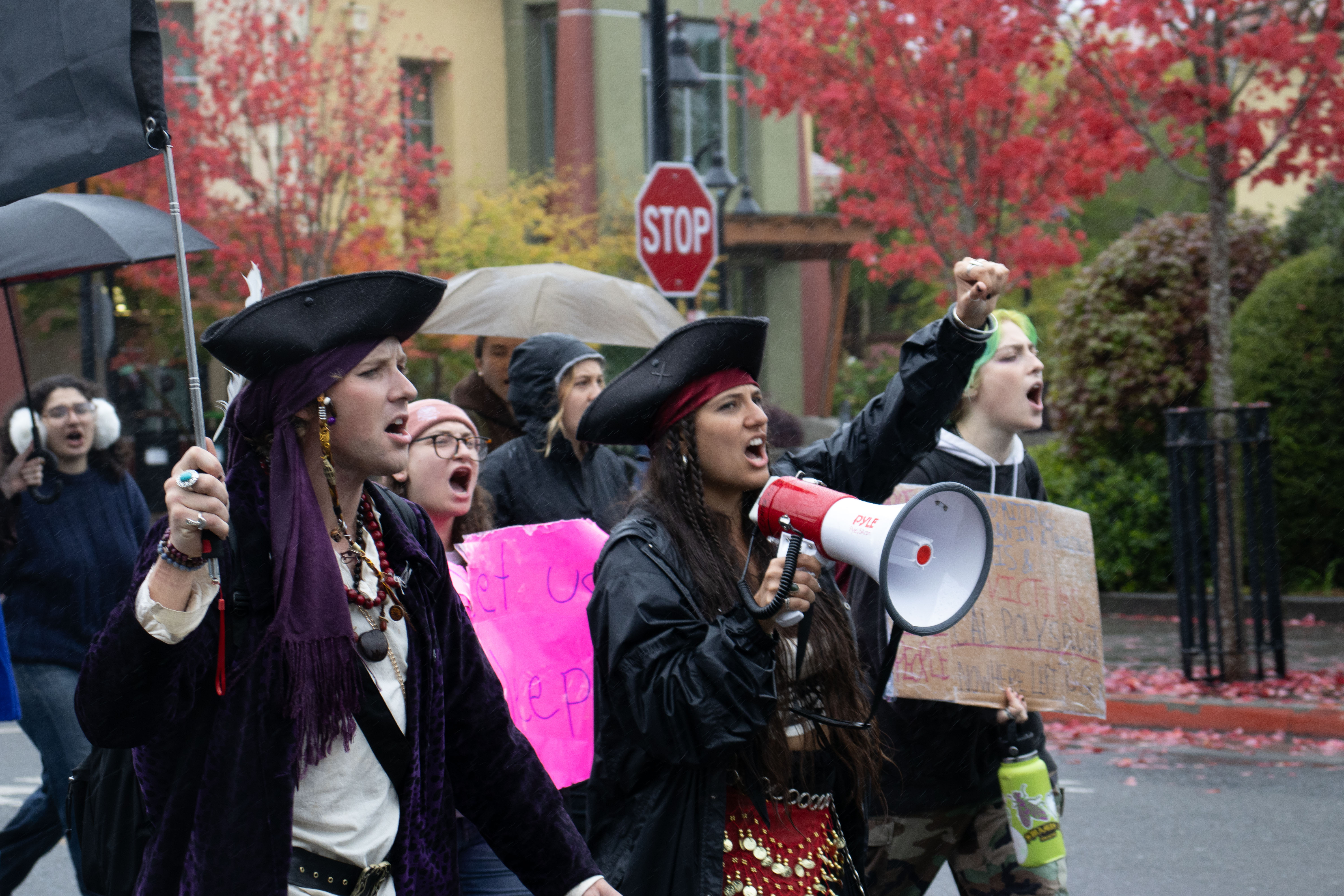
    In a powerful show of unity, students and faculty members gathered in the rain at Cal Poly Humboldt to protest the recent decision to evict students living in vehicles on campus. The protest, which took place on Thursday, Nov. 2, highlighted the larger problem of homelessness in Humboldt County. 

    The protest started at 11 a.m. in the G11 parking lot and lasted throughout the night. At 12 p.m., protestors marched to the quad in the rain chanting, “Hey, ho, hey, ho student eviction has got to go!”

    Photo by Cedrik Vonbriel. A sign at the protest.

    The protest was led by Maddy Montiel and Brad Butterfield, the president and vice president of the Alternative Living Club, who were dressed as pirates because of a long-running joke of them being “land pirates” and their RV’s being ships on wheels. Furthermore, the initial eviction email occurred during Halloween week, and since then Montiel and Butterfield have been solely focused on securing safe housing, but didn’t want the situation to take celebrating Halloween from them. 

    “The university took a lot from us last week,” Montiel said. “We decided we wanted to keep one thing for ourselves and still dress as pirates and give our outfits a chance to see the light of day.”

    Photo by Cedrik Vonbriel. A sign at the protest.

    The protest also featured an open discussion, where Montiel and Butterfield stated their list of demands from the university. 

    Their demands included the university allowing overnight camping or sleeping in vehicles through the end of the fall semester, at least, a formal apology for the dehumanizing language in the initial eviction email, the establishment of a committee for long-term solutions, more transparency in defining camping and its implementation, and evidence of the “unsafe and unsanitary conditions” that was stated in the email.

    At the protest, Butterfield stated students living in their vehicles are open to finding a solution that works for them and the university, but that the university hasn’t been willing to negotiate. For the students living in their vehicles, protesting was a last resort. 

    “For the school to assume that they can just get rid of us and push us out onto the streets and we’re going to go away quietly, is wrong,” Butterfield said.

    On Tuesday, Nov. 7, the University Senate passed a resolution that would pause the enforcement until the end of the 2023-2024 academic year; this resolution was sent to President Jackson’s office. It awaits a decision. Mark Johnson, the President’s Chief of Staff, who attended the meeting on behalf of Jackson, declined to answer any of The Lumberjack’s questions, as did Dean of Students Mitch Mitchell.

    During the protest, various speakers articulated their concerns, frustrations, and demands, emphasizing the need for understanding and fair solutions. The protest featured many voices and perspectives within the community, stressing the importance of addressing the issue with attainable solutions and compassion.

    Photo by Cedrik Vonbriel. A sign at the protest.

    Rouhollah Aghasaleh, an assistant professor in the School of Education, attended the protest and said that he sympathizes with the students who are being evicted.

    “Living in a [vehicle] doesn’t make you less human.” Aghasaleh said.

    Meheret Vasquez-Suomala, a religious studies major, expressed disappointment in the administration and hopes that they will listen and work with students, not evict them. 

    “You [Cal Poly Humboldt] are deliberately misplacing lower-income students and that’s what’s frustrating.” 

    Raymond Haeckel, another one of the speakers at the protest, questioned the accusations made by the university and stated that without proof of the unsafe and unsanitary conditions. Haeckel will continue to believe this is an effort to force these students into on-campus housing and collect housing fees.

    “This is motivated by money and money alone,” Haeckel said.

    Jules Tatum, another student at the protest, condemned the university’s decision to evict students.

    “To say that these people are unsanitary, unsafe, dangerous individuals is just a slap in the face. The only dangerous conditions are being created by the institution,” Tatum stated.

    Ultimately, the protest highlighted the need for realistic and attainable solutions that work with students, not evicting one of the most vulnerable student populations. 

    If you’re interested in learning more about this on-going issue, the Alternative Living Club is meeting on Friday, Nov. 10, at 3:30 in front of the library. 

    Disclaimer: Brad Butterfield is a member of the Lumberjack. He did not help write or edit this article.

  • Students find financial freedom in vanlife

    Students find financial freedom in vanlife

    by Jillian Wells

    Amidst housing shortages and the increasing cost of everyday living in recent years, students are looking to an alternative way of living: vanlife. The term “vanlife” means exactly like what it sounds like, living in a van, but the term encompasses various mobile living options such as trailers, campers, motorhomes and RVs. 

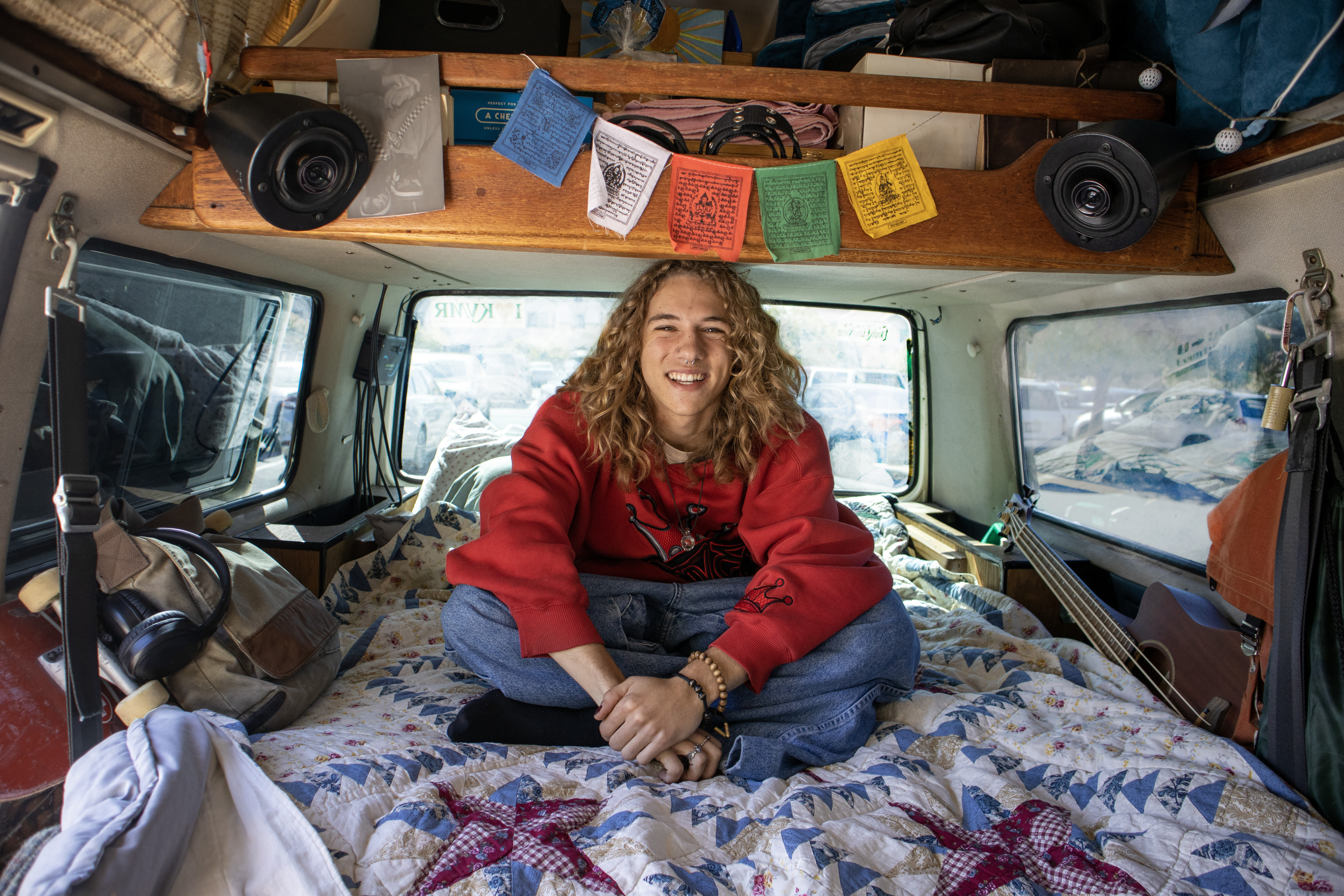
    For students seeking a more affordable lifestyle, vanlife is a compelling solution. According to Maddy Montiel, a senior environmental science major with five years of vanlife experience, this choice has allowed them to avoid the cost of traditional housing. Ultimately, Montiel hopes to never pay rent through college. On-campus housing, depending on the type and meal plan, can range from $5,000 to $15,000 per year. In contrast, by parking their motorhome on campus (with a general parking pass) Montiel saves about $500 on gas per month and their monthly living expenses can be as low as $300 for essentials, making it a financially sensible choice. 

    “I’m choosing to do this instead of putting myself into an insane amount of debt in order to pay rent somewhere,” said Montiel. “I’ve always wanted to do it and can’t see myself living another way.”

    Similarly, student van-lifer Steven Childs, a senior wildlife major, explained that while it may not be his preferred lifestyle, it aligns with his financial priorities.

    “If you think about it, the whole point of me being here is to study and go to school and learn. At the end of the day, your room generally is a place for you to put your head and sleep,” said Childs.

    Students are also being drawn to vanlife because of the freedom and independence it offers. When living on wheels, the world becomes your front porch.

    “It’s definitely a pro to be able to wake up on the beach, and pretty much wherever you want to wake up”, said Bohdi Haugen, a freshman doing vanlife. 

    Haugen also added some of the advantages that come with owning a van, including that it really feels like your own; a feeling you may not necessarily have when you’re renting someone else’s space. Jaikyn Russel, a freshman studying forestry, who shares a van with Sierra Cole and their dog Indy, believes vanlife is a lot more doable than people think it is. Cole added that one of the draws of vanlife is being able to travel and always have your home with you. 

    Even with all of the benefits of vanlife, it doesn’t come without its challenges, notably not having a bathroom.

    “I’ve grown pretty familiar with public restrooms nowadays,” said Haugen.

    Montiel added that vanlife often gets glorified, and that there are some harsh realities that come along with it, including dealing with every aspect of your consumption because resources are limited. For instance, Montiel mentioned that they have to always have propane or else they won’t have a way to cook food, boil water or keep their appliances running. Montiel also noted the less-than-glamorous aspects of vanlife.

    “You have to deal with your own shit – literally in every regard, you have to deal with your own shit,” said Montiel.

    But despite this challenge, they believe it forces you to have a shift in mindset and become more sustainable. 

    Students embracing this lifestyle feel that there is a sense of community among vanlifers. Haugen has met many other like-minded people who are in the same situation as him. Montiel further elaborated that they and other vanlifers have formed close-knit bonds, organizing events such as cookouts and beach bonfires together. These connections provide a support system for those navigating the challenges of this lifestyle.

    While this lifestyle isn’t for everyone, it can be cost effective, rewarding, and freeing for those who do it. If you’re interested in embracing this lifestyle, Montiel noted that an alternative living club is underway. The club’s first meeting will be Friday, Oct. 27 at 3:30 p.m. in Library room 114. 

    “We’re hoping to use that to create a space for students who live like this and students who are interested in living like this, to come and talk about it and learn about it and advocate for more resources,” said Montiel.