The Lumberjack


Students Serving The Cal Poly Humboldt Campus and Community Since 1929

Tag: Arcata High School

  • Coach Continues Creating Community

    Coach Continues Creating Community

    Arcata High School’s computer science teacher creates community for video gamers

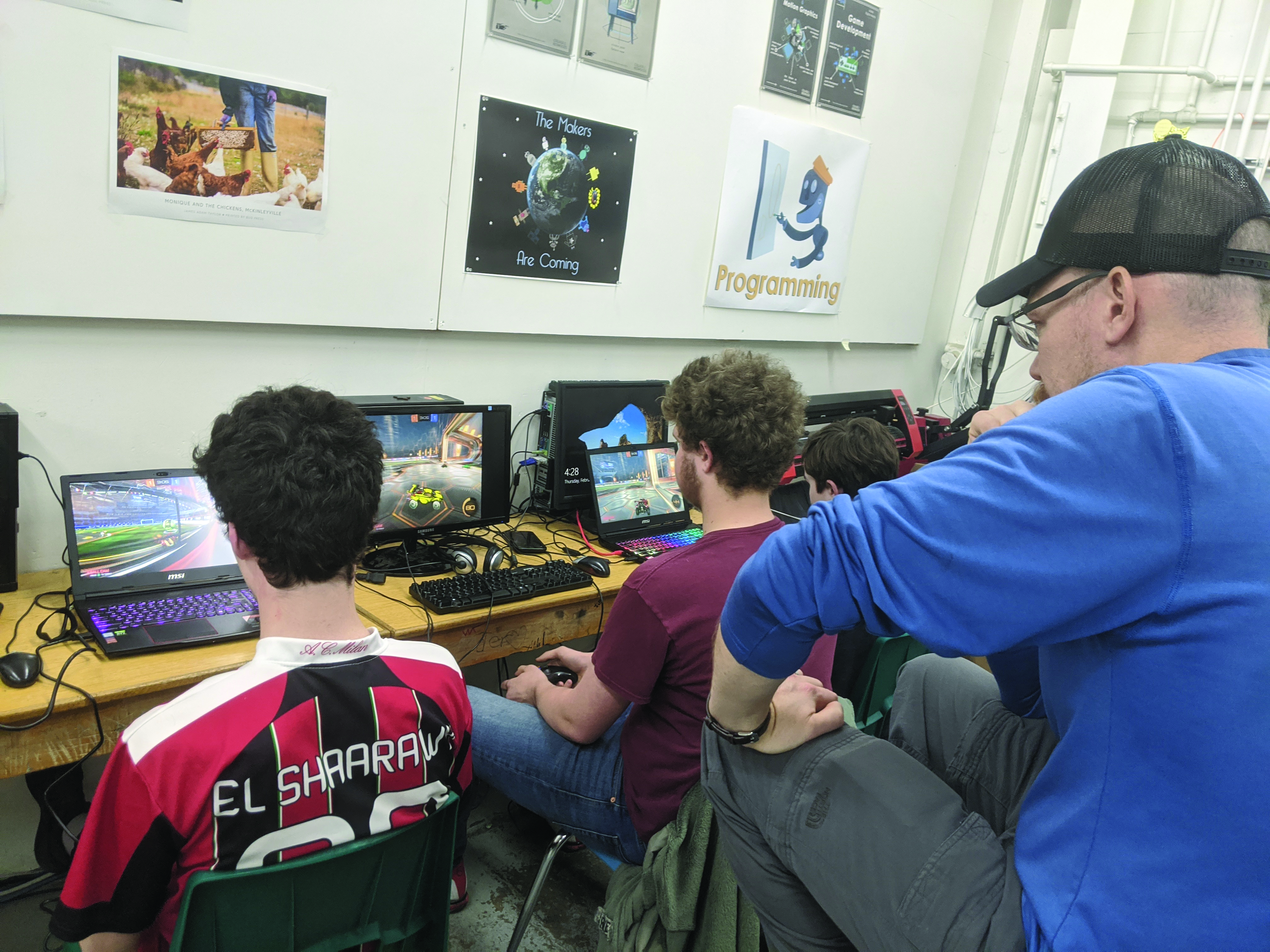
    Jason Sidell is an Arcata High School teacher responsible for their Makers Program and esports team. The Makers Program is a curriculum written by Sidell, designed to engage computer skills, wood shop tools and various other equipment to make anything the students want to create.

    This year Sidell coached the Arcata High School esports team that played their first season this spring. Fisher Boroughs is one of the team’s League of Legends players who just started playing the game this season.

    “He [Sidell] doesn’t know much about League of Legends,” Boroughs said. “He knew as much as me, which is basically nothing when it started.”

    Sidell says it’s a lot more like an organized sport than people would imagine. It has all of the same stakes of ranking, a team name, regular practices and all of your fellow gamers sitting right next to you.

    “It’s been more intense than I thought it would be,” Sidell said.

    Anthony Womack is a senior on the Rocket League team and is in his second year of the Makers class. He describes the Makers class as an incredibly open environment where Sidell encourages students to follow their own ideas as well as giving those less inspired something to begin with.

    “You’re just making your own independent projects,” Womack said. “That’s pretty much the only assignment, just make something.”

    He recalls building an electric guitar from scratch as being his most impressive project he’s completed in the class.

    “I would spend every single lunch inside the class,” Womack said. “I wouldn’t even eat most of the time because I would just be busy working on stuff.”

    Sidell graduated from Loyola University in Chicago with a degree in biology but wasn’t sure what direction to take it. On a whim, he took a vacation down to Baja with a childhood friend of his, but when he drove his friend up to Humboldt County, he never left.

    “I love the Pacific Northwest and the environment up here,” Sidell said. “I just fell in love with it.”

    Like many others moving to Humboldt, Sidell had trouble finding employment. He first landed a dish washing job at Golden Harvest Cafe, then found work through AmeriCorp for two years.

    “I made a lot of connections in education that way,” Sidell said.

    He would lead backpacking trips on the Lost Coast Trail and can remember the positive impact it had on the youth who had never left the Northern Humboldt metropolis of Arcata and Eureka. Sidell began work on his Master’s in education focusing on curriculum writing. At the same time he began part-time work at another non-profit run by Carol Newetts, called Tiffany’s Garden for Children.

    “I remember one year I would teach in the morning at McKinleyville High, and then a class at Eureka High and then I’d end up at Fortuna High in the afternoon.”

    The program he headed was called CyberTribe. It was set up as a youth-run computer business where teens would teach each other how to use certain programs including graphic design and fixing computers. They would take on paying jobs from the community like graphic design and web design work.

    “It was 20 years ago, but I still remember all those kids’ names,” Sidell said. “It was a really empowering experience.”

    Sidell taught a variety of programs to the youth at CyberTribe, but a program that could be used to make video games became very popular. After seeing the interest, Sidell told his boss that he thought that it could be taught as a high school course. His boss agreed and Sidell created a six week module for the video game development course that he began teaching across the county.

    “I think I’ve taught at just about every high school in Northern Humboldt,” Sidell said. “I remember one year I would teach in the morning at McKinleyville High, and then a class at Eureka High and then I’d end up at Fortuna High in the afternoon.”

    After 15 years of work all around the county, Sidell settled down at Arcata High School where he wrote the curriculum for the Makers program after finding a grant focused on encouraging STEM at the high school level. The funding he secured solidified his own place at Arcata High, assuming that interest remained.

    “It was a great feeling,” Sidell said. “Especially because I had been struggling year-to-year to maintain my job.”

    Sidell believes he was meant to be a teacher and is passionate about creating a space that welcomes and respects his students. He believes that the best way to positively impact the world and leave a good mark on it is through teaching.

    “If you can teach someone an idea and give them skills,” Sidell said, “that knowledge and information can be passed on through history.”

  • Letter to the Editor: HSU Did Not Violate California Law

    Letter to the Editor: HSU Did Not Violate California Law

    A letter from HSU’s vice president of Enrollment Management

    A letter from Humboldt State University Vice President of Enrollment Management Jason Meriwether follows:

    Wednesday, April 22, 2020

    James Wilde, Editor & Reporter
    Grace Caswell, Editor & Reporter
    The Lumberjack Newspaper
    Humboldt State University 

    Dear James and Grace,

    Please accept this letter (also enclosed) in response to the Lumberjack Article titled, Humboldt State Violated California Law by Requiring Registration for a Public Meeting, which was published on April 16, 2020.  

    While you were copied on a series of emails to me, and thus, on my responses, there are still a few important facts that I believe you will find useful in the wake of the April 16thstory.  Since my email was the source of the quotes by me in the article, I never had an opportunity to answer a couple of fundamental questions as you prepared for your story.  As such, I ask you to please consider the following:

    The University did not violate California Law.  

    When I received the original email, which copied numerous parties, Vice President Dawes and I took immediate action to verify that HSU was not in violation of the law.  This included going into consultation with other university stakeholders, including legal counsel.  This consultation reassured us that no violation of policy or law was taking place.  

    In particular, I urge you to please review the actual requirements of the Bagley-Keene Act.  First, please review a guidance document provided by the State’s Attorney General which outlines the scope of Bagley-Keene.  Most pertinent to this issue, the Bagley-Keene requirements at issue apply only to meetings of a statutorily defined “state body” (Section 11121) that do not apply to the informal meetings hosted by VP Dawes and me.  As explained in Section 11121 and in the guide from the State’s Attorney General, the sessions that were hosted do not fall within the scope of Bagley-Keene, which, based on guidance from legal counsel, means this law does not apply and was not broken.  

    With respect to the Brown Act, which was also referred to in the series of emails and in your article, this statute applies to local government agencies and essentially stands as a counterpart to Bagley-Keene, so to speak.  The California State University, in particular Humboldt State, is a state agency, which does not fall under the Brown Act.  Because Humboldt State, as a part of the CSU, is not subject to the Brown Act, legal counsel has advised us that the law was not broken.  

    Why did we add a public link to the originally scheduled presentations?

    We did so to eliminate any perceived barriers to participation.  As quoted in the story from one of my emails, “the entire point of the meetings was to be transparent.”  

    While we were fully aware that we were compliant with the law and that no persons were being barred from the meeting, the very notion that we were trying to keep people out, even though it was false and based on an incorrect interpretation of the law, compelled us to add an extra way to view the meeting.  In our perspective, if any person felt uncomfortable or interpreted the registration function as a barrier, then adding the extra link made sense.   In total, over 300 members of the university, media, and local community attended both meetings, and not a single person was excluded.  The zoom webinar function was not sought out as a barrier, but as the best way to allow so many people to receive the information at hand.  Registration for this meeting was not like a conference presentation or an event with limited access or hidden behind a paid wall.  Many instructors and students are using zoom for class and the majority, if not all, meetings and presentations are held over zoom.  We sent the information out to the entire campus, it was posted on the public events website, and we did not deny access to anyone.  Simply stated, because we could not have a meeting in the Great Hall or KBR, a zoom meeting appeared to be the best option to make sure that this important information was shared with the campus.   

    To be candid, the public webinars were not an attempt at secrecy.  Any notion to the contrary is simply false.  In our belief, these sessions were about being honest with the campus and sharing data that impacts everyone.  Making the report and data available online and readily sharing it with the media, students, faculty, and all interested parties was also necessary.  Personally, I can assure you that it would have been easier to not conduct public presentations about such a negative set of projections, but in fact, the public presentations were the right thing to do.   

    The first person to receive a copy of my report was a journalist from the Lumberjack who received the report even before my first public presentation to the University Senate.  The Senate presentation was also via zoom and on the same day I met with the student journalist.  This information has been presented to Associated Students, the University Senate, the University Planning and Resource Committee, and in two public meetings.  The report has also been cited by the media and directly provided to reporters who requested it.  These actions do not align with any intention to violate the law or fail in transparency.  

    In conclusion, I am committed to the voice of students through journalism, which I believe has been demonstrated during my first year at Humboldt State.  That commitment will not change.  To that end, my commitment to providing facts, information, and access to student journalists has also been demonstrated.  Accordingly, I ask that you please review the information and facts above and please weigh against the information that was provided to you and the information that was published in the article.   

    Thank you for your consideration.  

    Sincerely Yours,

    Dr. Jason L. Meriwether

    Vice President of Enrollment Management

    Humboldt State University

    Ralph M. Brown Act
    https://leginfo.legislature.ca.gov/faces/codes_displayText.xhtml?lawCode=GOV&division=2.&title=5.&part=1.&chapter=9

    Bagley-Keene Act’s Section 11121 https://leginfo.legislature.ca.gov/faces/codes_displayText.xhtml?lawCode=GOV&division=3.&title=2.&part=1.&chapter=1.&article=9.

    Attorney General’s Bagley-Keene Act Fact Sheet

    https://oag.ca.gov/sites/all/files/agweb/pdfs/publications/bagleykeene2004_ada.pdf

  • Humboldt Esports Builds Momentum

    Humboldt Esports Builds Momentum

    Arcata High CyberTigers face off against the Novato High Hornets

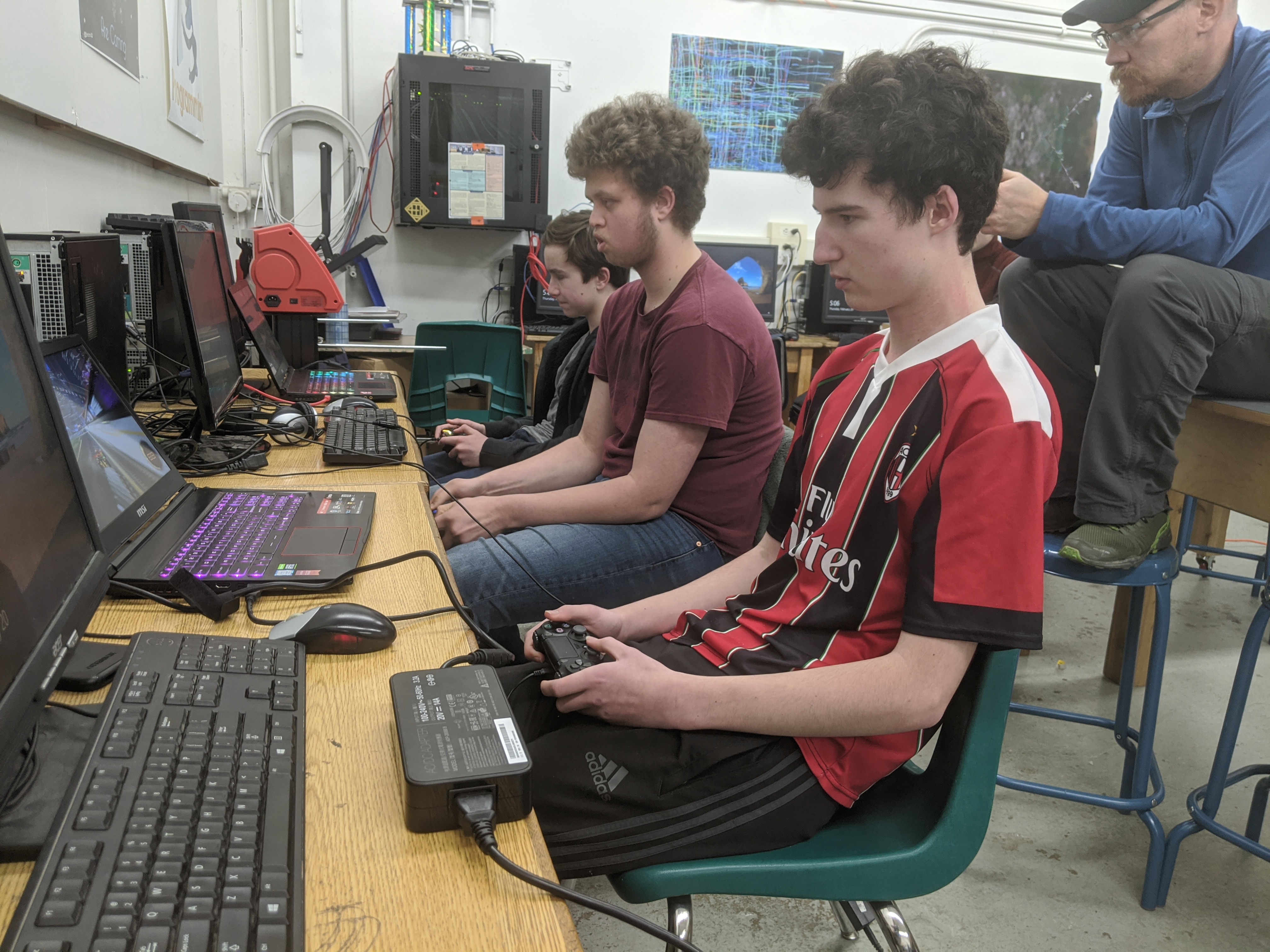
    With 15 minutes until start time, Rocket League players sectioned themselves off into corners of a combined Humboldt State University computer lab and classroom in their respective Arcata High School CyberTiger, CyberTiger B and CyberTiger C teams as their coach Jason Sidell turned on some “get psyched” tunes. Sidell isn’t incredibly well-versed in Rocket League, but he is quick to compare it to other sports.

    “When people think of esports, they think video games, and I think that they would be surprised if they were to observe our practices,” Sidell said. “Esports is to video gaming what a basketball team is to a pick up game.”

    Rocket League players for the CyberTigers faced off against the Novato High School Hornets Feb. 27.

    Rocket League, as described by the California Interscholastic Federation, is a fantastical sport-based video game that can be summed up as soccer with cars. It features a competitive game mode based on teamwork and outmaneuvering opponents.

    The teams are each made up of 3 players, with the CyberTiger team being more like a varsity team and the B and C teams being more like junior varsity. The matches are best-of-five games, with each game lasting a little over five minutes.

    Complete with pizza and La Croix, the HSU Gaming Club hosted a meet and play event for the Arcata High esports team earlier that month that brought an evening full of laughter and good old fashioned competition. The meetup was organized by HSU Gaming Club President Sarah Kanga Livingstone and advisor David Marshall, who reached out to the Arcata High esports team.

    “We’ve been trying to reach out more and more to see if we can get more ways of bringing (high school) students on to campus,” Livingstone said.

    The CyberTigers and their opponents are registered through a service called PlayVS, which is partnered with the CIF to provide the tournament brackets and infrastructure to run a state-wide league.

    The teams are each made up of 3 players, with the CyberTiger team being more like a varsity team and the B and C teams being more like junior varsity. The matches are best-of-five games, with each game lasting a little over five minutes.

    Within 20-30 minutes, both the B and C teams’ games were drawing to a close, but the CyberTigers’ Seth Simmons, Jonah Moore and Marley Thrift continued on in a dynamic match against the Hornets, with their coach cheering them on.

    “Don’t say nice,” Simmons said as Sidell mistakenly complimented a shot that looked like it was going to go in. “Don’t say anything.”

    Remarkably, the C team won while being down a player, and the B team swept their opponents 3-0. The CyberTigers, however, lost their match 3-1.

    Vice President of Enrollment Management Jason Meriwether stopped by to welcome the high schoolers as well. Due to the success of the event, the HSU gaming club is currently in the process of planning a gaming tournament for local high school students in mid-April.

  • Dream Season for Corsairs Continues

    Dream Season for Corsairs Continues

    College of the Redwoods men’s basketball team charges into the playoffs

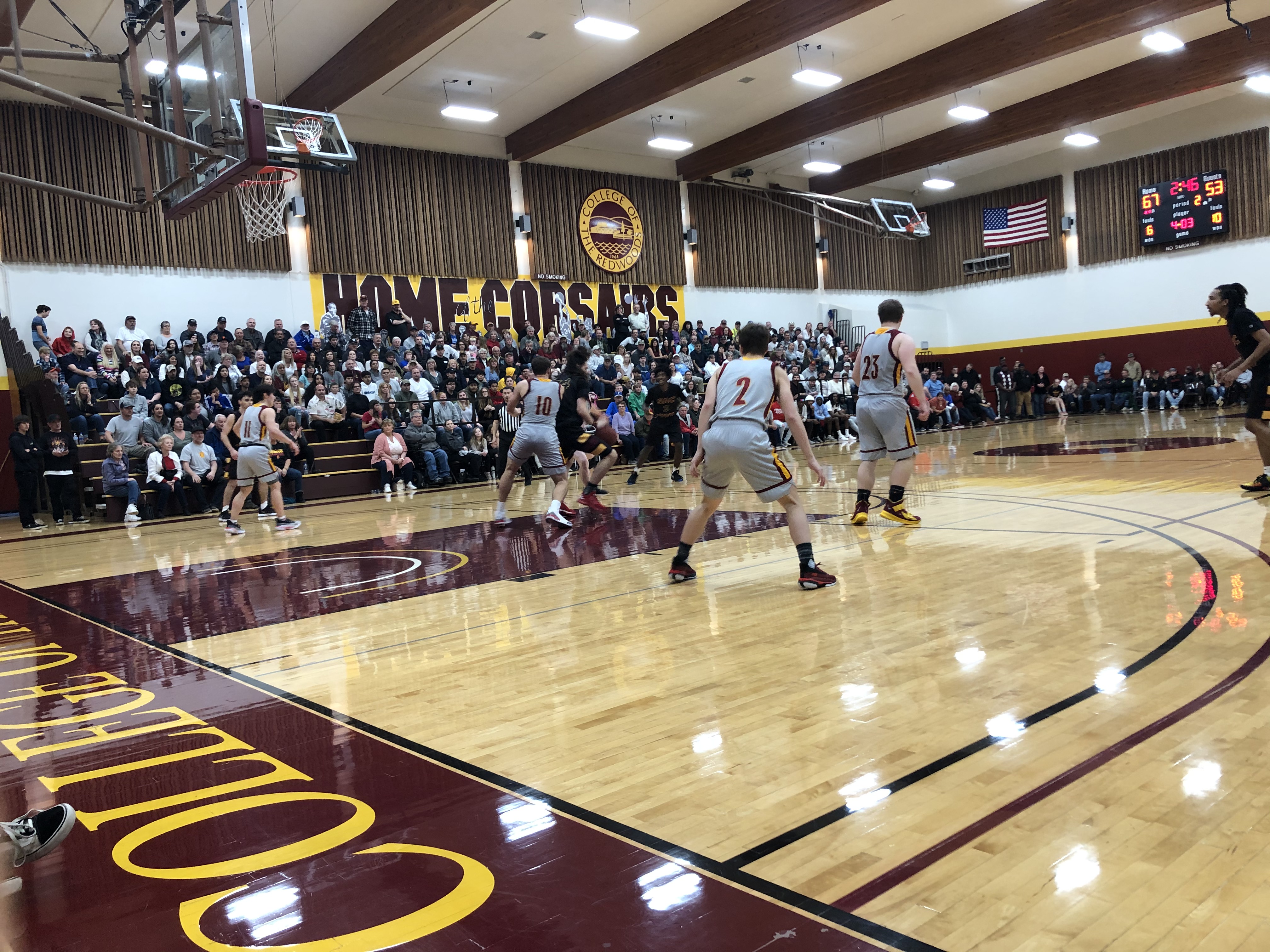
    With a 75-56 win over Sacramento City College Feb. 27, the College of the Redwoods men’s basketball team advanced to the second round of the California Community College Athletic Association state playoffs. The win put the Corsairs at 22-5 on the season, a complete turnaround from last year’s 0-26 record.

    First-year Head Coach Ryan Bisio set a plan into motion to turn the program around far before he got the job with the Corsairs. The plan was simple: build a team with high-quality local talent to showcase to the community. The plan worked immediately.

    The Corsairs are all graduates from local high schools like Fortuna, Arcata and McKinleyville, with the team composed of all freshman except for two sophomores.

    “I’ve known these kids for years,” Bisio said. “Last year I didn’t coach, so I got to watch all of them in high school and was able to build personal relationships with them. The unity was powerful and it made entrusting this young team easy.”

    This local talent dominated the Golden Valley Conference as the Corsairs, led by Arcata alumnus and conference MVP Thomas Nelson, were crowned champions.

    “Whenever we needed a bucket throughout the year we would go to Thomas,” Bisio said. “He scores in spurts from all three levels. The way he scores devastates our opponents and our team feeds off of him.”

    Nelson, who is in his sophomore year, has been one of the best players in the CCCAA this year, as he was named first-team All-State as well. He averaged 20 points and eight rebounds per game this year, and he scored over 25 in eight games.

    “I wanted to win conference just like in high school, and I knew I could have success. But I didn’t know I would be All-State in the process. I didn’t even know they had All-State teams in junior college until I made the first team.”

    Thomas Nelson

    “The coaching staff has your back in every situation and I have great teammates,” Nelson said. “It’s day and night from last year. We communicate and connect at a very high level and we work very well together.”

    The Arcata High School graduate had high season goals this year, and winning a conference championship was one of them.

    “I wanted to win conference just like in high school, and I knew I could have success,” Nelson said. “But I didn’t know I would be All-State in the process. I didn’t even know they had All-State teams in junior college until I made the first team.”

    With Nelson leading the way, the Corsairs had a multitude of successes this year. Four other players were honored, with Drew Gillette, Zac Claus and Donald Willis making first-team honors and Bradley Willis earning an honorable mention.

    Gillette chipped in 17 points while shooting 41% from the arc. Freshman marksman Isaac Puzz added 9 points while shooting a team high 44% from the three.

    While Puzz and Gillette were lighting it up from behind the arc, Claus took the role of primary ball handler with an average of 10 points, six assists and five rebounds per game.

    The Willis twins were the all-around guys. They combined for 22 points, 11 rebounds and 6 assists per game while leading the Corsairs defensively in steals and charges taken.

    Coach Bisio’s plan has come into fruition as CR is currently ranked 16 in the state and has advanced in the CCCAA Northern California state playoffs. With playoffs intensifying the competition, Bisio knows his team must play their best game now.

    “We need to tighten up on defense,” Bisio said. “We’re going to see some good teams in the playoffs so we need to have a high sense of urgency. We’ve been playing good so we have to do what we’ve been doing—just can’t get complacent.”

    The Corsairs defeated Sacramento City in the first round of the playoffs, but the road only gets rougher. College of the Redwoods will be traveling to play against the nation’s number one ranked team, San Francisco City College. Dubbed huge underdogs, the Corsairs have a huge challenge at hand, but with the success they’ve had this year, nothing looks impossible.

    You can livestream the game through the CR men’s basketball Facebook page or the CCCAA Network on YouTube. The game will start at 7:30 p.m. on Saturday, March 7.

  • 33 Months

    33 Months

    Living in a community full of love, fear and a growing void of justice

    Thirty-three months after a black HSU student was murdered in the city of Arcata, a circle of family, friends, students and community members huddled together, clasped hands and shouted his name.

    “Justice for David Josiah Lawson,” the group said loud and clear over and over from the steps of the Arcata City Hall. The sun had set hours ago, and a winter wind was biting at those gathered in attendance, but weather wouldn’t stop the crowd.

    “The vibe itself is very upbeat considering the weather,” said attendee Andre Ramos, who wore a heavy winter coat and a beanie pulled over his ears.

    Every month since the murder of David Josiah Lawson, a crowd has gathered around Charmaine Lawson, the mother of Josiah Lawson, and together they demand justice for Josiah. Lawson remains steadfast in her belief that justice will happen. She makes the journey all the way up to Humboldt from her home in Southern California to remind those in power that she will make it happen.

    “It will happen,” Lawson said. “I serve a mighty god. As long as I have breath in my body I will continue to be here.”

    “There are beautiful, amazing, wonderful, compassionate people here. There is love within this community, but there is evil and darkness here.”

    Charmaine Lawson

    To Lawson, this was an open and shut case. The original suspect, former Mckinleyville resident Kyle Christopher Zoellner, was apprehended the night of the murder. Lawson said the murder weapon was also found. She said DNA evidence should presumably solve this case.

    “Why we’re still here? Dumbfounded,” Lawson said.

    As the months go by, more and more students move to Humboldt to attend Humboldt State University. Yet Lawson is concerned these students don’t know the situation they’re moving into.

    HSU has a much higher population of people of color than the surrounding community. Most HSU students come from Los Angeles or the Bay Area and the small-town culture of Humboldt is different from what they’re used to. Lawson wants to ensure that all students who start the next step of their lives in Humboldt make it out again, but she feels that students of color simply aren’t welcome.

    “If you’re a student of color, be careful,” Lawson said. “There are beautiful, amazing, wonderful, compassionate people here. There is love within this community, but there is evil and darkness here.”

    Kwame Achebe, a San Diego native, agreed. Achebe has attended every vigil since the murder, but his voice still shook when talking about what happened. He chose his words carefully but spoke with a grim humor when recounting one of his first experiences in Humboldt.

    “What’s funny is in San Diego I’m pretty light skinned,” Achebe said with a laugh. “In San Diego I’d have to be convincing people I was black. I didn’t need to convince anybody here. My first day at Arcata High I was greeted as ‘the nigger,’ OK? I was greeted as ‘the nigger.’”

    Achebe said his experiences in Humboldt have told him that this isn’t an aberration.

    “For us not to have justice 33 months after the murder of a young black man? It’s not out of the norm at all,” Achebe said.

    Achebe said the elected leaders of Arcata don’t care about what happened to Josiah Lawson, so it’s up to the people.

    “I’ve been out here from the very beginning. I see the look on their faces when they’re addressing us. They have no souls in their eyes,” Achebe said. “They don’t care.”

    Part of the goal of the Justice for Josiah movement is justice in the form of political change, not just for Josiah Lawson, but for the whole system. Lawson vowed to keep working to elect people who she thinks will be able to uphold justice.

    “I will continue to call people in power out that are elected officials who are not doing their jobs and make sure we get people with integrity and love and compassion in seats,” Lawson said.

    Over the course of the almost three-year history of this case, it has faced numerous setbacks. The case against Zoellner was dismissed in 2017. In 2019, a criminal grand jury decided not to indict anyone for the murder of Josiah Lawson, and the California Attorney General declined to take the case.

    “Justice for me is having Kyle Christopher Zoellner arrested for the murder of my son David Josiah Lawson and held accountable for his actions,” Lawson said.

    The history of the case shows that a system that could bring about the justice that Lawson wants is not the one Humboldt has, but Lawson is convinced it will one day. Until then, Lawson is concerned for the students of color in the here and now.

    “Don’t go anywhere alone in this town,” Lawson said. “Stick together so someone can tell your story if you’re not able to.”

  • Protesting Climate Change

    Protesting Climate Change

    AHS and HSU students strike to advocate for climate action

    Video by James Wilde & Collin Slavey | Editing by Chelsea Wood

    Anxious and irritated with the lack of governmental action against climate change, masses of young people and students from Arcata High School and Humboldt State University took to the streets surrounding the Arcata Plaza on Friday as part of the Global Climate Strike.

    Inspired by the International Youth for Climate Action, the Humboldt Sunrise Movement in association with the Extinction Rebellion and students of AHS organized and executed the local school strike protesting climate change.

    Students were excited to show how strong their voices could be when used in unison. Maddie Marriott, a member of Extinction Rebellion, said the organization was aimed at gathering people for peaceful protest and that is what they hoped to achieve.

    “We dance, yell, sing and chant to show our energy,” Marriott said. “This shows we are cheerful and hopeful and happy in the face of this threat. It is rejuvenating and these friends are empowering. Now we have to wait and see if our voice is being heard.”

    Marriott ended up agreeing to hold a sign that said “Protect Rainbow Ridge, our forests and our climate.” Ecological protection is one of the main goals of the movement, but Extinction Rebellion as a national organization demands governments tell the truth about climate change and act now to prevent species loss and lower greenhouse gas emissions.

    Vanessa Argonza, a Humboldt State student and member of the Extinction Rebellion, said speaking out and advocating for action is important. Change requires people to care and be passionate about an issue, while also realizing we can come together to create change.

    “In moments of injustice you must speak out because if you do not, you are part of the problem,” Argonza said. “The youth is well aware and willing to be part of the change because it affects them. We can come together and make change. You just have to be aware of your footprint and educate yourself before you speak out.”

    The protest did run into some technical issues as it spilled out into the Arcata Plaza. Unfortunately, the strike organizers failed to bring a speaker system that was loud enough for all of the attendees to hear, causing the message to fall flat. Joanne McGarry, a local supporter of the Environmental Advocacy and self-prescribed ‘gadfly’ suggested better planning in the future for a more impactful demonstration.

    Jene L. McCovey delivers a powerful, emotional speech about the threats to the Earth faces. | Photo by Collin Slavey

    “I am more than happy to let young people lead, they just have to lead well,” McGarry said. “Having music is important when you’re walking into the plaza, during the demonstration and as you exit the plaza. Having a speaker that is loud enough for the entire crowd to hear is unbelievably important.”

    The Sunrise movement was originally created as a youth advocacy group to show support for the Green New Deal, a stimulus package proposed by politician and activist Alexandria Ocasio-Cortez in February of this year. The Sunrise Movement intends to work within ‘the system’ while actively changing the system, in pursuit of environmental and social justice through nonviolent and direct action. They are building an army of young people to stop climate change and create millions of good jobs in the process.

    Tribal elder Jene L. McCovey began the rally in the plaza with a song called “Feeling Sorry for My Womenfolk,” a somber tune that spoke of hate and woe. She went on to tell stories and sing more songs to give purpose to the actions of the demonstrators.

    “The stumps are really big- that is all we have left of the old forest,” McCovey said. “Clear cutters, defilers, denude the land down to the earth and they burn it. Wherever you find your trials, be that healer. Be that person that walks with people in that good way. Be the water protectors.”

  • Protest for gun control leads Arcata High students to walk out

    Protest for gun control leads Arcata High students to walk out

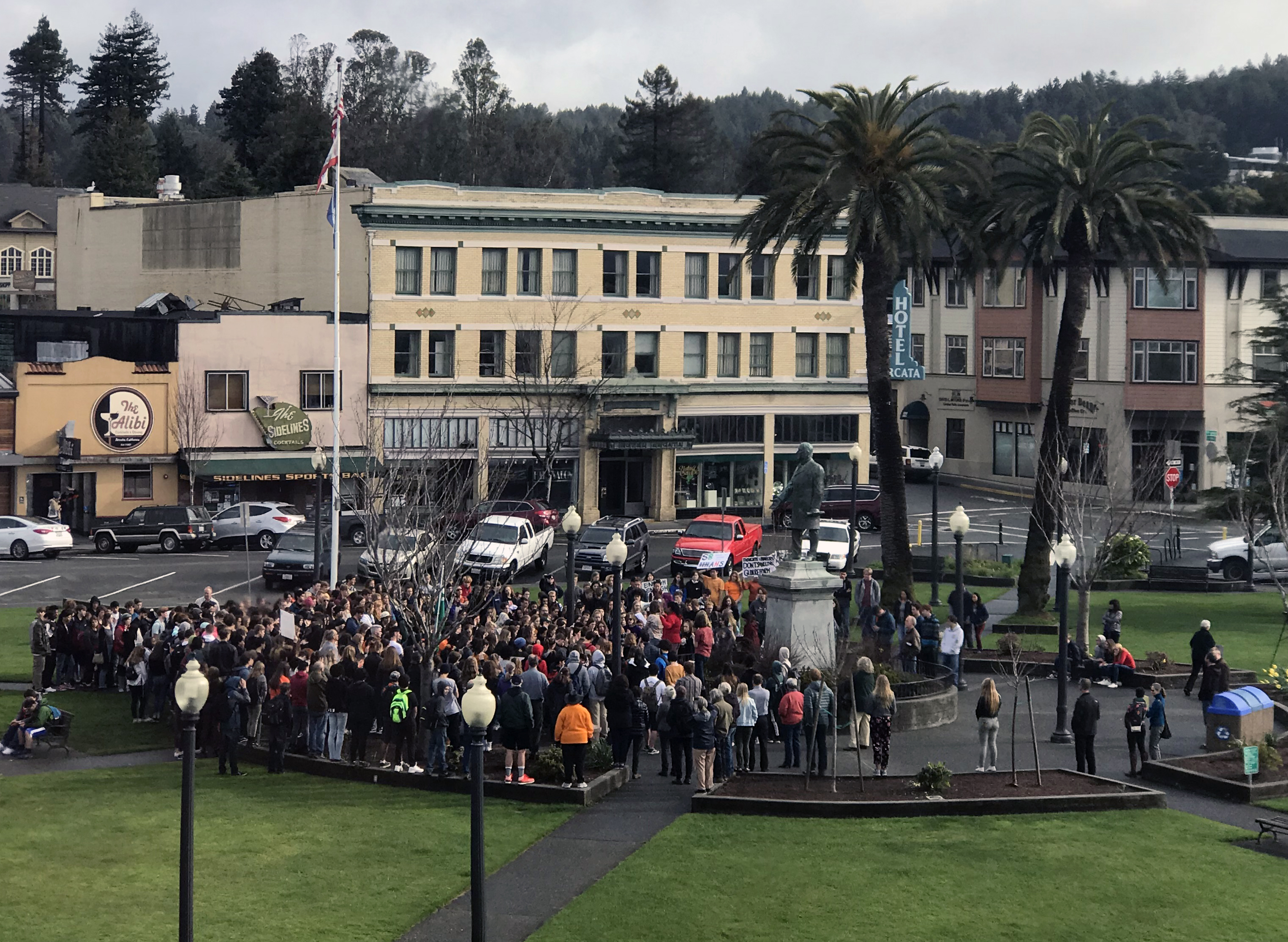
    Arcata High School students joined a nationwide walkout on March 14. The walkout was in reaction to the recent shooting in Florida at Marjory Stoneman Douglas High School, where a man with a semi-automatic rifle took the lives of three faculty members and 14 students.

    Arcata High sophomore Fiona Murphy left her class to join the rest of the students and faculty participating in the walkout last Wednesday morning. The destination was the Arcata Plaza.

    The walkout was led by Arcata High sophomore Skaidra Pulley and freshman Maddie Lankarani. Pulley compiled a six-page list of victims of semi-automatic weapons. The names were read during the 17 minutes of silence.

    “During those 17 minutes I went through a range of emotions,” Murphy said. “I went from crying to pure anger that this is happening, to crying again.”

    Jennifer Rosebrook teaches American history at Arcata High. She stayed on campus during the walkout. Rosebrook graduated from Humboldt State and has been teaching at the high school for 22 years.

    “I stayed on campus during the walkout as per my contract,” Rosebrook said. “It’s just like if you worked in a factory, you don’t just get up and leave in the middle of it.”

    The administration found a teacher who wasn’t teaching in order to cover for those who wanted to be part of the walkout.

    “That allowed those teachers who really wanted to go down with the kids and keep them safe,” Rosebrook said.

    The Trump Administration’s proposal to provide school personnel with firearms and training brought criticism from Rosebrook.

    “I’m not a big fan of any weapons to be honest. It doesn’t matter if they’re a rifle, a gun or nunchucks,” Rosebrook said. “I would never consider carrying a gun on [campus]. I think it is a reaction to what’s going on, not a proposal to fix it.”

    Not all high school students attended the walkout. James Manion, a senior at Arcata High, chose to stay in school and go to class.

    “I was thinking about going, but at the same time, I didn’t really want to get involved with something like that,” Manion said. “I stayed in my English class, but everyone in the English class left. I just sat in the parking lot waiting for my next class to start.”

    Murphy went around writing the words “Who’s next?” on people’s hands with a Sharpie as they held their hands up.

    “Our arms started to cramp, because we had to hold our hands up while all the names were read,” Murphy said. “We didn’t have to hold our arms up, but we wanted to.”

    Murphy said that Pulley told her the list of names originally compiled was going to be a list of every student and teacher who had been killed in a school shooting by a gun. The list was 11 pages long and hadn’t been completed.

    “People are dying. We have to remember the names of the victims and not the shooter,” Murphy said. “You feel like you’re in a bubble when you just see it on the news, but participating and hearing the names of all the people who died makes it real.”

    In the last two minutes of the silence, someone in a pickup truck drove around the Arcata Plaza two or three times blasting music out of their car.

    “It turned out to be a McKinleyville student,” Murphy said. “I think he was doing it to be antagonistic and break up the memoriam.”

    When the memorial for the Parkland victims ended, Murphy didn’t go back to school. She stayed in the plaza with a small group until 5 p.m., writing letters to Congress.

    “We packed pens, pencils and papers to write to Congress,” Murphy said. “Throughout the day, different moms were bringing us food, tea and cookies,”

    Students wrote the letters to Paul Ryan, Donald Trump and others, asking for more restrictions on AR-15 rifles. They also sent thank you notes to congressman Jared Huffman for lobbying for gun control.

    “Since it is national, it is putting more pressure on the government to do something,” Murphy said. “Even if our little walkout doesn’t directly affect it, it’s making a ripple. It’s laying a foundation for getting something done.”