Try and lose yourself in the Arcata Marsh for the best experience
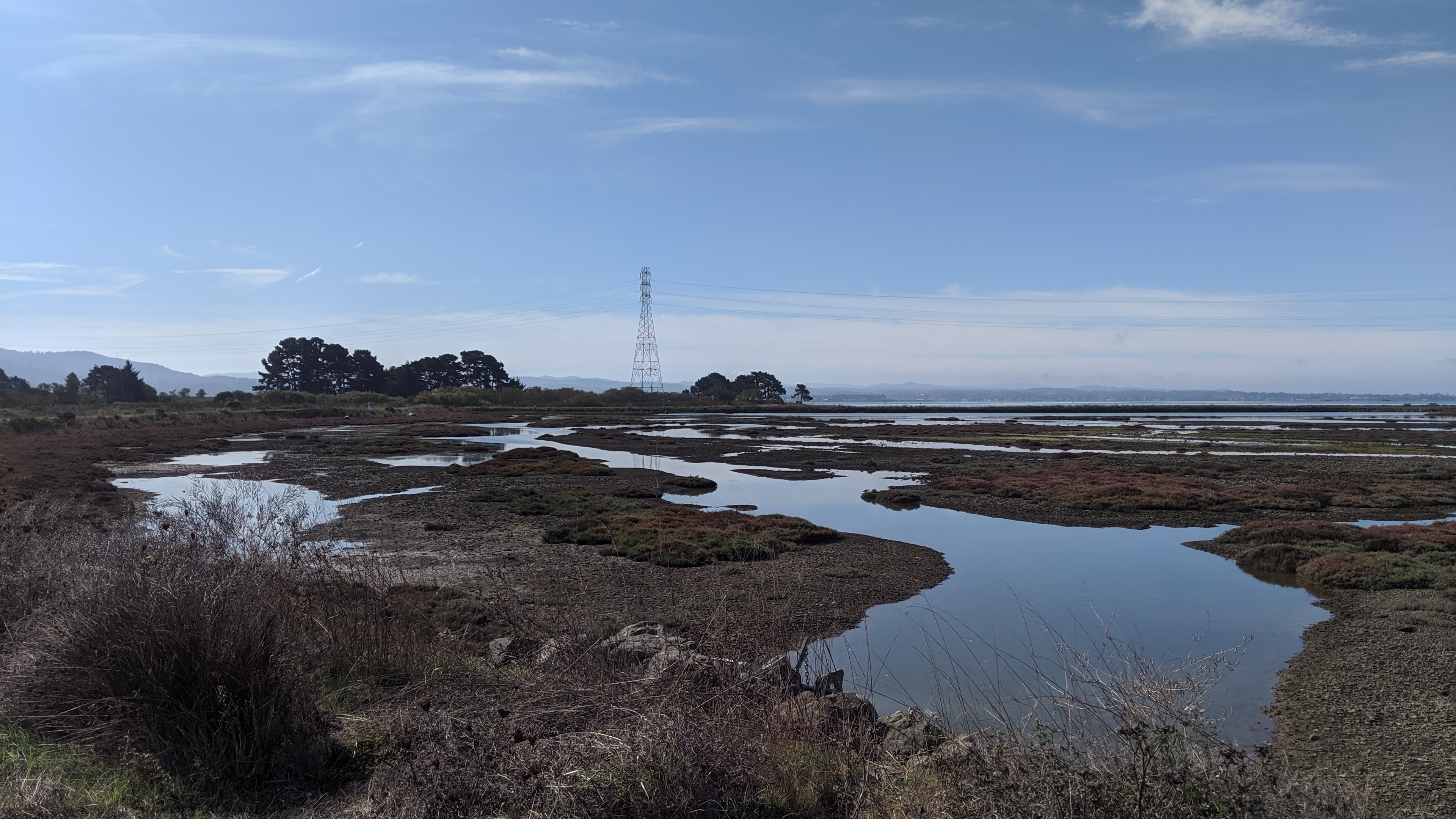
Welcome back to the #ExploreHumboldt column, your source for accessible natural areas to visit in your spare time. This week, we’ll look at a unique, double-duty location that serves as a wastewater treatment facility and a beautiful habitat for countless bird species: the Arcata Marsh!
This 307-acre sanctuary is located in southern Arcata, and can be accessed from South G and I streets. This places the marsh within a 15-minute walk or a five-minute bike ride from campus.
The Marsh’s interpretive center provides information on the wide variety of bird species that frequent the marsh, and how the marsh filters Arcata’s wastewater into clean water that can be released back into the bay. | Photo by Jett Williams
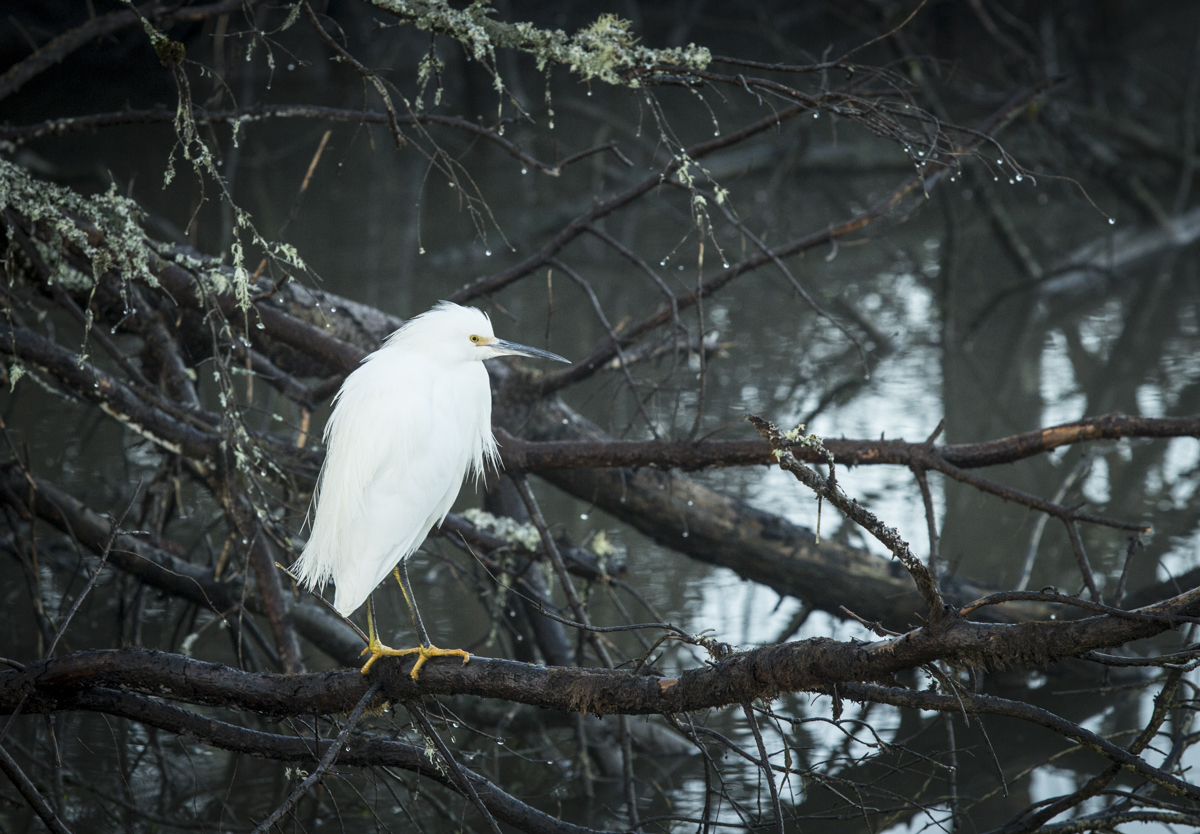
Any trip to the Marsh should start at the Interpretive Center. There, you’ll find installations detailing the many exotic bird species that stop at the marsh on their migratory journeys up and down the coast. So far, over 300 unique bird species have been spotted in the marsh this year. Some of these are extremely rare, or are typically found on the East Coast.
From the Interpretive Center, multiple trails spiderweb out to every corner of the park. In total, there are about 5.4 miles of mostly gravel trail, with some paved sections. Strategically-placed maps ensure that you won’t get lost and provide interesting information on the park’s science and history.
But, as with any natural area, the best way to get a lay of the land is to get lost. Around every corner is another table or bench overlooking a scenic view, or an enclosed shelter for birdwatchers to observe the local wildlife.
Organized nature walks are a good way to experience the marsh in a social environment, with experienced birdwatchers who can point out and identify rare bird species. | Photo by Jett Williams
If you want a recommended route to get started, begin at the Interpretive Center and head north along the west side of Butcher Slough Log Pond. Turn left and follow the trail as it winds around Brackish Pond.
This time of year, Brackish Pond is covered in a layer of green algae that gives it a surreal look and is a hotspot for birds. Stop at the bird viewing station on the northwest corner before heading south past Gearheart Marsh, and looping back to the Interpretive Center.
In addition to being a nearby natural spot to get out to for some nature time, the Arcata Marsh serves as a wastewater treatment plant. Algae and bacteria help to purify the water as it moves through the different ponds of the marsh.
One can spend hours wandering the marsh, checking out the different ponds and looking for exotic bird species. The marsh is expansive and rarely crowded, offering ample opportunities for seclusion. | Photo by Jett Williams
Eventually, the water is sterilized with chlorine and flows back into the Humboldt Bay. This system allows Arcata to manage its wastewater production while providing a refuge for local wildlife and a local park for residents to enjoy.
If you’d like to check out the Arcata Marsh with the help of experienced and knowledgable guides, there are several guided marsh walks available. Friends of the Arcata Marsh meets every Saturday at 2:00 p.m. at the Interpretive Center for a guided marsh walk.
For those looking to learn more about the many bird species that call the marsh a temporary home, the Redwood Region Audubon Society meets for guided birding walks every Saturday at 8:30 a.m. This walk meets at the I street parking lot.
The Arcata Marsh is an amazing free resource for students in need of a quiet oceanside spot to explore and relax in. Get it while you can, and don’t forget to #ExploreHumboldt!
Community members gather to watch the mesmerizing flights of shorebirds dancing on the wind at the Godwit Days Spring Migration Bird Festival.
The natural habitat of the North Coast includes the Pacific Flyway. The Pacific Flyway spans the Pacific Coast from South America to the Arctic, making Humboldt Bay a stopover for millions of shorebirds on their migration.
Mark Colwell is a Humboldt State ornithology professor. While watching the spring migration at the Arcata Marsh on Sunday, Colwell describes the multitude of bird populations.
“Western sandpipers are one of the most spectacular aspects of bird migration in the Pacific Flyway,” Colwell said. “There are over 100,000 western sandpipers going north every day. They will spend three to four days in Humboldt Bay and then fly on.”
The Godwit Days Spring Migration Bird Festival is a week-long event. Godwit Days has many ways to explore bird species, field trips, lectures, workshops and boat trips, led by expert local guides. The tours include rivers, bay mudflats, redwood forests and the rocky coast.
The Arcata Marsh is a great place to bird watch. The marsh is close to HSU and just a few minutes walk from downtown Arcata. There are hundreds of species of birds that visit and live in the marsh that can be seen from the trails that meander through it.
Samantha Bacon teaches Birding 101 for Godwit Days.
“The marsh is one of the premiere birding places in California,” Bacon said.
Bacon spends an hour in class with her group going over the descriptions, habitats and behavior of birds. Bacon pulls apart the bird families, characteristics and names so the group of beginning birders can learn them better.
Bacon also gave information on bird feeding.
“Hummingbird liquid is four parts water and one part sugar,” Bacon said. “Make sure to keep the hummingbird and other bird feeders clean. Birds can get conjunctivitis from bird feeders and go blind.”
Birding 101 then spends a few hours viewing and identifying birds in the Arcata Marsh. Part of the excitement of birding is identifying or confirming rare sightings of bird species that are not frequently found in this region.
A green heron local to the San Francisco Bay has taken up residence in a tree at the Arcata Marsh.
“The green herons have been coming to the Arcata Marsh for the last three to four years. There is between one to four green herons a year at the Arcata Marsh,” Bacon said.
Citizen science helps identify and maintain reviewed listings of bird sightings on eBird, an online collection of sightings, maps and bird migration routes.
After confirming quite a few bird sightings, the group ends at the Arcata Marsh parking lot. There are numerous tripods mounted with telescopes along the path by the parking lot where people are viewing the tens of thousands of shore birds lifting off, flying back and forth and landing back down on the bay.
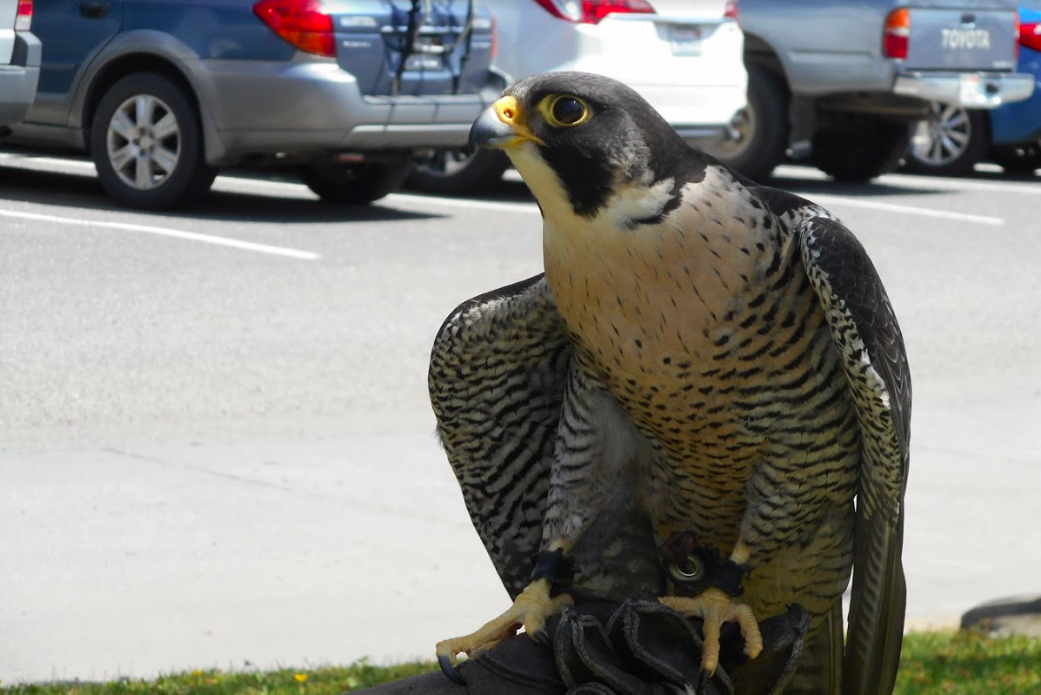
“This is called shuffling the deck,” Bacon said. “A peregrine falcon will fly down upon a flock of shorebirds and try to pick one off.”
Rob Fowler is a HSU alumnus and local editor for the quarterly ornithological journal North American Birds, and the eBird reviewer for the area.
While at the marsh parking lot viewing the shorebirds, Fowler refers to the scope of what is visible in the distance.
“This is a sight you don’t see often in nature — 200,000 shorebirds at once,” Fowler said.
The Godwit Days keynote speaker Sharon Stiteler is from Minnesota. Stiteler has seen 1 million snow geese at once while in Hardy, Nebraska.
“Shorebird-wise, this is exceptional,” Stiteler said.
The Arcata Community Center was “birding headquarters” for Godwit Days on Friday, Saturday and Sunday. At the community center, there were vendors, non-profit groups and government agencies. In addition, there were exhibits, workshops and live birds of prey on display.
Carson is a 16-year-old peregrine falcon. Carson was out in front of the community center with his handler, Amanda Harwood, a senior at Arcata High School. Carson is the fastest animal on Earth, reaching speeds up to 273 mph.
“Carson is named after Rachel Carson the conservationist,” Harwood said. “He was found in the Arcata marsh with a broken femur and taken into the Humboldt Wildlife Center.”
People were fascinated by Carson. Spike Ciotti attends Fuente Nueva Charter School in Arcata and thought Carson looked fast.
“I think Carson can build a nest in about a minute,” Spike said.
You can see the shorebird spring migration on Humboldt Bay from the Arcata Marsh until mid-May.
The Migratory Birds of the Americas Conservation Act was enacted by the Senate and House of Representatives on July 12, 2017. U.S. Senators Ben Cardin and Rob Portman introduced the bill as a reauthorization to The Neotropical Migratory Bird Conservation Act. The bill is intended to promote long-term conservation of Neotropical migratory birds and their habitats through a grants program, and so far, it is the only federal U.S grant program available throughout the Americas dedicated to the conservation of migratory birds.
This slideshow requires JavaScript.
Projects part of MBACA benefit most of the 386 bird species that breed in the continental United States or Canada and spend the winter in Mexico, Central America, the Caribbean, or South America. In addition, MBACA works to protect over 4.2 mill. acres of bird habitat, spanning across thirty six countries, according to The U.S. Fish and Wildlife Service.
The North Coast of California happens to be one of richest areas in the country in terms of avian diversity, between some 300 and 350 species of birds can be found from just offshore, all the way to the first inland ridge-line. Humboldt Bay in particular is a vital stop for birds migrating along the Pacific Flyway which is a route used by millions of birds for migration to wintering and breeding grounds. The Bay’s coastal mudflats support some of the highest densities of shorebirds in California, housing 60% of all migrating Black Brant, 23% of all migrating and overwintering Western Sandpiper, 44% of all migrating and overwintering Dublin, and 3.5% of all Long Billed Curlews, just to name a few, but there are several other species of birds protected under the act that migrate to and through Humboldt County.
Great Blue Heron with Mallard Ducks at Klopp Lake. Photo credit: Ian Thompson
The Humboldt Bay Wildlife Refuge, located within the Pacific Flyway, serves as a key migratory stopover and/or wintering area for several species of waterfowl and shorebirds. “The purpose of establishing the refuge was to provide habitat for those birds for their Wintering stopover.” said Kurt Roblek of the Humboldt Bay Wildlife Refuge. “Let’s say for example… Aleutian Cackling Goose, we provide Wintering grounds for that species…whose numbers were very low before the bird was listed.”
While he was not aware of Migratory Birds of the Americas Conservation Act itself, he says that-
“We do have projects that will have direct benefits to those species. Such as our White Slough Restoration Project, where we are creating salt marsh habitat along the edges of Humboldt Bay.”
How exactly are you creating these habitats?
“We are actually taking fill material and we are increasing the elevation behind the levees, so when the levees breach, that land will be high enough that it will be salt marsh.”
So what happens when it breaches?
“So once it’s breached… In a few years, through passive and active restoration of that habitat, we will create something that used to exist, but didnt… we’ll bring it back.” Says Robleck. “Pre-human, or pre-white man- In the past, there was salt marsh”
Looking out towards Arcata Bay at sunset from the marsh. Photo credit: Ian Thompson
*
George Ziminsky of the Arcata Marsh Interpretive Center, board member for the Friends of the Arcata Marsh, and graduate of HSU felt similarly about the necessity of our coastal habitats, stating that “Most migrating birds need mudflats for the invertebrates they eat.” Yet, a lot of the other habitats along the Pacific Flyway migratory birds rely on have been compromised, such as “Down in San Francisco Bay, places have been dyked and filled in so what was normally habitat for food for them, just had soil brought in and dumped on top of it.” He stated that over at the Arcata Marsh they are doing what they can to “create a more diverse habitat” and “restore what was taken away.” He also expressed that the city actually has been very involved in their efforts to restore the salt marshes.
“A Lot of the areas west of I Street was being used for agricultural land, 15 to 20 years ago, and the City of Arcata has removed part of the levee and took out the tide gate.”
As of now, The Arcata Marsh, includes around 307 acres of mixed habitat and serves as a solid foraging place for birds on their winter stopover. “The shorebird numbers are in the hundred of thousands in the winter” says Ziminsky
*
Jim Clark The Redwood Region Audubon Conservation Director and 4 time president, who graduated from HSU some 40 years ago, states that The MBACA is “the key conservation act that dictates everything from development to hunting,”
Yet when it comes to avian conservation, “A Lot of it is advocacy,” says Clark. “So we look at the act as backups to those principles. We largely are reactionary, we try to be proactive.” He feels that public awareness, “Going beyond just birdwatching, but understanding a need to protect migratory birds.” plays a vital role in habitat and species conservation. His hope is that one day people will see “that little yellowish’ bird with the black top, Wilson’s Warbler, actually migrates 1000’s of miles. I think that would be an outstanding thing if all the people saw it, better understood what it has to go through to have a life.”
“About 5 years ago we had seeds of varied thrush, and you wonder why this happens” says Clark
“If you don’t protect the birds, there won’t be any birders, because there won’t be any birds to watch, to put it bluntly.”
How can the public get involved in bird conservation?
“Be aware of what they can do on an individual basis for birds”
He recommends “putting reflective strips on windows so you don’t get bird strikes.” In addition, he advises that we also not leave garbage out on the street because it’s attracting crows and ravens, which have now become quite a nuisance. He says that “40 years ago when I was going to HSU I had to get in a car and go over the first ridge inland to see one or two ravens. And now their thick because they’ve learned that where humans live, there’s stuff to eat.”
In regards to what he has done to keep birds coming to his home, he says “in our yard we have planted red alders, it’s a native tree, and they get infected with little leaf hoppers which the warblers love to eat, sparrows love them too, they need them during nesting season.” In addition he states that he’s “planted native grass instead of the typical lawn.”
We can also do our part by “Carrying out invasive, non native plants, encouraging native plants that provide food for birds at the right time of the year.” On the same note, “rat ladders” as he calls them, in reference to Ivy in particular, he states, “let’s rats go up into the trees and eat birds eggs” says Clark “The rats love Ivy, they love Pampas grass, and they love Himalayan Blackberries. All 3 of those plants are non native invasive plants.” Yet the birds aren’t the only ones affected by the fuzzy creatures according to Clark, “When you consider rats it’s also a public health issue.”
What issues do you see having the greatest effect on the community now or in the near future?
“I think we’re going to be looking in the future to sea level rise and how that is going to affect the natural environment and how we’re going to live with that natural environment when we have to change our urban planning to accommodate that sea level rise, and it’s already happening.”
This website uses cookies to improve your experience. We'll assume you're ok with this, but you can opt-out if you wish. Cookie settingsACCEPT
Privacy & Cookies Policy
Privacy Overview
This website uses cookies to improve your experience while you navigate through the website. Out of these cookies, the cookies that are categorized as necessary are stored on your browser as they are essential for the working of basic functionalities of the website. We also use third-party cookies that help us analyze and understand how you use this website. These cookies will be stored in your browser only with your consent. You also have the option to opt-out of these cookies. But opting out of some of these cookies may have an effect on your browsing experience.
Necessary cookies are absolutely essential for the website to function properly. This category only includes cookies that ensures basic functionalities and security features of the website. These cookies do not store any personal information.
Any cookies that may not be particularly necessary for the website to function and is used specifically to collect user personal data via analytics, ads, other embedded contents are termed as non-necessary cookies. It is mandatory to procure user consent prior to running these cookies on your website.