The Lumberjack


Students Serving The Cal Poly Humboldt Campus and Community Since 1929

Tag: astronomy

  • Comet visible from Humboldt County

    by Alina Ferguson

    A comet is a ball of ice which burns up when it passes the sun. That burn-off is what is seen by the human eye. On February 1, the green comet known as ​​C/2022 E3 (ZTF) was at its closest and able to be seen by the naked eye, though it was 26 million miles from Earth. 


    Though it was visible in the Northern Hemisphere, the conditions in Humboldt were not optimal for viewing. Many may have had a hard time seeing this comet, referred to as C/2022, due to fog and pollution in the sky. For those who missed it on Feb. 1, it was still visible by telescope or binoculars Feb. 2. 

    Comets have an elliptical orbit. They spin close to the sun and then away from it, interacting with the gravity of other objects along the way. When they pass by the sun, they sometimes become visible from Earth. What we see is the comet releasing gasses.

    Comets are from the outer solar system and they spend most of their lives very far from the sun. Tyler Mitchell, a physics professor at Cal Poly Humboldt, refers to them as, “little time capsules of frozen ices and a variety of different types of dust, like carbon and silicates.” 

    C/2022 is a green comet. “The color comes from two carbon atoms stuck together,” said Mitchell. “The tails of most comets are yellow.”

    To Tanner B. Hooven, a student and member of the Cal Poly Humboldt Astronomy Club, C/2022 is a reminder of Earth’s past. We are the first people since the recording of time to see this comet.

    “This comet is special because of its orbital period, or the time it takes to make one full journey around the sun, is approximately 50,000 years according to Nasa’s Jet Propulsion Laboratory,” Hooven said. “The last time this comet approached its perigee was at a time in which Neanderthals were still roaming the earth.” 

    Comets are sometimes called “dirty ice balls”, though they should be referred to as an icy dirt ball, given their respective ratios. Comets can become asteroids, which are referred to as “dormant comets.” 

    When identifying comets, or asteroids, astronomers look for what is essentially a “photobomb” and streak that was not previously there, or a bright shining star that was not before visible, according to Mitchell. 

    This comet is currently on its way out of the inner solar system. It will take months for it to fade from our view. 

    “It is likely this comet will continue to orbit the sun for millions of years until the off-gassing process subsides due to a lack of ice left in the comet,” Hooven said.
  • Astrology versus Astronomy

    Astrology versus Astronomy

    Similar origin stories don’t change the fact that one tends to be taken more seriously

    Astrology is the study of how the planet’s movements affect our human sphere. Astronomy is the study of celestial objects and these objects are said to surround earth. Both of these fields originated from our ancestors’ observations of the skies.

    Astrology was first recorded in about 3000 B.C., by the Mesopotamian Babylonian people. They believed the stars and planets represented the heavens and used their observations of the sky to create the Zodiac. The Greeks continued these advancements by linking constellations to the planets. The ancient civilizations would use their observations to make decisions about their lives. The Indian civilization created what we use today for astrology predictions in about 1000 B.C.

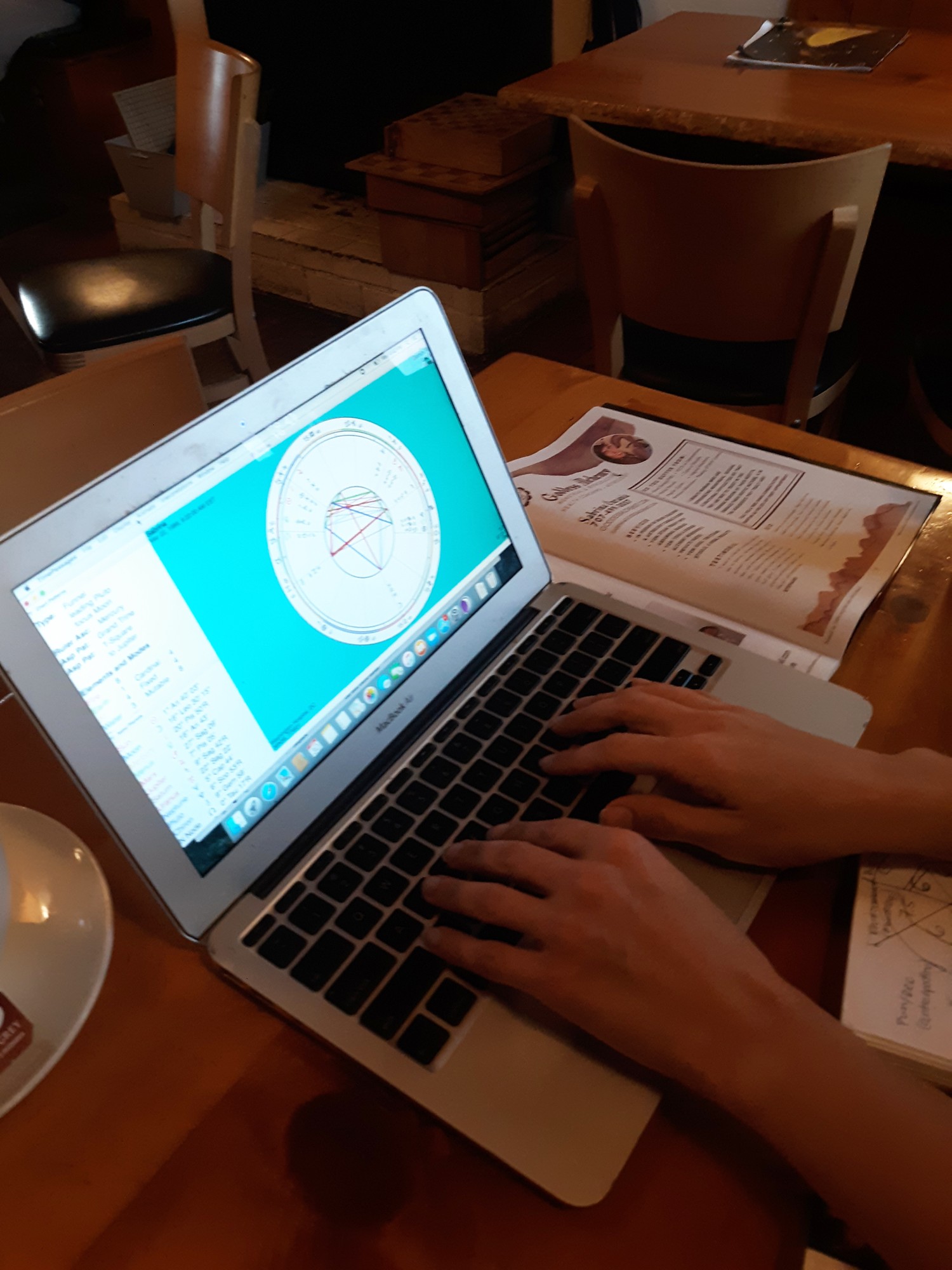
    Sabrina Ourania is an astrologer at the Arcata Healing Center and has been studying astrology for 10 years. Ourania described how people could have perceived the stars. She said that some people felt that astrology is the divine celestial realm where different gods live.

    “It’s predictable, the sun always rises, the moon is always up,” Ourania said. “It was such a contrast to what the experience was on earth, it brought a lot of awe and admiration and devotion.”

    20190130_164057.jpg
    Sabrina Ouriana, owner and astrologer at Godless Alchemist. | Photo by Maia Wood

    People are still just as interested in how our sky affects us on the inside. According to a Gallup Poll, 25 percent of Americans believe in astrology. The field is more popular now than ever. Though, science has debunked most of the predictions in astrology, people are more connected to these ideas.

    Humboldt State’s astronomy professor, Ryan Campbell said that people want to believe in astrology because it’s fun.

    “People want to believe in astrology because it’s comforting, we engage in motivated reasoning to reach conclusions that we want to reach,” Campbell said.

    20190129_144708.jpg
    Ryan Campell, Humboldt State University physics and astronomy professor. | Photo by Maia Wood

    With astrology being used as a way to experience the world around them, it makes sense that some of these traditions would still be used today. This said, the Greeks and Mesopotamians had very little understanding of modern day science. Why are these traditions still being used in our modern societies?

    For Ourania, astrology is more than science can explain.

    “I see it as a deeper lay of reality and has a lot do with our own psyche,” Ourania said. “We’ve taken the experiences of our psyche and have projected them onto these planetary bodies.”

    Humboldt State students Norma Warren and Trena Neel agree with professor Campbell. Astrology is not something to believe in but is just something fun.

    “I believe that astrology is something that people believe in, but I don’t treat it as good model about making predictions about the universe,” Campbell said.

    Astronomy and astrology were very closely related throughout history. According to Ourania, many of the great astronomers such as Kepler and Galileo were also astrologists. To fund their discoveries, they would make predictions for wealthy individuals.

    “Back then there were not universities offering grants for new discoveries. But was happening wealthy patrons or leaders were coming to know, should they go to war etc. Astronomers day jobs were astrologers, because that is what they were getting paid to do,” Ourinia said.

    This close tie to astronomy is what keeps astrology alive today. As we try to move forward in advancements in how we perceive the world, it makes it hard to let go of some traditions. As a science-based society, we can appreciate the past while still having a health perception of reality.

    “The history of astrology and astronomy are really tied and I appreciate the historical background that came out of astrology, but I think we have better models now,” Campbell said.