The Lumberjack


Students Serving The Cal Poly Humboldt Campus and Community Since 1929

Tag: Big Lagoon

  • Field Camp tests geology students’ knowledge and endurance

    Field Camp tests geology students’ knowledge and endurance

    by August Linton

    Field Camp for Cal Poly Humboldt’s geology majors is a month-long academic camping trip, and a foundational experience in the field that geologists remember with love. 

    Local field trips to places in Humboldt like Agate Beach and Big Lagoon are testing grounds for students used to dusty labs on campus. The university has a large library of rock samples, but students enjoy collecting their own. 

    “Agate Beach was a good one,” said Riley Clark, a CPH graduate and Field Camp returnee. “I’ve had structural geology trips there to look at faults and things like that, and sedimentary geology trips there to look at marine sediments.”

    Geology department classes teach both book knowledge and field techniques. One class called petrology, about the origin and microscopic structure of rocks, uses a technique called thin sectioning. With careful sanding, epoxy, and heat, students can make microns-thick samples of rock for microscope analysis. Field trips give students the opportunity to use these techniques at actual sites rather than in a lab.

    From May 29 to June 29, students from the program visited teaching sites in California’s Eastern Sierras for their capstone Field Camp, which is a more intense iteration of the geology field trip. Other geology programs also visit those same sites.

    “The first field site we went to we were alone, then at the next site there was Sac State, Montana State, a class from Wyoming, Northridge was there,” said graduated geology student Nay de la Torre. 

    Field Camp is analogous to a capstone project for geology students, a field-wide tradition that most programs participate in. It teaches students how to apply their knowledge, but also 

    Photo courtesy of Riley Clark | Roch Creek, an area that students were tasked with mapping near Bishop, California
    Photo courtesy of Riley Clark | Roch Creek, an area that students were tasked with mapping near Bishop, California

    The Poleta Formation is a common teaching location located in the Eastern Sierras, where different layers of sediment are exposed and can tell geologists about the geologic history of that place. 

    “It was deposited during the Cambrian…when California was covered in a shallow sea,” said de la Torre. “You could walk from LA to Las Vegas with water up to your knees.”

    This shallow sea still had tidal action, which geologists can tell based on those layers.

    “The tide would come in and come out, so during this time sandstone would be deposited, then when the tide went out the water would evaporate and deposit carbonate rocks like limestone,” de la Torre said.

    At a second location in the Inyo-White Mountains, students spent time studying igneous intrusions into the crust, called plutons. There are also several wide-reaching fault systems that span the area, which students were tasked with mapping. 

    “At one of our sites we saw a series of faults and then at another one we saw a series there,” said Clark. “It was neat to correlate those…we know that the same compression on the continent caused it.”

    De la Torre says this trip stretched the students to their limits mentally and physically.

    “Everything that you’ve learned, you use it at Field Camp, with every class since freshman year,” said de la Torre. “You don’t really have time to do much else other than go to the field, eat dinner, and go to sleep, cause you’re so tired every single day.”

    Weeks of complete isolation from everything other than a small group of colleagues, six to nine miles of hiking every day in baking sun, and living in tents for a month taxed the students, but also galvanized them. Their daily tasks, like surveying areas for map-making, mirror what they will be asked to do in their careers as geologists.

    “Field Camp feels like something that I’m going to remember for the rest of my life, because all the older geoscience people that I talk to still remember their Field Camp,” de la Torre said.
  • Coast Guard gears up

    Coast Guard gears up

    Humboldt Bay Coast Guard prepare for the worst at Big Lagoon

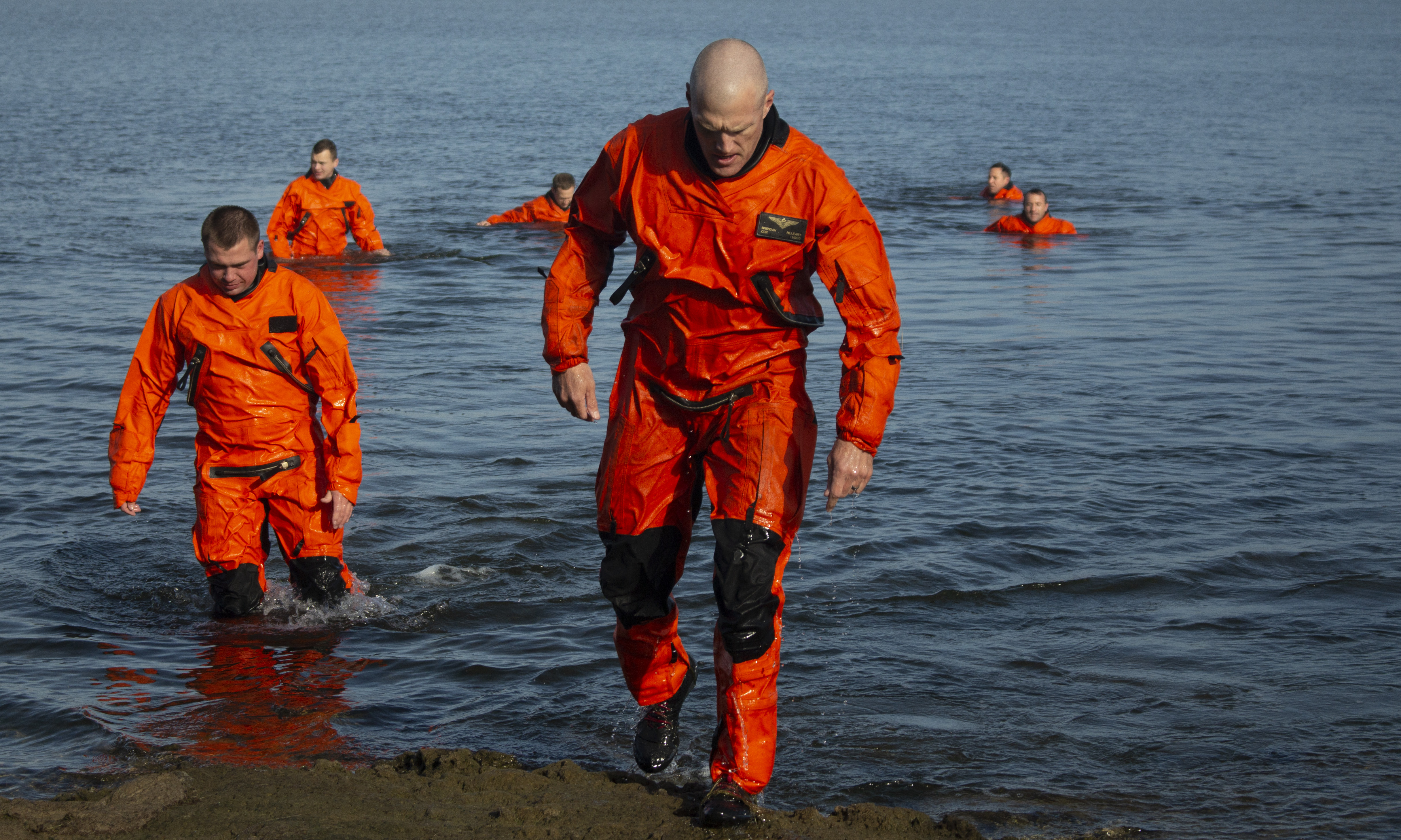
    Despite a barbecue filled with pulled pork and dogs begging for attention, a meeting was held at Big Lagoon Campgrounds in Trinidad with an ominous purpose. Though the setting was light-hearted, the crew donned orange and black suits, preparing for the worst case scenario.

    “The swimmer is basically dragging you through what seems like a monsoon or a mini-hurricane from the rotor wash coming off the helicopter,” said aviation mechanic Matt Lareau, age 28 from Springfield, Massachusetts, still wet after being hoisted up to the helicopter for the first time.

    More than 40 members of the Coast Guard aviation unit went to Big Lagoon on Oct. 11 to practice their annual “wet drills.” The drills involve four training scenarios built around surviving a helicopter crash. The training covered raft and swimming drills, pyrotechnic training with flairs, land survival and vest itemization drills.

    Chief rescue swimmer Chris Razoyk, age 40 from Haverhill, Massachusetts, said this training was a chance for the crew to come together and become well acquainted with procedures before they are in a stressful situation.

    “Today is a good opportunity for the flight mechanics, pilots, whatever, to get a feel for what it’s like to be under the helicopter,” Razoyk said. “And to feel what it’s like for us, for them, to be in a real situation.”

    DC.IMG_7864
    Matthew Lindblad sets off a smoke flare at one station of the annual Coast Guard aviation training Oct. 11 at Big Lagoon Campground in Trinidad. | Photo by Deven Chavannes

    The crew wore neon orange flight suits resembling space suits and waded out into the lagoon to learn how to stay afloat and wrangle each other into a raft of bad scenarios. They also wore bulky black vests to carry survival essentials that weigh 30 pounds on their own.

    Avionics electrical technician John Kummerer, age 28 from Columbus, Ohio, experienced his first round of wet drills.

    “It’s good to know what you have to do, in case god forbid you do go down,” Kummerer said.

    The land survival lecture covered the use of sticks and clothing to create makeshift splints in the event of a land crash involving injuries. Interesting tidbits, such as peeing onto cloth to make it stronger, as made famous in the movie Shanghai Noon, were dispensed to educate the trainees and to also keep the mood light, in opposition to heavy training.

    Kummerer found the lecture to be not only helpful in the event of catastrophe at work, but in day to day life here in Humboldt.

    “You’re hiking and you don’t have any of that gear on you and you realize that you can use sticks, rocks, whatever for tourniquets,” Kummerer said.

    Kummerer may have more use for this practical training now that he’s found a new passion here in Humboldt: disc golf.

    “I had never even heard of it until I moved here,” Kummerer said. “And now I love playing disc golf.”

    About a dozen pilots and technicians in the lagoon waited for their turn to be lifted up into a hovering helicopter and dropped back down again; a drill that simulated what rescue swimmers and victims experience during a real rescue operation. For some trainees, it was for their first time.

    DC.IMG_8098
    A helicopter hoists up the Humboldt Bay Coast Guard at the annual Coast Guard aviation training Oct. 11 at Big Lagoon Campground in Trinidad. | Photo by Deven Chavannes

    Lareau had his first experience being lifted out of the water during these drills. Lareau said he wasn’t scared of the experience at all.

    “The guy that was hoisting us up, I work with him every day,” Lareau said. “So I have really no doubt in my mind that everyone up there has our best interest in mind.”

    The crew in the Coast Guard have dangerous jobs, but they are a tight-knit group, which makes the job, and living in a secluded place like Humboldt County, a little easier.

    “Everybody makes sure that you don’t feel alone,” Lareau said. “We’re pretty close.”

    After the drills finished, the grill churned out burgers and pork sandwiches by high-ranking Coast Guard officers. The crew seemed relaxed and at home despite the high-pressure trainings they had just experienced.

    “It’s exhilarating,” Lareau said. “That’s why we took jobs like this in the Coast Guard.”