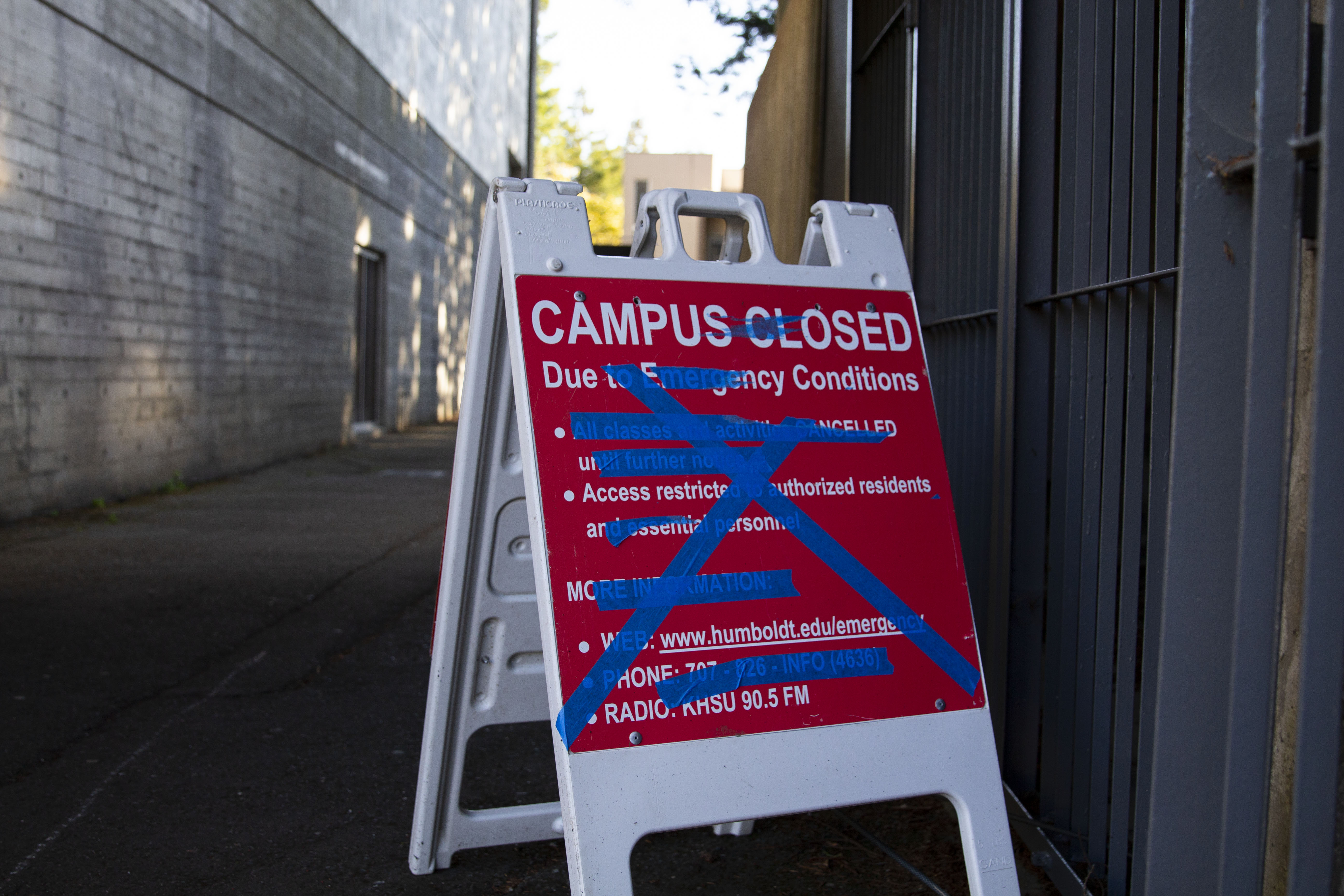
A letter from HSU’s vice president of Enrollment Management
A letter from Humboldt State University Vice President of Enrollment Management Jason Meriwether follows:
Wednesday, April 22, 2020
James Wilde, Editor & Reporter
Grace Caswell, Editor & Reporter
The Lumberjack Newspaper
Humboldt State UniversityDear James and Grace,
Please accept this letter (also enclosed) in response to the Lumberjack Article titled, Humboldt State Violated California Law by Requiring Registration for a Public Meeting, which was published on April 16, 2020.
While you were copied on a series of emails to me, and thus, on my responses, there are still a few important facts that I believe you will find useful in the wake of the April 16thstory. Since my email was the source of the quotes by me in the article, I never had an opportunity to answer a couple of fundamental questions as you prepared for your story. As such, I ask you to please consider the following:
The University did not violate California Law.When I received the original email, which copied numerous parties, Vice President Dawes and I took immediate action to verify that HSU was not in violation of the law. This included going into consultation with other university stakeholders, including legal counsel. This consultation reassured us that no violation of policy or law was taking place.
In particular, I urge you to please review the actual requirements of the Bagley-Keene Act. First, please review a guidance document provided by the State’s Attorney General which outlines the scope of Bagley-Keene. Most pertinent to this issue, the Bagley-Keene requirements at issue apply only to meetings of a statutorily defined “state body” (Section 11121) that do not apply to the informal meetings hosted by VP Dawes and me. As explained in Section 11121 and in the guide from the State’s Attorney General, the sessions that were hosted do not fall within the scope of Bagley-Keene, which, based on guidance from legal counsel, means this law does not apply and was not broken.
With respect to the Brown Act, which was also referred to in the series of emails and in your article, this statute applies to local government agencies and essentially stands as a counterpart to Bagley-Keene, so to speak. The California State University, in particular Humboldt State, is a state agency, which does not fall under the Brown Act. Because Humboldt State, as a part of the CSU, is not subject to the Brown Act, legal counsel has advised us that the law was not broken.
Why did we add a public link to the originally scheduled presentations?
We did so to eliminate any perceived barriers to participation. As quoted in the story from one of my emails, “the entire point of the meetings was to be transparent.”
While we were fully aware that we were compliant with the law and that no persons were being barred from the meeting, the very notion that we were trying to keep people out, even though it was false and based on an incorrect interpretation of the law, compelled us to add an extra way to view the meeting. In our perspective, if any person felt uncomfortable or interpreted the registration function as a barrier, then adding the extra link made sense. In total, over 300 members of the university, media, and local community attended both meetings, and not a single person was excluded. The zoom webinar function was not sought out as a barrier, but as the best way to allow so many people to receive the information at hand. Registration for this meeting was not like a conference presentation or an event with limited access or hidden behind a paid wall. Many instructors and students are using zoom for class and the majority, if not all, meetings and presentations are held over zoom. We sent the information out to the entire campus, it was posted on the public events website, and we did not deny access to anyone. Simply stated, because we could not have a meeting in the Great Hall or KBR, a zoom meeting appeared to be the best option to make sure that this important information was shared with the campus.
To be candid, the public webinars were not an attempt at secrecy. Any notion to the contrary is simply false. In our belief, these sessions were about being honest with the campus and sharing data that impacts everyone. Making the report and data available online and readily sharing it with the media, students, faculty, and all interested parties was also necessary. Personally, I can assure you that it would have been easier to not conduct public presentations about such a negative set of projections, but in fact, the public presentations were the right thing to do.
The first person to receive a copy of my report was a journalist from the Lumberjack who received the report even before my first public presentation to the University Senate. The Senate presentation was also via zoom and on the same day I met with the student journalist. This information has been presented to Associated Students, the University Senate, the University Planning and Resource Committee, and in two public meetings. The report has also been cited by the media and directly provided to reporters who requested it. These actions do not align with any intention to violate the law or fail in transparency.
In conclusion, I am committed to the voice of students through journalism, which I believe has been demonstrated during my first year at Humboldt State. That commitment will not change. To that end, my commitment to providing facts, information, and access to student journalists has also been demonstrated. Accordingly, I ask that you please review the information and facts above and please weigh against the information that was provided to you and the information that was published in the article.
Thank you for your consideration.
Sincerely Yours,
Dr. Jason L. Meriwether
Vice President of Enrollment Management
Humboldt State University
Ralph M. Brown Act
https://leginfo.legislature.ca.gov/faces/codes_displayText.xhtml?lawCode=GOV&division=2.&title=5.&part=1.&chapter=9.Bagley-Keene Act’s Section 11121 https://leginfo.legislature.ca.gov/faces/codes_displayText.xhtml?lawCode=GOV&division=3.&title=2.&part=1.&chapter=1.&article=9.
Attorney General’s Bagley-Keene Act Fact Sheet
https://oag.ca.gov/sites/all/files/agweb/pdfs/publications/bagleykeene2004_ada.pdf