by Andres Felix Romero and Emma Wilson
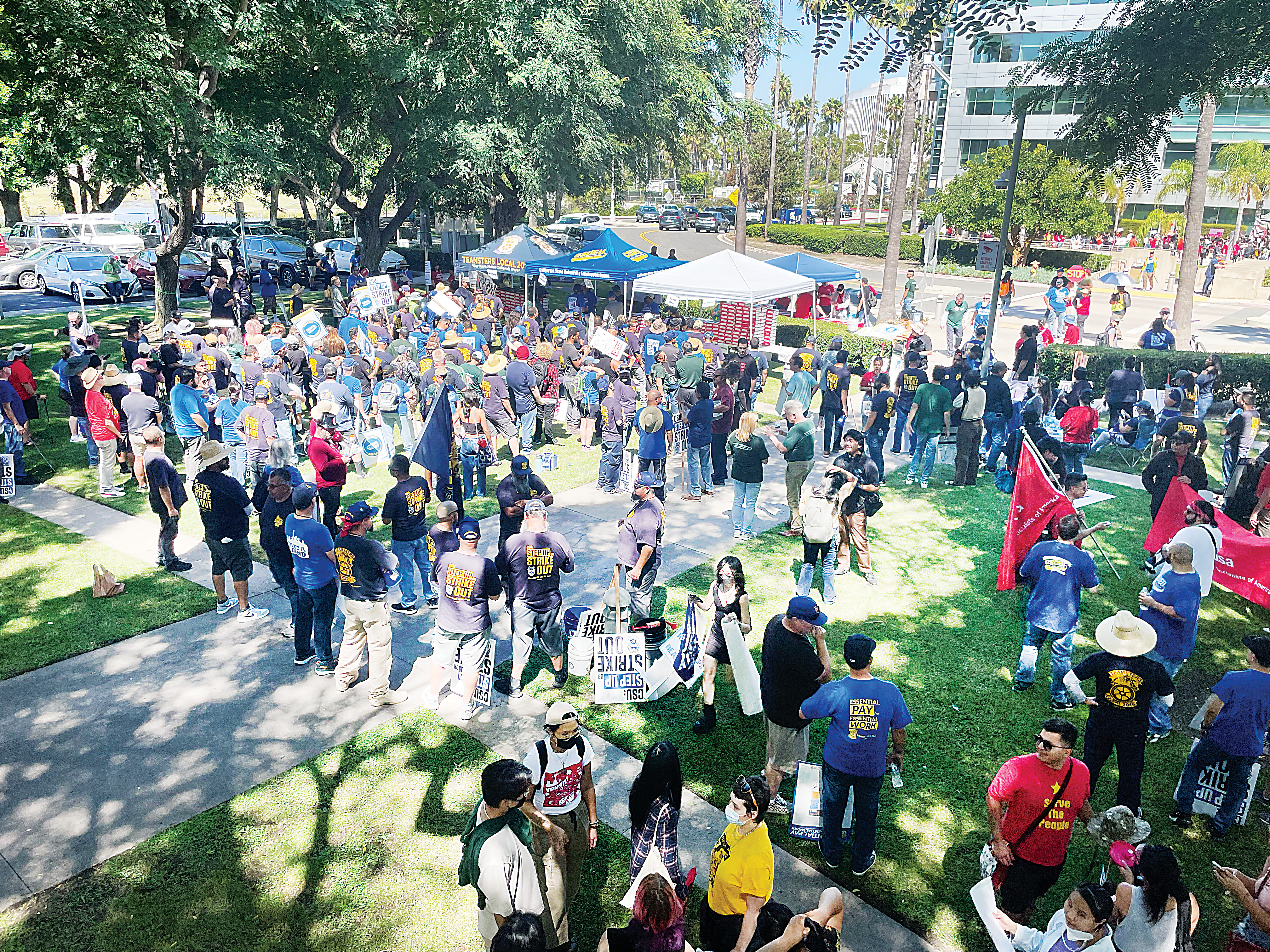
Hundreds of miles from Humboldt county in Long Beach, dozens of people are rallying against the decisions of the Chancellor’s and the Board of Trustees that hold the fate of our communities’ future outside of the headquarters of the California State University (CSU).
What the CFA is fighting for
The California Faculty Association (CFA) is one of six CSU Unions present across the 23 campuses. The CFA focuses their support on staff that work directly with students such as lecturers, coaches, and counselors.
The other unions are the CSU Employees Union (CSUEU) who support staff that provide essential services to students such as those in admin, the Union of American Physicians and Dentists, Teamsters Local 2010 that supports skilled trade workers such as painters and carpenters, the student union UAW 4123 and finally, the Academic Professionals of California (APC) which provides support to campus staff that work with students outside of the classroom such as financial aid and residence life.
Currently, the unions are collectively bargaining, and they are fighting for many of the same things. The CFA is campaigning on two main fronts, better wages and financial compensation, as well as better workloads and support to faculty
Wages
The CFA is asking for a 12% general salary increase. Cal Poly Pomona CFA member and associate professor of Political Science Marc Scarcelli reasons that although a 12% increase may seem like a lot, it’s essential to keep wages fair as the inflation rates increased 8% since the last bargaining session between the CFA and the CSU.
“If your wage increases don’t keep up with inflation, your wages are actually going down,” said Scarcelli, “and so if you think about it, we have to threaten the strike just to break even if we’re not actually fighting for more. We’re fighting just to break even. We [got a 3% pay raise] at a time when inflation was over 8%. What we got is effectively a pay cut.”
The CFA is also hoping to raise the salary floor for lecturers. Chief Steward of the Humboldt APC Chapter Tania Marin-Zeldin feels that this proposal is needed to help faculty with their standard of living.
“To hear that some of our members have two jobs because they can’t afford to have a decent living and provide for their families, that’s the sad part,” Said Marin-Zeldin. “We shouldn’t have to have two jobs. We shouldn’t have to be barely living, paycheck to paycheck.”
Freshman Evaluator and Union Representative of the APC Sierra Farmer hopes that having more competitive wages could help with retention of workers within the CSU system. She explains that because of what feels like unfair wages, many CSU workers, including alumni, leave because they can’t live comfortably with the wages provided.
“We lose good employees in the Cal State system,” Said Farmer. “We have lower wages than the UC’s and the community colleges. So we lose really good people to the other systems all the time because they don’t make a living wage.”
Another financial goal to increase fair wages and combat inflation resulting in pay cuts, is the unions fighting for yearly step-raises within the CSU system.
Better support for staff and faculty
To also help with retention rates for faculty and staff, especially counselors, Professor and CFA President of the Humboldt Chapter Marisol Ruiz notes that better policies surrounding tenure and more long-term contracts can help with the feeling of stability for employees.
“We want [counselors] to get three year contracts,” said Ruiz. “When you’re in a [year-long contract], you’re in a precarious situation. You don’t know if you’re getting your job back or not, so people sometimes don’t want to stay. We’ve had a hard time getting good counselors to stay. We need to offer them better [contracts], where they will be more likely to stay due to better conditions.”
On top of contracts, the unions want there to be more fair workloads for faculty, as well as better ratios between students and faculty. Ruiz remarks on the importance of a healthy ratio between students and faculty.
“We want to give [students] more attention,” said Ruiz. “We want to lower class sizes, and focus on [student’s work]. But the [CSU] just wants to cram everybody in. The more care that we have for our students, the better they will do in their classes and the more effective they will be as [learners] and we want that. ”
Beyond workloads and wages, the unions are also wanting to ensure more gender equity on campuses by providing bathrooms and changing facilities that people can feel safe with no matter their gender. They also want better paid parental leave and more lactation stations for parents across campuses.
Process of Union Bargaining and Current State of Negotiations
Every few years, each of the unions on the CSU campuses reopen their contracts with the CSU to bargain. This year’s cycle is unique as it was delayed due to COVID, and instead of bargaining in a staggered way, every union is negotiating their contracts at once. As of the writing of this article, every union aside from the CFA is still at the bargaining table. The CFA has declared an impasse with the CSU since they did not come anywhere close to an agreement, and has moved onto the fact-finding stage. Faculty Rights Chair for the CFA Humboldt Chapter and Lecturer in the Philosophy Department Loren Cannon explains the process
“Fact finding is where [the CFA] and [the CSU] produce information and argumentation as to why our proposals are good. [The CSU] will probably try to produce information that says, ‘Oh, we just can’t afford it.’ [The CFA] will produce information that says, ‘well, actually, you can.’ We could go back to bargaining somewhere in the middle here, but if we don’t have any agreement at that point, there might be collective action.”
If the mediation following the fact finding stage again fails, the union can then vote on to take action, such as a strike. If the CFA does decide to strike, it will likely be in early November as of the time of writing this article. Scarcelli notes that a few within the CFA are looking forward to a chance to strike.
“In terms of willingness to strike, I talked to a lot of my colleagues and honestly, they’re not just willing, they’re eager,” said Scarcelli. “Colleagues all over the place are chomping at the bit like, ‘when do we get to strike,’ because they’re pissed. They’re just furious. You know, when our incomes are effectively going down. And then we keep seeing that they give appalling raises to university presidents and the Chancellor.”
CSU Response
In a video message and written statement from interim Chancellor Jolene Koester, she affirmed that the CSU is committed to fair pay and compensation for faculty and staff. The CSU has proposed a salary step structure for faculty and staff in the CSU’s to reach 12% over three years, however the increase will be 5% in the first year. The CFA has rejected this and declared impasse following the offer. The CSU leadership say they will be challenged to meet the proposals of the CFA and other unions throughout the CSU.

Why Faculty are Fighting
With the CSU rejecting some of the union’s requests, many within the union are becoming more frustrated, especially with the wages that the CSU higher-ups and presidents are making. Ruiz notes that on average, after the average CSU president’s salary and allowances for their car and housing, they generate more income than the governor of California.
“I do not think it is acceptable for us to have a housing allowance for anybody who’s making $300,000. it’s not right, when our students are homeless and are living in cars, and we don’t even pay a living wage to lecturers,” said Ruiz. “ How [is the CSU] getting all this money for car allowances? How are you getting a housing allowance? How are [CSU presidents] being provided for? And our students are not? Your job is not as important as the governor of California, let’s put back the money where it needs to go.”
Farmer also notes that her yearly wage barely compares to Humboldt President Jacskon’s yearly housing allowance
Overall, the unions and their members such as Scarcelli are working towards better compensation and working environments to continue supporting students in their journey of creating a better future for themselves.
“We do what we do because we love education,” said Scarcelli. “We love our students. It would pain me to skip classes, but I will, and I find most students are very receptive to our cause.”