by Andrés Felix Romero and Emma Wilson
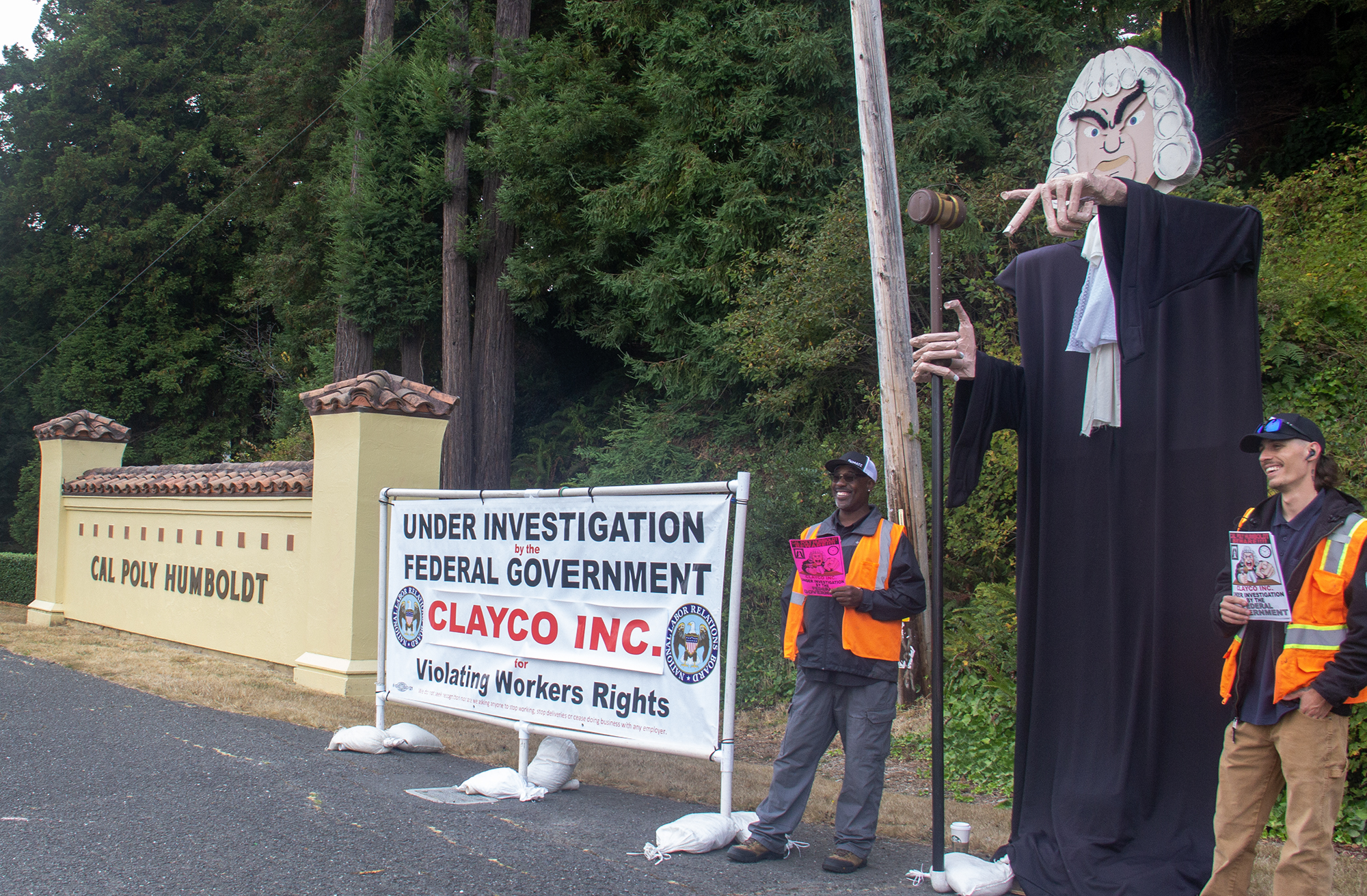
A giant stood on LK Wood. It was twice the height of the men around it, armed with a massive hammer and a demonic scowl. It pointed with a long, curled finger at every soul underneath its gaze, framed by a wooden wig and caterpillar eyebrows. It was a judge, and judge it did.

“Judgment day is coming,” it said. “Shame on you. Shame, shame, shame!”
No ogre was laying waste to Arcata. It was built as a protest by Local Carpenter’s Union 751 against Clayco, one the companies in the running to bid on the Cal Poly Health, Housing and Dining Infrastructure project, also referred to as #PLY106. The Union and their main goal is to bring the company’s legal issues and history of malpractice to the attention of the campus committee that awards infrastructure projects, and to the community in general.
THE CONSTRUCTION PROJECT
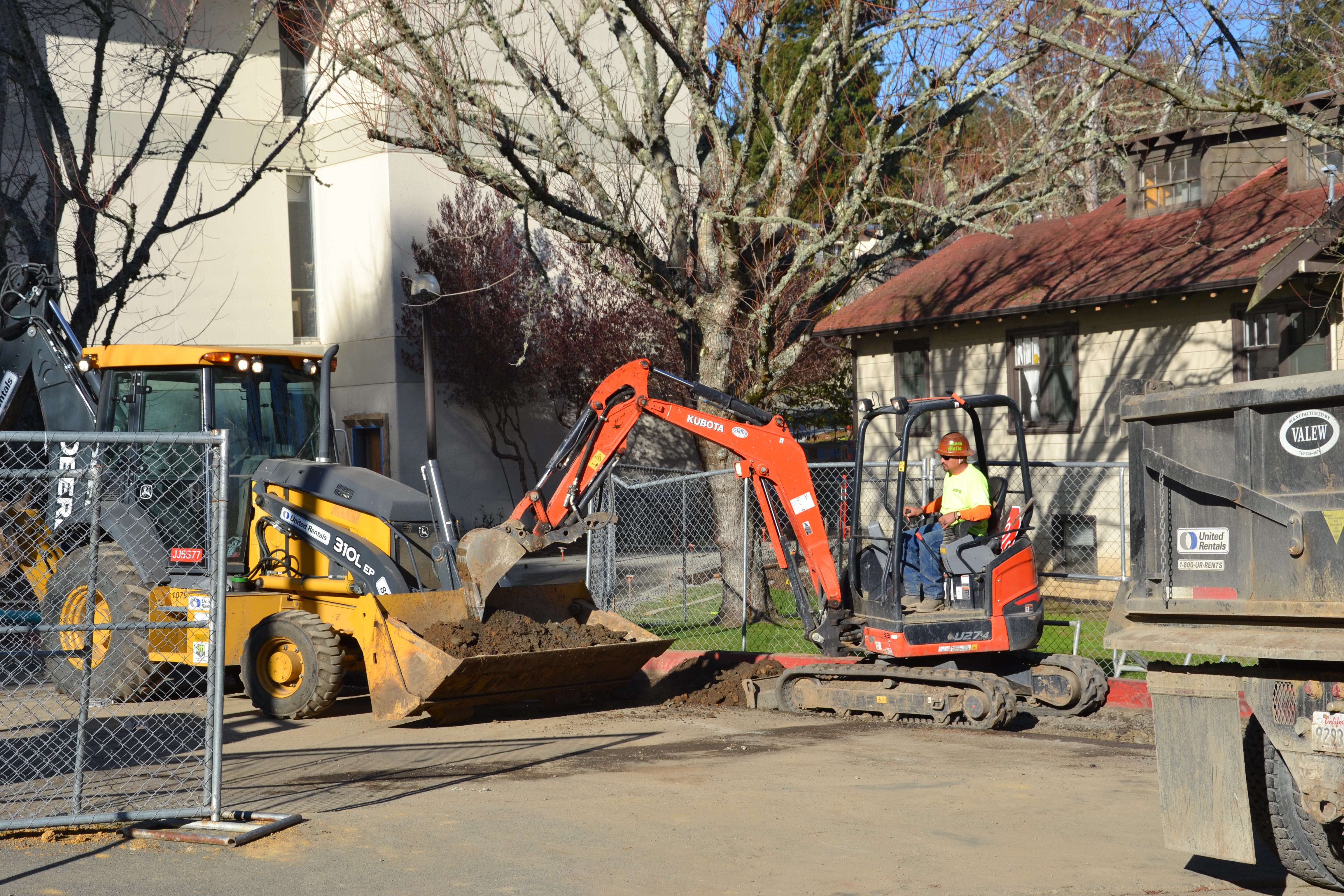
Construction on the Housing, Health, and Dining building is set to begin fall 2024. The new facilities include a new health center and dining hall, and will be able to house roughly 450-500 students. The facilities are planned to be operating by August 2026, or summer 2027 at the latest. The direct construction will cost at least $108.9 million and the guaranteed maximum budget is $131.9 million. The winning contractor will be announced in October of this year.
MALPRACTICE AND WORKING CONDITIONS
In a legally fact-checked letter from Union Local 751 to the CSU Board of Trustees, there is a list that cites Clayco’s history of legal issues due to allegations of malpractice. Clayco has been a defendant in at least 22 cases since March 2000. Since 2010, they have had at least 17 OSHA violations brought against them, resulting in fines around $81,336. Clayco’s legal issues include an active investigation by the Federal government concerning allegations of violating worker’s rights and harassment of union members, a pending case concerning allegations of wage theft, and a wrongful death lawsuit concerning a worker’s death that was settled last year.

In August 2017, Kirk Smith, an employee of the subcontractor Watson Companies Inc., fell 35 feet to his death while working on the construction of an Ulta Beauty warehouse in Fresno CA. The fall was a result of a weakened roof not being fixed for employees to safely work on, as well as a lack of warnings concerning the stability of the roof. Smith left behind a wife and children, who then sued Clayco along with Ulta and Watson for wrongful death in April 2018. Clayco, along with the other defendants in the case, eventually settled with the Smith family for $5 million in 2022. Attorney Brett D. Beyler, representing Smith’s family, wrote in the court settlement document that the incident was entirely avoidable.
“On August 9, 2017, Kirk Smith (the decedent) arrived at the Project,” Beyler wrote in the settlement document. “He was directed by Watson [Companies Inc.] foreman, Mr. Rabideau, to cut out the membrane and insulation on top of the metal decking. As Mr. Smith was cutting the membrane and insulation out with a hand knife, the weakened metal decking gave way like a trap door, causing Mr. Smith to fall nearly 40 feet to his death. This incident was entirely avoidable. Unfortunately, due to the negligence of Clayco and NDBS [National Design Build Services], Mr. Smith is no longer alive.”
WAGE THEFT

Clayco is currently in an active case regarding wage theft. These allegations are brought forth by labor rights organization, The Workforce Defence League (WDL), representing laborers who worked on Amazon Fulfillment Centers in Sacramento and Tracy who say that they have not been compensated for their overtime work or use of their own tools in the construction project.
According to the WDL, the laborers worked 58 hours a week and were promised $20-24 an hour. They weren’t fully paid for their regular or overtime hours, and they didn’t receive their work breaks and only got one meal break. They also didn’t get compensated for the missed breaks.
HARASSMENT OF UNION REPRESENTATIVES

Clayco is also under current investigation by the federal government for allegations of violating workers’ rights as well as harassment of union representatives. Two separate documented charges brought against Clayco by the National Labor Relations Board were filed as recently as November 2021. They claim that the contractor unfairly fired a subcontractor from their position, and attempted to prevent the Carpenter’s Union from conducting their activities by barring them from Clayco properties and instructing Clayco employees to limit contact with Union representatives. Additionally, videos on the Local 751-run website, Claycofails.com, show alleged harassment of Union organizers. One instance alleges that a Clayco foreman followed and videotaped an organizer.
“[Clayco] interfered with the exercise of protected rights by firing a Union signatory subcontractor when Union Agents tried to access the site,” one document read.
“[Clayco] interfered with the exercise of protected rights by calling the police when the Union tried to access the job site, surveilled and videotaped Union agents and ordered workers not to talk to the Union,” according to the other document.
CLAYCO’S RESPONSE
In an email, Clayco’s Vice President of Marketing and Communications Sarah Green forwarded a statement from Clayco’s legal team. The statement said that Clayco is the target of a campaign of Union harassment. The statement made the case that the Union has no legal right to access any Clayco properties and that the Union’s ultimate goal is to get Clayco to sign a collective bargaining agreement with them.
“Since 2021, [Union members] have filed 11 unfair labor practice charges against Clayco with the National Labor Relations Board (NLRB),” according to the email. “8 out of these 11 charges have either been withdrawn or dismissed, and the remaining three charges will go to hearing in October [2023]. Nor does the [Union] report that the NLRB matters arise from the [Union] and/or its members attempting to forcibly enter two Clayco California projects despite having no legal bona fide right to enter those projects – resulting in them having to be removed by police.”
Labor Counsel for Clayco, Andrew Martone, adds that no one affiliated with Clayco has brought charges against the company through the National Labor Relations Board, and that any Federal investigation against Clayco is a result of Union actions only.
“No Clayco employee and no employee at any Clayco worksite has filed a complaint with the NLRB,” said Martone. “Charges brought are by the [Union], and they don’t represent any Clayco employee.”

Green also stated that the Union has been misleading in their campaign.
“The [Union] misleads the reader to believe OSHA citations were issued against Clayco that were in fact issued to other entities,” said Green, “and reports OSHA Citations without informing the reader that OSHA found no violations existed.”
However, Lumberjack reporters were able to find OSHA violation documents concerning the death of Kirk Smith. Clayco shared a court statute with Lumberjack writers that documented tactics by the Union. However, the statute was labeled as “amended, repealed, superseded, or held unconstitutional in whole or part” by Westlaw, a legal research company. Unfortunately, since Lumberjack writers were unable to gain further access to Westlaw files, we are unable to say why it was labeled as such.
UNIVERSITY INVOLVEMENT
Lumberjack writers reached out to Procurement Specialist, Addie Dunaway of Contracts and Procurement department of Cal Poly Humboldt, as well as Humboldt Director Planning, Design & Construction, Kassidy Banducci of the Facilities Management Department. Both expressed a desire to comment, but were limited in their ability to speak as the bidding process is still active. Any comment on Clayco’s involvement from Cal Poly Humboldt staff and admin could violate legal obligations, as well as compromising fairness to the other three potential contractors.
University documents confims that Clayco, Sundt, and Swinerton are three companies on the shortlist for the #PLY106 contract. A fourth potential bidder is currently unconfirmed. The Union has also sent a letter to the Board of Trustees concerning Sundt’s history of malpractice.
Communications Specialist with the News and Information department, Grant Scott-Goforth, shared some information on the infrastructure project, though he was unable to comment on any allegations brought against potential contractors.
“The Committee remains diligent in their work towards a fair and equitable evaluation process governed under the provisions of the law in the state of California,” according to a statement released by the University. “Cal Poly Humboldt is committed to its responsibility under California regulations for public work projects and the better good of the construction industry. Any information regarding the performance or behaviors of proposing firms will be considered against CSU policies and State regulations.”
UNION AWARENESS
Union Organizers from Local 751 spread awareness to the campus community about where their money may be going—especially the funds that students give to the school as part of their tuition.
“How has a contractor with this history got this close to a major project?” said Harvey McKeon, a field representative for the Union. “Which, at the end of the day, is [funded by] public money, and it’s also by extension student’s money, and [the students] should have some sort of control and say over how that money is spent.”
The organizers from Local 751 want to make it clear that although they are a union, their endgame isn’t to try and have a union-backed construction company be awarded the contract. Rather, they want to ensure that a company with multiple legal issues and allegations of malpractice isn’t able to gain a foothold in the community and public works projects, and to try and create a better and safer working environment for all laborers.
“As a union, our recent track record has been to lift standards for workers whether they’re union or non-union,” McKeon said. “The reason why we are seeking to generate awareness about Clayco is because we want to draw attention to what Clayco does to workers that we don’t formally represent, but we care about their working conditions.”
Beyond a desire to bring Clayco’s past and current legal issues to light and try to create safer environments for workers, some organizers such as McKeon feel a personal responsibility to ensure a safe working environment for both contractors and the community at large due to their personal experience as a worker without union support. The union also wants those at Cal Poly Humboldt that awards infrastructure projects like #PLY106 and potential contractors that there must be precedence for companies rooted in ethics.
“I’ve been in jobs before I was a labor union organizer where I didn’t have anyone looking out for me because I wasn’t in a union, and I don’t think that’s a reason why you shouldn’t have people not look out for you,” McKeon said. “We’re trying to represent [all laborers] even if they’re not currently union members. It’s like trying to plant a tree whose shade you may never sit in.”
Editing note:
On Sept. 6, this article was edited to clarify that Clayco’s Vice President of Marketing and Communications Sarah Green shared Clayco’s statement from legal team with a reporter via email. The statement made the case that Clayco is the target of a campaign of Union harassment and that the Union has no legal right to access any Clayco properties and that the Union’s ultimate goal is to get Clayco to sign a collective bargaining agreement with them.
The article was also edited to remove reference to a contractor who’s bid on the project could not be confirmed.