The Lumberjack


Students Serving The Cal Poly Humboldt Campus and Community Since 1929

Tag: CAPS

  • Queer students are afraid to use TimelyMD counseling option

    by August Linton and Camille Delany

    Originally printed April 26, 2023

    Art Wardynski has lost almost all of his adult family members in the past few years, most recently his mother. He reached out to Counseling and Psychological Services (CAPS) for support, and was only offered a telehealth appointment with TimelyMD. 

    This wasn’t acceptable to him. As a queer person, Wardynski wasn’t comfortable with the fact that TimelyMD is a Texas-based company, or that they offer faith-based therapy as an option for universities. 

    “When I’m already going through such a vulnerable time in my life, I don’t want to risk being discriminated against,” Wardynski said. “They told me that my only option was to go through TimelyCare, and that is not an option for me.”

    After the death of his mother, on whose insurance he was dependent, Wardynski wasn’t sure if he had the ability to access off-campus healthcare, either. In the meantime, he’s just been trying to finish the school year.

    “I feel like I’m just chipping away at energy that I don’t even have,” Wardynski said.

    He isn’t alone in his concerns. Many queer students have voiced fears about the safety of the service, according to Landon White, Outreach Director for CPH’s Eric Rofes Multicultural Queer Resource Center (ERC).

    TimelyMD is an online mental health company which markets itself to universities as a stopgap and after-hours counseling service. CPH has contracted with the company, it says to provide students with after-hours healthcare.

    TimelyMD’s location in Texas, a state that is currently considering over 50 bills which limit the rights of transgender people, is one of the main issues that White has with Humboldt’s use of it.

    Other than the objection to university dollars going into Texas, the likelihood of being paired with a non Queer-affirming therapist is too high for many students’ comfort. Even in the relative haven of trans rights that is California, many therapists are transphobic, according to trans students. 

    “There are other telehealth organizations out there,” White said. “We need accessible mental health services that don’t come at the cost of forcing Queer and BIPOC students to play roulette.”

    The ERC advocates for the university to employ more CAPS counselors, especially those familiar with Queer and BIPOC issues. That would take competitive pay, job security, and outreach, said White. They also point out that the accessibility of telehealth is definitely a good thing, but don’t think that TimelyCare is a good option. 

    The use of online therapy services as replacement for in-person treatment by CAPS forces students into a situation that many are not comfortable with, should they need mental healthcare. 

    An open letter to the Associated Students, signed by campus groups including the Students for Quality Education (SQE), Queer Student Union, Black Student Union, and clubs such as the Mycology Club and Critical Race, Gender, and Sexuality (CRGS) Club, took a direct stance against TimelyMD. They asked AS to support the campaign against the service, something the body has not yet done.

    Student Allison Miranda also feels uncomfortable going to TimelyCare for mental health support due to her and her family’s Queer identities.

    “I need support. My tuition is paying for Timely,” Miranda said. “But I know that… LGBT+ students haven’t felt supported by them.”

    Miranda is a transfer student from College of the Redwoods, and said that she feels comparatively unsupported at Humboldt.

    “They [CR] had three different people, licensed therapists, who were trained in addiction counseling and all this stuff,” Miranda said. “Coming to HSU I expected an equivalent, if not better, experience. [Not having therapy] has impacted my studies.”

  • COVID-19 defines society’s future mental health

    COVID-19 defines society’s future mental health

    Though it’s still far from over, the effects of the COVID-19 pandemic could last a lifetime.

    All CSU campuses offer mental health services with a range of options available, included in the cost of student fees. Operations Coordinator and Staff Psychologist for HSU’s Counseling And Psychological Services program Dr. Elizabeth A. McCallion said their services are especially valuable now that students are facing additional stressors brought upon by the pandemic. Though in-person services are currently unavailable, CAPS is operating at full capacity, offering all of the regular services, virtually.

    “Students come to counseling at CAPS for a range of reasons and I think it’s really important to recognize that,” McCallion said. “We are not just a support for students who are in a crisis situation, though we do provide that support as well.”

    For students curious about the practice or grappling with issues of any size, CAPS provides an opportunity to uncover the answers to some of your questions. For those who decide it’s not for them, McCallion especially recommends placing emphasis on the prioritization of our emotional health.

    “Getting good sleep, nutrition and physical exercise have been shown to have really positive benefits on our mental health,” McCallion said. “So, I think looking at our health behavior and our lifestyle choices can be really key to making sure that we’re taking care of our emotional health.”

    Professor of Psychology Gregg Gold believes the effects of isolation will remain, to some capacity, with those who live through the pandemic.

    “There will probably be some permanent mental health issues for those of us who spent a year and a half alone,” Gold said. “I don’t think you could say that’s not going to have some kind of effect on people.”

    Gold said the pandemic lifestyle has generated more loneliness and frustration in his life as he battles with motivation and concentration droughts. The monotony of quarantine is largely to blame, Gold said, giving us nothing to look forward to with each day being the same as the last. The most significant factor influencing this is the deprivation of genuine, in-person human interaction.

    “It’s a basic human need to be around other people, face to face,” Gold said. “We’ve evolved to crave the company of other humans because the more friends we have, the bigger our network, the more we can ask others to do things we can’t do for ourselves, the more likely we were in the very recent past to be able to survive and even today, [we’re] much more likely to be successful.”

    Our time in isolation is not only damaging to our present well-being, according to Gold. Each day we spend contained inside the walls of our homes, interacting only with a familiar few and the algorithms of our social media accounts, we are being deprived of opportunities to explore new ideas.

    “When you’re out in the real world, you actually run into people that might think differently than you do,” Gold said. “That tends to broaden your view.”

    Though some are willing to place their own lives and those of others in immediate danger in order to go about life as usual, the majority of people are less inclined to make the sacrifice.

    “If you can’t [socialize] safely it means there’s underlying tension and fear and that takes the fun out of it,” Gold said. “It’s like trying to go out and party the night before you have a major midterm, how much fun are you really gonna have?”

    While millions of people lost their homes, their loved ones, and their lives to COVID-19, it can put those who’ve been more fortunate in a position where they don’t feel comfortable feeling sorry for the lesser losses they’ve suffered in their own lives, Gold said. The reality, however, is that the individual struggles we face now will be significant in our entire lives.

    “It’s easier for people to become depressed,” Gold said. “If you think about it, [depression] is the reaction you would expect, given the circumstances.”

    The increase in depression among American citizens is evident by the increased rates of substance abuse and suicide since the pandemic began, Gold pointed out. These reactions also come from severe anxiety surrounding financial and health insecurity. According to Gold, the two are one in the same in this country, where our physical and mental well-being are treated as commodities.

    Masters Student and Associate Professor of Sociology Travis Cunha began work on his thesis around the same time COVID-19 reached the United States and explored how different countries initially navigated the pandemic, specifically in regards to business practices. Given the high volume of jobs that have moved online and are planned to remain there, Cunha is concerned for smaller communities that rely upon only a few providers for a high volume of jobs, as he expects more outsourcing of labor than ever when the pandemic has finally passed.

    Cunha is curious to see what will come of all the vacant buildings left over from businesses that were forced to leave. He fears outside sources will capitalize on the opportunities and feed off the people who are in need of relief. This is especially a problem in low-income communities of color.

    “It was already like that even before the pandemic. These communities aren’t getting the resources other communities are,” Cunha said. “Since the pandemic, those things have just been made a lot worse.”

    According to Cunha, the most shameless offenders are the loan companies by allowing opportunities for business owners to remain open, for families to keep their homes and for students to pursue their educations. With a contract guaranteeing significant profits, loan companies have nothing to lose and everything to gain.

    “It’s not a coincidence that they’re opening places where communities have been hit the hardest,” Cunha said. “These communities need loans and grants and stuff to recover from this pandemic because they got no help during the pandemic, so I think it could be a recipe for disaster in that sense.”

    Unlike the psychological trauma that will follow us out of the pandemic, the financial burden that will plague the post-pandemic society is entirely avoidable if we were to come together in solidarity, recognize the problem and create a solution.

    “I would hope that after this is over, people wouldn’t dismiss the views of scientists as politically motivated when they tell them something they don’t want to hear,” Gold said. “But the incredible ability of people to completely deny reality even when it’s right in front of them is profound.”

  • It’s time to stop the taboo talk around therapy

    It’s time to stop the taboo talk around therapy

    I remember the first time I went to therapy. I had just dropped out of a public high school my sophomore year and joined a charter school with only two days a week of face to face classes. I was 15, overwhelmed, depressed and confused – all things that come along with growing up. I told my parents I didn’t know how to handle these feelings, how empty and lost I felt. So my dad connected me with a local therapist.

    For a long time, I didn’t tell people I was going to therapy because it felt shameful. Now as a 10-year therapy veteran, I can honestly say it was the best decision I have ever made.

    You are not any less valid for wanting to better yourself, and therapy can help you do that. It isn’t something that will happen overnight, but therapy can help you learn and exercise healthy coping mechanisms.

    Being able to talk to someone I knew I could trust helped me process the feelings at hand. Being stuck in my own head was detrimental to my well-being because I couldn’t always see both sides of the coin. When you talk to your therapist, they will offer you alternative perspectives that you may not have ever considered.

    The most valuable thing I’ve learned is that I am allowed to feel sad, angry and happy. I can give myself permission to experience all of the emotions that come with life. With negative emotions, it’s important to recognize them, accept them, but not let them consume you, challenge them. I have learned, and am still putting into practice, that concept.

    The coping mechanisms that I find most useful when I’m not able to see my therapist are reaching out to people I trust, letting myself enjoy moments of happiness, to be vulnerable and receive emotional support. Self-care is another important coping mechanism. Mine is drinking coffee and watching Gilmore Girls. It doesn’t have to be extravagant. It can be as simple as letting yourself sleep in one day a week, taking a walk on the beach or writing down how you feel, whatever brings you joy.

    The Mental Health America Association has a long list of healthy coping mechanisms to adapt which I learned in therapy as well, including but not limited to, connecting with yourself, doing things you enjoy, and setting realistic goals for yourself.

    Life is not one size fits all. Everyone struggles in life, everyone has a story and trauma unique to themselves. You are valid in your feelings, you deserve to be helped, you deserve to flourish. When I understood that reaching out for help can only benefit me, it changed my life.

    I’m not cured, but I’ve learned to function with my mental illness, how to adapt in times of distress, and you deserve that too.

  • How to cope with post election anxiety

    The election may be over but the emotional aftereffects can be difficult to manage

    In addition to handling mental health post election, students have reached the middle of the semester and are working to finish strong after adjusting to the new virtual learning conduction of class.

    Resources are available for all students during these stressful times. According to the Humboldt State University’s website, “Counseling and Psychological Services (CAPS) promotes the well being of students through outreach, consultation, educational and counseling services.”

    Students are able to utilize CAPS from traditional one-on-one counseling support, group therapy, Single Session Therapy, “Web-In Wednesdays,” a “walk-in” service for students, and on-call services from 9 a.m.-4 p.m. Mon-Fri.

    The university also holds formalized events in the virtual quad for students to attend and discuss their mental health with professionals.

    On Nov. 4, a student dialogue event was hosted to discuss the election.

    The event was led by professional therapists and counselors of HSU. It was a safe environment and a fully confidential meeting where students were able to talk about their recent feelings surrounding the presidential election, the pandemic or anything else on their mind.

    One of the hosts of the meeting, Cedric Aaron, is a multicultural specialist and staff psychotherapist at CAPS. His advice for students is to not ignore or minimize any feelings.

    “If we distract ourselves to the point of ignoring them, then our wellness tank will overflow and spill out onto different areas of our lives,” Aaron said.

    He also suggests students lean on their peers for emotional support even if it’s as simple as a text message or a written letter.

    The election has not only affected students but many individuals in our community. Aaron, as a Black man and candidate in a local election in Humboldt County, has had to discover ways to manage his own stress and anxiety. His fear for our community intensified these past few months of elections.

    “Maintaining a strong connection and being in space within my Black/BIPOC community was key in getting me through these stressful months,” Aaron said.

    Paula Nedelcoff is a staff psychotherapist and community outreach coordinator at CAPS. She suggests movement is a good way to relieve stress. Whether it’s walking or talking out our feelings, movement is what works best for her.

    “The faculty and staff at HSU are here for the students, we at CAPS want to support your needs,” Nedelcoff said.

    For more information about confidential support, contact CAPS at (707) 826-3236, Humboldt County Mental Health at (707) 268-2900 or the 24-Hour County Crisis Line (707) 445-7715.

  • HSU Health Center Remains Open

    HSU Health Center Remains Open

    Students on campus can still reach out to medical services

    The Humboldt State University campus is closed to the public, but the Student Health Center expects to remain open for the remainder of the semester to help any students remaining on campus. The health center is limiting face-to-face contact as much as possible, but is still helping students without physical appointments when possible.

    “We’re doing everything we can to help minimize the risk of exposure for students and Student Health and Counseling staff by limiting as much face-to-face contact as possible,” HSU Director of News and Information Aileen Yoo said. “For emotional support, for instance, students can talk to a CAPS counselor over the phone and, in most cases, if preferred, Zoom.”

    The Health Center is still offering other essential services like prescription refills and COVID-19 testing.

    “For those who are sick or suspect they have COVID-19, we have urged them to call before visiting the health center,” Yoo said. “When it comes to COVID-19, our main focus is assessing the student and collecting swab samples if we think that’s necessary.”

    “It is normal to have ebbs and flows with your mood and productivity levels but if you get “stuck” in a dark space for an uncomfortably long time, consider reaching out to get help such as from a counselor at CAPS.”

    Jennifer Sanford, director of Counseling and Psychological Services and associate director of student health and wellbeing

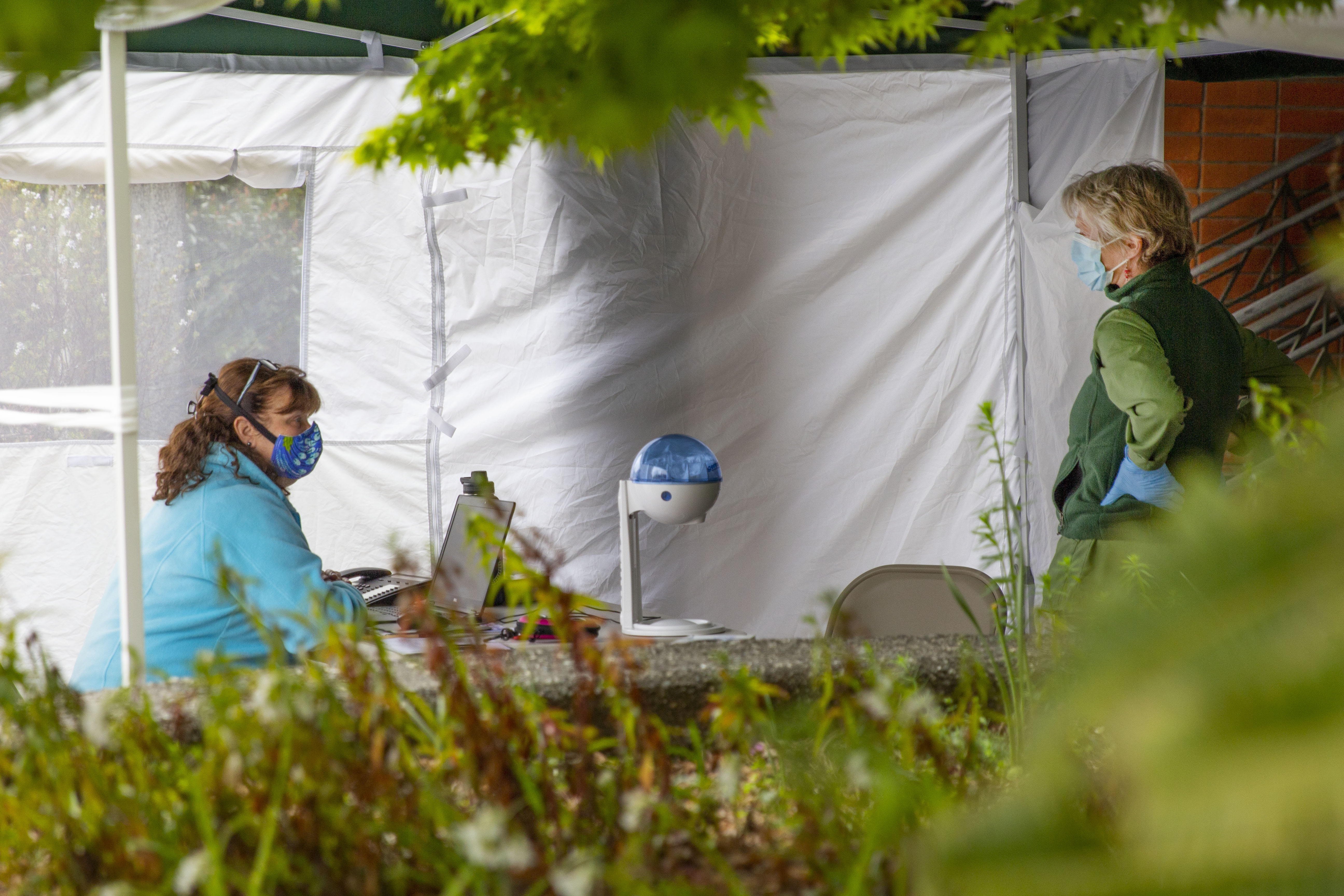
    The Health Center set up white triage tents in front of the building to help students check in and get assessed. If a student tests positive for COVID-19, the Health Center will work with county health services to make sure the student gets the treatment they need.

    During a pandemic, the disease itself isn’t the only medical problem facing students. The Center for Disease Control warns the stress of a pandemic can cause or worsen mental health problems, and recommends calling a health care provider if symptoms persist.

    The Director of Counseling and Psychological Services and Associate Director of Student Health and Wellbeing Jennifer Sanford asked students to consider reaching out to Counseling and Psychological Services if they feel their mental health is deteriorating.

    “Pay attention to how your thoughts and attitudes in any given moment are impacting your mood and overall wellbeing,” Sanford said. “Talk with others, connect. It is normal to have ebbs and flows with your mood and productivity levels but if you get “stuck” in a dark space for an uncomfortably long time, consider reaching out to get help such as from a counselor at CAPS.”

    Sanford said that this can be an uncertain time, but it’s important to see social distancing as community care.

    “The reality is that in our physical distancing, we are displaying compassion and care for our elderly and medically compromised,” Sanford said. “We are allowing our healthcare system to better manage the flow and care of patients, and we are caring for ourselves by lessening our own risk.”

  • New Grant Spurs CAPS Growth

    New Grant Spurs CAPS Growth

    CAPS will provide 36 more appointments per day by next year

    On Jan. 9, the California State University Office of the Chancellor gave Counseling and Psychological Services a grant of $150,000 under the California Budget Act of 2019 to provide Humboldt State University students with more counseling services to combat mental health issues.

    Director of Counseling and Psychological Services and Associate Director of Student Health and Wellbeing Services Jennifer Sanford was closely involved in the acceptance of the grant.

    “I’m most excited about the pilot project to get innovative programs off the ground that’s focused on high-risk students,” Sanford said. “In developing this program we will be doing some specialized training that we’re doing research on now to launch next year.”

    “Mental health doesn’t get the recognition that it should. When you’re not mentally well, your body reacts to that. If you’re stressed out, you’re only going to make it worse. More people should pay attention to it.”

    Danele Quijas

    Lobby areas will be built to hold more students and allow for an increase in counseling appointments. The grant will also fund two new therapy offices in the Behavioral and Social Sciences building, which will allow therapists to extend their hours. More tables and chairs will be added to the waiting areas to eliminate standing-room-only appointments. Construction will begin this summer.

    The funds are expected to help students learn life skills, cope, regulate stress and manage moods. CAPS says improving these areas can improve class attendance, retention in school and promote graduation. With anti-stigma campaigning, CAPS hopes to make students feel comfortable talking about their problems.

    Danele Quijas, a 22-year-old biology major, said students don’t pay enough attention to their mental health.

    “Mental health doesn’t get the recognition that it should,” Quijas said. “When you’re not mentally well, your body reacts to that. If you’re stressed out, you’re only going to make it worse. More people should pay attention to it.”

    A pilot project of $25,000 was also accepted by CAPS and will allow the growth of an intensive treatment program for high-risk students with disabling and chronic mental health issues. This treatment plan will include individual and group therapy as well as the highly-researched dialectical behavior therapy. CAPS hopes to continue this growth by providing other California State Universities with the tools to rebuild their own programs to be as effective as possible.

    Casey Pederson, a senior majoring in business marketing, said HSU should do more to make resources clearly available to students.

    “In a case like this with mental health, there can never be too many resources—so I definitely think it would help,” Pederson said. “I also think a big issue about it is getting people to know. Like I said, I had no knowledge that this was happening, and the big thing with mental health is the lack of knowledge and getting help. And there are resources available.”