The Lumberjack


Students Serving The Cal Poly Humboldt Campus and Community Since 1929

Tag: cdor

  • CDOR hosts drag show and dialogue

    by Monica Robinson

    Individuals from diverse backgrounds and viewpoints participated in programs centered around racial, social and environmental justice during the Campus and Community Dialogue on Race. The goal is to provide spaces for reflection, examination and dialogue to promote change.

    “Brown, Bearded, and Beautiful” was the last presentation held by Production Manager and Show Host Jorge Luis, aka Val De Flores, of the Vibe Queer Bar on Friday, Oct. 27.

    The discussion entailed the creation of an LGBTQIA+ supportive community environment through drag performances and open dialogue to promote education in a predominantly white and heteronormative Humboldt.

    When Luis moved to Humboldt, it was the first time he felt a feeling of safety and belonging in a queer community.

    Luis reflected upon his “machismo” upbringing near San Diego. 

    “You know, I’ve always been a weird kid, like, that’s why I didn’t play soccer,” Luis said. “Because I wanted to wear my mom’s heels.”

    Luis’s mission is to provide a stage for people to reveal their talents, creating an environment where everyone feels significant and acknowledged. He explains how drag shows go beyond entertainment and are an opportunity to build connections in a safe space. 

    The joy Luis said he experiences when seeing the audience sing and dance during performances highlights the heartfelt solidarity within the drag culture in Humboldt County. 

    “I’m married, so it’s my way to let loose and not kill my husband,” Pearl Anderson said, an occasional attendee of the Vibe Queer Pop-Up Bar.

    The shared passion for self-expression and acceptance creates a bond that surpasses societal boundaries.

    “Drag is something that you put on to make yourself feel a little bit more competent each day,” said Luis. “Sometimes that means a wig, and sometimes it’s your dad’s cowboy hat, you know. It’s like, whatever you want to put on that day to kind of just give yourself that little push.”
  • CDOR continues virtually

    CDOR continues virtually

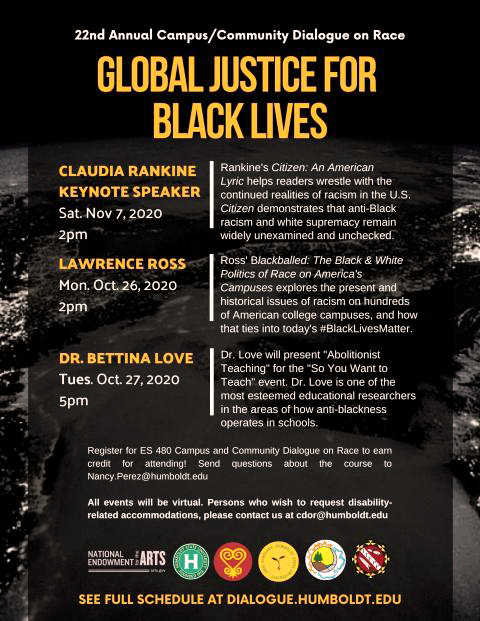
    The Campus and Community Dialogue On Race returns covering global justice for Black Lives.

    The theme for this year’s Campus and Community Dialogue on Race will be “Global Justice for Black Lives: Examining the Past and Reimagining the Future.” Two guest speakers will present at the end of October and a keynote speaker will be introduced at the beginning of November. This event provides students, staff, faculty and community members a safe space to discuss race.

    The events will take place on Zoom and instead of lasting a week, there will be talks and workshops taking place for two weeks from Oct. 26 – Nov. 7.

    Featured speakers will be on Zoom and will be viewed webinar style, meaning the audience will not be able to view all other attendees, just the speaker.

    CDOR has been holding annual events since 1998 and has grown exponentially since then. CDOR gives attendees the opportunity to participate in workshops, have those important discussions and listen to keynote speakers.

    Claudia Rankine is the featured keynote speaker for this years’ CDOR event. She will be participating in two student engagements. The first will be a book talk at 11 a.m. for her new book “Just Us.” Next, is her keynote event taking place in the afternoon at 2 p.m. for “Citizen: An American Lyric,” a book loaded with poetry and media that questions racial politics.

    Rankine’s talk will take place on Nov. 7 conveniently after the election.

    Corrina Wells, the program coordinator for the Developing Hispanic Serving Institution (DHSI) grant program, explained that Rankine makes these questions about the topic available for her readers.

    “What’s really powerful about the book is that she, as a Black woman, is making [racial politics] visible for all of her readers,” Wells said.

    They added that Rankine makes relatable content for BIPOC and educational content for non-BIPOC.

    The keynote event will also touch on Rankine’s process of writing and creating “Citizen,” a book-length poem about race in America.

    Lawrence Ross will be holding a virtual talk Mon., Oct. 26 speaking on the politics of race in American colleges. This will be a follow-up on the talk he had earlier this year in February addressing campus racism.

    Ross will be referencing his book, “Blackballed: The Black and White Politics of Race on American Campuses.” The book exposes the racist practices prevalent in university politics that targets and distances students of color from engagement.

    “Ross really focuses on higher education and the ways that racism is perpetuated in institutions of higher education,” Wells said.

    Ross’ talk from earlier this year in February is available on the CDOR website on the welcome page.

    Bettina Love, Ph.D, will be presenting during the “So You Want To Teach” series all day and cover various aspects regarding white supremacy, incarceration, and abolition on Tues., Oct. 27.

    Douglas Smith, the African American Center for Academic Excellence Coordinator, explains that Love’s talk is about restoring humanity for children in schools.

    Love will be incorporating her new book, “We Want To Do More Than Survive” in her talk.

    “Dr. Love focuses on K-12, the overall education industrial complex and the ways that racism happens there,” Wells said

    CDOR is also a class that gives students credit for helping plan and participate in the events. Indigo Eden, a CDOR peer mentor, expressed great appreciation for this year’s event planning.

    “I give so much respect to the planning committee and everyone involved,” Eden said.

    Registration is open and required for all featured speakers and sessions.

  • El Leñador: Inspiring Diverse Coverage

    El Leñador: Inspiring Diverse Coverage

    HSU’s bilingual monthly newspaper highlights and represents minority groups 

    Lack of diversity in newsrooms across the nation perpetuates the lack of representation in stories. According to the Jelani Cobb from the Guardian, it is all too often that the demographics of news writers look nothing like the communities they cover.

    Humboldt State University’s bilingual newspaper, El Leñador, is changing that one monthly issue at a time.

    “This paper is so special because it’s part of taking back that narrative,” Jose Herrera, El Leñador’s layout editor, said. “We are producing the paper. We are first generation, Latinx, African American, LGBTQ or Asian. We’re writing our own stories.”

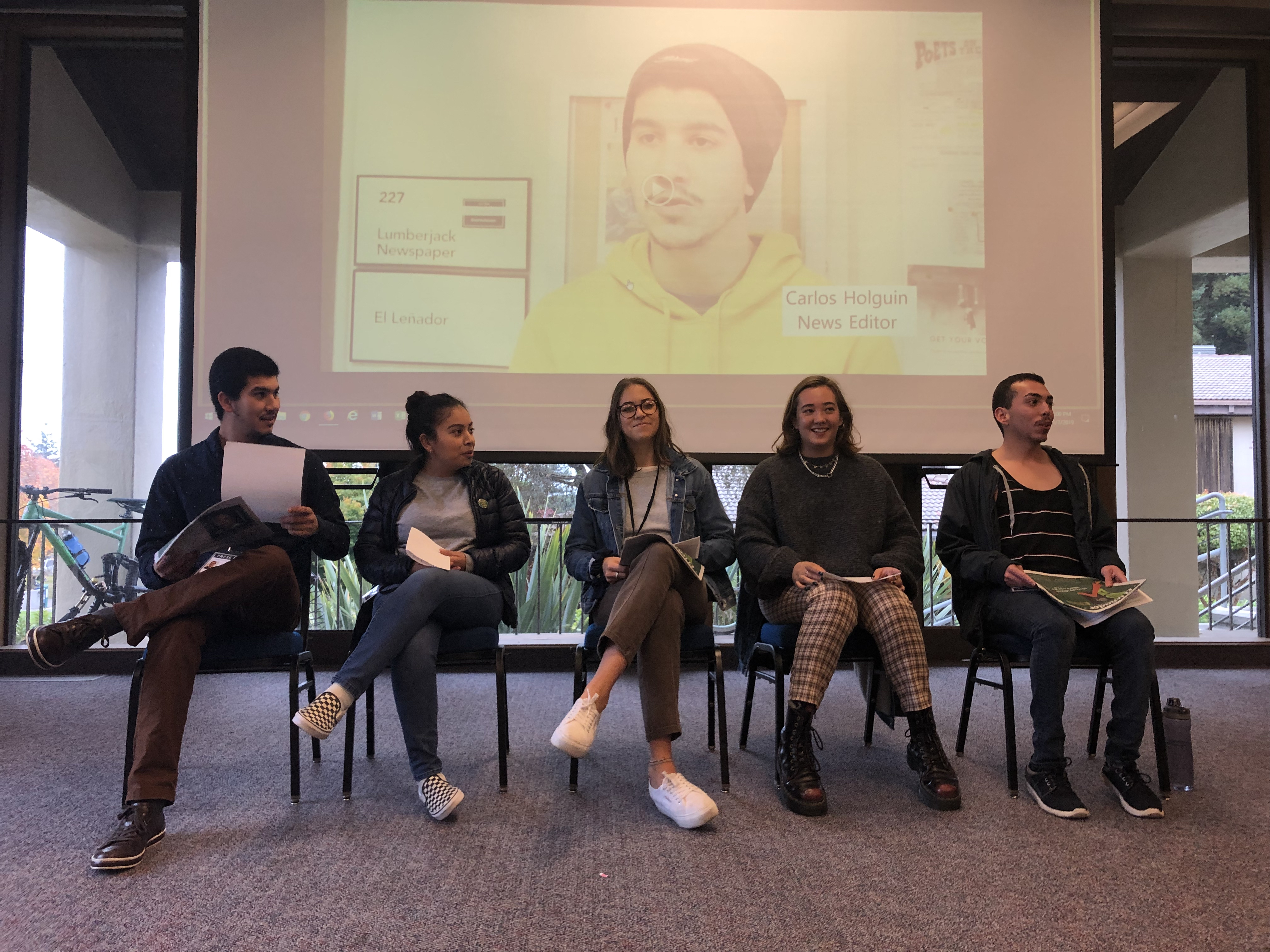
    El Leñador held a panel discussion Nov. 7 in the Goodwin Forum as part of the week-long Campus & Community Dialogue on Race event. The student-run publication features under-represented stories of the school and community.

    Attendees of the CDOR event listen to editors speak about the paper’s production process. | Photo by Chelsea Wood

    El Leñador’s staff is not limited to those who can speak both Spanish and English, or specific journalism majors; all HSU students are welcome and encouraged to contribute.

    “For me it’s been a life changing experience,” Vanessa Flores, El Leñador’s editor-in-chief, said. “It’s very important for students to pick up newspapers. Not just ours, but the other publications on campus.”

    Flores stressed the importance of student journalism. Without it, campus stories would remain unrepresented since local media isn’t as connected to a campus story as student journalists are.

    Over the past six years El Leñador has covered under-represented communities and continues to carve out a space for minority narratives within Humboldt-based media.

    The work by the student-run publication reverberates throughout the secluded community. El Leñador has forged ahead of larger, local news publications by connecting with its audience more intimately.

    “This paper is so special because it’s part of taking back that narrative. We are producing the paper. We are first generation, Latinx, African American, LGBTQ or Asian. We’re writing our own stories.”

    Jose Herrera

    The editorial board reminded community members at the discussion about the importance of continuing to cover underrepresented stories.

    Cali Fournier, an HSU student, attended the panel discussion and believes that informative, speaking panels are important to have.

    “Racism is a big deal still to this day,” Fournier said. “You should be judged by who you are not by the color of your skin.”

    The El Leñador staff assume multiple roles within the publication. Producing the paper monthly gives students access to a hands-on learning environment, and staff are able to expand their passions whether their skills are in writing, video, audio or art.

    “As a monthly paper and as a student-run paper, it’s really a big training ground for students,” Silvia Alfonso, El Leñador’s managing editor, said.

    El Leñador enables its contributors to bring different perspectives to the table. Its staff encouraged the panel attendees to contribute to the publication.

    Jack Surmani, an HSU alumnus, believes in the message El Leñador emits and thinks the the commitment of the students behind the publication is evident.

    “They know why they’re doing it and have a passion and commitment for being better journalists,” Surmani said.