
The Lumberjack


Students Serving The Cal Poly Humboldt Campus and Community Since 1929

Tag: Cesar Chavez

  • Community potluck for Humboldt State students

    Community potluck for Humboldt State students

    A potluck was held in the D Street Community Center on April 1. The theme of the event was for the Arcata community to bring Latin American food in honor of Cesar Chavez Day.

    This is the fourth community potluck that the community has held for Humboldt State University students and the Arcata community. Pauli Bachemin is one of the event organizers.

    “The purpose of holding this event is to not only have students meet with the community,” Bachemin said. “I want [students] to be able to network with city officials from the community.”

    There were various city officials who were present at the potluck, including Karen Diemer, the city manager of Arcata.

    “We want students to know that they are a part of the community,” Diemer said. “I was a former student of HSU, and the support I felt from the community made me want to stay in Arcata. I hope that students today will feel the same way.”

    Isabel Quintaro is an HSU student who praised the university’s efforts.

    “With the issue that has been going on lately, I think that the city has been doing a great job in listening to student’s voices,” Quintaro said.

    Nacirema Johnson is another HSU student.

    “With the city officials being present in this event, it shows that there is [a] genuine interest with what is going on with students,” Johnson said.

    The food wasn’t the only thing that the event gave out, there was a “free stuff” table where students could pick up donated items.

    “I really appreciate the help that the community gives with the free stuff they give out,” Kelly Garcia, a first-year HSU student, said.

    While help is given from the community event, some have expressed how they truly felt about how the community has dealt with ongoing problems in the community.

    Tina Sampay is a former student of HSU. She majored in critical race, gender and sexuality studies.

    “It is important events like these are happening, but you can’t cover up the pain with fake progress,” Sampay said.

    With the ongoing issues that affect HSU, the D Street Community Center has been making an effort by holding events for students like the community potluck.

    Anne Hartline attended the event. She is a professor at HSU teaching English 124, and attended the event to support students.

    “This event is a way for building a community,” Hartline said. “It’s important for students to be a part of the community.”

    This article was changed from its original version on at 11:08 a.m. on April 5, 2018. 
  • Sí Se Puede!

    Sí Se Puede!

    By | Robert Brown

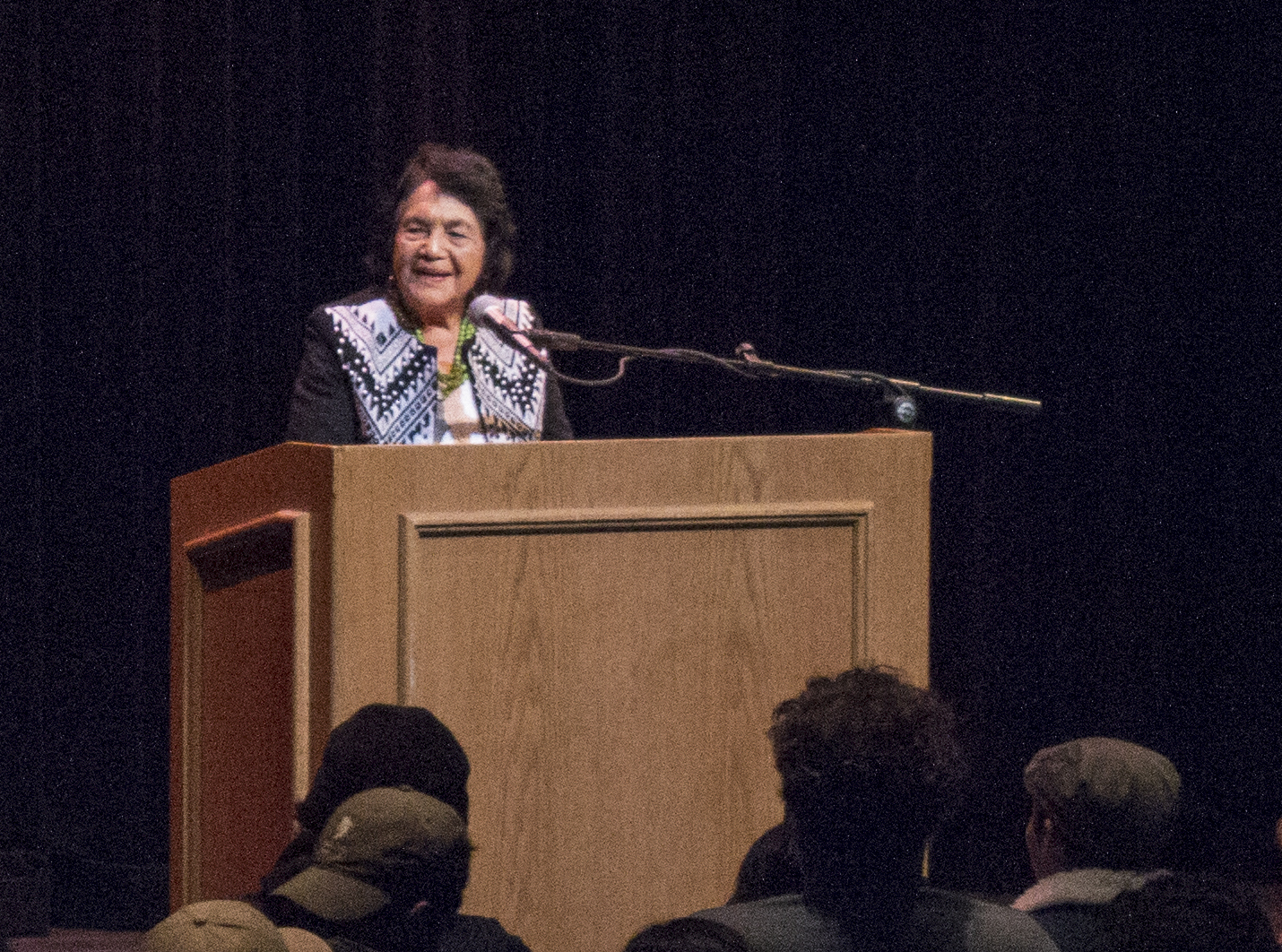
    Dolores Huerta spoke to an audience at The Van Duzer Theater at Humboldt State University on Monday, Nov. 13 during her new video documentary tour, celebrating her life’s work entitled, “Dolores.”

    Huerta is legendary for her ability to organize protests and boycotts. She co-founded the United Farm Workers Union with Cesar Chavez and helped to pass the Immigration Reform and Control Act of 1986, giving legal residency status to more than one million farm workers.


    She has won numerous awards throughout her career, including The Eleanor Roosevelt Human Right’s Award, The Ohtli Award from the Mexican Government, The U.S. Presidential Medal of Freedom, and nine Honorary Doctorates from different universities, just to name a few. She was inducted into the California Hall of Fame in March of 2013.

    In her talk, she discussed human rights, which she considers to be a woven tapestry made up of several separate issues including race, gender inequality, and sexual preference. She stressed the importance of being able to live and let live, and not be concerned with others’ identities.

    Another point she made is that it’s not a crime to cross the border, it’s a civil offense. By crossing the border, no one is hurting anyone else. Legalization has always been part of the immigration system in the United States since the country was founded by immigrants centuries ago. She applauded Senator Diane Feinstein, who proposed a bill for a blue card, which would allow undocumented farm workers to stay in the United States as long as they are working.

    Huerta has been actively involved organizing for over 60 years, starting with the Stockton Community Service Organization. At that time, farm workers were only earning 70 cents per hour working from sunup to sundown, they didn’t have toilets or drinking water in the fields, and were not given any breaks.

    She was part of California’s enactment of the Agricultural Labor Relations Act of 1975, granting farm workers the right to organize and bargain for better wages and working conditions. She eventually became one of the UFW’s most visible spokespersons, campaigning with Robert F. Kennedy, Bill and Hillary Clinton, and Barack Obama.

    The slogan she uses, “Sí se puede,” which translates to, “Yes we can,” was used by Barack Obama during his 2008 Presidential campaign. It originated from a law in Arizona stating that if someone said, “boycott,” or, “strike,” they could go to prison. Huerta organized protests against that law. The people in Arizona said, “no se puede, you can’t do that here.” She responded, “No, in Arizona, sí se puede!”

    Huerta directed the first national boycott of California table grapes which caused 17 million people to stop eating grapes, along with a march on Sacramento. During this time, she met Gloria Steinem, one of the leaders of the feminist movement. Women played a major role in the boycott because the women took over the strike and run the picket lines while the men marched.

    In 1988, during a protest of George Bush in San Francisco, she was assaulted by police. She ended up with seven broken ribs and a punctured spleen. The beating was caught on videotape and broadcast on television, allowing Huerta to win a large judgment against the SFPD and the City of San Francisco.

    As she described the many events that she experienced throughout history, the conversation evolved into events happening now at the Standing Rock protests. It’s clear to see that corporate greed, and dirty “politricks” continue to plague society.

    At 83 years old, there is no slowing down for Huerta, who continues organizing movements and expanding her focus from workers rights to women’s rights, indigenous rights, civil rights, and gay rights.

    With the dichotomy of empire looming overhead, it makes it all the more sweet to see a woman who has endured so much, and fought so hard, as she continues to persevere with the vitality and spirit that has become an inspiration for thousands of people.

    Anyone wanting to become active or show support can join the Vecinos Unidos (United Neighbors). The Dolores Huerta Foundation provides organizing, training, and resources to rural, and low-income communities, and also provides a platform to advocate for change. Go to http://doloreshuerta.org for more information.