The Lumberjack


Students Serving The Cal Poly Humboldt Campus and Community Since 1929

Tag: clubs

  • Umoja Center helps people make friends

    Umoja Center helps people make friends

    by Dezmond Remington

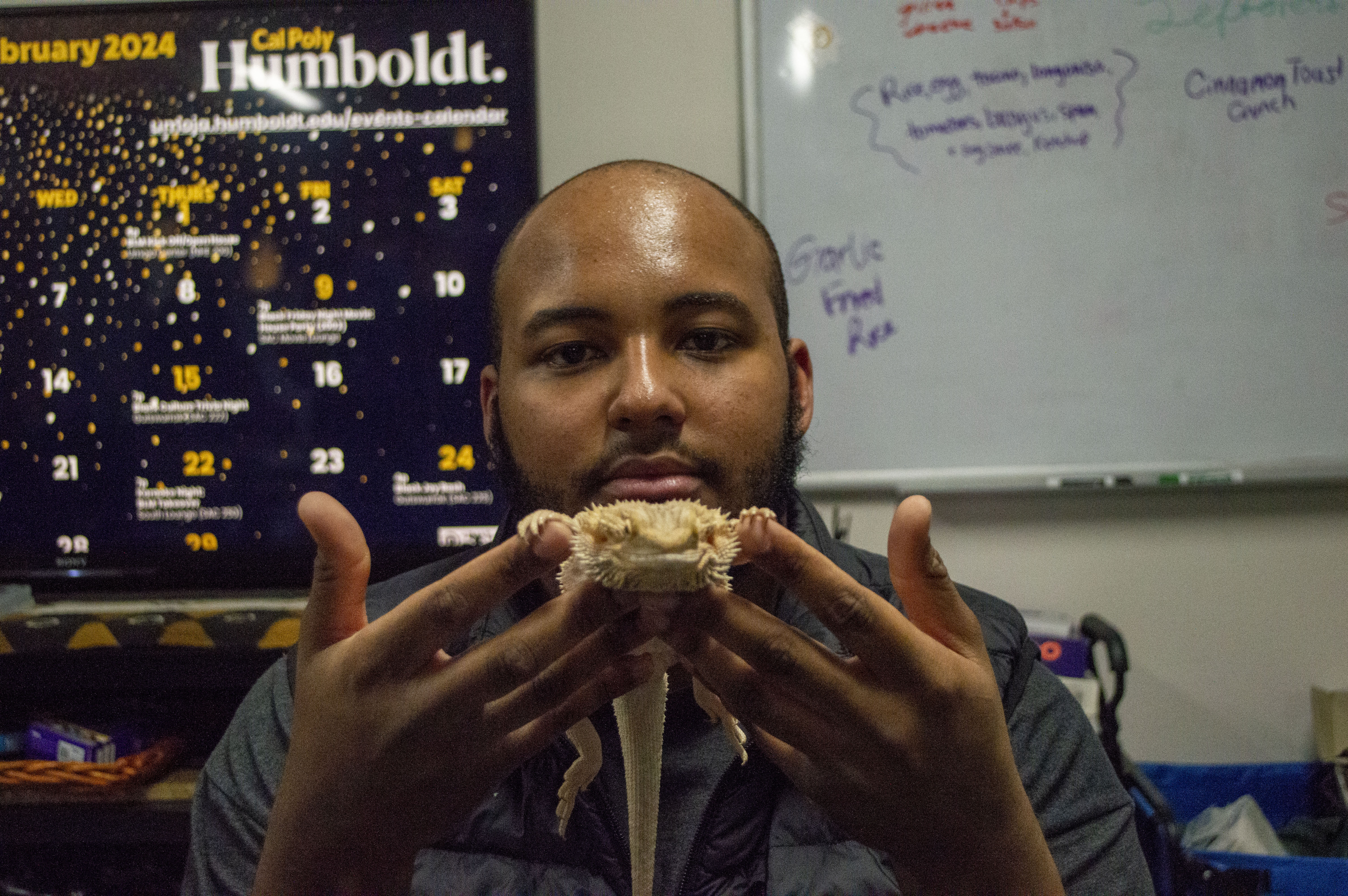
    Tigger doesn’t have any stripes. He isn’t furry, and his jumping skills are horrible. His scales are nice and smooth, and his facial hair rivals a 19th century president’s. Tigger the bearded dragon is just one of many attractions people at the Umoja Center can offer.

    The Umoja Center for Pan-African Student Excellence, located in Nelson Hall East, kicked off a month of events for Black Liberation Month on Feb. 1 with an open house. 

    Student art and photos of Black activists, athletes, musicians, and historical figures line the walls from floor to ceiling. “I love my melanin,” said one sign. A box with loanable art supplies sits at the front desk, free for anyone to use.

    The center hosts many events, such as discussions about Black joy and movie screenings or even a Black trivia night. The center also offers academic advising and computers students can use, but the most important thing most students take from the center is community.

    Many Black students have found community at the Umoja Center — a difficult thing to do when, according to the Cal Poly Humboldt website, only 3% of students at Humboldt are Black. Delaena Montes, a student assistant at the center, said it’s a place she could feel like herself.

    “It’s an open space,” Montes said. “I can reach back to my roots here, my background. I felt like it was somewhere I could be myself. It’s freedom at a very white school. Having a place to escape is a great feeling. I feel comfortable here.”

    Kamar Little holds Tigger the bearded dragon at the Umoja Center Feb. 1. Photo by Dezmond Remington

    Jerry Turner, Tigger’s owner, agrees. He found the center when he was a freshman last year. He’s a mechanical engineering major with a lot of coursework, so having a place to relax and make friends is important to him. 

    “It’s a family,” Turner said. “That’s the best way I can put it… all of my friends I’ve met here, at the Umoja Center. It’s just beautiful.”

    Ryen Price joined the Umoja Center last year after living in the Sankofa House, the Black culture-focused dorm in Cypress. She started coming to the Umoja Center to meet other Black students. She said she’s made a lot of good friends, the type she has potlucks and in-depth discussions with.

    “I love how different we are, but also how similar,” Price said. “We’re like a family here.”

    Montes is surprised more students don’t show up to the center, as well as other culturally-focused programs such as the Indian Tribal & Educational Personnel Program or El Centro, located down the hall from the Umoja Center.

    “People should know about these places,” Montes said. “There’s a lot of culture up here [in Nelson Hall].”

    That doesn’t surprise Kamar Little, a Student Advisory Group for Equity representative at the Office of Diversity, Equity, and Inclusion. Little works to connect students with those centers.

    “I’m making them a bigger name,” Little said. “I’m letting people know things exist. There have been instances where people have never heard of [the programs].”

    Price said anyone curious or doubting should lay those worries to rest and visit the center.

    “People ask themselves, ‘[am I] black enough?’” Price said. “It’s the right place. Don’t think. You’re always welcome here. Don’t be shy, just come.”
  • Free Radicals chemistry club has fun with science

    Free Radicals chemistry club has fun with science

    by Dezmond Remington

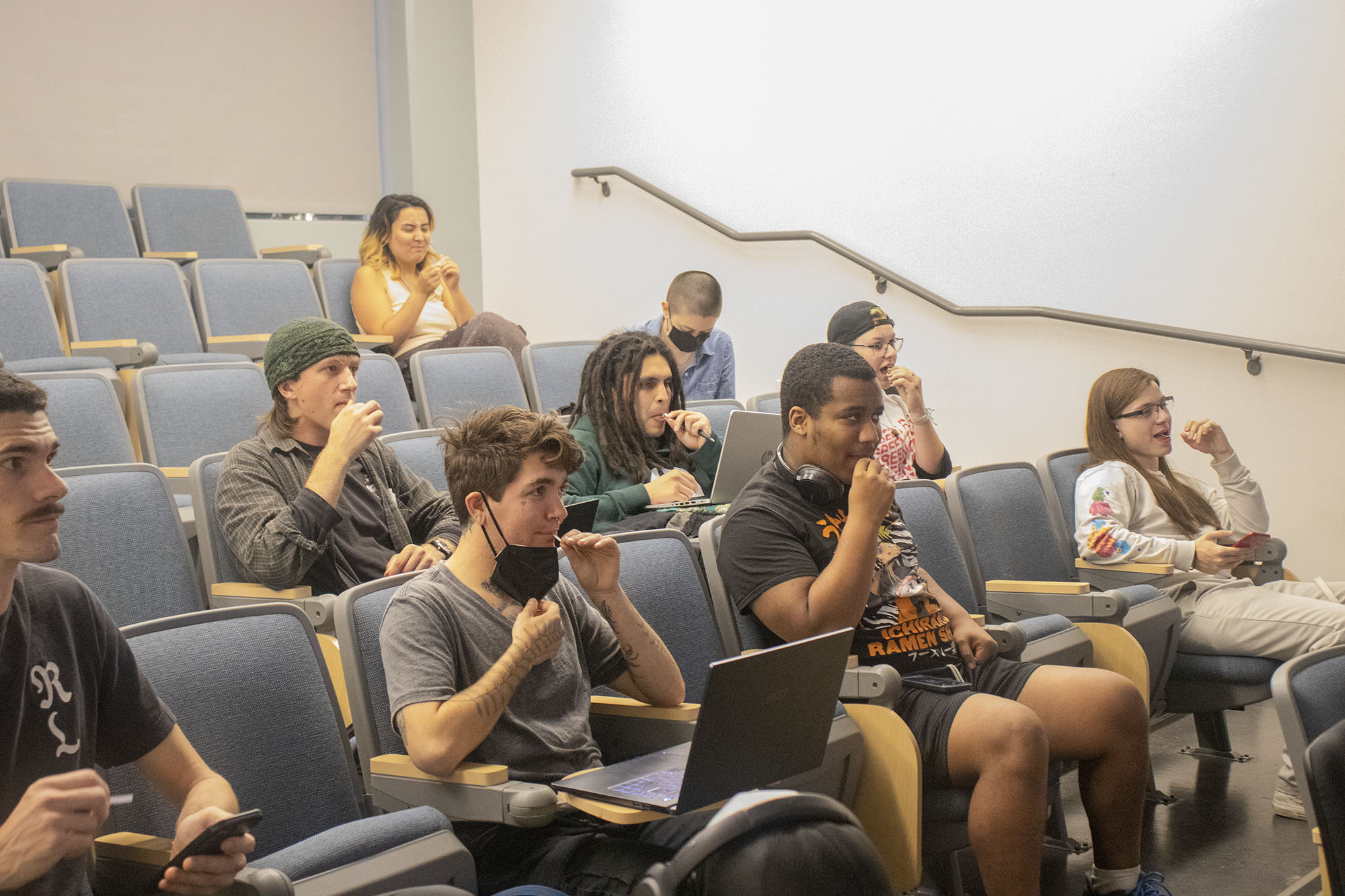
    On Sep. 20 in room 564 of the science A building, approximately 20 people ingested a toxic chemical known as propylthiouracil. It was not a mass suicide attempt. It was not a Jonestown re-enactment, nor were they getting high. It was a meeting of the Humboldt chemistry club.

    Propylthiouracil is a chemical used to test if an individual is especially sensitive to taste, someone known as a “supertaster.” If the paper containing the substance was especially bitter, then chances are good that person is a supertaster. The members of the Free Radicals, the chemistry club on campus, were testing if they were supertasters. 

    “I just put poison on my tongue, so I guess I’m ok with anything,” laughed member Angela Takahara. 

    If the energy of the Free Radicals could be put into one quote, that would probably be it. 

    “People. That’s the best part,” club president Jack McLaughlin said. “It’s probably the best place for chemistry majors and a lot of other majors to socialize. It’s just a great community to have and to talk to, because not a lot of other people really understand chemistry…it’s nice to have people who understand you, where you don’t have to explain every other concept.”

    McLaughlin joined the club his freshman year, and hasn’t regretted it once. He said it’s an excellent way to get connected with important resources and more experienced students, as well as guest speakers who are in the industry or are teaching currently. 

    “It really helps guide newer students and even sophomores, juniors, and such towards figuring out what to do with their chemistry degree,” McLaughlin said, “And also how to make the most out of college.”

    The Free Radicals aren’t only open to those working on chemistry degrees, however. Shay Konradsdottir, the club’s Social Director and Events Coordinator, is a molecular biology and computer science double major, with only a minor in chemistry. Her favorite part of being in the club is putting events on, such as a tie-dye event the club held last semester to showcase the science of colors. 

    “As social coordinator here, I really enjoy planning the events and making fun things,” Konradsdottir said. “Making this stuff, and sharing this interest in the sciences and interest in chemistry in a way that’s not just ‘here’s what the reactions are called.’”

    And it is that interest in chemistry that binds all of the members together. McLaughlin said the nature of chemistry being everywhere was the appeal, and how it oftentimes was the key to understanding so much of life. 

    “[Chemistry] is like the building blocks of the universe,” McLaughlin said. “…I feel like I can pursue all of my passions for environmentalism and such through chemistry.”

    Senior Sam Emerson, attending his first meeting at the Chemistry Club, holds a similar viewpoint. 

    “I like figuring out what makes the universe run the way it does,” Emerson said. “It feels like getting to know the game engine behind everything…I’ve always thought life was really fascinating and that although the universe prefers disorder, there are certain, random spins of chemicals that happen to make order out of nothing.”

    Konradsdottir, who Emerson credits with convincing him to join the Free Radicals, has a much more personal background with science and how it interacts with their lives. She was diagnosed with Type 1 diabetes when she was young, and was a subject in medical studies. It was a defining moment in her life, she said, and it inspired her to become a doctor and help people. Eventually, she became interested in coding, and that led her to where she is today; gunning for an MD-PhD and potentially opening her own free clinic or making more effective medical diagnostic tools. 

    “I felt really awful about when I’ve heard stories from my friends or even some family members that were prevented from doing the things they loved doing because they got an injury or they got sick,” Konradsdottir said. “I myself, being a diabetic, there are lots of things I missed out on because I’m a diabetic, so being able to catch those things and prevent them from happening–that’s interesting to me.”

    Being the club events coordinator, Konradsdottir hopes to share that fascination with the rest of campus. Last semester, she went on a field trip where she got to make a pleasant-smelling chemical, but wasn’t allowed to take any home. If the club had unlimited money, she would hold an event where anyone could show up, get a free lab coat and goggles, and concoct something similar to what she got to make–with the difference being they would get to keep it. 

    “It’s fun! We just do fun stuff here,” McLaughlin said. “It’s not like actual work…you don’t have to understand anything about chemistry, so long as you show up with a good attitude.”

  • Slack is Back at Cal Poly Humboldt

    Slack is Back at Cal Poly Humboldt

    by Liam Gwynn

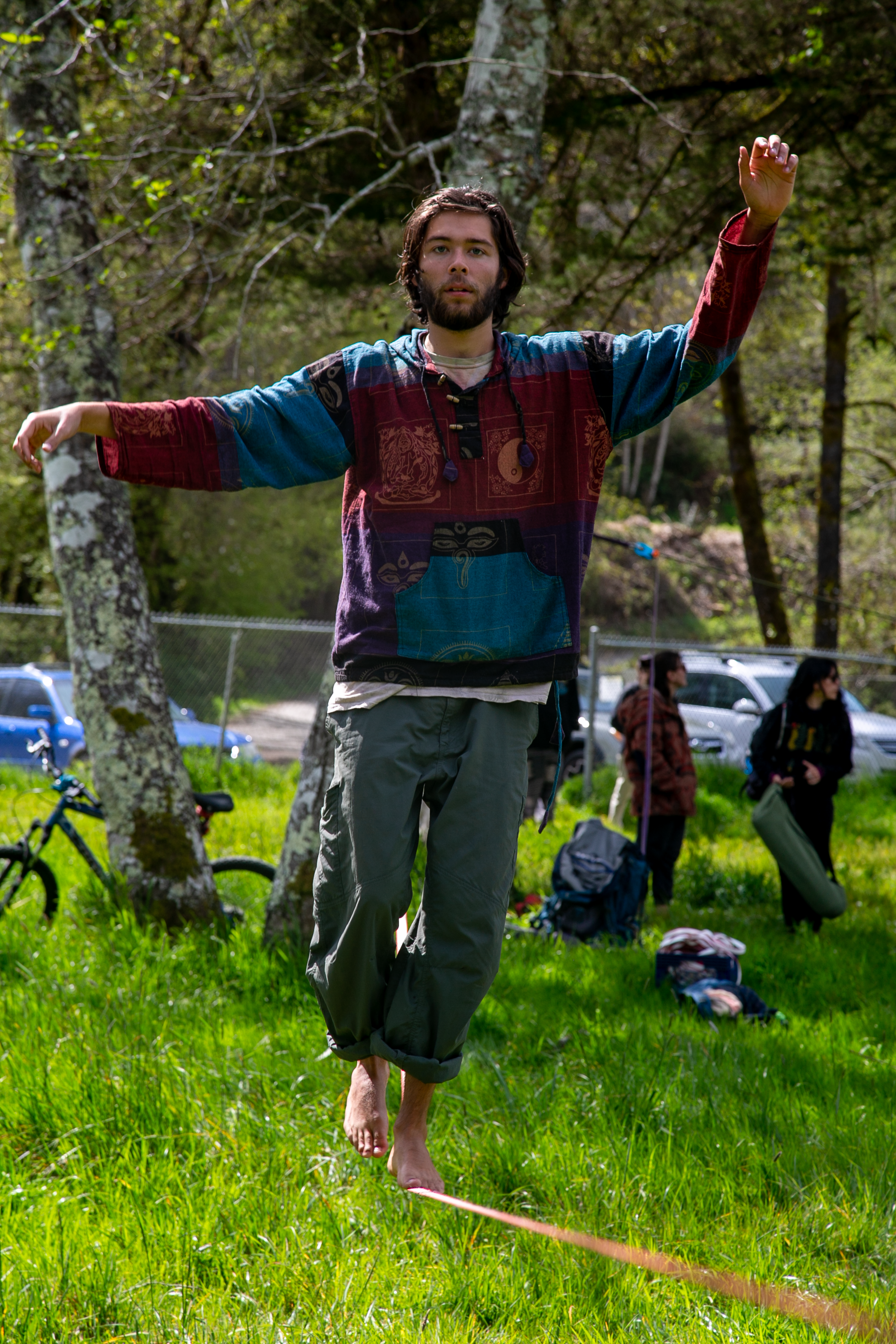
    Ethereal flute, harmonious tarot prophecies, and a faint vaguely skunkish smell: you’d think it was a description of a sixties wet dream. However, you would be wrong, that dream is very much alive in Humboldt county, particularly with a group of students who have started a slacklining group that meets every Sunday.

    Before the pandemic, Cal Poly Humboldt had a thriving slacklining community with a club that would meet weekly. The club fell apart in 2020, however, one former member has gathered a group of fellow slackers and begun the process of getting this group turned into an official club at Cal Poly Humboldt. Joseph Aguilar, organizer of the prospective slacklining club, joined the original club in 2019 and has been slacklining ever since.

    “I love how when you’re on [the slackline] it’s just you, you have to be focused and present, and in that moment and you have to be hyperaware of all the muscles in your body,” Aguilar said. “It’s really good for core strength and all sorts of stuff.”

    Aguilar decided to start throwing “Slack Sundays” with a group of his friends and it gradually blossomed into a communal gathering of musicians, slack enthusiasts, and an assortment of nature lovers.

    The atmosphere at “Slack Sunday” was laid back and welcoming. Unlike many sports activities, there was no sort of competitive spirit or pressure to perform perfectly. People stretched back on picnic blankets and relaxed while others painted, played a variety of instruments, gave tarot card readings, threw a frisbee, and even tossed around a boomerang. Others came just to meet new people and hang out.

    The skill levels at “Slack Sunday” were equally diverse. For some, it was their first time and veterans held their hands and gave tips on how to cross. On the opposite side of the spectrum, genuine professionals showed off their skills with remarkable tricks on a line five feet off the ground.

    Photo by Abraham Navarro | Gabriela Vargas and Joe Mallory, both experienced slackliners do tricks and balance on their lines at the Mad River Pump Station on March 22.

    One of those professionals was Gabriela Vargas. She started by slacklining in her hometown Mexico City and moved to the US after receiving a sponsorship for competing in a trick line competition. Vargas originally moved to Colorado but was attracted to Arcata because of the slacklining culture that exists here.

    One issue that many professional slackliners face is debilitating injuries. Vargas said one injury she had forced her out of the competitive space after a leg injury that took six months to recover.

    “I like to take my healing slow, because if you don’t let it fully heal and just go back to doing it, it can get chronic and I don’t want that to happen,” said Vargas.

    Despite the setback from her injuries, Vargas has continued to expand her skills and has become proficient in highline, when a slackliner is harnessed to the slackline and balances over massive heights. Vargas showed a picture of her slacklining over an incredible drop of over 6,500 feet.

    People enjoy slacklining for a variety of reasons but one central theme is the benefits of achieving mental and physical balance when on the line. The appointed treasurer of the prospective club Ella Feick explained how her passion for slacklining stemmed from that need for balance.

    “You’re thinking in your head, you’re breathing in your body, and you’re focusing on your balance in a way that you’re not typically. If you’re stressed out or having a hard day you can’t really be thinking about all that stuff, you’re just there,” Feick said. “It’s a very present activity.”

    “Slack Sundays” are hosted every Sunday from 12-5 p.m. at the Mad River Pump Station 4 – Disc Golf Course.

    Photo by Abraham Navarro | Destiny Vera, Joey Agualar, Ella Feic, Ang Younger and Younger, all students interested in the Slacklining club on campus, at the Mad River Pump Station on March 27.
  • Humboldt Circus clowns around campus

    Humboldt Circus clowns around campus

    by Gabriel Zucker

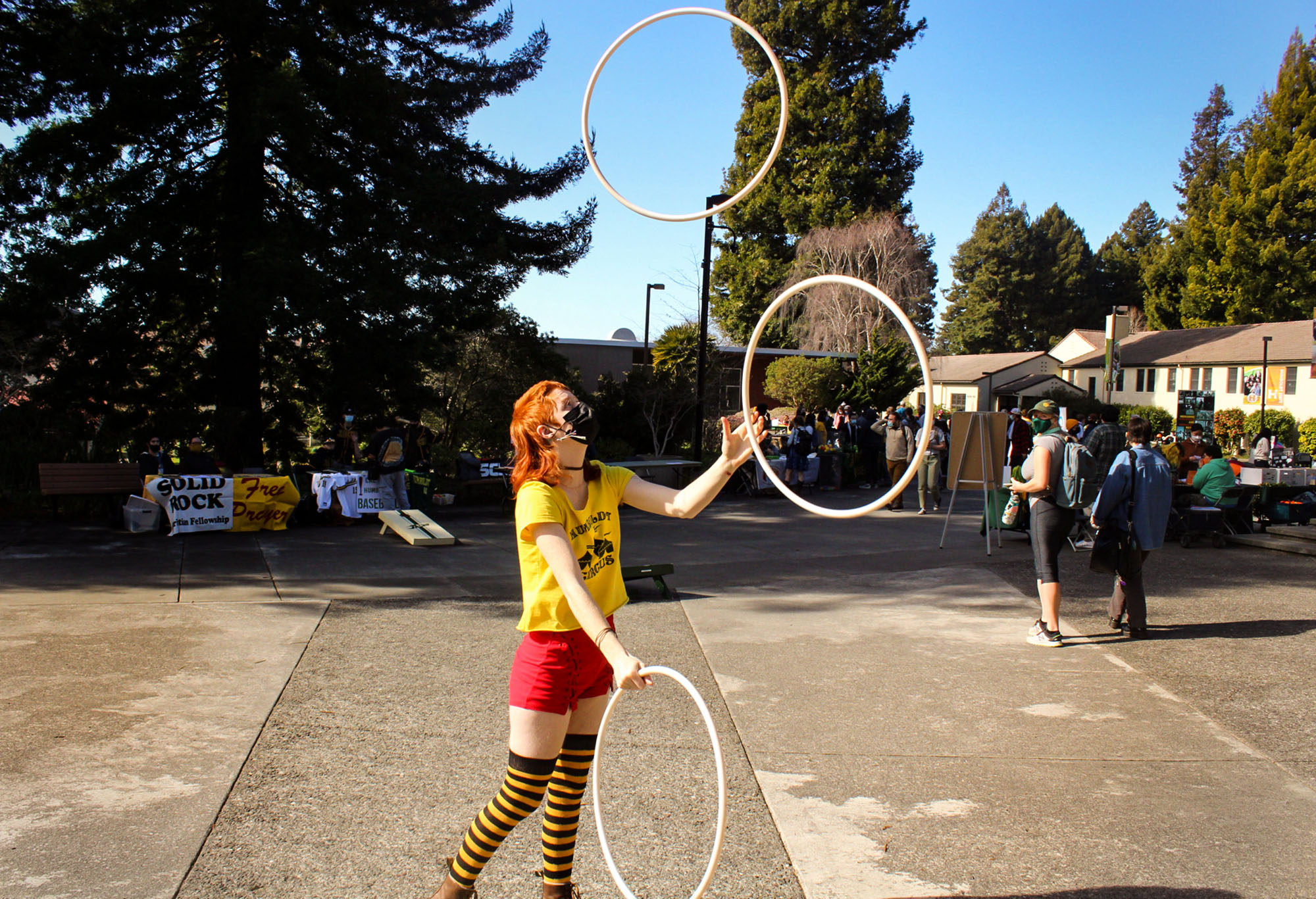
    As his staff flew around his body. It became an extension of himself, twirling over the pavement. Man and tool became one through dance. Liam Boyd, a transfer student, and part-time circus performer ran up to the booth with a clown nose and a staff in hand. He had no idea Humboldt had a circus club and was overjoyed to meet everyone. Boyd started to perform with his staff and soon was joined by others, slowly growing into a full-grown performance.

    The Humboldt Circus is one of many student-led Cal Poly Humboldt clubs. These clubs give students a safe place to meet like-minded individuals and learn new skills.

    Photo by Gabriel Zucker | Louis Parr and Isla Marten sit behind the Circus Club banner, calling people over to check them out. Feb. 11.

    On Wednesday, Feb. 10, student clubs set up booths around the Quad. This gave new students a chance to learn about and join these clubs, opening the door for new friendships and experiences.

    Louis Parr, President of Humboldt Circus, brought a box full of circus props to their booth. Immediately the traffic in front of the booth increased.

    “Circus is a magical place, full of fun and free creativity,” Parr said. “You are allowed to do whatever you want to, within the circus.”

    Every week Circus hosts “Play Time” Monday from 5-8 pm at the West Gym. There they give students a chance to let their inner freak out in an artistically unique way. In this space, students are given complete freedom to explore and experiment to their heart’s content, trying new things every time, or perfecting one act over the course of the year.

    Isla Merten, a longtime member of Humboldt Circus, walked around the Club Fair. They juggled everything from bowling pins to thin disks. Soon they were joined by more and more interested students, all signing up for the club and trying out some of the cool props. By the end of the club fair, multiple students had stopped what they were doing and taken a couple of minutes to try out different props and write down their emails.

    Photo by Gabriel Zucker | Louis Parr, President of Circus Club, does bike tricks around the quad, during the Club Fair on Feb. 11.

    Humboldt Circus gives its members endless possibilities for what they can perform and act out. Character acting and improv also have a place in Humboldt Circus. Props are used for tricks, laughs, and skits, adding a new layer to the performance. This year Merten moved away from the props and instead focused on improv and clowning.

    “A clown means being creative and open to work with what you are given,” Merten said. “The spirit of play and creation.”

    Embodying the clown, they act out scenes by themselves and with others. Merten uses improv to expand and perfect their character. Humboldt Circus, like all the other student clubs, gives a social place for students to bond with one another. When asked about who usually joins the club, Merten didn’t miss a beat.

    “It’s a club for introverted weirdos,” Merten said with a laugh. “We have extroverted weirdos too.”

  • Associated Students Lose Core Programs and Student Wages

    Associated Students Lose Core Programs and Student Wages

    Based on projected enrollment, the Associated Students budget is expected to decrease 20% each year, for the next five years

    The Associated Students Board finalized their proposed budget for the upcoming academic year, during the April 24 board meeting. The budget includes cutting the entire budgets of the Asian, Desi, Pacific Islander Center, the Eric Rofes Multicultural Queer Resource Center or ERC and the Women’s Resource Center, among other programs.

    Jeremiah Finley was elected the incoming AS President for the 2020-21 academic year. He wants to assure students they won’t be losing their programs.

    “The reality is that we want to support y’all so bad,” Finley said. “That we’re willing to go into our reserves almost $100,000 to be able to still support in some type of way.”

    Budget Administrator of the Campus Center for Appropriate Technology Justin Hawkins was baffled by the budget decisions and spoke out during the meeting.

    “How does the budget increase $14,000 and it’s going directly to the AS government in-between these recommended budgets, and yet, all of us are getting cut.”

    Justin Hawkins

    “It’s just tragic, honestly, to see these massive cuts to the ERC and the Women’s Resource Center,” Hawkins said. “I’m a male body person, I identify that way, but that doesn’t mean that I don’t empathize and really appreciate the services that are provided.”

    Hawkins questioned the justification for the AS budget increase after having several thousand dollars of his own program cut.

    “It’s really troubling what I see going on,” Hawkins said. “How does the budget increase $14,000 and it’s going directly to the AS government in-between these recommended budgets, and yet, all of us are getting cut.”

    Despite losing one of their three staff positions, the AS general operations budget has increased over $15,000 for the upcoming academic-year. This comes as a result of general operations losing miscellaneous revenue, largely made up of compensation for the oversight of Instructionally Related Activities. Without the $35,000 miscellaneous revenue provided for the 2019-20 year, the general operations budget requires additional funds to function.

    As a result of budget reductions, AS was forced to down-size their office administrator position. This sharp deadline made it impossible for AS to administer payroll for the upcoming year and as a result student-wages have been removed from AS and most of its funded-programs. Executive Director of AS, Jenessa Lund, said the current system isn’t working.

    “Even with three employees,” Lund said. “When we have eight programs spread across campus, the oversight is impossible. It’s a huge liability!”

    In order to compensate students for their time, AS has come up with several loopholes to get around the extra paperwork that comes with administering official wages. These include paid-internships and stipends for students, both of which have been allocated specific funds in the final budget.

    These allocations include a $15,000 committee compensation package that increased the AS government budget. The package is specifically set aside for non-AS board members that are involved in AS committees.

    “The optics on the final number of $111,000 looks bad,” Lund said. “But if you really look at what’s inside of it, it’s support to the students.”

    The finalized proposal includes a significant increase to the clubs’ budget, with money that can be used for student-stipends and internships. Programs that didn’t receive any funding from AS have the option to transition their organization into a club and can apply for funding through AS and the clubs’ office. Programs that weren’t given a budget for the upcoming year have also been allocated specific funds.

    “I don’t think that all of the clubs should have an equal opportunity for that funding.”

    Alexia Siebuhr

    Queer Coordinator for the MultiCultural Center, Alexia Siebuhr voiced her concerns about access to AS grants distributed through clubs, at a board meeting on May 8. Siebuhr pointed out a white supremacist club on campus, who promotes hateful behavior towards groups denied an AS budget, is competition for club funding.

    “I don’t think that all of the clubs should have an equal opportunity for that funding,” Siebuhr said. “They have the equal opportunity to apply for those grants. That just rubs me a little bit the wrong way.”

    President-Elect Finley addressed Siebuhr’s concerns, explaining the reasoning behind the allocation.

    “Every fee-paying student has to be able to have access to these funds,” Finley said. “If we do not allow them to have access to these funds, then we are doing a dis-service to our students.”

    Programs with a department and a state employee overseeing paperwork are the only ones able to maintain regular wages because their payroll doesn’t go through AS. For programs that didn’t receive a budget from AS, finding a department to adopt them and re-applying for funding is currently their only option.

    AS is already in discussion with the Student Access Gallery, the Waste-Reduction and Resource Awareness Program, the Campus Center for Appropriate Technology and several departments about the possibility of adoption. Executive Director Lund believes this will be the most beneficial direction for the programs, moving into next year.

    “We didn’t have enough time to do that for every program,” Lund said. “That would’ve been ideal.”

    AS is prepared for the possibility of refunding fee-paying students for potentially cancelled events and other unspent student-fee funds. Ultimately, if they aren’t providing the services outlined by student-fees, they shouldn’t be charging them.

  • Humboldt State’s Theatre Fraternity Tries a Comeback

    Humboldt State’s Theatre Fraternity Tries a Comeback

    Alpha Psi Omega attempts a comeback with new students and adviser

    Humboldt State University’s theatre fraternity is trying a comeback to campus (or it was, prior to the COVID-19 outbreak). Alpha Psi Omega intends to allow students to increase funding for competitions and student-directed shows.

    Rae Robinson, the faculty adviser for APO, said the return of the fraternity excited her.

    “The first chapter was like 1919 or 1920,” Robinson said. “There have been a few different departments as long as there has been Humboldt State.”

    Robinson said APO was reinstated when she arrived at Humboldt State 14 years ago. APO had a few years of club work, but the group of students interested in the fraternity graduated. APO went dormant.

    “We want to pull all of our performing art students together so we can all support each other better.”

    Jaiden Clark, APO president

    “Those kids graduated, the MFA was dissolved by the university, and it went under the radar for a while,” Robinson said. “Last year we had a new group of incoming students and they said, ‘We want a theatre club again,’ and I said, ‘We have Alpha Psi Omega.’”

    APO President Jaiden Clark said they’re passionate about creating change within the theatre department by unifying performing arts students through APO.

    “We want to pull all of our performing art students together so we can all support each other better,” Clark said. “We want to make more connections with more clubs around the school like the improv club and the circus club.”

    APO’s fundraisers will allow students to determine how the money is used instead of the theatre department allocating funds. The fundraiser money will allow for student competitions and student-operated shows.

    “School-wide enrollment is down, and as far as I understand, the school can’t afford to hire another faculty member to the theatre department. We need the students to feel empowered to do more.”

    Jaiden Clark

    “They don’t give us the money that we need in this department,” Clark said. “Neither have any schools in any theatre department that I have ever been to. So the students are going to pick it up.”

    Clark said the theatre department is low in faculty members, and having a more unified body of performing arts students would better support the students.

    “We lost a lot of faculty all at once,” Clark said. “School-wide enrollment is down, and as far as I understand, the school can’t afford to hire another faculty member to the theatre department. We need the students to feel empowered to do more.”

    Professor Patrick Ulrich, assistant adviser for APO, looked forward to working with the students to reach their goals.

    “I would like to work directly with the students,” Ulrich said. “Making money for their goals, serving their community, getting our name out to everybody and really just having an avenue for an honors fraternity.”

    APO would give the students freedom to advertise themselves how they see fit.

    “It really is in the hands of the officers,” Ulrich said, “who are all students.”

  • Clubs Budget Crunched in Wake of Declining Enrollment

    Clubs Budget Crunched in Wake of Declining Enrollment

    Associated Students takes over remains of the clubs budget

    The Associated Students Programs Grants budget has been cut by more than half of the previous academic year’s budget to $25,000 from $52,000. With student enrollment on the decline since 2016, student fees. which make up the entire AS budget, have taken a significant hit.

    As a result of the cuts, it was decided the control of the budgets would be kept within the Associated Students Board of Finance for this academic year. All student clubs are allowed to apply for AS grants, either for events or travel.

    Grant requests are brought to the Associated Students Board of Finance for evaluation before being handed off to the Associated Students Board of Directors, made up of 15 voting and three non-voting members, for final approval.

    In the past five years, between about 10-18% of the AS Programs Grants budget has gone to AS category two programs like CCAT and the MultiCultural Center, which receive separate funding through different outlets. This year, AS decided clubs will receive the entire AS Programs Grants budget in the 2019-2020 academic year.

    The AS Board is currently in the process of their third and final grant allocation for the 2019-2020 academic year. So far, the Board of Directors has approved grants to all 29 clubs that requested—however, not all requests have been entirely met.

    As a result of the budget reduction, AS put in place a cap of $500 per event, $800 per cultural event and $100 per person for travel. The Board of Directors will hold their final vote on March 13 to decide the 11 remaining grant requests for the academic year.

    AS Legislative Vice President Jeremiah Finley is working to provide a fair opportunity for all clubs to receive funding.

    “AS is doing the best with the situation that they’re having to navigate through.”

    Molly Kresl

    “I think clubs always need more access to more funds across the board,” Finley said. “I think the goal of AS here is to really try to make sure that they do have access to funds. And so, in trying to do that, we’re trying on our part, to find ways in our budget to make sure they have access.”

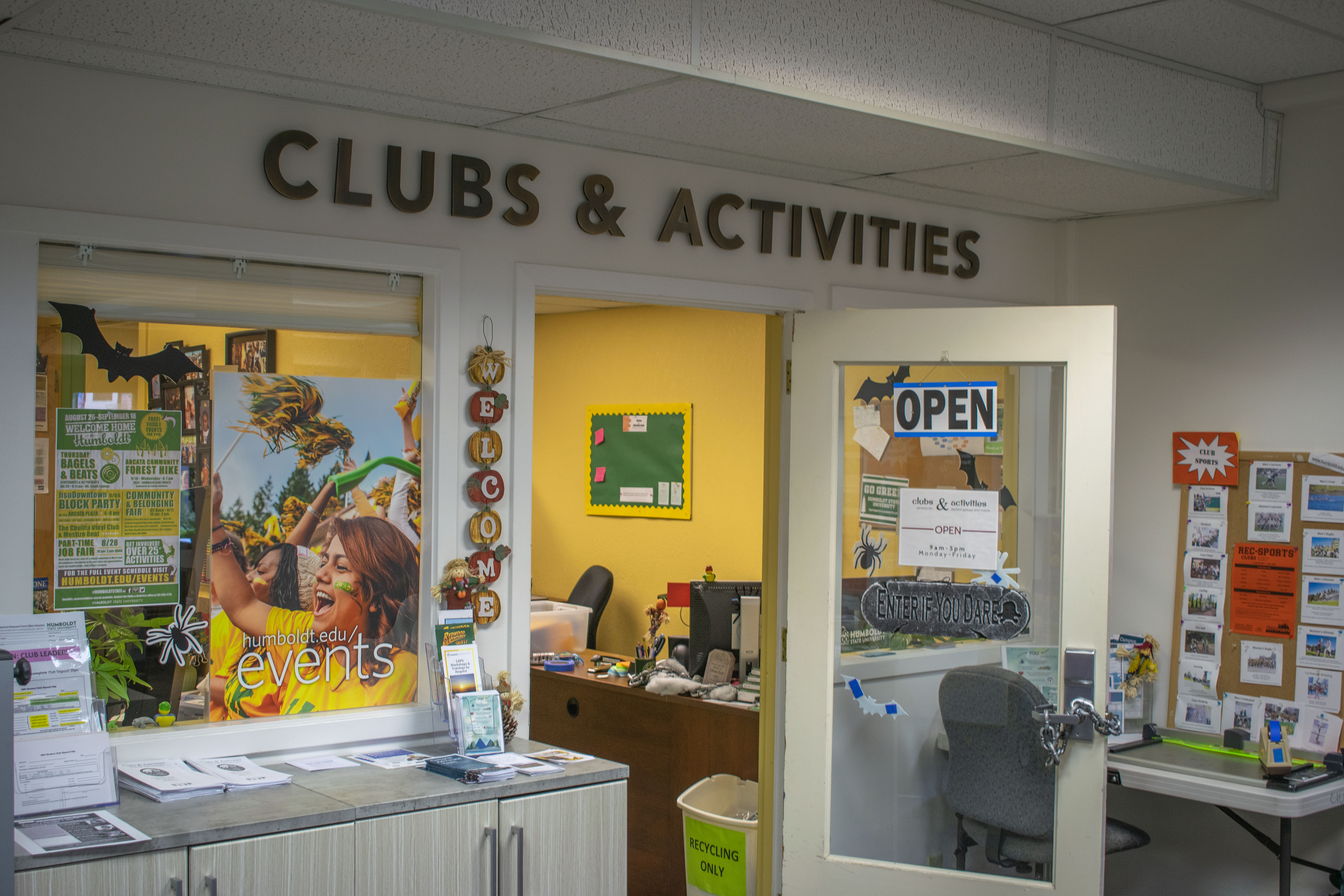
    The clubs budget reduction has forced everyone involved to be more responsible with their spending, according to Clubs and Activities Coordinator Molly Kresl.

    “That’s something that’s been really cool that’s come out of this unfortunate situation,” Kresl said. “Even though we have a decrease in funding, there’s an increase in collaboration with student-initiated programs.”

    However, there’s still much improvement to be made. AS wants to hear the voices of students that are affected by these decisions. For students who want to take matters into their own hands, they can sign up as a candidate for the AS Board.

    “AS is doing the best with the situation that they’re having to navigate through,” Kresl said. “It’s important to recognize the complexity of the situation, and that there are ways that we can help our students be successful and do what they wanna do on campus.”