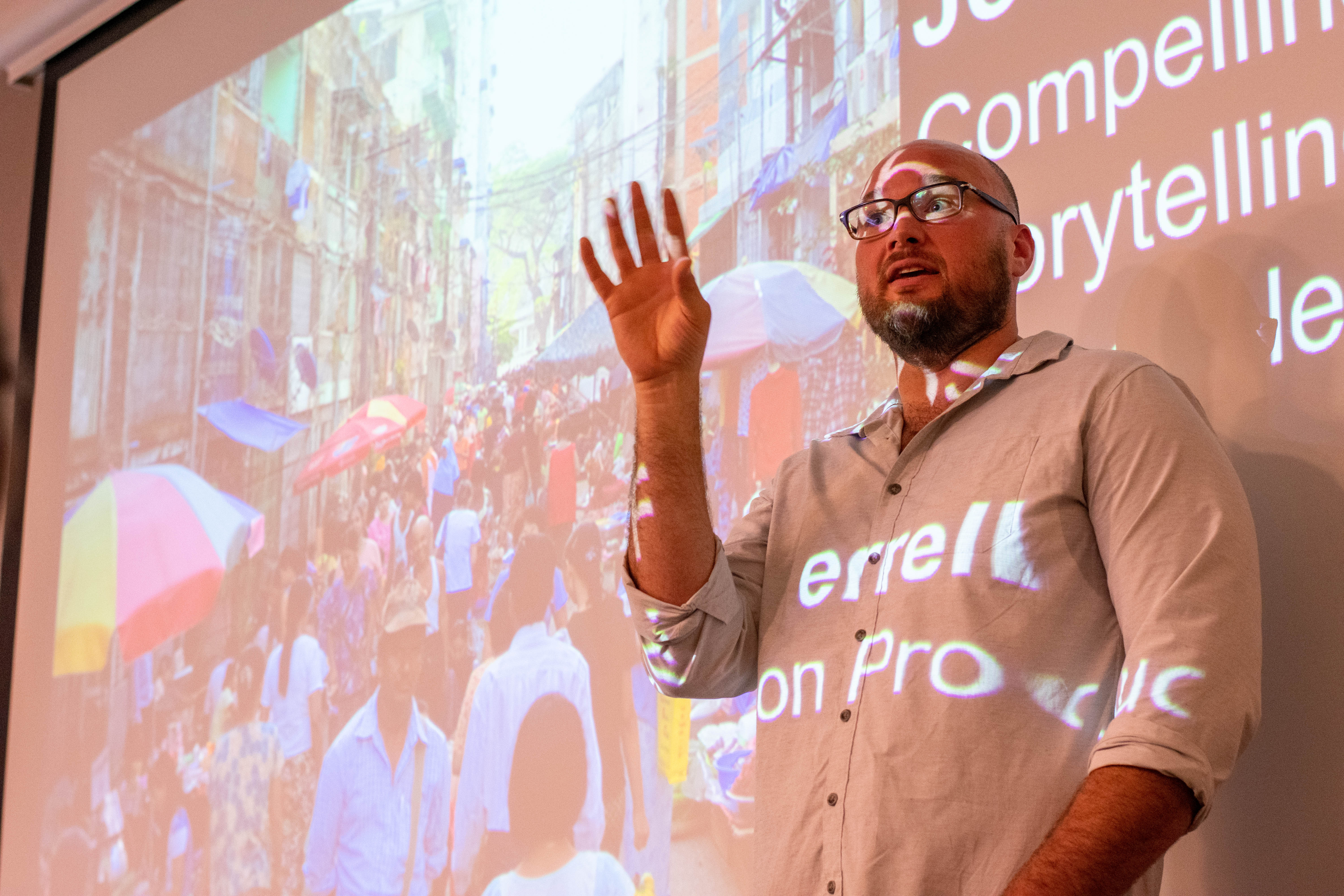
Josh Ferrell recounts his work and experiences on ‘Parts Unknown’ and ‘No Reservations with Anthony Bourdain’
Crammed into the Humboldt State library fishbowl, Josh Ferrell quickly silences the room with a startling picture of a busy street in Myanmar. An hour flies by as Ferrell recounts his time traveling the world and working with the late celebrity chef and traveler Anthony Bourdain.
Ferrell is as a freelance television producer. He helped produce the Travel Channel’s “No Reservations with Anthony Bourdain” and CNN’s “Parts Unknown.” But before traveling the world, Ferrell was an HSU journalism student minoring in history and captain of the rugby team.

“I loved going to Humboldt State, it looks completely different now,” Ferrell said. “It’s such a small, family-oriented place and that helped me come to terms with keeping it close, keeping it comfortable.The Humboldt mindset helps me get jobs and make people comfortable, keep things comfortable.”
Shortly after graduating, Ferrell worked as a park ranger and substitute teacher in Southern California. Eventually making the move to New York to pursue work as a production assistant and taking up physical training to make ends meet.
“I got discouraged so much and had an ‘is this for me?’ moment in New York when I was a production assistant,” Ferrell said. “But you need to stay persistent like ‘what else you got?’ because those contacts and that networking is what I got out of all the stress. At the end of the day, people remember a great attitude and that’s part of paying the dues.”
Ferrell’s mother, Sharon Ferrell, reminisces about his first day on the job with Anthony Bourdain in Brazil.

“He was in the mouth of the Amazon with Bourdain,” Sharon said. “I guess Tony [Bourdain] was behind him and a giant bird landed on his [Ferrell’s] shoulder and took a massive leak. It was running down his shoulder and his shirt and everyone started turning and leaning in to see how he would react and all Josh said was, ‘must be good luck, right?’ After that Josh had the job.”
Ferrell recounted his trips to Libya and Jamaica, which sparked the making of some of the more prominent and powerful episodes.
“Tony really wanted to do an episode in Libya,” Ferrell said. “This was back in 2013, it was important to show Libya in a different light because everyone was seeing war news and we thought it was important to show and tell the stories of people with hope.”
In 2013 Libya was in the midst of a civil war. Ferrell and his crew went with a security team due to the possible dangers.

“I didn’t sleep in Libya,” Ferrel said. “The security team told us to leave, but we pushed for a couple more days. It’s important to show relatability and showing people places and cultures is important.”
Some moments of Ferrell’s work may have been dangerous, but many were impactful.
When the crew traveled to Jamaica, a beloved local beach was in the midst of being scouted by Sandals, all-inclusive resort company. Ferrell and his team used the angle as a focal point in their episode, publicizing the controversy. Two weeks after the episode aired, Winnifred beach was declared public by the Jamaican government.
“Food as a vehicle is brilliant, it gets you in everywhere because everyone likes food. CNN brought us on as a food show, however, food was just the thread and platform we used to tell the stories we wanted to tell.”
Josh Ferrell
“Our ambition paid off and we told stories, supported science and talked about the greater good,” Ferrell said. “We realized we are super lucky and had to pinch ourselves like ‘Holy crap! We‘re very fortunate to be doing this!’”
Ferrell explained that the show wasn’t so much recipes or tutorials surrounding food and cooking, but rather commentary on specific regions utilizing food to find stories.
“Food as a vehicle is brilliant, it gets you in everywhere because everyone likes food,” Ferrell said. “CNN brought us on as a food show, however, food was just the thread and platform we used to tell the stories we wanted to tell.”

With food as the drive behind the episodes, stories opened up. But every episode took extreme preparation and at times, mandatory safety courses.
“Tony loved the military expression, ‘prior preparation prevents poor performance,’” Ferrell said. “There was no hand-holding because it was his show. Every two years the team takes a hazardous environment training course. It’s a three-day intensive course where you learn what to do when your shot in the chest or kidnapped.”
While not every episode required a safety course, shots took extreme preparation, and Ferrell recounts his time spent with Bourdain as inspirational and personal.
“I was extremely lucky to work with him and when he passed, I lost a friend,” Ferrell said. “He went to my wedding and he created a family of close friends. He helped me figure out what I wanted to do as a producer.”

Ferrell credits Bourdain with a big portion of his career as well as the close-knit circle that surrounds him to this day. Ferrell worked his way to producing some of the most powerful and recognizable shows around the world. However, shoot days were often taxing.
“As a producer, I never slept,” Ferrell said. “We shot two scenes a day. We wanted each episode to be a mini-movie but we also tried to keep it under a 12-hour-day, ended up having a lot of 18-hour-days.”
Ferrell’s success in the film industry inspired the audience. Allison Lehenbauer, a film student, felt the need to do more.
“I feel mostly encouragement,” Lehenbauer said. “It’s easy to get overwhelmed in film, and now I know I need to do new things and learn more.”
Ferrell’s advice to students seeking his occupation is simple.
“Do as much as you can, you don’t know what you’re going to enjoy,” Ferrell said. “Try and learn more, especially in media, you’ll learn what you want to do. I love it all and that’s why I produce. I want to do it all.”
