
The Lumberjack


Students Serving The Cal Poly Humboldt Campus and Community Since 1929

Tag: Communication

  • Impending mergers threaten Humboldt’s identity

    Impending mergers threaten Humboldt’s identity

    The merging of departments within the College of Arts Humanities & Social Sciences will lead to the detriment of distinct programs and the appeal of Humboldt State as a unique university. 

    As smaller departments are pressured to combine in order to meet the demands of budget cuts that add up relentlessly in the face of the COVID-19 pandemic, we run the risk of losing the focused, intimate education that drew students to campus in the first place. 

    Due to low enrollment the journalism and communication departments have submitted a proposal to Dean Roseamel S. Benavides-Garb, suggesting they be combined, for fear of losing the departments altogether – a fear that is shared among many of the smaller departments on campus.

    One practical benefit of combining the journalism department with the communication department is the opportunity it would allow for courses to be offered more often with more students in the department. On the flip side, combining departments presents the potential to strip each major of its individual identity. While the increased size of the combined department could potentially attract more attention to each discipline, the lack of distinction between the two could also prove confusing and drive prospective students away. 

    Higher education is a step away from the general, scattershot education of grade school. We learn what we’ll focus on, and begin developing specific skills. We also begin to add to the greater pool of knowledge for our chosen field of study. The less our education hones in on a specific field, the more it feels like a shallow high school class – lacking the depth that student’s pay for when they attend a university. 

    While the emphasis of the study of communication is on the underlying meaning of how we communicate, the primary concern for most journalism students is the application of skills to make media of our own. Journalists are already required to take communication classes which prepare them for their chosen focus. Communication classes are valuable to journalists. Every member of our editorial board has taken a communication class which has shaped our perspective, just as our other general education classes impart valuable lessons. 

    Combining departments also comes with grave concerns that the departments will lose lecturers and potentially some of the classes they teach as former chairs are forced to move into teaching positions. This would cost journalism students opportunities to interact with more media professionals and those lecturers would be placed in danger of losing pay and the health insurance they have come to rely upon for themselves and their families. 

    The proposed plan not only throws the student experience in the department into question but ultimately, the merger’s promise to cut $180,000 in expenses annually feels almost like chump change in comparison to the monster deficit the university currently faces. At the end of the day, administrators, students and faculty have to ask themselves whether or not all this restructuring will benefit the university in the long term. Cuts save some money in the short run, but they represent a greater loss to the university and the Humboldt community.

    Some good will come of department mergers. We all have a lot to learn from each other. As journalism students, we will welcome our peers from the communication department and the value their program will add to ours in regards to the developing fields of ethics and theory of communication. Understanding how we interact with the world through language and the culture of communication is critical to operating as an effective journalist. 

    We hope that we can offer greater knowledge of media literacy. Today especially, media literacy is an essential skill any student with a university education should have, and it is crucial that students across all disciplines are armed with the tools to critically assess, analyze and critique media so that they can be more mindful of the media they consume.

    We also hope to impart our own personal experience writing about our university. All of us hear stories of poorly run programs, incompetence at the top of the HSU ladder, haphazard cuts, and a lack of forward thinking. We speak to staff who are afraid of the repercussions for simply telling us their stories. If we want to make HSU a better place, where else might $180,000 per year be saved?

  • Professor Ponders California’s Independent Future

    Professor Ponders California’s Independent Future

    Alison Holmes, Ph.D. spent her sabbatical researching whether California acts as its own nation

    California has the means to be its own nation. It’s big, it’s wealthy and it’s been disrupting the status quo by acting internationally.

    “California has been acting outside the box,” Humboldt State University Associate Professor and International Studies program leader Alison Holmes said. “They’ve been going and doing stuff with China, Mexico and Canada. It’s like, ‘Wait, you’re not supposed to do that. That’s not what international relations theory says, it’s not what the U.S. Constitution says, it’s not what all kinds of other rules suggest.’ So how are they doing that?”

    Holmes spent her sabbatical last school year researching California and talking with state officials and those the state has dealt with.

    In August, Holmes presented her research to the Center for California Studies at Sacramento State University in a presentation called, “California as a Nation-State: Innovative or Inevitable?”

    In her research, Holmes found that cities and industries within California may act internationally, but the state itself doesn’t typically act as its own nation.

    “We do things internationally but we don’t do them in a coordinated fashion,” Holmes said.

    Holmes grew up in Oklahoma, but she moved to the United Kingdom after volunteering in Belfast during college. Holmes lived in the United Kingdom for 25 years, where, among other things, she worked for and advised the Liberal Democrats and worked as the Deputy Head of Corporate Communication Strategy for the BBC.

    In 2005, Holmes completed her doctorate in London and then became a speechwriter for Ambassador Robert Tuttle.

    “When I worked for the ambassador, I became very interested in international relations and diplomacy,” Holmes said.

    California likes to think that it’s an innovator. We’re really big and proud about how we do stuff. And actually we’re not at the front of that innovation edge; a lot of other places in the world have been doing this for a long time.”

    Alison Holmes, Ph.D.

    When Holmes moved to California, she saw a perfect opportunity for research.

    “California makes an excellent case-study, because it is the fifth largest economy in the world,” Holmes said. “But it is a sub-national unit of a huge, hegemonic, vast, largest-nation power.

    Holmes said California’s international actions are part of a larger globalization trend.

    “What a lot of international relations theory will tell you is that globalization has meant a bunch of people who aren’t nation-states have started to do things on the international stage,” Holmes said.

    With this in mind, Holmes said that while California might be innovative for the United States, it isn’t elsewhere.

    “California likes to think that it’s an innovator,” Holmes said. “We’re really big and proud about how we do stuff. And actually we’re not at the front of that innovation edge; a lot of other places in the world have been doing this for a long time.”

    Holmes also said non-state entities acting internationally brings up questions about the very nature of sovereignty.

    “When does a sovereign not have sovereignty?” Holmes said. “At what point do state relations at the international level become a foreign policy? My point here is that our traditional ideas of sovereignty are ill-equipped to describe what we see in the real world.”

    Holmes says there are three future goals for California: the establishment of an agency focused on international policy, the honoring of tribal relations and the inclusion of tribes in international policy, and the coordination of city and county international efforts with state efforts.

    Holmes ended her research presentation with an urge to take advantage of California’s diversity across all of its communities.

    “That is the only way to create a robust local-global citizenship and to turn California’s state-nation vision of unity from diversity into a reality,” Holmes said.

    Locally, Holmes said Humboldt is more global than it might think. Holmes urged Humboldt residents to connect local actions with outside, global forces.

    “I worry that Humboldt is a little too proud of being the Lost Coast or being behind the Redwood Curtain,” Holmes said. “Privileging what they perceive to be the local over the global, to the point of seeking to disconnect from rather than engage with the world outside.”

    Holmes said ignoring global events has consequences.

    “If you don’t understand these things, you’re not really paying attention to what’s happening, how you can take advantage of that, how you can be a part of that and how it doesn’t have to roll over you like a steamroller,” Holmes said. “Because otherwise it will.”

    However, Holmes cautioned that connecting local issues with the rest of the globe doesn’t mean people should start blaming external forces for all local problems.

    “Trying to understand it is not the same as trying to find somebody else to blame,” Holmes said.

    Holmes suggested that freshmen coming to HSU would likely benefit from learning intercultural communication strategies that international studies students use.

    “There is culture shock,” Holmes said of new HSU students. “There is intercultural communication issues between the different groups of people who turn up here.”

    While HSU politics professor and international relations teacher Noah Zerbe said Holmes’ work goes beyond the scope of his expertise, he did agree with the importance of paying attention to the rest of the globe.

    “Stuff that happens globally affects us everywhere,” Zerbe said. “It affects us here as well.”

    California’s prowess has led some to believe that California should secede from the United States.

    Marcus Ruiz Evans, president of Yes California, the largest organization dedicated to California’s secession, said he believes California would be better off on its own.

    “The basic idea is that California is held back financially because it’s part of America,” Ruiz Evans said over the phone.

    “The basic idea is that California is held back financially because it’s part of America.”

    Marcus Ruiz Evans

    Ruiz Evans said Yes California and the #CalExit movement started back in 2011. Since then, it has seen significant growth, especially following the election of Donald Trump.

    However, Ruiz Evans said that the movement’s growth led to a divide in its supporters that left the movement momentarily stagnant.

    “With success came civil divorce,” Ruiz Evans said.

    Nevertheless, Ruiz Evans said he firmly believes California should secede. Ruiz Evans said that California, on its own, wouldn’t have to fight with the president or the rest of the country, wouldn’t have to fight with federal immigration laws and would save billions of dollars.

    Ruiz Evans also said California is held back politically and financially, and that he believes a split is only logical.

    “We think it’s inevitable,” Ruiz Evans said.

    Yet, when asked, Holmes put a damper on such enthusiasm.

    “I am not sure ‘doing it alone’ is ever a great idea,” Holmes said. “I think while California is rich by many standards, if they had to pay for all the things that the federal government currently does, our situation would change rapidly. California could go that route, but revolutions rarely end well or the way the instigators intended. Be careful what you wish for.”

  • The Educated Landlord and Tenant Program has been brought to the table

    The Educated Landlord and Tenant Program has been brought to the table

    Tenants, landlords and community members were invited to discuss the development of the ELT Program during town hall meeting

    A study done by the CSU office of the chancellor found that one in five Humboldt State students reported being without housing one or more times last year.

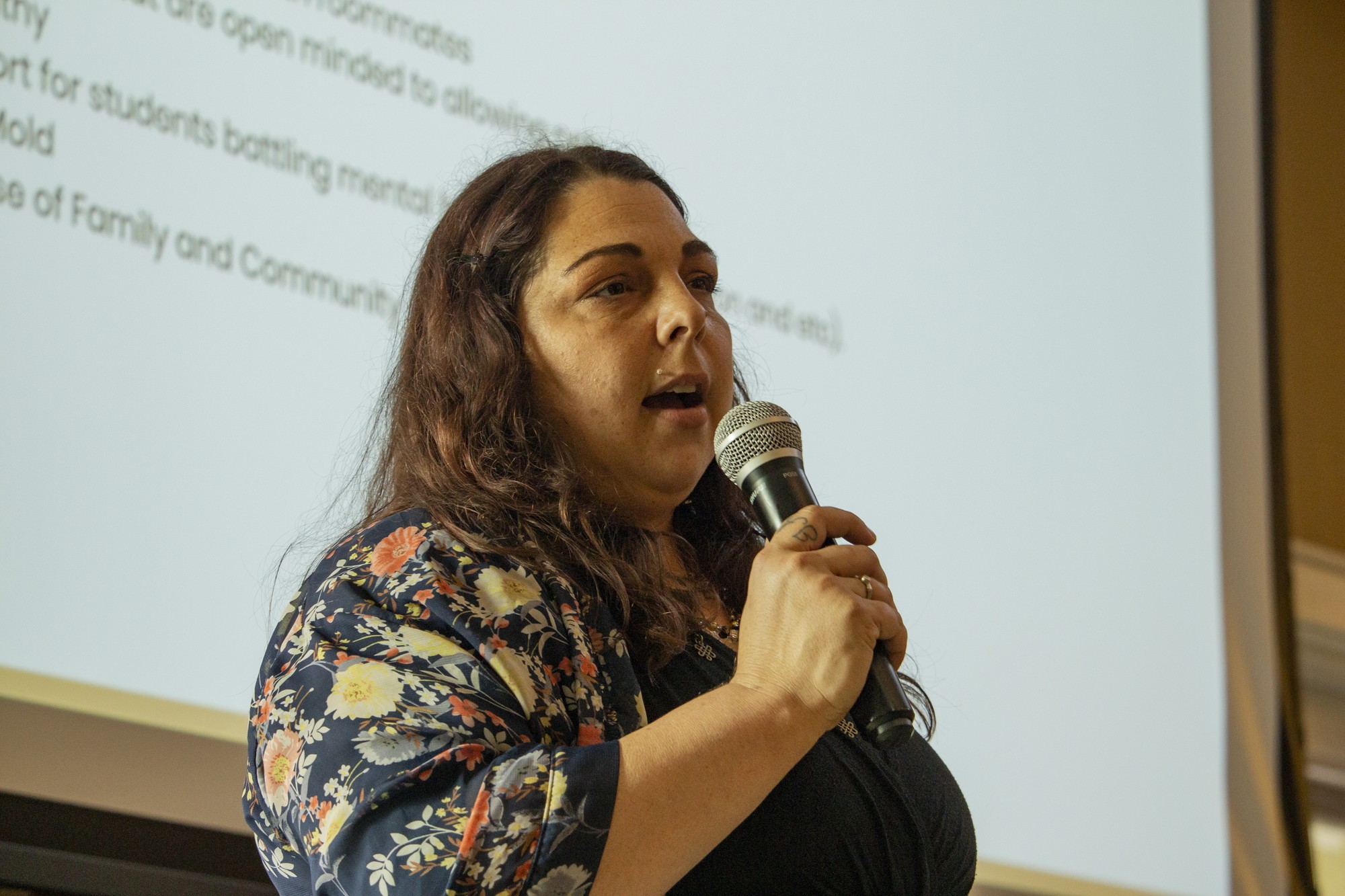
    Humboldt State’s off-campus housing coordinator, Chant’e Catt hosted a meeting on Nov. 30 in the Great Hall on campus to discuss this major concern of housing and other potential issues that lay ahead for student renters and landlords in Humboldt County.

    “We’re looking to get feedback and create connections in the community,” Catt said.

    Catt has been collecting data since Aug. to develop a program called the Tenant and Landlord Education Program. This program is centered around educating local landlords and student tenants. Catt’s goal is to raise awareness about equitable practices and cohesion between the two sides.

    “We want to create open communication and bridge the gap between the community and campus,” Catt said.

    SB.TOWN.HALL.IMG_9254.JPG
    A frustrated community member goes on about privatization in housing while event organizers Ashley Bradshaw and Chant’e Catt listen in the back. Photo by Sean Bendon

    Sasheen Raymond, a support administrator in the social work department on campus, explained the need for good communication between tenants and landlords. Raymond also called attention to the issue of finances in some cases.

    “The goal is coming to some sort of agreement between students and landlords,” Raymond said. “ We want to know where the middle ground is for both sides.”

    Raymond and Catt have been working to create a donor supported stipend that could be applied to student housing deposits in the future. This could help create a better system for student housing and alleviate some of the pressures students face when looking to find off campus housing.

    Humboldt State’s associate director of housing, Todd Larsen supports the idea of the program.

    “They’re trying to create a better future for the students,” Larsen said.

    SB.TOWN.HALL.
    Ashley Bradshaw listens as a community member voices their concerns at the landlord and tenant town hall meeting held in the Great Hall. Photo by Sean Bendon

    Catt and her associates have been working to reach out to students about their concerns by emailing well over a 1000 students and holding open meetings in the UC Quad. Students and landlords alike have come forward to express their fears in hopes of finding a balance.

    “Today’s meeting was a synthesis of all the concerns students and landlords presented us with,” Catt said. “We asked them what they didn’t like and now we’re working on it.”