The Lumberjack


Students Serving The Cal Poly Humboldt Campus and Community Since 1929

Tag: Compost

  • So You Want to Compost

    So You Want to Compost

    Composting can be one of the most beneficial ways to handle waste

    Learn the steps to compost.

    Every Wednesday, the trash bin, filled with whatever waste was tossed during the week, goes to the curb to be picked up by Recology and shipped off to a landfill.

    Forty percent of the waste that ends up in landfills is food waste, according to Recology. This can include raw scraps from food preparation, old sandwiches left to rot and unwanted leftovers. When food scraps end up in a landfill, the material is not just waste, it’s being wasted.

    “The average American generates 4.4 pounds of garbage a day,” the Recology site says. “Don’t let your food scraps go to waste.”

    Illustration by Collin Slavey

    It’s a big deal if food waste gets tossed into landfills. Besides taking up space in our already overwhelmed landfills, food waste doesn’t decompose properly in such settings. For example, an apple that falls above ground breaks down into useful nutrients like nitrogen, which enriches the soil. Underground the apple isn’t able to break down.

    Buried in a landfill, the apple is in an anaerobic environment, meaning that it is starved of oxygen. Anaerobic decomposition creates some nasty byproducts. The most malicious of these byproducts are methane and liquid leachate. Both of these are pollutants with consequences.

    “Fortunately, avoiding these pollutants is simple. Just compost it,” international waste management firm ToWaSo said. “Food and yard waste can be reused and turned into nutrient rich compost. Composting exposes the green waste to oxygen, allowing it to decompose as it would in nature.”

    Humboldt State does compost food waste. According to an email from TallChief Comet, the director of sustainability, energy and grounds keeping with Facilities Management, HSU compost is managed in two ways. The Waste Reduction and Resource Awareness Program manages the composting bins on campus, while food waste is diverted from dining services.

    “The on-campus composting process is handled by WRRAP and is using the material from the public compost bins scattered around campus,” Comet said in an email. “This material goes into an Earthtub composting vessel, located at Facilities Management and processes about 10,000 lbs (5 tons) of material per year.”

    “The average American generates 4.4 pounds of garbage a day. Don’t let your food scraps go to waste.”

    Recology

    “The food-waste diverted from all the dining locations on campus is collected by FM waste and recycling staff into a large pre-composting container,” Comet said. “About every three weeks it is transported by Recology (a local waste hauler) to a vermicomposting facility in Dows Prairie run by The Local Worm Guy.”

    Comet emphasized that it is important to keep contamination out of the materials’ stream, and if someone is in doubt about whether or not to compost, trash it.

    “The best effort students can make is to not generate waste in any form to begin with,” Comet said. “For compostable waste they can achieve this by not purchasing more than they will use/consume during the anticipated period.”

    But composting may very well be appropriate. Composting may seem like an intimidating, tedious and smelly thing to do, but with a bit of practice it becomes second nature. Working with local resources like the Campus Center for Appropriate Technologies can help prepare a student for their own compost bin.

    Jacob Gellatly, an active member of CCAT, recommended that students learn about composting.

    “Before a student starts composting they should learn a few things,” Gellatly said. “It is critical to get educated on the process of composting. Learn the recipe.”
  • CCAT Poised to Pig Out

    CCAT Poised to Pig Out

    CCAT plans to keep pigs on campus to reduce food waste

    Humboldt State University’s Campus Center for Appropriate Technology plans to house two pigs on campus as soon as next week.

    CCAT will loan the pigs from the Tule Fog Farm in Arcata for the duration of the fall semester. CCAT plans to feed the pigs food waste from HSU’s J dining hall.

    Jacob Gellatly, environmental resources engineering major and former CCAT Co-Director, helped lead the project from concept to reality.

    “We want to show how animals can be raised in a residential environment, and how you can use urban byproducts such as food waste to raise animals in an urban setting,” Gellatly said.

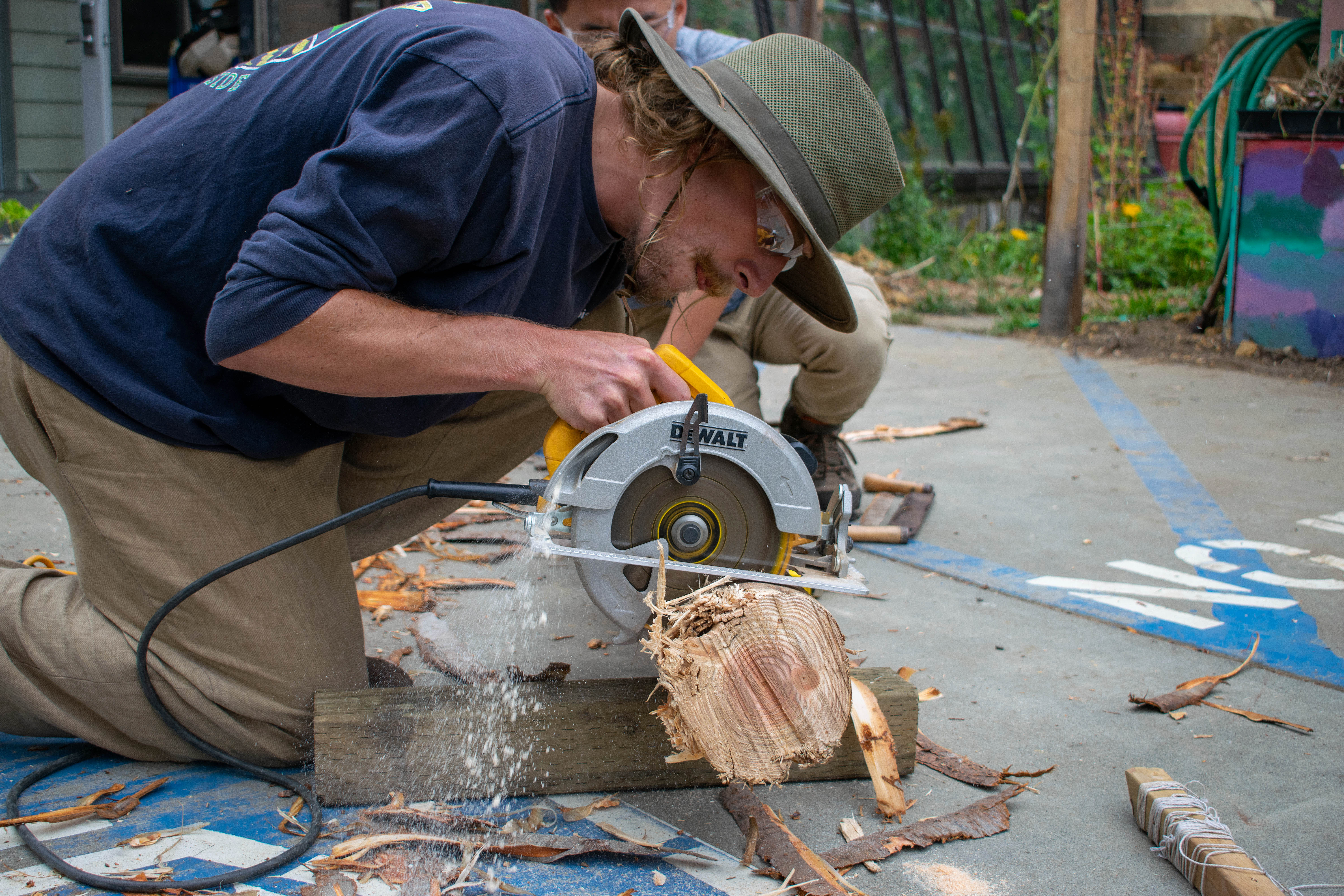
    EnvironmentalRresource Engineering majors Jacob Gellatly (right) and Kong Vang (left) prepare a log on Sept. 6 to be used for the roof of a pig pen. | Photo by James Wilde

    The plan to house the pigs began last fall when students in the CCAT Student Club vocalized interest in keeping animals on campus. CCAT contacted Shail Pec-Crouse from the Tule Fog Farm in Arcata. Pec-Crouse recommended pigs as the most viable animal.

    “The easiest animal for us to raise would be pigs,” Gellatly said. “The reasoning for that is—a big thing is predators. So it’s a lot harder for something to come and get a hold of a pig as opposed to a chicken.”

    As part of their plan, CCAT realized they could feed the pigs food waste from the J. While CCAT couldn’t feed the pigs food thrown away by customers of the J, CCAT could feed the pigs pre-consumer waste, such as food trimmings or spoiled foods not suitable for people.

    “Another goal with the project was how can we divert food waste on campus,” Gellatly said. “And with that we can feed almost, and in some cases, their entire diet from food waste that’s at the school here.”

    Once CCAT decided to loan the pigs from the Tule Fog Farm it needed approval from HSU’s Associated Students, Institutional Animal Care and Use Committee, Facilities Management, Risk Management and an environmental health and safety specialist.

    The pig pen-in-progress on Sept. 6. CCAT plans to house two pigs in the pen for the duration of the fall semester. | Photo by James Wilde

    Humboldt State’s IACUC reviews the use of animals on campus to ensure the animals are treated humanely under the requirements of federal and state law. College of Natural Resources Associate Dean Rick Zechman, who chairs IACUC, said the IACUC proactively reviews and inspects over 100 animal-involved projects on campus each year.

    “There’s varying kinds of emotional feelings about the use of animals, and that’s respected and honored in the system of review,” Zechman said. “And that’s why the Animal Welfare Act was developed, to prevent mistreatment of animals. And I think, you know, in our committee, that’s sort of our first principle.”

    While Zechman could not comment on the details of CCAT’s proposal, which is still pending, CCAT has worked over the last year to assuage concerns raised by various HSU faculty.

    CCAT started by building a pig pen out of reclaimed wood from a local logging operation in Fieldbrook. CCAT has since integrated plans for a roof to prevent flooding of the pen and security to prevent people from getting harmed by the pigs.

    In the long run, Gellatly hopes the project might convince the University to keep animals around for good.

    “Big picture, I would like the school to see this and see, with what we’re having to deal with—getting rid of all this food—we could be raising meat for the school and have locally-produced meat with a byproduct of our current dining system,” Gellatly said.

    Environmental Rresource Engineering majors Jacob Gellatly (right) and Kong Vang (left) working with a log for the pen. | Photo by James Wilde

    CCAT’s plan to house pigs has only recently become known to the wider HSU campus. Saraí Escalante, psychology graduate student and president of HSU’s Vegan Club, sees the value of reducing food waste but wonders about the sustainability of the project.

    “I think the underlying problem is that we see them as a convenience, as objects, so we see them as a tool to help us fix a problem or make our problems or our lives easier,” Escalante said. “And from a sustainability point of view, you still waste a lot of water in all of the slaughter process and the cleaning up of the meat. In that way, it wouldn’t be sustainable.”

    Escalante said she’s considering starting a fundraiser to purchase the pigs and send them to a sanctuary instead of a slaughterhouse. However, Escalante said she plans to talk with CCAT to exchange thoughts, as she does like the idea of reducing food waste on campus.

    Gellatly, for his part, noted that the current plan as registered with Tule Fog Farm and IACUC is for CCAT to house the pigs only for the rest of the semester.

    “I think it’s, in theory, possible for them to buy the animals from the farmer if that’s something they’re inclined to do,” Gellatly said. “But, as far as our scope goes with the IACUC, once the project’s done, we’re taking the animals back to the farm and that’s where it ends for us.”

    The project’s beginnings are dependent on approval from IACUC, but the pigs could arrive at CCAT as early as the week of Sept. 8 through 14.

  • HSU compost goes to landfill

    HSU compost goes to landfill

    UPDATED: 6:00 p.m. on Oct. 16

    More than six weeks worth of compost went to a landfill. That’s after the composting contract HSU had with the Local Worm Guy ended and wasn’t renewed. All compost materials which ends up in the compost BiobiN vessel will be sent to landfill, as there is no alternative in sight.

    IMG_9809
    HSU bio bin located near the Jolly Giants Commons. | Ahmed Al-Sakkaf

    Last year, the university signed a $14 thousand contract with The Local Worm Guy farm to divert all the food waste the campus generates. All campus-generated compostable material is deposited to the 20-cubic-yard composting bio bin that was installed a year ago near the Jolly Giant Commons. When the bin is close to full, it’s then hauled away by Recology Arcata to be dumped at the worm farm. The university pays Recology around $80 per haul.

    Last August, the owner of the worm farm Lloyd Barker informed HSU that he wouldn’t renew the contract with the university.

    “It’s probably one of the harder decisions that we’ve had to make as a business,” Barker said. “With the challenges we faced last year we’ve had to take a step back and look at exactly what we need in terms of our business development to be able to offer that service again.”

    The volume and the type of material that is generated on campus is challenging from a composting perspective. The challenges his business was facing from the university’s material didn’t leave him an option.

    IMG_9819
    Organic food wastes inside the bio bin. | Ahmed Al-Sakkaf

    “HSU is really a big feather in someone’s cap, it’s a really important customer for us, but right now it’s really hard to offer them the service we want to be able to offer them,” Barker said.

    The university has a small scale composting facility called the Earth Tub. The Earth Tub is run by Waste-Reduction & Resource Awareness Program. WRRAP compost food waste they collect from student-run coffee tables, departmental break rooms and zero waste events, food waste that is not sent to the biobin where the majority of the organic waste ends up.

    For organic waste to compost, it requires a consistent balance of carbon to nitrogen ratio. The ratio is around 25 to 30 parts of carbon to every one part of nitrogen. The compost material generated on campus mainly consists of heavily water saturated food type materials with very little carbon. Besides the imbalanced ratio of carbon to nitrogen, the university’s compost material tends to have a lot of garbage in it, such as F’real milkshake cubs and other noncompostable plastic bags from dining kitchens.

    IMG_9815
    Organic food wastes inside the bio bin. | Ahmed Al-Sakkaf

    “We end up with a lot of those pre-made milkshakes in a little plastic cups. We end up with probably 50 of those milkshake containers, and up to 150 pieces of recycles and garbage from the cafeteria per load,” Barker said. “We’ll also end up with big bags of stuff from the back of the house. It caused us a lot of problems and issues along the way.”

    Last year alone, the worm farm composted over 200 cubic yards of HSU’s material that weighed about 97 tons. The university paid a total of $64 per cubic yard to divert this food waste from landfill to compost.

    HSU is mandated by California’s AB 1826 law to compost. The law currently requires businesses that generate four cubic yards or more of organic waste per week to arrange for organic waste recycling services. Organic waste includes green waste, landscape pruning and wood waste. The university generates over seven cubic yards of organic waste per week.

    “We are a state agency. We need to be compliant with this law,” said Morgan King HSU’s Sustainability and Climate Action Analyst.

    Neither the university nor the county has the infrastructure or the appropriate facilities to compost large amounts of organic waste. Until the county builds a facility that can accept HSU’s food wastes, the university has no option but to try to work with the local worm farmer to resume their agreement.

    IMG_9793
    Katherine Rodriguez scraping off leftover food into a compost bucket. | Ahmed Al-Sakkaf

    “We’re kinda stuck. We need to haul it out to someone else who is a professional and can compost it,” said King. “He [Barker] can’t take our stuff and there’s no one locally besides him that would take this amount of food waste.”

    Both the university and The Local Worm Guy view this as a temporary setback until they are all ready to resume their cooperation and resume their work.

    “The Local Worm Guy is working on his side to be in a better position to take our food waste, and on our side, we are working on making our material more acceptable,” said King.

    Prior to signing this contract with the local worm farmer, HSU didn’t have a large-scale composting program in place. Madi Whaley, the WRRAP program manager, said that before last year parts of the food waste generated on campus was diverted to a local hog farmer for pigs to eat.

    “It is unfortunate,” said Whaley. “It’s a real shame that the compost is going to the landfill instead of being diverted to a composting facility.”

    HSU prides itself on having a great food recovery system. This past summer, HSU won the Innovative Waste Reduction Award at the California Higher Education Sustainability Conference. The composting program HSU had in place partnering with Barker was a significant factor in winning the award. A factor that isn’t in place now.