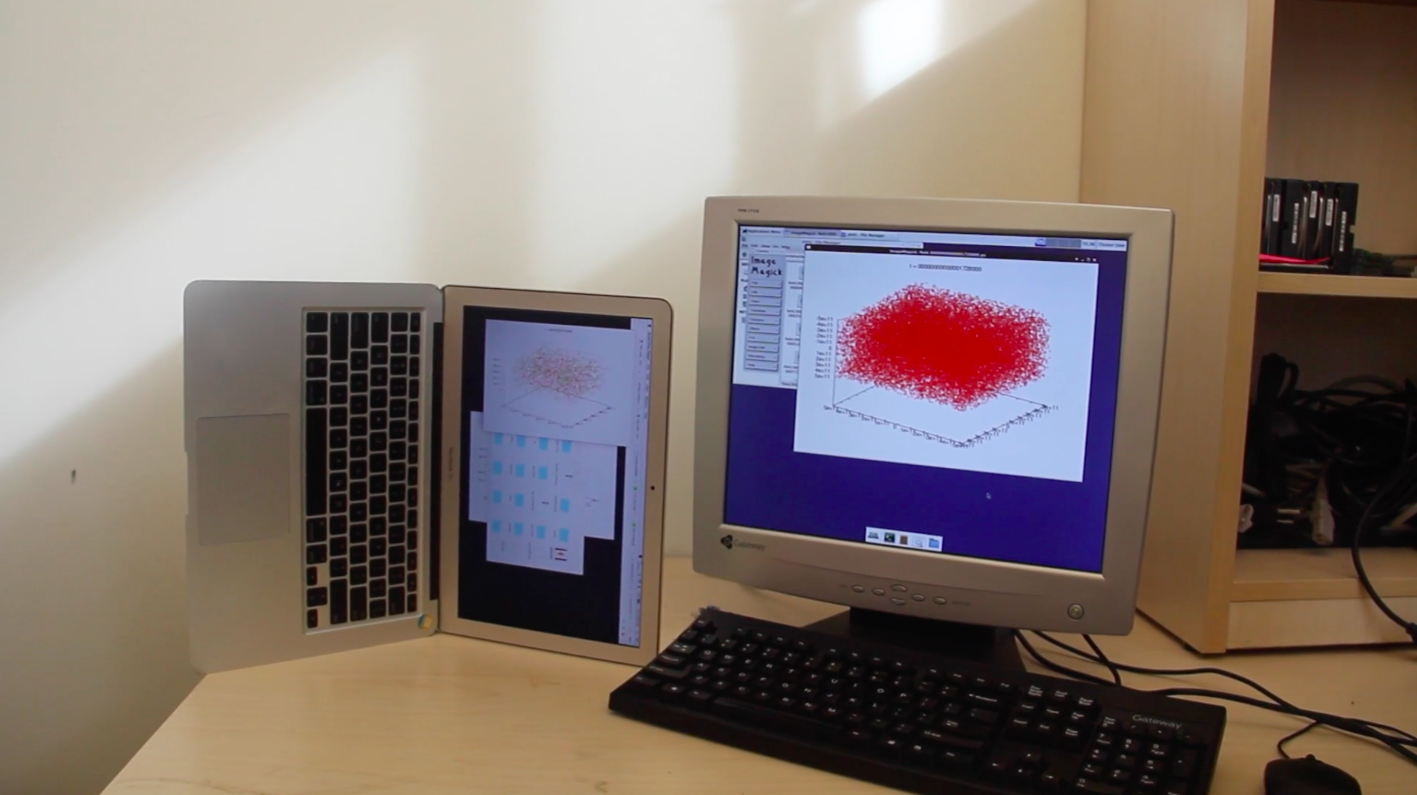
HSU students Sean Haas and Jack Eicher build a supercomputer to better conduct biophysics research on campus.
At large research institutions such as Lawrence Livermore National Laboratory and International Business Machines, or IBM, supercomputers can cost anywhere from $100 million and $250 million to design and assemble (Wagstaff, 2012).
Sean Haas, an astrophysics student, and Jack Eicher, a biochemistry student, built a supercomputer for nothing.
“All of the parts we used for the supercomputer came from eWaste and ITS,” Haas said. “Professor Chris Harmon from the chemistry department donated the rack that houses the supercomputer.”
Eicher said that students also donate computer components.
Information given to computers is stored in their short-term memory, known as the random access memory, or RAM, and the long-term memory hard drive. Supercomputers have an enormous amount of both storage types.
“Computers’ storage capacity are measured in bytes. The larger the bytes value, the more memory the computer can store,” Haas said. “A normal computer contains between four and eight gigabytes of RAM. Our supercomputer has 106 gigabytes of RAM.”
Processors are components that pull information from the RAM and hard drive to perform calculations. A processor is divided into multiple cores. The core amount determines how many calculations a processor can perform at one time.
“Our supercomputer contains 96 cores, which means that it can perform 96 calculations at one time,” Haas said. “When combined with the computer’s large memory, these 96 cores should allow us to do more calculations in a shorter period of time.”
Haas is now testing the supercomputer’s capacities using galaxy formation simulations. Galaxies are large collections of gas, dust and various materials that exist in space. By giving these particles different physical properties, computer simulations can change the the particles’ locations until they form galaxies.
Footage by Surya Gopalan. Edited by Linh Pham.
“On my normal computer, I can put 8,000 particles under the galaxy simulations, but galaxies are really big, and could contain millions of particles,” Haas said. “8,000 particles isn’t really enough to accurately resemble galaxy formations.”
Using the supercomputer, Haas has put 30,000 particles through the galaxy simulations.
“My own computer would melt if I try to do that many particles,” Haas said.
The supercomputer was born out of Jack Eicher’s wish to study biophysics at Humboldt State.
“I remember checking out library books about biophysics during my sophomore year and wanting to learn more about this topic in my classes, but there were no classes that teach biophysics,” Eicher said.
Biophysics is the study of living organisms using math principles and the laws of physics. The lack of resources for biophysics at HSU motivated Eicher to start his own biophysics learning community.
“I’m currently the president of the biophysics club on campus,” Eicher said. “Our club is very research-focused. We develop [biophysics-related] research projects based on the interests of both faculty and students.”
In biophysics, computer models are often used to explain how a biological phenomenon may work, especially when the phenomenon cannot be observed with previously existing methods. Some of these models, such as models that describe protein formation, require a supercomputer’s capabilities.
“Proteins are made from long chains of building blocks, or amino acids. Amino acids have different properties, allowing them to interact with each other. These interactions cause the chains to fold in different ways, eventually forming big proteins,” Eicher said. “Calculating all the ways that amino acids can interact to form a protein really requires a supercomputer’s power.”
“In the future, we plan on showing the galaxies simulation results to tech companies,” Haas said. “We hope that this would encourage the companies to donate more components for our supercomputer, such as graphics cards. This would allow Jack to start studying protein folding.”
Haas and Eicher’s supercomputer has already garnered interests from students and faculty, such as Ruth Saunders, a professor in the physics department.
“In my lab, we study how very small carbon tubes, called carbon nanotubes, are formed,” Saunders said. “We use computers to model these tubes’ formation, but some of our calculations would require two days to do on a normal computer. Using the supercomputer, we may be able to reduce our computing time, and simulate the formation of more nanotubes at the same time.”
For Eicher, building the supercomputer taught him an important lesson on resourcefulness.
“I honestly didn’t think that we would be able to build this supercomputer, given that our school has very low funding for research,” Eicher said. “But when we were able to put this project together, it made me realize that even if we have constraints to what we want to do, if we really want to do it, we can make it happen.”