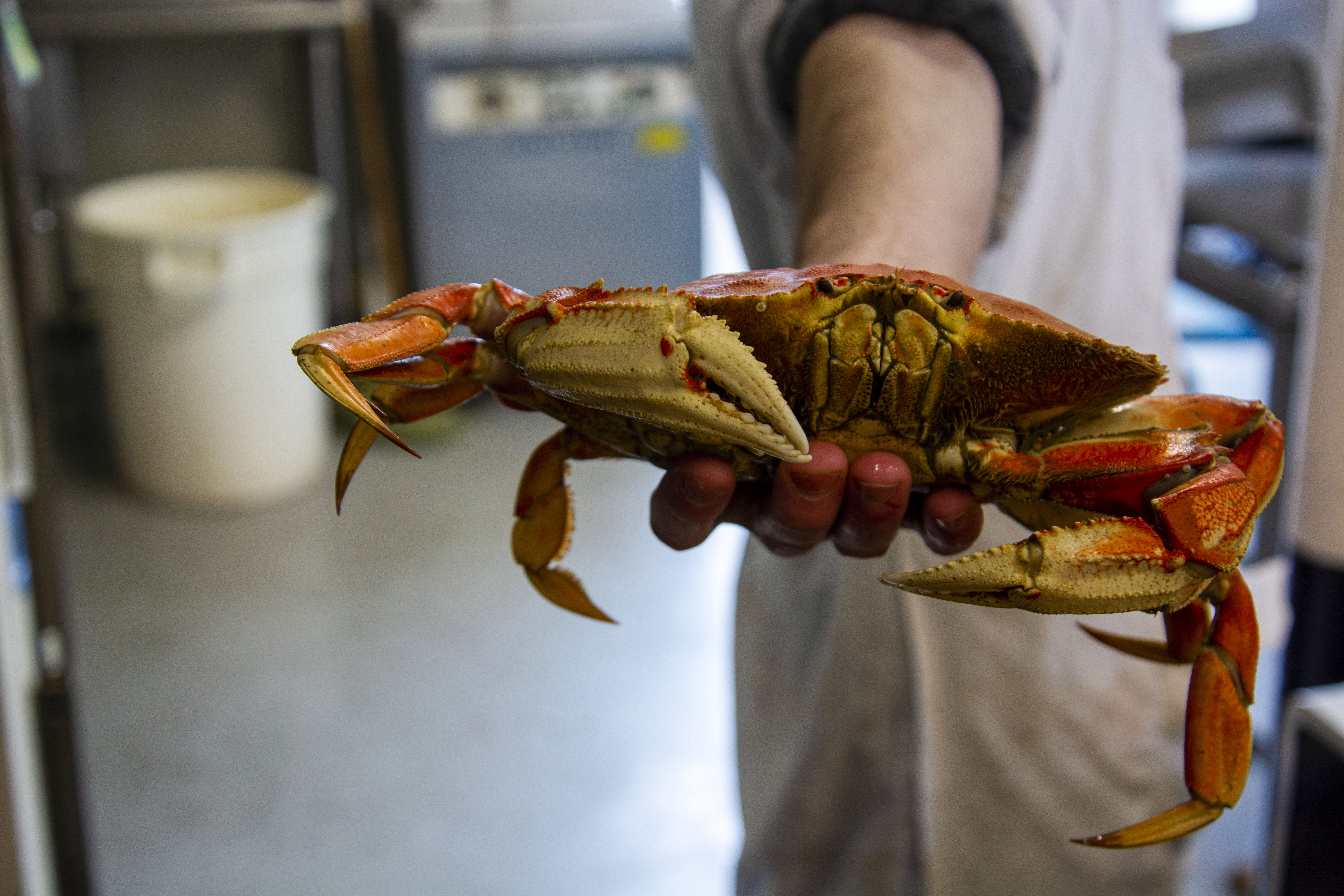
It’s officially Dungeness crab season in Humboldt county. Local fishermen have been given the green light to fish for local crab on the bay after a long year of negotiations and COVID. So, what does that exactly mean? The freshest and most decadent crab is now available to Pacific coast natives. The Dungeness is long sought after by food junkies for its richness and the demand hasn’t slowed.
The season was initially delayed from it’s original Dec. 1 opening when the Department of Fish and Wildlife found that crabs in the area did not weigh enough to carry out the necessary tests for quality.
“Based on the lack of data and the interest in cooperatively managing the interstate Dungeness crab fishery, I am delaying the opening of Dungeness crab season in northern California,” DFW Director Charlton Bonham said in a press release on Nov 20, 2020.
Now that the season is up and running, local restaurants across Humboldt county are featuring fresh and local Dungeness crab on their daily menus. If you find yourself in Trinidad, there are a lot of options to choose from.
Local resident Mary Mignani is on the hunt for the best crab cakes in Humboldt with it being crab season.
“You have to find the best ones, the best restaurant offering it because crab cakes are really a hit and miss,” Mignani said. “It’s all about the crab and the way it’s prepared, cooked, seasoned, it all makes a difference.”
Trinidad Bay Eatery offers an array of crab options for dinner. They have crab sandwiches when crab is fresh, crab cakes, seafood platters, and Cioppino, an Italian seafood dish flavored with white wine sauce.
Trinidad Bay Eatery also offers crab infused breakfast items such as their crab omelet and crab benedict.
The Lighthouse Grill offers a variety of crab dishes like crab melts and crab cake sandwiches.
Rita’s Margaritas offers crab tacos, enchiladas, and quesadillas with fresh Dungeness crab.
If you’re feeling adventurous and want to try cooking your own crab, there are plenty of options for that too. Many vendors across Humboldt are offering daily catches of fresh crab by the pound so you can try your hand at it. If you aren’t ready to cook crab on your own, many are offering their cooked crab for sale as well to add to your own homemade dishes.
If you’re interested in catching your own crab to cook, there are resources for that, too. The California Department of Fish and Wildlife is showcasing tutorials on their government website on how to fish and catch Dungeness crab. Along with supplies for the catch, you will need to follow state regulations and obtain a license which you can get locally in Trinidad at Murphy’s Market.
Whether you’re craving crab on the go, planning for a nice dinner, or spending the day on the pier in search of the rich Dungeness crab, Humboldt has all the options you would need to fulfill your seafood dreams in peak season.
Why HSU should bring back baseball in the post-football era
It has been over a year since the Humboldt State University football team played their final game ever, leaving local sports fans wondering how we are going to fill the void the HSU football team left in its wake.
Now that I’ve had some time to get used to a fall semester without the green and gold jerseys at the Redwood Bowl, it’s begun to feel more normal for HSU to be a school without a football team.
I know that bringing back the football team, at least in the near future, is an idea that seems like a pipe dream. Once you cut a program that was as much of a financial strain as the football team was, it is really hard to justify bringing such a program back. I think we need to explore alternatives of bringing back other, less expensive sports to HSU, and I know exactly what sport it should be.
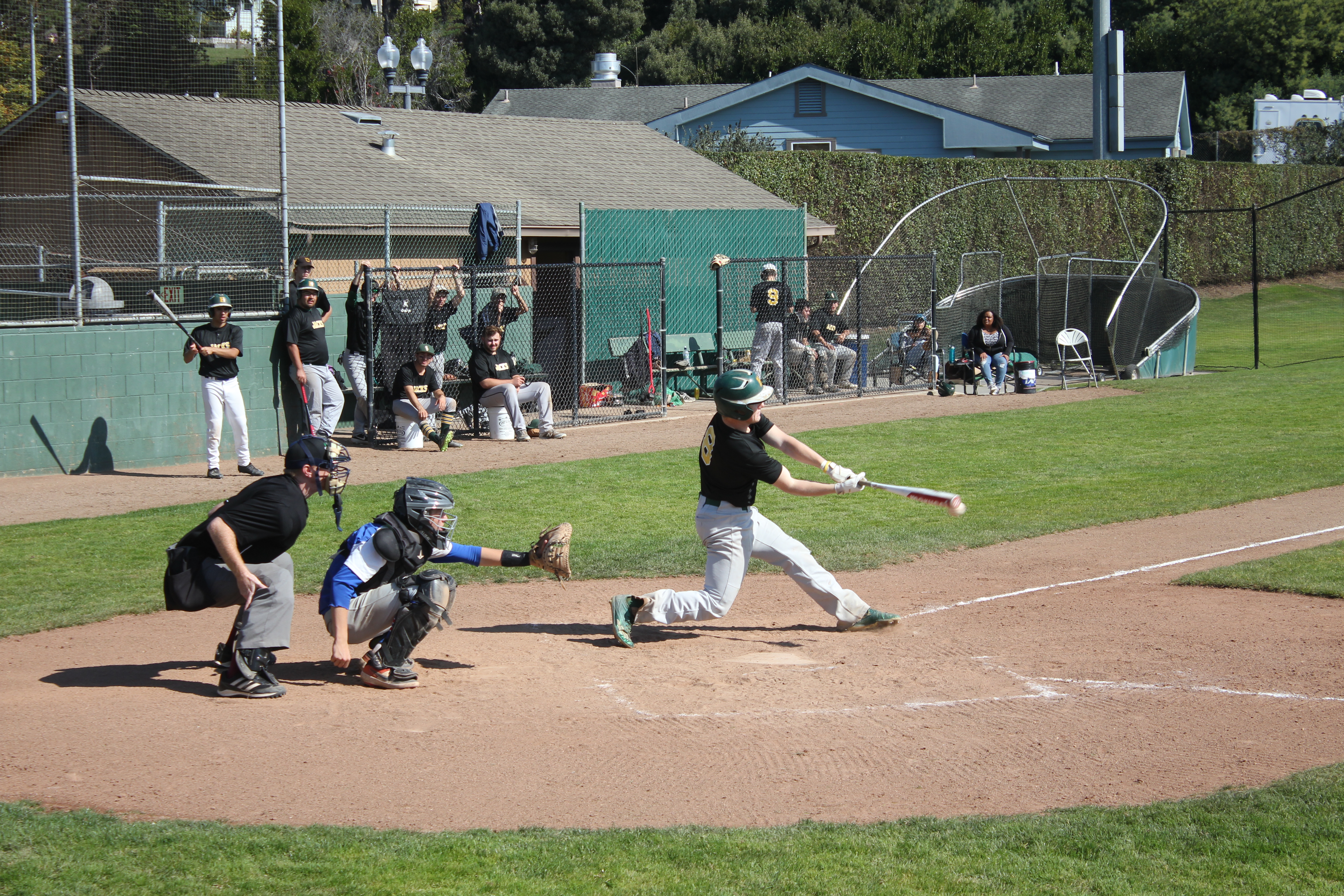
Humboldt State needs to revive its baseball program, and I know that HSU baseball would be very well supported by the community.
For one, sports fans in Arcata and the rest of Humboldt County love baseball. There is no bigger example of this than the support that Arcata’s summer collegiate baseball team, the Humboldt Crabs, receives every summer from June until early August.
“From a baseball perspective, an HSU baseball team would be a huge benefit to both the athletes that would play here and the Humboldt Crabs organization.”
Liam Warner
Experiencing a Crabs game is one of the purest forms of Arcata that you will ever experience. From the world-famous Crab Grass Band to the unique heckling coming from the fans, thousands of people pack the Arcata Ballpark every summer to watch the Crabs play. Unfortunately, this is when most of the student population is home for the summer.
Another reason why an HSU baseball team would be easy to start is because finding a facility to play at won’t be a problem. The Arcata Ballpark, which is located right next to Arcata City Hall, is considered to be one of the best ballparks on the summer baseball circuit. For a Division II baseball school, I’m sure we would have one of the best baseball facilities on the West Coast.
Having an HSU baseball team that plays at the Arcata Ballpark would also give fans a lot more opportunities to watch baseball in downtown Arcata. Typically, college baseball season runs from February into late April. The Humboldt Crabs season starts in late May or early June, meaning that we would have six months of baseball with a gap in May between the seasons.
I’m sure extending the season of high-level baseball in Arcata would provide a boost to the economy downtown, as it would allow the opportunity for more people to watch quality baseball at the ballpark.
From a baseball perspective, an HSU baseball team would be a huge benefit to both the athletes that would play here and the Humboldt Crabs organization. The Crabs draw quite a few of their homegrown players from the College of the Redwoods baseball team, so an HSU baseball team would naturally become a feeder of players to play on the Crabs during the summer.
HSU Jacks players would have the opportunity to continue their season on a well-established summer baseball club, and the Crabs would have a local pool of baseball players they could pick from.
Ultimately, it’s up to HSU athletics to make the decision to bring back a sport. But I think all of the factors are there to make an HSU baseball team a successful part of the community.
Benjamin Shaeffer’s double life as an HSU philosophy professor and Crabs’ baseball announcer
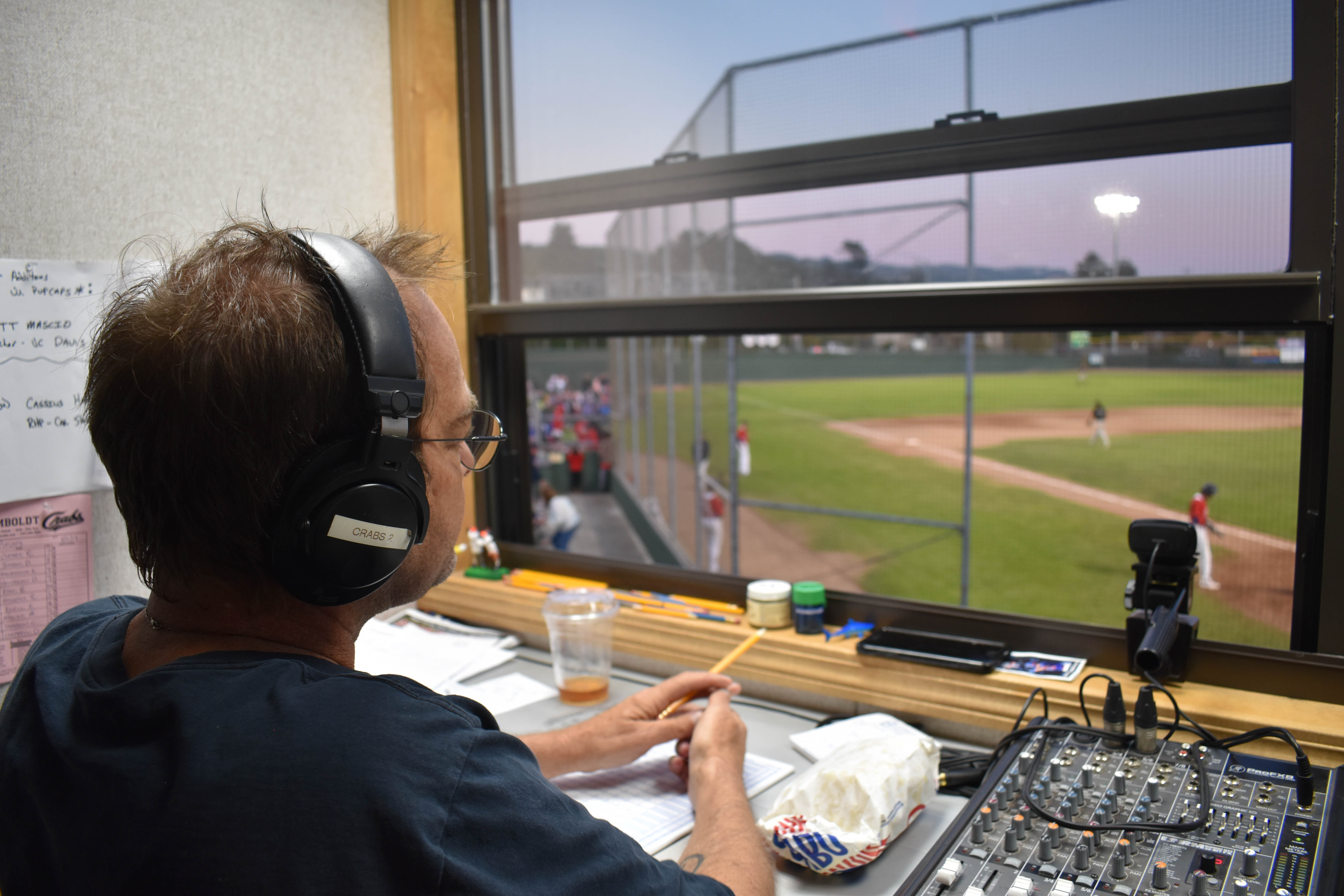
It’s a brisk June night in downtown Arcata as Benjamin Shaeffer arrives at the ballpark around 6:30 in the evening. He climbs up the ladder to the media booth, sets his personal belongings down, and says hello to the other people working in the booth that night.
Before the game starts, Shaeffer will usually talk to the others in the booth about world events of that day, philosophical musings, or about how bad the Giants are doing. He looks over the lineups for both teams, noting the pronunciation of the players’ names and he fills out his fielding chart, putting a player’s name in each position on the baseball diamond.
It’s around 6:45 p.m. when Shaeffer gets ready to put his voice on air, connecting to hundreds of radios, phones, and computers across Humboldt County and beyond. He puts his headset on, waits for the countdown to go on air, then begins the broadcast with, “Good evening Crabs fans around the world and around the block, on the world wide web, and on the radio, it’s time for Crabs baseball!”
Shaeffer is the current philosophy department chair and for almost 10 months of the year he teaches philosophy full time at Humboldt State University. For two months every summer, he spends his evenings in the Arcata Ballpark broadcast booth.
Shaeffer grew up in the Southern California city of El Monte, 13 miles east of downtown Los Angeles at the base of the San Gabriel Mountains. Journalism was his primary interest as he was the editor of his high school paper and then majored in journalism at Pasadena City College. But it wasn’t long before he started to lose interest in journalism, and it was then that he began to find what he believed to be his true calling in life.
“When I discovered philosophy, I realized that these are the questions I’ve been wondering about my whole life. I just didn’t know that you could get paid to ask them.”
Benjamin Shaeffer
“It seemed like it was more about selling papers than it was about informing people what was going on in the world,” Shaeffer said. “When I discovered philosophy, I realized that these are the questions I’ve been wondering about my whole life, I just didn’t know that you could get paid to ask them.”
Shaeffer went on to get his bachelor’s degree at UC Santa Cruz and then later received his Ph.D. at UC Santa Barbara. In 1998, not long after earning his degree at UCSB, Shaeffer accepted what he thought at the time was a one-year teaching position at Humboldt State University. Like many students and faculty who make the trek from LA to Humboldt, Shaeffer was not sure what to expect and was anxious about living in an unfamiliar place so far from home. He was certain that he wasn’t going to be in Humboldt for long and imagined he would return to his job in SoCal soon.
“I had this image of Humboldt,” Shaeffer said. “I thought I was going to live in the woods and it was going to be quiet like a small town. But when I got to Eureka and saw the Bayshore Mall, I was a little bit upset.”
Benjamin Shaeffer fills out his scorebook prior to the game. | Photo by Liam Warner
Aside from his interest in philosophy, a constant presence and a dear friend throughout Shaeffer’s life has been baseball. Shaeffer does not consider himself a sports fan as he has never been interested in other popular sports like basketball or football, but when it comes to baseball, he can recall the exact moment he fell in love with the sport.
“When I was seven, at the end of the street I grew up on, there was a park with a little league field,” Shaeffer said. “I remember going down there and just being fascinated by watching these kids plays baseball. I started to play as soon as I was old enough to play, but I didn’t get past little league.”
Thankfully, it wasn’t long before Shaeffer discovered the Humboldt Crabs baseball team that played their summers in downtown Arcata.
“I was in heaven,” Shaeffer said.”I started to hang out at the games, and in 1999 there was an opening for a ballpark announcer. I wanted to be the ballpark announcer.”
Although Shaeffer didn’t get the ballpark announcing gig, there was an opening for an official scorer and he took that position. After being the official scorer for a year and hanging out in the booth next to the radio broadcasters, Shaeffer was given a chance to be on the radio. He would then join Robert “Hoke” Holcomb on the Crabs radio broadcast, and that started a summer tradition that continues to this day.
“I always said that if you didn’t get along with Benjamin Shaeffer you had a personality disorder and you needed to see somebody.”
Hoke Holcomb
“So I sat right next to [the radio broadcasters],” Shaeffer said. “I would interject things over the air, and then after the first season Hoke asked me if I wanted to volunteer. He asked me ‘why don’t you be my color man?’”
Benjamin Shaeffer and Hoke Holcomb would develop both an on-air and off-air friendship that would last 19 summers before Hoke retired at the end of the 2018 season. Shaeffer and Hoke both came from an academic background, were politically active, but most importantly loved the game of baseball, and that made for instant on-air chemistry.
“I always said that if you didn’t get along with Benjamin Shaeffer you had a personality disorder and you needed to see somebody,” Holcomb said. “I think he brings enthusiasm to the broadcast without having that enthusiasm drown out what he’s conveying.”
Throughout his summers as the voice of the Crabs, Shaeffer has brought a unique perspective to the sport of baseball, often sprinkling philosophical musings throughout the broadcast. His philosophical background allows him to view the game in a different light, valuing the slow and building moments of the game rather than the high energy, action-packed moments.
Photo by Liam Warner
“I think the thing about baseball that is philosophical is its slowness and its meditative quality,” Shaeffer said. “It creates tension and that’s the source of its excitement, rather than speed and things moving really fast. It builds to these moments of tension that have to get resolved.”
Tim “Tres” O’Brien is one of the Crabs’ current ballpark announcers. He worked in the booth back in 2004 and then returned to his ballpark announcing duties in 2016. Tres has listened to Shaeffer both in the booth and on the radio, and he talked about what made Shaeffer a unique baseball announcer.
“Benjamin, while I think his style is more straightforward, he would have intellectual humor that would come out here and there,” O’Brien said. “He would ‘mini ponder’ about a certain play, and he would bring this other element to announcing a baseball game.”
Shaeffer’s day job might be teaching philosophy for most of the year, but to him, there is no better place to be during the summer than high up on that perch above the Arcata Ballpark, watching baseball.
“If I find somewhere where there’s baseball, I go,” Shaeffer said.
Standing at the fish counter at Katy’s Smokehouse, you get a sense of the sea around you. The breeze and the roar of the sea is right outside, while the inside is warm. The experience is accompanied by the aroma of smoked fish. If you like fish and crab, there is no place like Katy’s.
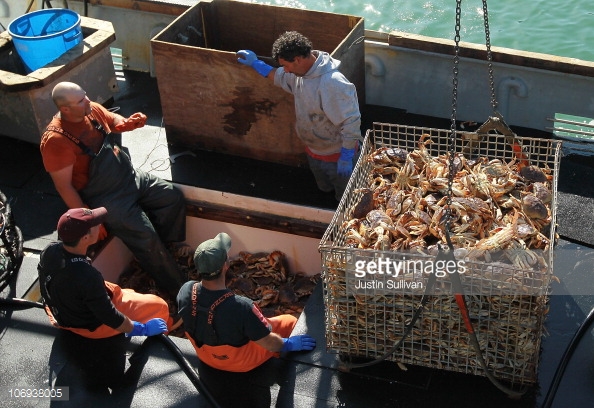
Bob Lake is the owner of Katy’s Smokehouse in Trinidad. He makes his living off of the sea, selling fish at his market. Lake’s routine involves loading and unloading boats and supplying bait to the Trinidad Crab Fleet at the pier, which is located just down the street from his market.
The North Coast Crab Fleet consists of Eureka, Trinidad and Crescent City combined. The ideal Dungeness crabs have a 25 percent to 28 percent meat-to-shell ratio, but crabs can even get as big as 30 percent, meat per shell. The official ratio for the commercial crab fleet is set at 25 percent meat to shell. People pay good money for Dungeness crabs, and fishermen don’t want to sell anything but the best. A crab with a 25 percent to 28 percent meat-to-shell ratio means a happy customer.
Fisherman went out Tuesday, Jan. 23 to catch some crabs to send to the processor for meat-to-shell ratio tests. Up until now, the crabs have had a 19 to 20 percent meat-to-shell ratio this season.
“It would be a waste of a resource, and a travesty, to take these crabs in the condition they are currently in,” Lake said.
Crab developmental problems have been due to the possibilities of a late molting period and less available food on the ocean floor. The competition for food is a big factor. When crabs get into this state, cannibalism becomes prevalent, and the weak get eaten by the strong.
“There is just not enough food to keep every crab full,” Lake said.
Testing protocol states strict testing sites and no selecting of the catch. If the fishermen were to bring in poor crabs and delude the processor, the observers themselves could not afford the cost of doing business. The yield, quality and customers’ perceptions of the crabs are worth the substantial amount of money it costs. These details are all taken into account before the crab season begins. Crab fisherman have to protect the resource and their customers.
As fishing officially begins, the market sets the price. If the fleet catches a lot of crabs, the price goes down. If more crabs are being caught than can be sold at market, the price will be lowered to allow more people to buy the abundant crabs. If at some point there are not enough crabs, or if the market is sucking them up faster than the fisherman can bring the crabs in, then the price will go up.
The locally agreed upon ex-vessel price is set by the large buyers and the Fisherman’s Market Association that represents the North Coast Crab Fleet’s three ports in Eureka, Trinidad and Crescent City.
“The retail price will be around $4.99 per pound,” Lake said. “Canneries and processors pay fish taxes, loading fees, transportation and the employees get paid to cook the crabs.”
Lake and the crew of the F/V Joie-Lynn, Cary Meyer and Clark Ward, all expect a very good year for crab lovers and the fleet alike.
“I was born with optimism,” Ward said.
Optimism swirls aboard Meyer and Ward’s crab fishing vessel, Joie-Lynn. Meyer and Ward said the crabs were caught, tested and showed 25 percent meat-to-shell last week, meaning the crab season can get under way as soon as a dock price per pound for Dungeness crab is set.
This story was updated on Feb. 1, 2018 from its original publication on Jan. 23, 2018 per request by the author.
This website uses cookies to improve your experience. We'll assume you're ok with this, but you can opt-out if you wish. Cookie settingsACCEPT
Privacy & Cookies Policy
Privacy Overview
This website uses cookies to improve your experience while you navigate through the website. Out of these cookies, the cookies that are categorized as necessary are stored on your browser as they are essential for the working of basic functionalities of the website. We also use third-party cookies that help us analyze and understand how you use this website. These cookies will be stored in your browser only with your consent. You also have the option to opt-out of these cookies. But opting out of some of these cookies may have an effect on your browsing experience.
Necessary cookies are absolutely essential for the website to function properly. This category only includes cookies that ensures basic functionalities and security features of the website. These cookies do not store any personal information.
Any cookies that may not be particularly necessary for the website to function and is used specifically to collect user personal data via analytics, ads, other embedded contents are termed as non-necessary cookies. It is mandatory to procure user consent prior to running these cookies on your website.