Innovative research and a discovery in HSU’s molecular biology lab
Biology professor John Steele guided a cell biology lab his first year at HSU wherein he wanted to teach students that cells need nutrients to survive. After 48 hours, the lab discovered quite the opposite. James Gomez, a current student in the lab, had the opportunity to research more into the groundbreaking discovery.
“In science, you’re kinda looking for that unexpected stuff,” Gomez said. “Right after I came in, I was really excited to be a part of that. There was this thing that was happening that we particularly can’t fully explain, and I’m actually in the lab doing that science.”
Steele’s experiment for his class involved students starving the cells of nutrients to trigger a state of autophagy, which is when the cell starts to consume itself. Steele meant to emphasize that cells needed nutrients like amino acids and lipids to survive. It was assumed that starving cells of key nutrients eventually killed them.

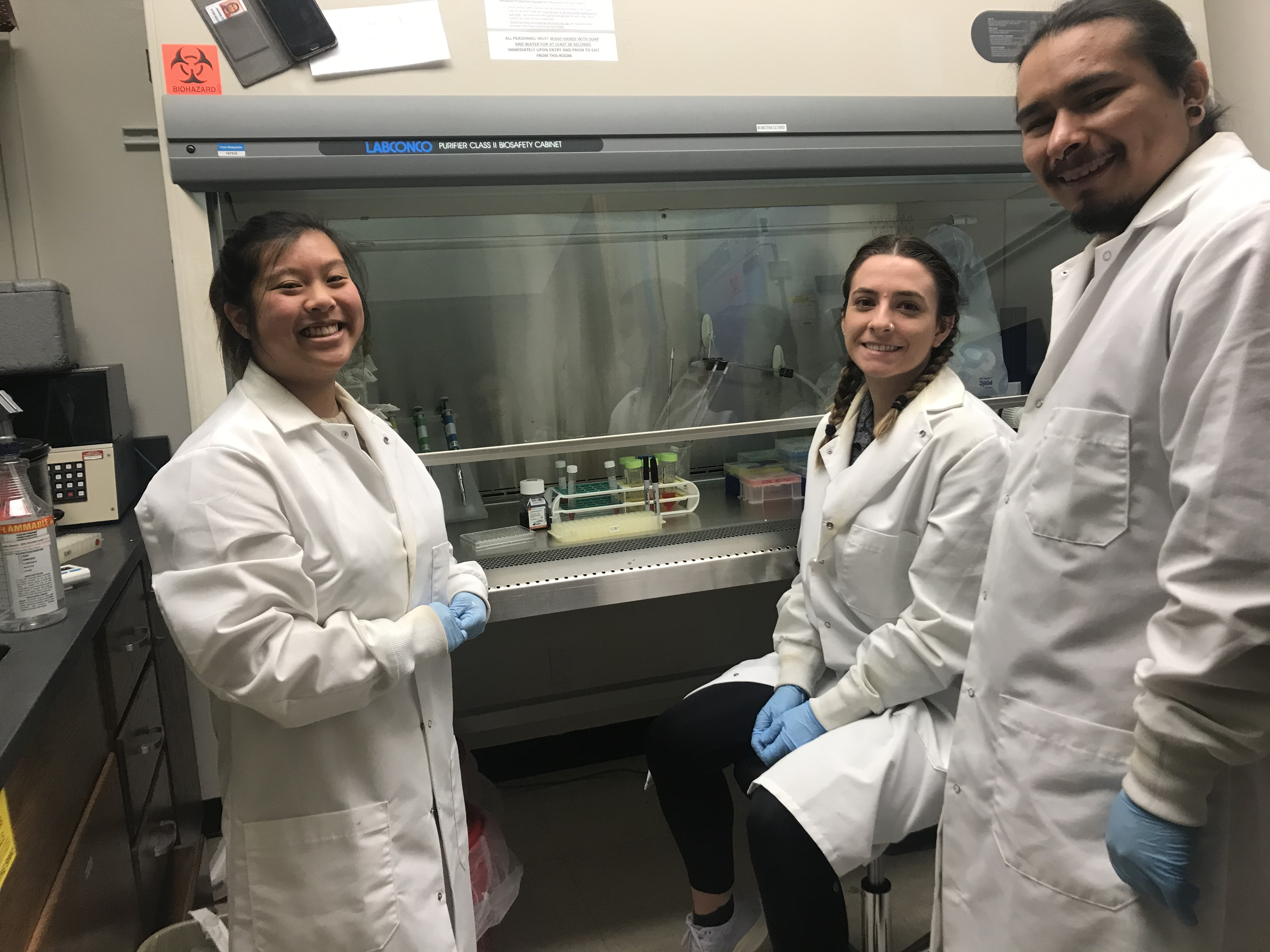
John Steele in his lab with graduate students in the background working on their research on Jan. 31. The lab specializes in molecular biology. | Photo by Collin Slavey
Steele said the experiment was common, and was usually shut down after six to eight hours. Steele decided to run it for 48 hours instead, since that was the time between lab sections. When his class returned returned to the lab, rather than seeing a bunch of dead cells, they were decidedly more alive. The lab had made a discovery.
Despite the cells being in autophagy in Steele’s experiment, they had stopped dividing and took on a strange morphology. Their metabolic rate was high—they were very much not dead.
Now the lab, including Gomez, are deep in research. The lab is introducing pathway inhibitors, or drugs, to block basic cell functions, narrowing down the essential and non-essential. The project is open-ended, as students methodically look at every cellular pathway to determine the needs of cells.
“What I love about this project is that it was born here,” Steele said. “Nobody else that I know of is working on this, outside of HSU. That’s an awesome process to be a part of, where students get hands-on training in phenotypic genetic screening and drug screening, and we get to learn about the basic biology of cells in doing this.”
Steele encourages the students in his lab to explore the boundaries of their knowledge. CRISPR, Cas9 and stem cell cultures are unique tools available to these students, and they offer an opportunity to think outside the box and do creative science.
Steele’s lab combines bio-technologies using unique stem cell cultures and genome editing techniques. The lab cultures stem cells—cells which can grow into any cell type—and chops up DNA using CRISPR, a revolutionary gene-clipping tool, to learn how rare neurodegenerative diseases develop in the brain.
“There have been some really cool applications of CRISPR out there. And they’re just because somebody said, ‘I wonder if we could do that?’ and they did.”
John Steele
Steele’s graduate student Kyle Anthoney, on the other hand, is working on making a model of a rare disease called progressive supernucleogical palsy, which looks like a combination of Parkinson’s and Alzheimer’s diseases. The disease is a tauopathic disease because a main characteristic of the disease is a buildup of the tau protein, which blocks some necessary cell functions. To understand the finer details of the disease, Anthoney developed a new method for growing neurosphere cell types into what is, effectively, a miniature brain.
Scientifically named 3D neural sphere cultures, these miniature brains offer a platform for researchers to study three types of brain cells at the same time. Anthoney’s method allowed him to organically grow neurons, oligodendrocytes and astrocytes, three dominant cell types in the brain, from human stem cells, so they would develop naturally like they would in a growing brain.
Anthoney’s research is up for review in a number of scientific publications and his name is on some breakthrough scientific papers. He is contributing to research about progressive supernucleogical palsy and other tauopathic diseases. His research concentrates the tau protein in a miniature brain to simulate the symptoms of progressive supernucleogical palsy, and he is exploring how the protein and disease impact his lab-grown brain cells.
“There have been some really cool applications of CRISPR out there,” Steele said. “And they’re just because somebody said, ‘I wonder if we could do that?’ and they did.”
