by Alex Anderson
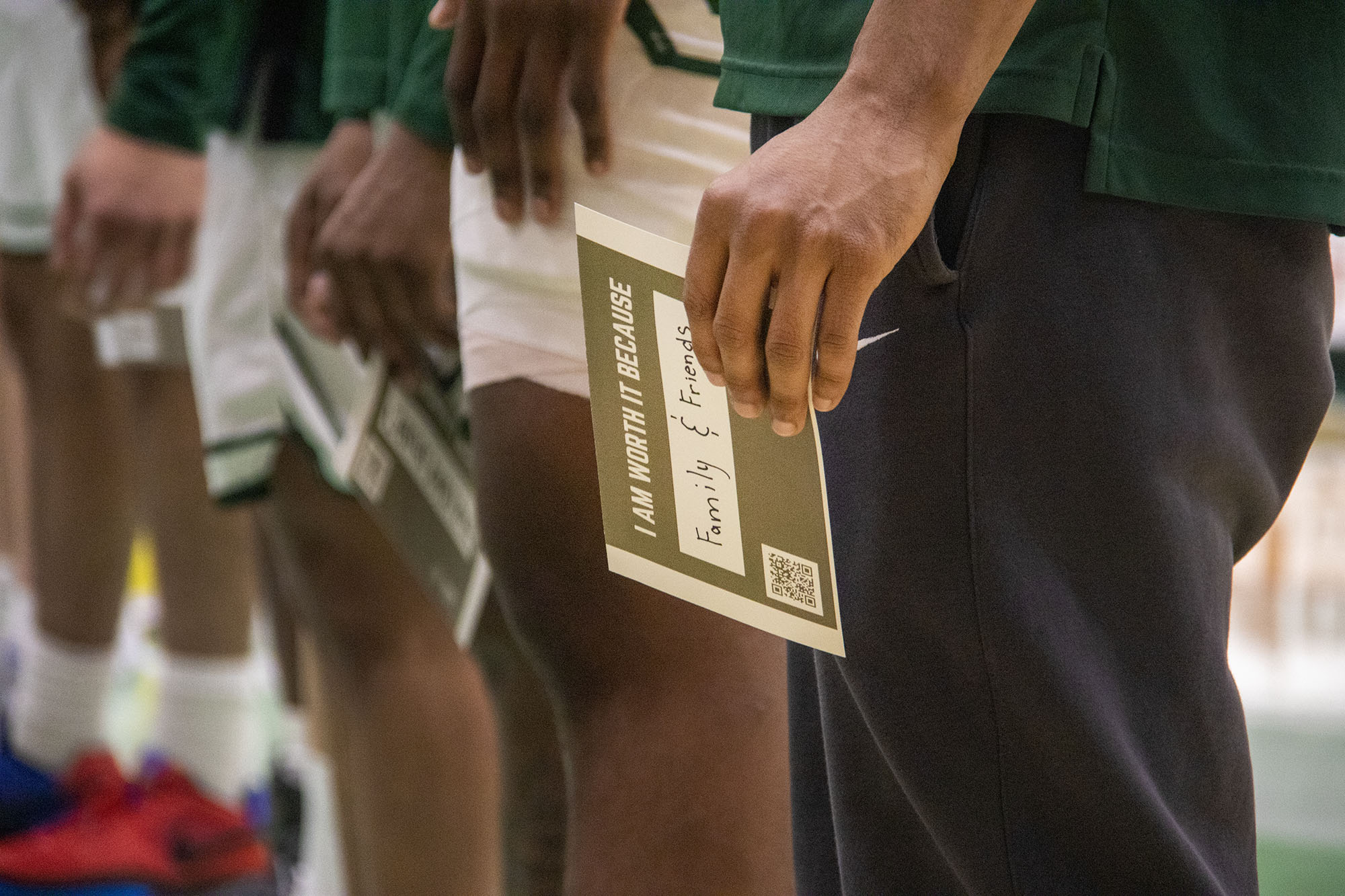
Walking into the arena, music blaring, teammates running onto the court mentally preparing to go to battle. Coming together and huddling as one, teammates are there for each other. Lining up with signs in hand, showing the world why they are damn worth it.
The Humboldt branch of Dam Worth It (DWI) celebrated Cal Poly Humboldt men’s and women’s basketball in the Lumberjack Arena on Saturday, Jan. 27. Despite the Lumberjacks losing both games against Cal State San Marcos, athletes from both teams came together as a community to recognize the significance of mental health awareness.
DWI started in 2017 as a campaign to end the stigma surrounding mental health, and has been raising awareness and fueling conversations around mental health in college sports ever since. Coaches, players, cheerleaders and fans celebrated DWI, shedding light on mental health through storytelling and community.
Vice President for DWI’s Humboldt branch and former Cal Poly Humboldt athlete Gianna Giacomotto described what DWI’s mission is among college athletes. According to Giacomotto, a senior studying psychology, opening the dialogue about her struggles has helped her find comfort through hard times, and has facilitated the ability to help others going through the same struggles.
“I have struggled with mental health for a lot of my life and it’s really affected both my ability to perform on and off the court,” Giacomotto said. “I have found that by talking about it and being open about my mental health that I find personal ease through that and I also am able to find that I help others by making it less controversial to talk about and helping people get the help they need.”

Opening the dialogue about the mental health struggles athletes face is a key component of DWI. Introducing the tough conversations that help facilitate healing and combating the stigma against mental health struggles in sports is the ultimate goal of the organization. As part of that goal, DWI organizes college sports events, such as the basketball games in the Lumberjack Arena, to show athletes that they matter.
“Having these games for our athletes lets them know that they’re not alone, we provide resources to all of our student-athletes and try [to] remind them that they are damn worth it,” Giacomotto said. “You are more than just your sport and your identity that comes with your sport.”
Juggling college athletics while trying to pursue an education is no easy feat. College athletes bear a heavy load navigating the world of performing on a team as well as in the classroom. Maneuvering through practices, competing in games, managing homework on the road, communicating with professors and combating injuries – all while trying to excel athletically and academically is the reality for college athletes.

Cal Poly Humboldt Women’s Basketball team in the group huddle during the Dam Worth It game against Cal State San Marcos on Jan. 27.
Delilah Kimble-Gray is a junior studying kinesiology and plays guard for Cal Poly Humboldt’s women’s Basketball team. Kimble-Gray knows firsthand how much time and effort is needed to succeed on the court and inside the classroom. On the Dean’s list from 2019 to 2022, as well as the Presidential List, Kimble-Gray puts in the time but knows the significance of communication and the ability to ask for help.
“Being able to continue, to keep going, keep your head on, being able to communicate with others I feel like is a challenge because as an athlete you don’t want to be seen as, ‘Oh, I’m not strong enough, or I feel weak’ but really you need that help,” Kimble-Gray said.
Currently sidelined due to a recent ACL injury, Kimble-Gray appreciates the need for community and communication.
“It’s hard. It’s my first major injury to my ACL. It’s the team, coaches and trainers that keep you going like a family, because it’s hard,” Kimble-Gray said. “You’re doing it by yourself, but you’re not – you know, everyone here is here to help you. It goes back to just asking for that help. That’s the challenge, being accepting of it and embracing the journey. Being within the injury is the hardest part, but everything else is super easy, as long as you just keep going and ask for help.”
Cal Poly Humboldt volleyball player Kaitlyn Patterson views Dam Worth It as a crucial safe space where athletes can share their stories. To Patterson, building a community and helping other athletes feel comfortable about having difficult conversations is indispensable. College athletes such as Patterson endure the difficulties that come with playing sports because they truly love the game.

“I would say just like the pressure of performing, trying to be perfect, of what the world wants,” Patterson said. “Ultimately, [I] have to dial down and really take it back, and realize that I am playing this sport for me – because I love it and not for anything else, not for the outside attention.”
Athletes such as Giacomotto, Kimble-Gray and Patterson embrace Dam Worth It’s mission of fostering community and dialogue. Ending the stigma related to mental health only strengthens that community.
“No matter what anyone says to us or what anyone dislikes about you, whatever you’re going through, you’re worth it,” Kimble-Gray said. “You can overcome any and everything as long as you know that you’re worth it.”