
The Lumberjack


Students Serving The Cal Poly Humboldt Campus and Community Since 1929

Tag: Dark matter

  • 14 Books to Read While Self-Isolating

    14 Books to Read While Self-Isolating

    There’s never been a better time to start reading books

    You’re stuck inside. You’ve already watched all the best shows on Netflix. You’ve already done your homework. Instead of wasting away the hours on social media, do something good for yourself and your mental state. Read a book.

    Maybe you’ve never read a book for fun, but don’t let that discourage you. Reading is for everyone. You don’t have to be an intellectual to enjoy books.

    Listed below are a few my favorite books—hopefully you can find something to check out.

    If: you want to read a dystopian satire set in a world eerily similar to our current pandemic-stricken one,

    Then read: Severance, by Ling Ma

    If: you want a thrilling, can’t-put-it-down time travel science fiction novel paced like an action movie,

    Then read: Dark Matter, by Blake Crouch

    If: you want to read a smartly plotted story of the very real lives of modern, urban Native Americans in Oakland,

    Then read: There There, by Tommy Orange

    If: you want a masterwork of combining science fiction and fantasy and also race relations in the first of a trilogy,

    Then read: The Fifth Season, by N.K. Jemisin

    If: you want the best damn story of friendship chronicling two women in Italy from the 1950s onward,

    Then read: My Brilliant Friend (and the next three books in the series), by Elena Ferrante

    If: you just want some relaxing, in-touch poems about nature,

    Then read: New and Selected Poems, Volume One, by Mary Oliver

    If: you want to experience Nobel Prize-winning literature mixed with a little science fiction fun,

    Then read: Never Let Me Go, by Kazuo Ishiguro

    If: you like history and want to reframe your perspective of society without feeling like you’re read a history book,

    Then read: Sapiens: A Brief History of Humankind, by Yuval Noah Harari

    If: you want to discover what it’s like to grow up without ever going to school and somehow ending up at Cambridge,

    Then read: Educated, by Tara Westover

    If: you want to read a saga about a Korean family living through multiple generations, spanning topics of love, family and history,

    Then read: Pachinko, by Min Jin Lee

    If: you want to get lost in the long, engrossing story of one kid’s slip into darker and darker rungs of society,

    Then read: The Goldfinch, by Donna Tartt

    If: you want some truly strange and original dystopian fiction with a giant floating bear,

    Then read: Borne, by Jeff VanderMeer

    If: you just want to read the words of a fearless, always-interesting filmmaker,

    Then read: Werner Herzog – A Guide for the Perplexed: Conversations with Paul Cronin

    If: you want to get existential and ponder how you experience life,

    Then read: Why Time Flies, by Alan Burdick

    Where should you buy a book if you want to pick one up?

    I always recommend supporting your local, independent bookstores, especially right now. Each book above is linked to Powell’s bookstore—probably the most famous independent bookstore, located in Portland, Oregon.

    If you’re in Arcata, you can order books online from Northtown Books and pick it up on the curb as of March 25. You can also order a book from Tin Can Mailman, which is shipping orders of $10 or more for free to anywhere in Humboldt, and orders of $40 or more for free outside Humboldt.

    Eureka Books and Booklegger in Eureka can also ship books to you.

    If you’re outside Humboldt, look up your local bookstore and see how to grab a book. More than ever, they could use your support.

    If you’d rather not have anyone handle your books, your alternative is to try the e-book versions. Happy reading!
  • Illuminating the dark

    Illuminating the dark

    Professor Derek F. Jackson Kimball sheds some light on his research into dark matter

    Gravity keeps us down, thermodynamics keep us warm and dark energy is getting big. CSU East Bay physics Professor Derek F. Jackson Kimball uncovers the nature of dark matter.

    Students from the physics department gathered in Science A 475 to listen to Kimball explain his research into the nature of dark matter. Kimball and his team hypothesized that dark matter is axion particles.

    Axion particles are hypothetical particles that are unbelievably small and weigh almost nothing. They’re classified as boson particles. This means multiple axion particles could occupy the same space without interfering with one another.

    IMG_4933.HEIC.jpg
    Professor Kimball pointing out equations used to determine the frequency of an axion’s rotation. | Photo by Collin Slavey

    Why does dark matter matter? Kimball used a colorful example to explain his pursuits in physics. His colleague Max Zolotorev, a former citizen of Soviet Russia, said that physicists care about dark matter because they “are curious to know how things work.”

    “Three percent of rats are physicists,” Zolotorev said. “In a Soviet experiment, an electrode is placed on top of a rat cage. Seventy percent of rats touch the electrode, get shocked and never touch the electrode again. Twenty-seven percent of rats watch 70 percent of rats touch the electrode, get shocked and never touch electrode in the first place. Three percent of rats touch the electrode and get shocked. Then the [three percent of rats] touch the electrode from the side, gets shocked. Then rats touch the top of electrode, also gets shocked. [Those] three percent of rats are physicists.”

    Kimball hopes to detect the axion particles in a rather unconventional way. Since the theoretical particle would be very small, Kimball’s team is going to try to detect them using magnetic resonance.

    Gynell Higby, a student of physics at HSU, attended the seminar. She was inspired by Kimball’s efforts.

    “Theories were taken from my modern physics class and made real,” Higby said. “That he can put together a new model from his mind and make it happen, it’s awesome.”

    Kimball is working together with physicists from around the world to figure out whether their axion hypothesis is valid. To detect axion particles using magnetic resonance, the GNOME program is a global network of sensors designed to record an event where the planet Earth passes through axion particles.

    The basic idea is to get a baseline recording of what space sounds like. When a sensor passes through dark matter, the axion particles in the air will change the baseline recording, appearing as a spike or a curve over the baseline data. Alas, so far there has been no such event.

    IMG_4920.HEIC.jpg
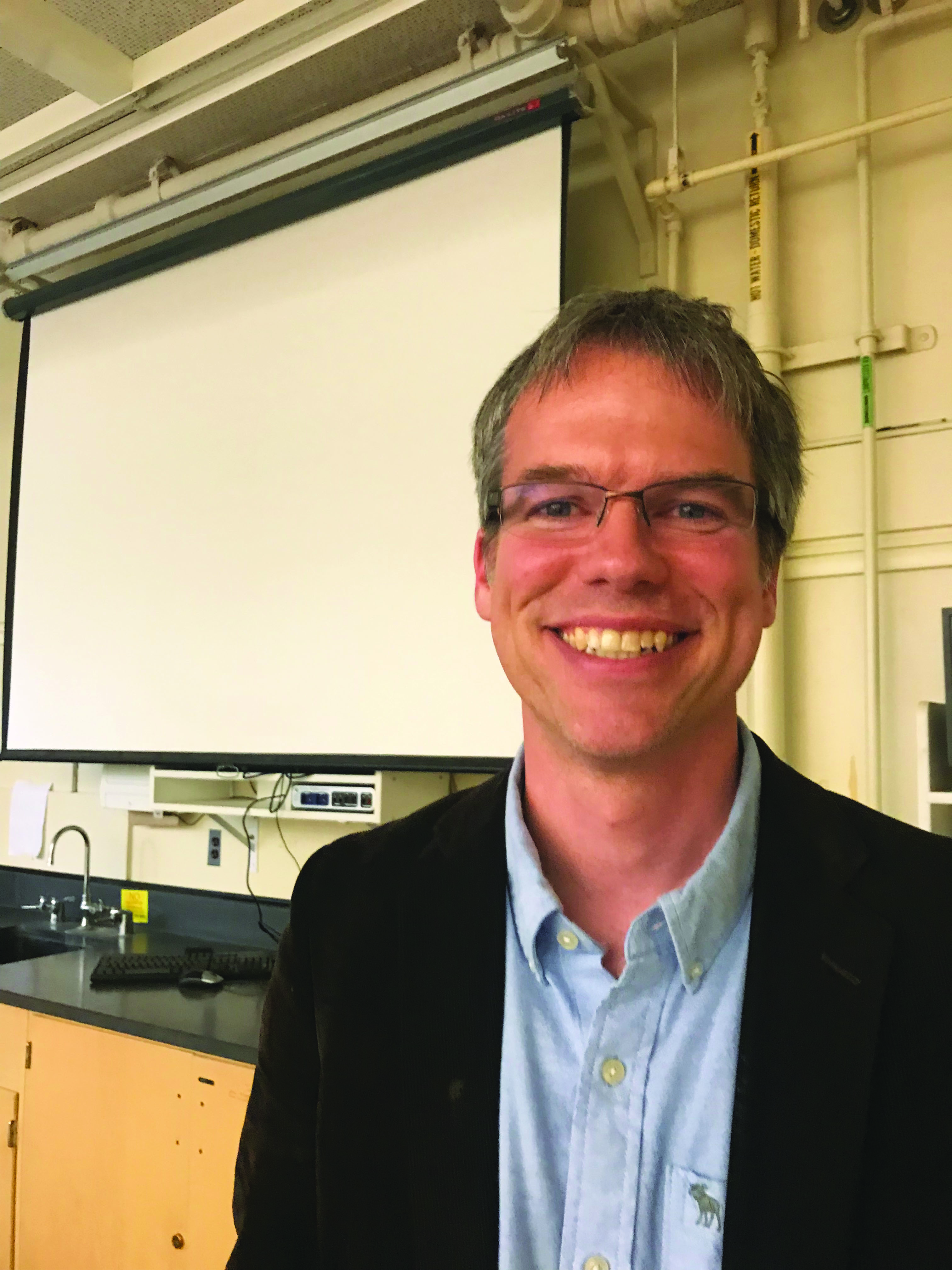
    Professor Derek Kimball | Photo by Collin Slavey

    Dark matter is a great mystery of nature. It won’t necessarily build a better toaster, but to discover what dark matter is will be a great human achievement. Kimball began his explanation of dark matter with a brief overview of what we know about it.

    First, we cannot see dark matter because it does not interact with light. That’s why dark matter is dark. Second, there is a lot of dark matter. Observations and a lot of complicated gravitational math inform us that dark matter makes up 26.8 percent of the observable universe.

    The remaining 63.8 percent of space is dark energy, an expanding force. And the remaining 4.9 percent of the universe is observable matter, stars, planets, galaxies etc. Finally, we know that we know just about nothing else about dark matter.

    Knowing so little drives Kimball’s research. Physicists know dark matter exists because of some significant astronomical observations. Primarily, the fact galaxies don’t spin themselves apart as they rotate tells us dark matter exists.

    If only the gravity from visible matter was holding galaxies together, galaxies would break apart and scatter stars across the universe. But they don’t. Gravity from dark matter and visible matter combined has enough force to hold galaxies together. The math works out to confirm dark matter exists.

    “We may be just swimming in dark matter,” Kimball said. “We could be able to detect it here from Earth today. Or maybe we are mostly sitting in nothing but every so often we run into dark matter. It may be clumped up in little dark matter balls or it may exist as massive dark matter walls. We will figure it out.”