The Lumberjack


Students Serving The Cal Poly Humboldt Campus and Community Since 1929

Tag: Democracy

  • Dismal democracy

    Dismal democracy

    The Lumberjack editorial staff comments on America’s flawed electoral system

    As the world watches the United States 2020 election results, waiting for our pseudodemocratic process to churn out a new president, historically unprecedented voting methods misrepresents the reported Election Day results.

    A common misconception surrounding the democratic voting process is that a casted ballot directly counts toward and impacts the presidential election. However, the reality is that every individual’s vote doesn’t hold the same amount of power or equitable value.

    The power and value behind your vote is entirely dependent on where you live. Because the electoral college ultimately chooses the president, not the people, the real value of your vote is determined by the ratio of individual votes to electoral votes in each state. 

    For example, California has a population of about 39.5 million. We have 55 electoral votes, one for each of our congressional representatives. That works out to about 718,000 people per electoral vote. Wyoming has a population of about 579,000. They have three electoral votes. Only one from their representative in the house, but two from their representatives in the senate like every other state. That works out to about 193,000 people per electoral vote. If you’re from California, a Wyoming presidential vote is worth 3.7 times the amount of yours. The story is the same for many of the less populated states.

    The voting process falsely validates casted ballots and ultimately undermines votes through the electoral college’s overriding casted vote. Ultimately, you’re not directly voting for a presidential candidate, you’re informing the decision of the electors who do. 

    Within battleground states, Democrats are sending in more mail-in ballots than their Republican counterparts. The New York Times estimates that 64 million mail in ballots were cast in this election, nearly three times the amount cast in the 2016 election. While COVID-19 played a significant factor in the disparity, pushes came from Democratic candidates across the nation to gain momentum moving into Election Day.

    Due to mail-in ballots accounting anywhere from 20-50 percent of the votes in different states, we may not know actual election results until days after election night. States, such as North Carolina, are planning to accept ballots postmarked on election night until Nov. 12. Some states have relatively small margins of difference, which could result in swing states prolonging the definitive results of the election.

    Additionally, the United States leaves self-declared territories, for example Guam and the Dominican Republic, neglected in the political process and without influence in the choice of US president. The same could be said for the millions of American citizens who have been deprived of their right to vote because of the criminal justice system. This imbalance significantly alters the demographic of voting participants, therefore not valuing or accounting for every community’s perspective. 

    This disparity leads to presidents with less votes defeating their opponents, or candidates never getting a clear majority. 

    While the Lumberjack staff believes the US’s democratic process is deceitful in terms of transparency, we do not agree or echo any of Trump’s sentiments that discredit voting. Instead, we believe his spewing of misinformation contributes to the detriment of the country’s Democratic Republic status. 

    The US glamorizes its democratic facade as legitimate, straight forward and for the people, however, systemic strategies have displaced and deprived American citizens of their Constitutional right to vote. Between systemic imbalance of the electoral college, active voter suppression and unequal voter representation, our democracy is rooted in unequal representation. 
  • Government shutdowns: uncertainty as a price for democracy?

    Government shutdowns: uncertainty as a price for democracy?

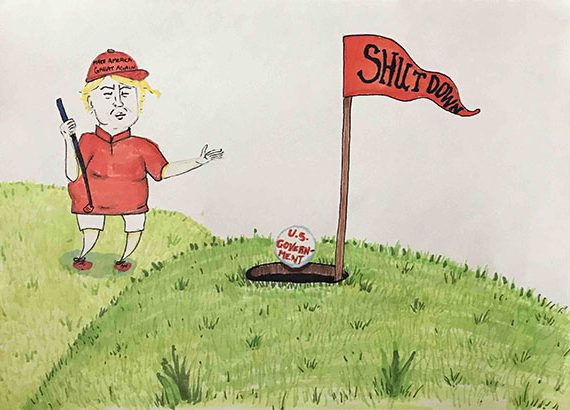
    The showcase of the United States’ unique democratic system happened on Jan. 20. It marked the one-year anniversary of a reality TV star’s presidential inauguration. It also highlighted the country’s freedom of speech in the form of a nationwide women’s rights demonstration, as well as the beginning of a short-lived government shutdown.

    Professor Stephanie Burkhalter, a political science professor at HSU who studies communication strategies between Congress and the president, provides more insights on the phenomena of government shutdowns.

    What is a government shutdown?

    A government shutdown occurs when the House of Representatives and the Senate cannot pass an appropriations bill — the technical name for a bill that funds the government agencies — that the president will sign.

    Shutdowns are a uniquely U.S. government thing, because of our constitution, the filibuster rule and our two-party system. The two parties have become increasingly polarized on policy issues and more willing to have a shutdown if they cannot get the policy changes that they think are important.

    What caused this previous government shutdown and why was it so short?

    This answer depends on whom you ask. The consensus from mainstream media sources is that the Senate Democrats caused the shutdown by filibustering and demanding that the Senate markup — the official term for editing a bill — and debate an immigration bill that would create a pathway to citizenship for DACA recipients, known as “Dreamers.”

    Senate Democrats agreed to fund the government through Feb. 8 in exchange for Senate Majority Leader Mitch McConnell’s promise that the Senate will take up an immigration bill in the next two weeks.

    In this shutdown, Democrats were also able to negotiate six years of funding for the Children’s Health Insurance Program. House Republicans had not funded this program in their version of the permanent appropriations bill.

    What does a shutdown say about the administration of President Trump?

    From my understanding, President Trump was ready to make a deal on Jan. 19 to avoid a shutdown, but his advisers scuttled the deal, because they believed that this deal was not tough enough on immigration policy.

    So, this shutdown says less about Trump and more about the partisan politics plaguing our nation’s capital.

    What could happen around Feb. 8?

    [On Feb. 8], the Senate will reconsider a permanent spending bill. If Democrats again decide to filibuster, another shutdown could occur if a deal cannot be reached between Republicans and Democrats on immigration policy.

    Government employees, such as those who work in the National Park Service and the Bureau of Land Management, will not be paid.

    ——–

    Eric Nelson, the manager of Humboldt Wildlife Refuge, an organization managed by U.S. Fish and Wildlife Service, detailed the obstacles a shutdown would impose on the refuge’s operations.

    “In 2013, there was a shutdown that lasted 13 days, I believe,” Nelson said. “Probably the most challenging part of a shutdown is dealing with the uncertainty, and what it can do to schedules and scheduled work.”

    Because shutdowns are often prevented at the last minute, preparing for them is difficult. Fortunately, most shutdowns occurred outside of the spring/summer restoration work season and did not pose big problems for the refuge’s projects.

    If a shutdown occurs on Feb. 8, the refuge will be closed to most of the public. However, independent researchers working on the refuge will be allowed to continue their work, as long as they can access their research site without the help of a federal employee.

    Nelson added that if the shutdown goes on for three to four weeks, the financial challenge of not getting paid will become an issue.

    “Ironically, Congressional members do get paid during a shutdown,” Nelson said.

    Burkhalter also recognizes that a shutdown’s impact is affected by its length.

    “The effects of a shutdown are felt the longer it continues,” Burkhalter said. “Let’s hope that the Senate can make a deal on immigration policy, a permanent spending measure can be passed and we can feel secure that our government is funded through this fiscal year.”

    On the potential of shutdowns that may occur beyond Feb. 8, Burkhalter said that they could happen again when Congress tries to pass appropriate measures.

    “I would not be surprised if a few more shutdowns are headed our way in the next few years,” Burkhalter said.