The Lumberjack


Students Serving The Cal Poly Humboldt Campus and Community Since 1929

Tag: disabilities

  • Understaffed SDRC struggles to support students with disabilities

    By Ollie Hancock

    Ash McElroy is a proudly disabled student. They came to Cal Poly Humboldt well aware of the hills and stairs the campus was built upon. McElroy informed Housing they would need an accommodating dorm for their mobility aid, Housing assigned McElroy to the notably inaccessible College Creek dorms on the hill.

    “To their credit, they put me on the first floor, but I could not get my chair through the door,” McElroy said. “I was like, hey, this is not working. Can we move me?”

    Housing took months to reply after denying the dorm was inaccessible in the first place. McElroy requested at least adding a push button to get in the door.

    “They told me that actually my building was accessible and they didn’t know what I was talking about,” McElroy said.

    In an email to McElroy, Housing said a locksmith had confirmed that the press to open button does work.

    “I had to have the SDRC go and take pictures of the building to prove that there is not one. Like how’s [Housing] straight-up gaslighting me about this?” McElroy said. It would take a few more months before housing accommodated McElroy’s needs.

    13% of Cal Poly Humboldt students have a disability, the second-highest rate of disability in any Cal State University. Humboldt is right behind Cal State Maritime Academy, which has only 600 students. At the Student Disability Resources Center, Mary Smith and one other part-time staff advisor address accessibility needs on campus. Smith believes the access to green space, small classrooms, and positive learning environment attract students with disabilities to Humboldt’s campus.

    “We feel like we’re drowning,” Smith said. “We have nearly 800 students with registered disabilities and one and a half advisors. At California State University San Bernardino, the ratio of accessibility advisors to students is one to 65. At Cal Poly Humboldt, the ratio is one to 500.”

    “A majority of the disabilities on campus are psych disabilities. It used to be learning disabilities,” Smith said. “Learning disabilities are much more manageable. It requires some training and accommodations, but usually, you set them up, and they’re good to go. Psych disabilities are a much more revolving door. You can’t set someone up, and they’re just good to go. The level of services is way more intense.”

    In the past years, between the pandemic and Cal Poly Humboldt’s fiscal history, Smith has struggled with job security.

    Two years ago, the administration offered a retirement buy-out offer. Smith took it and retired.

    “They never replaced me, and they called me back…I have so many asks, and I also have absolutely no job security,” Smith said.

    The strain of an undersupported SDRC can go undetected by non-disabled admin, faculty, and students. It is not something that disabled students have the privilege to ignore. Alicia Martin is a Cal Poly Humboldt grad student and the founder and director of Adaptable, the campus club for students with disabilities.

    “We’re the only club that serves this population of students on campus, and there’s a lot of pressure,” Martin said. “We’re not funded by A.S. It’s all just completely our time and our energy. And we love doing it, but it’s overwhelming. Because we end up having to support students who can’t access food. Who can’t get into buildings. Who aren’t able to hear or see their lectures. Who are months behind in course work because their accommodations aren’t met.”

    Martin is working with students on campus to transition to a post-pandemic world. The pandemic forced to change and exacerbated problems that impact students with disabilities. On the other hand, with so many people adapting to the pandemic new adaptive technologies became commonplace.

    “Some of this technology is very useful,” Martin said. “We have people who don’t use sign language and rely heavily on lip-reading, and so Zoom was great. Now, they’re transitioning back to the classroom.”

    Students with disabilities continue to support each other despite the obstacles and limited bandwidth on campus. They find support from each other while advocating for universal design. Universal design centers on usability and access for all. It often makes life more convenient for everyone when design is accessibility-based. Accommodating issues on a need basis frames people with disabilities as a problem.

    “We are not the problem,” Martin said. “[Campus operates] on a medical model of disabilities. In a social model, the people who say I can’t are the problem, not me.”
  • Seeing is not believing: hidden disabilities in science students

    Seeing is not believing: hidden disabilities in science students

    Every morning, Humboldt State University senior and cellular molecular biology student Shazi Saboori wakes up next to a stack of pill bottles.

    “Depending on the day, I take between 8-10 pills, including Adderall when I wake up,” Saboori said. “I then eat something small, lay in bed for 30-40 minutes and wait for the Adderall to kick in, and allow me to have access to my brain.”

    Six months ago, Saboori was diagnosed with postural orthostatic tachycardia syndrome, or POTS.

    “There’s a part of my brain that cannot regulate blood flow,” Saboori said. “This causes me to get blood pooling, have a sudden drop in blood pressure and almost faint.”

    Saboori’s body attempts to increase the pressure drop through tachycardia, an extremely fast pumping of the heart while it’s at rest.

    “At one point, my resting heart rate was 214 [beats per minute],” Saboori said.

    In addition to tachycardia, POTS inhibits the left side of Saboori’s brain from communicating with the right side.

    “In my classes, I can’t just read the book and understand the material,” Saboori said. “I take a long time to make a master study guide, and to write and rewrite the material. I still get mediocre scores on tests.”

    POTS also causes Saboori to have anemia, or red blood cell deficiency, and gastric distress, which makes eating difficult. Saboori feels frustrated when people do not acknowledge her disorder, because it isn’t visible.

    “Many people have told me, ‘You don’t look like you’re sick,’” Saboori said. “I’m not looking for pity, or for people to lower their expectations for me. I’m looking for people to understand that [POTS] is not something I can control.”

    Michelle Goldberg, another HSU senior cell/molecular biology student, has ankylosing spondilitis (AS).

    AS is a form of rheumatoid arthritis (RA), which leads to joint degradation and inflammation of the surrounding membrane. Goldberg was first diagnosed at 12.

    “For awhile, I went to a support group for people with RA,” Goldberg said. “Most of the people there were adults. I was there with my dad.”

    RA causes Goldberg to experience pain in her lower body, center of spine, hips and joints.

    “When I feel good, I go to the gym, and do a little bit of elliptical and weight,” Goldberg said. “If it’s bad, I take some Aleve and put a smile on my face. Some days, I can’t stand up straight. Luckily, this has only happened twice since I’ve been at HSU.”

    Similar to Saboori, Goldberg recognizes that an invisible disability is not taken seriously.

    “Sometimes, I can encounter people who say, ‘You’re fine.’ But really, I’m not,” Goldberg said. “You can’t see what I have until my knees are really inflamed, and turned red.”

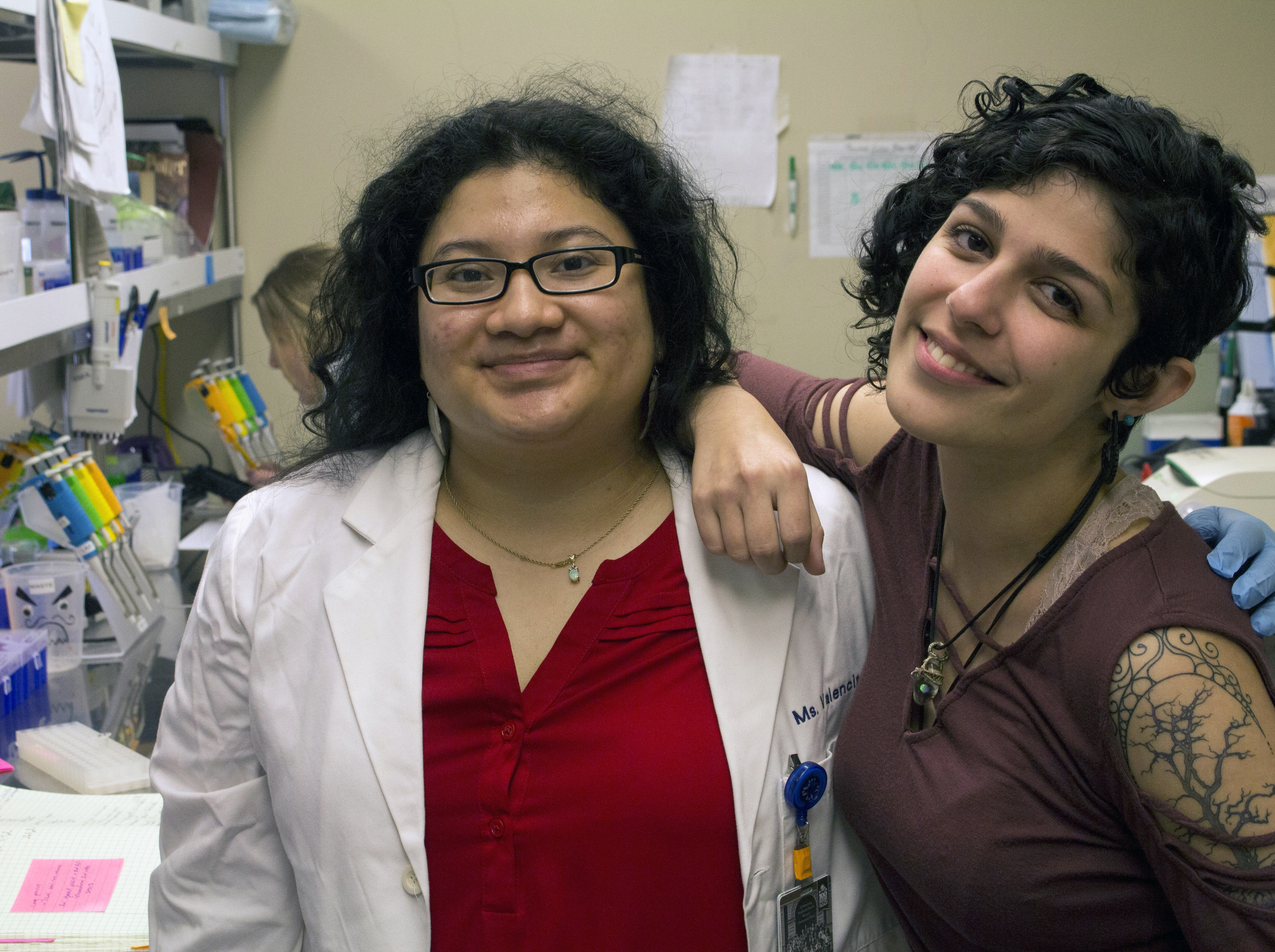
    Stephanie Valencia, also an HSU senior cell/molecular biology student, took eight years to finish a bachelor’s degree due to her hidden disorders.

    “I became friends with my microbiology teacher at my community college,” Valencia said. “She told me to get tested for a learning disability. I didn’t always have the best grade, but she believed I was a good scientist.”

    Valencia was diagnosed with a processing disorder, similar to autism and dyslexia. For people with processing disorders, learning new things takes a lot more time.

    “I wanted to know why I didn’t figure this out when I was younger,” Valencia said. “[My psychologist] said that a lot of people who are brown, like me, don’t get diagnosed until they’re in college. Elementary school teachers assume that brown students are dumb. They don’t push for students to go get tested.”

    When Valencia transferred to HSU, she began to suffer from anxiety attacks that caused her to miss classes. She was eventually diagnosed with generalized anxiety disorder, or GAD.

    “There’s a stigma about anxiety and depression in the sciences,” Valencia said. “People think that you don’t have the mental capacity to complete a rigorous program in STEM.”

    Valencia hopes to eventually become a physician-scientist in the field of neuroscience, even though the stigma around GAD could cause her some difficulty in pursuing her dream.

    “Unfortunately, people may not give you the opportunity to show that you could do it when they know of your disability,” Valencia said. “People think, ‘Oh, maybe she can’t.’ It’s the maybe that gets in the way of me being able to prove myself.”

    For more information on individuals with disability in the sciences, check out Dr. Mahadeo Sukhai and his book Creating a Culture of Accessibility in the Sciences.