The Lumberjack


Students Serving The Cal Poly Humboldt Campus and Community Since 1929

Tag: Earth Week

  • Capitalism is cancer

    Capitalism is cancer

    Earth Week kicks off with a Trashion show and David Cobb as keynote speaker

    A fashion show highlighting wardrobes made of trash, awards given for sustainability and a speech given by Cooperation Humboldt board member David Cobb kicked off Humboldt State’s Earth Week.

    The “Earth Week Every Week” committee is a coalition of Associated Students programs and student clubs that organized the event to educate, create community and foster dialogue on issues of social and environmental justice, human and non-human rights and healthy lifestyles.

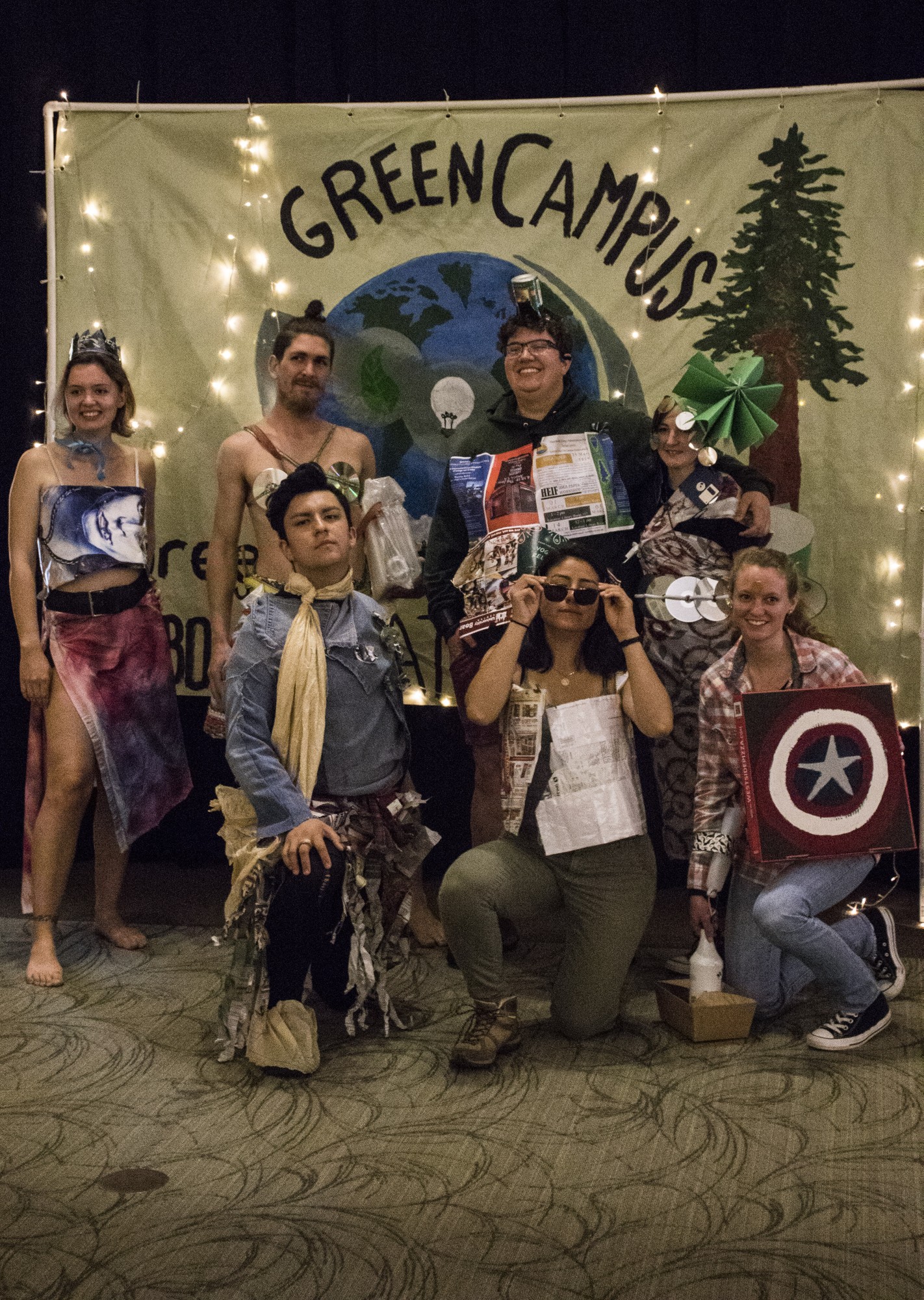
    The “Trashion” show that started off the event was organized by Green Campus Team Lead Morgan Kipf.

    31c93b6f-5388-409a-a751-b76b9805d840.jpg
    Trashion Show contestant on the stage striking a pose. | Photo by T.William Wallin

    “Our main goal is to spread awareness of sustainability and encourage behavioral change on campus,” Kipf said. “We also want to help save energy and water on campus.”

    The Trashion show is a fashion show competition that promotes fashion creativity, waste reduction and sustainability. There were students adorned in old sheets crocheted by their grandma, recycled posters and beer cans acting as crowns. Beads held together warped and scratched CDs worn as crop tops walked the runway of the stage as techno music blared in the background.

    Kipf said the third annual Trashion show was by far the biggest it’s been and gives her hope to include community members in the future.

    “This is something I’ve always been a lead in,” Kipf said. “It started off as fun and silly and hopefully it keeps on growing.”

    Trashion Show contestant on the stage striking a pose with a crown made of beer cans. | Photo by T.William Wallin

    It’s organizations like Green Campus that Associated Students Environmental Sustainability Officer Isabel Sanchez said helps to create Earth Week. Sanchez is the head of the Earth Week Every Week Committee and said their role in A.S. is to make sure Earth Week happens and there is a committee in charge of it.

    “I helped create this event and 20 other ones,” Sanchez said. “It’s difficult but so many people in A.S. and other organizations help out. Students are there for the event and stand by me.”

    IMG_0028.jpg
    David Cobb, board member of Cooperation Humboldt, was the keynote speaker during the first day of events for Earth Week on April 21. | Photo by T.WIlliam Wallin

    Sanchez invited David Cobb as the keynote speaker because “he’s radical, and to build resilience you have to be radical.” Cobb is an attorney who ran for U.S. president under the Green Party, is a member of the North Coast People’s Alliance, co-founder of Move to Amend and member of Cooperation Humboldt. Sanchez participated in Cooperation Humboldt workshops in the past and met Cobb through them.

    “He is an energetic community member,” Sanchez said. “The workshops are way interesting. They make you physically move and speak with one another in a nonverbal way and are very community oriented.”

    Cobb’s energy never waned as he spoke to a cheering crowd of students and faculty on his reasons for an ecological and economical crisis. Cobb said the capitalist system in the U.S. is racist and sexist and needs to be deconstructed.

    “If we’re serious about making Earth Day real we have to understand how we are living is destroying Mother Earth,” Cobb said. “We are in a crisis, an ecological crisis. It isn’t coming, it’s here and it’s getting worse.”

    IMG_9985.jpg
    Miles Kinman, environmental studies junior, on the runway stage during Green Campus’ third annual Trashion Show. | Photo by T.WIlliam Wallin

    Cobb went on to say the ecological crisis is fundamentally tied to the economic crisis. He said if capitalism is unlimited growth in a finite world then “capitalism is cancer” because cancer is the only thing in existence that has unlimited growth in our finite world. Cobb also said this is the first time he could say confidently we have enough resources to feed people and give health care, yet we aren’t doing that.

    “It’s not one percent but .01 percent of psychopaths in charge of the system,” Cobb said. “The fundamental structures in which we are operating in needs to stop.”

    When asked how HSU can contribute to the transition out of capitalism Cobb said by doing more of the good, like sustainability actions coming out of HSU dining services and less destroying, like the recent shut down of KHSU. Cobb then apologized to the students for the state of the world in which they inherited.

    “It may not be your fault, but it’s your problem,” Cobb said.

    Green Campus held their third annual Trashion show in the Kate Buchanan Room at HSU during Earth Week on April 21. | Photo by T.William Wallin

    For more information detailing Earth Week events go to: https://associatedstudents.humboldt.edu/content/2019-schedule

  • Every day can be Earth Day

    Every day can be Earth Day

    Green Campus, CCAT, WRRAP and Associated Students have organized an Earth Week

    A buzz is on campus as Earth Week begins, a celebration of progress towards a bright green tomorrow. The theme is “Building Resilience in a Time of Climate Crisis.”

    In the Kate Buchanan Room, Green Campus took reduce, reuse, recycle to a whole new level, kicking off Earth Week with a ‘Trashion’ show. Participants used recycled rugs, sheets and even toilet paper rolls to create one-of-a-kind fashion masterpieces. The goal was simply to bring awareness to waste.

    Kassidy Fosdick of Green Campus said the Trashion Show was a great way to get people involved in Earth Week.

    “Trashion Show is a great communal gathering,” Fosdick said. “We have a big message and we need a lot of time to communicate it.”

    Building resilience in a time of climate crisis is a bold, challenging initiative. It requires people to start paying attention and adapting to a reality that will otherwise be a rude awakening.

    To be resilient to climate change, people must be prepared to use less water, buy food grown closer to home and turn the lights on later in the evening.

    Mark Farrell, a student studying energy and climate encourages anyone who hasn’t began to be conservation-minded to catch up.

    “If you haven’t realized how to live a less wasteful life by now, it’s time to figure it out,” Farrell said. “Earth Day isn’t the only day to be environmentally friendly. We should be living that way every day. Make every day Earth Day.”

    Earth Day, April 22, 1970, 20 million Americans turned their faces towards the warm spring sun. Sweet-smelling flowers were tucked behind the ears of beautiful humans.

    Fifth Avenue, New York, NY was closed off to celebrate the very first Earth Day. Rolling music wafted through the streets as thousands of people marched to advocate for action to heal a sick planet.

    Gaylord Nelson was the founder of the Earth Day movement. His will caused the first Earth Day to happen. In 1970, on a stage in Denver Colorado, here is what he had to say.

    “Earth Day is dramatic evidence of a broad new national concern that cuts across generations and ideologies,” Nelson said. “It may be symbolic of a new communication between young and old about our values and priorities.”

    Nelson had witnessed the ravages of the 1969 oil spill in Santa Barbara, California and demanded something be done about it. The United States was rocked with disaster after ecological disaster as the Cuyahoga River caught on fire, also in 1969. Unrestrained and unregulated smoke stacks poured smog into the atmosphere, poisoning the citizens of the United States.

    “Establishing [environmental] quality on a par with quantity is going to require new national policies that quite frankly will interfere with what many have considered their right to use and abuse the air, the water, the land, just because that is what we have always done,” Nelson said.

    Today, the planet continues to face an assault from humanity. Pollution is more subtle now, but the impacts on Earth are just as severe. Society’s demand for things requires massive amounts of natural resources to be extracted, processed and consumed.

    These processes release Carbon Dioxide in excessive amounts, which has been proven time and time again to create a destructive warming effect on the planet.

    Dillon Anderson with the Energy and Climate Professionals Club on campus went over some ways to decarbonize your life.

    “One low-cost change would be to switch your electricity service to a 100% renewable source, with Redwood Coast Energy Authority for example,” Anderson said. “Beyond that, make small adjustments to your lifestyle.”

    Every single human can give a helping hand to Earth. Any great American should want to protect the unique and precious landscape we’re blessed with. From sea to shining sea, citizens have the opportunity to make change. It’s simple. Biking or riding the bus to school may be a little less convenient than a car, but it can save buckets of money and will improve health while also reducing emissions.

    On Wednesday April, 24 in Nelson Hall East there will be a Humboldt County Climate Action Plan Forum. All are encouraged to attend.

    CCAT co-director Karina Coronado said it was important to get everybody involved in the climate conversation.

    “When it comes to the Earth, as inhabitants, we are collaborating towards a shared vision,” Coronado said. “With events on the quad, we get to meet people beyond those in science. Climate needs to be an inter-sectional issue. All inhabitants are part of the community.”

    Schedule.JPG

  • Warriors of Rainbow Ridge

    Warriors of Rainbow Ridge

    In between the Humboldt Redwoods State Park and the King Range National Conservation Area lies Rainbow Ridge, a hidden treasure connecting the redwoods to the sea. 

    About an hour south from Humboldt State University lies Rainbow Ridge, a fairy tale forest with 300-foot tall trees covered in lichen and moss. Fungi grows in all shapes, sizes and colors. Rare and endangered animals lurk; the agarikon, the pine marten, the Pacific fisher, the spotted owl, Coho salmon and Sonoma tree vole. The endangered Coho salmon return here to spawn.

    “It is really important that we save the remainder of old growth. It is all that we have left,” conservation consultant for the Lost Coast League, Gabrielle Ward said. “We need to look at how we can help preserve and maintain landscape connectivity so that animals can continue to move across landscapes and not be isolated.”

    Rainbow Ridge is a combination of coastal Douglas fir trees and mixed-hardwood forest along the north fork of the Mattole River. Inside of Rainbow Ridge’s 18,000 acres of forest and meadows lies 1,100 acres of old growth coastal Douglas fir trees.

    Rainbow Ridge is “one of only two old growth Douglas fir forests that have been unentered and untouched, and the only one in California,” Joe Seney, a HSU lecturer in forestry and wildland soils, said.

    “There are very few remaining tracks of old growth Douglas fir anywhere along this part of the California coast,” Seney said.

    The Lost Coast League is a group of citizens from the Mattole watershed and they have been in land acquisition, litigation and conservancy since the early 1970s. The Lost Coast League has acquired and protected thousands of acres of forest since their inception.

    “The goals of the Lost Coast League are to study, survey, understand and preserve and restore this forest,” Ward said.

    The Lost Coast League hopes to acquire and restore Rainbow Ridge. The Rainbow Ridge is privately owned by the Fisher family, who is known for their GAP clothing stores. The Lost Coast League intends to purchase Rainbow Ridge from the Fisher family.

    The east border of Rainbow Ridge is adjacent to Humboldt Redwoods State Park, which holds Rockefeller Forest within it that has the largest contiguous old growth redwood forest in the world.

    The west border of Rainbow Ridge is the King Range National Conservation Area. The purchase and preservation of Rainbow Ridge would connect the world’s largest redwood forest with the ocean, creating a wildlife corridor to remain throughout time.

    “If the Fisher family would recognize the treasure value of Rainbow Ridge and what kind of legacy they could leave, they could create a Fisher Forest standing adjacent to Rockefeller Forest. This is something that could last throughout time,” Michael Evenson, vice president of the Lost Coast League, said.

    The advantages of this biodiverse forest close to HSU provides unique opportunities. The Lost Coast League would like to see the University of California’s nature preserve program or Humboldt State’s College of Natural Resources utilize Rainbow Ridge for research.

    “By looking at what is left we can understand what the rest is supposed to look like,” Ward said.

    There is the potential for new discoveries on Rainbow Ridge, especially in fungi. Agarikon is a fungus found growing on Rainbow Ridge with medicinal properties that can treat antibiotic resistant tuberculosis.

    “There is a vast opportunity for students to be a part of the solution. Looking at fire regimes and restoring portions of the landscape that have been [logged] in the past, and it does have some deep carbon sinks,” Ward said.

    The Cascadia Temperate Rainforest spans from Southern Alaska to Southern Humboldt and is the largest carbon sink on the planet.

    “The only deep carbon sinks left in the United States are along the coastline of this Cascadian Temperate Rainforest,” Ward said. “It’s all that we have left, we can’t continue to fragment this endangered ecosystem.”

    Paulo Sweeney, a forest defender, addresses Humboldt Redwood Company’s inconsistencies in forest practices.

    “Humboldt Redwood Company sets aside high conservation areas that they are not going to log at that time. They aren’t going to log the area now but that does not mean that it is protected from being logged in the future,” Paulo said. “These are key places for restoration.”

    During Earth Week from April 16-22, HSU will be having talks, films, demonstrations and workshops on environmentally sound practices and sustainability.

    Paulo will be having a question and answer period on April 19 after the film “If a Tree Falls” in Forestry Room 201 from 3-4:30 p.m., as part of the documentary day hosted by the Climate Crisis club for Earth Week. Come and learn more on forest defense in the community, climate change, ecological collapse and student involvement in direct action.