The Lumberjack


Students Serving The Cal Poly Humboldt Campus and Community Since 1929

Tag: earth

  • Cal Poly Humboldt, Home of the World’s First 3D Herbarium

    Cal Poly Humboldt, Home of the World’s First 3D Herbarium

    By Griffin Mancuso and Savana Robinson

    Last Thursday, on the third floor of Cal Poly Humboldt’s library, a very important first birthday was celebrated. Students, faculty and community members gathered to enjoy cake, pizza, pie and refreshments to celebrate the launch of the world’s first 3D herbarium. 

    Hosted at 3dherbarium.org, the 3D herbarium has digitized 3D models of various plants with information on each species. At time of publication, 39 models are available to view. From the seaside daisy, Erigeron glaucus, to the coast redwood, Sequoia sempervirens, each plant’s page has a classification breakdown, profile and information on the model itself.

    Library Dean Cyril Oberlander started the opening speech for the event, thanking everyone for attending and emphasizing the project’s testament to hard work, dedication and collaborative efforts.

    “We chose 3D modeling of plants because, well, not really anybody was doing it,” Oberlander said. “You can imagine how hard it is to do a three-dimensional shape of a two-dimensional leaf. While creating the 3D digital herbarium has never been done — and because plants are so crucial to life on Earth, and for our understanding of plants — this was incredibly important.”

    The project has been in development for over a year and students have been anticipating its release, including botany major Juniper Beke.

    “Last semester, I believe it was teased at the end of a session on satellite information using satellite data,” Beke said. “[The teaser] had appeared there at the end and so I was hyped up for it.”

    Many students, like engineering and community practices major Filip Amborski, had ideas for what the program could accomplish. Amborski thinks the herbarium will be a great resource.

    “I’m hoping that they have notes on anything that’s been identified as culturally significant to Native tribes,” Amborski said.

    The seeds of inspiration

    The 3D herbarium was created by Team Flora, which is comprised of computer science and botany students. Botany graduate student Heather Davis, undergraduate botany student Grayson Prater and computer science major David Yaranon helped create the website under the management of computer science graduate AJ Bealum.

    AJ Bealum, computer science graduate and manager of Team Flora, credited the idea for the 3D herbarium to Oberlander. The university library was the sole sponsor for this project.

    “His main source of inspiration was the anatomage table downstairs and he thought, ‘Why isn’t anyone doing this with plants?’” Bealum said.

    Located on the second floor of the library, the anatomage table is a 3D human anatomy system where users can simulate cadaver dissection.

    Prater wanted to join Team Flora to bring botany to those unfamiliar with the topic and introduce them to scientific language. Through this project, he has learned about programming and the difficulties that come with scanning plants.

    “I really love writing about plants. This was a great job to start doing that and practicing that skill, especially science communication, making botany accessible to other non-botanists,” Prater said.

    Davis accepted the position on Team Flora to satiate her passion for bringing the joy of botany to others. Her decision to join the team was inspired by Oscar Vargas of the botany department. Vargas is an assistant professor at Cal Poly Humboldt and director of the university’s Vascular Plant Herbarium.

    “Dr. Oscar Vargas has been my professor, mentor and boss for the last couple of years,” Davis said. “Over the summer last year, the job got posted and he had been talking to AJ, so he reached out to me and sent me the link for the herbarium. I applied for it after that and joined the team.”

    Current growth

    The 3D herbarium website currently has a collection of 3D plant models, plant photos contributed from around the world and a plant identification component. 

    Each 3D model was created using a process called photogrammetry. Photogrammetry requires around 100 to 300 photos of a single plant from many different angles in order to convert it into a 3D model. Yaranon created many of the plant models for the 3D herbarium.

    “As you take more photos, the processing time increases exponentially,” Yaranon said. “In the beginning, we were running these off of rented laptops from the library, so we would have to wait a couple of days per model. Now we’re on a server, so we can put these out a lot quicker.” 

    Davis collaborated with the computer scientists on Team Flora to annotate each plant model. She collected plant specimens for Bealum and Yaranon to photograph and create a model from. Then, she annotated different parts of the plant model with information for people with all levels of experience.

    “It’s a really challenging subject for many people when they’re first introduced to it, especially with the names and all of the different scientific terms you have to learn,” Davis said. “So this project has been [a] really fun [way] to be able to give access to that knowledge and to make it a fun, engaging activity, instead of challenging and being afraid of a new topic.”

    The herbarium also adds to its database with photos from iNaturalist, a website that allows users to upload photos of plants and animals to create a public database. Visitors can search up the common or scientific name of a plant and peruse a gallery with hundreds of photos taken around the world.

    Additionally, the website has a plant identification program. Once a photo of a plant is uploaded, the program will provide a list of possible species and a short description. The program pulls from websites like Wikipedia, iNaturalist and the Global Biodiversity Information Facility.

    From left to right, Team Flora members Grayson Prater, Heater Davis, David Yaranon and AJ Bealum stand in front of a touchscreen monitor displaying the 3D herbarium in the Cal Poly Humboldt library on Jan. 25. Photo by Savana Robinson.

    Plan(ts) for the future

    During the opening speech, Oberlander announced a planned second version of the 3D herbarium. The day before the ceremony, Team Flora got approval to start a full grant proposal to the Institute for Museum Library Services to get funding for further development of the program. Version two will include models that are applicable for other majors like anthropology or zoology. Oberlander mentioned that Team Flora hopes to receive the funding this summer.

    “Our next version is going to be something that is anything that wants to be a 3D model, whether it’s art or something else. People can do all sorts of things with this 3D exhibit tool,” Oberlander said. “It’s either intended for students with projects or a classroom that wants to use this as a lab notebook, as opposed to the print version.”

    Team Flora also hopes for other groups on campus to contribute to the 3D herbarium. They plan to make the process of photogrammetry more accessible so that clubs or classes can add to the website’s model collection. Bealum described meeting with the mycology club to help them learn how to use photogrammetry software so they could produce a fungus model for the website.

    “Our ultimate goal with this [website] is to make it a school-incorporated tool,” Bealum said. “So that instead of us sitting in our office trying to pump out these 3D models and working with the botany students as assistants, the botany department can ultimately kind of take this over. [They can] make it a part of their classes, make it so that students can submit models as part of a class.”
  • Humboldt State Geologists Research Faults

    Humboldt State Geologists Research Faults

    Faults give clues to the history of the earth’s crust and how it impacts our future

    Earthquakes are more than just shaking. Turns out the rumbling is sound vibrations from the massive snap caused by slipping, bending and breaking rock.

    Deep below Earth’s crust, a mantle of plastic-behaving rock bends and twists under immense pressure. Its mass is 67% of the Earth’s mass. Its temperature ranges from 392 degrees Fahrenheit at the upper boundary of the crust to an incendiary 7,230 degrees Fahrenheit at the core-mantle boundary. Sometimes the overlying, thin 50 to 20 kilometer thick crust cracks.

    “The earthquake is the sound waves moving through the rock, elastic waves propagating through it,” said Dr. Mark Hemphill-Haley, a Humboldt State University neotectonics professor and the co-chair of the geology department. “People who have seen the ground moving are seeing the surface waves of rock bending back and forth.”

    According to Hemphill-Haley, imagining the scale of the mantle is challenging both in size and as a metric of time. Some people have compared the movement in the mantle to lava lamps or boiling water, a force called convection, where hot liquid bubbles up through cooler liquid, but Hemphill-Haley said that can be misleading.

    “We’ve had these old models of the mantle convecting but it’s probably less like that- we’re talking about solid rocks,” Hemphill-Haley said. “They’re solid but they are plastic too. Tectonic plates, which consist of the crust and the upper mantle are in motion and can move faster than four to five centimeters per year. Mantle convection is likely a more slow process than that.”

    Like the snap one hears when a pencil breaks, the sound vibrations from the snapping rock shake the ground all around the breaking point, quaking the earth.

    Giragos Derderian, a fourth year geology student, explained the nuance between elastic, plastic and brittle rock. Generally, a rock seems solid but if enough force is applied, the rock can change shape. Derderian said the change in a rock is called deformation.

    “Plastic deformation is when structures change shape due to a force and the rock stays deformed when the force dissipates,” Derderian said. “After elastic deformation, the rock returns to its original shape when the force is removed.”

    Brittle deformation, Hemphill-Haley said, is when forces are so great, the stress exceeds the rock’s elastic limit and snaps it, like a pencil bent too far. An earthquake is when massive bodies of rock experience so much force that they become brittle and break. Like the snap one hears when a pencil breaks, the sound vibrations from the snapping rock shake the ground all around the breaking point, quaking the earth.

    The earth’s crust is made up of massive plates that fit together like an ill-constructed puzzle with some plates pushed too hard into each other and some plates pulling away from each other. Force builds up where these plates meet and can deform each other in elastic, plastic and brittle ways.

    Hemphill-Haley said the big thing that causes plate motion is the weight of oceanic plates. In this example, oceanic plates have converged with continental plates. he denser oceanic plates are diving below the less dense oceanic or continental plate.

    These convergent plates cause a few things to happen on the surface. The leading edge of the less dense plate can crumple into massive mountain ranges like the Klamath Mountains. The oceanic plate descends deep into the mantle at submarine trenches referred to as subduction zones like off our coast—the Cascadia subduction zone. Geologists research the effects of plate tectonics here on the northern California coast in a variety of ways.

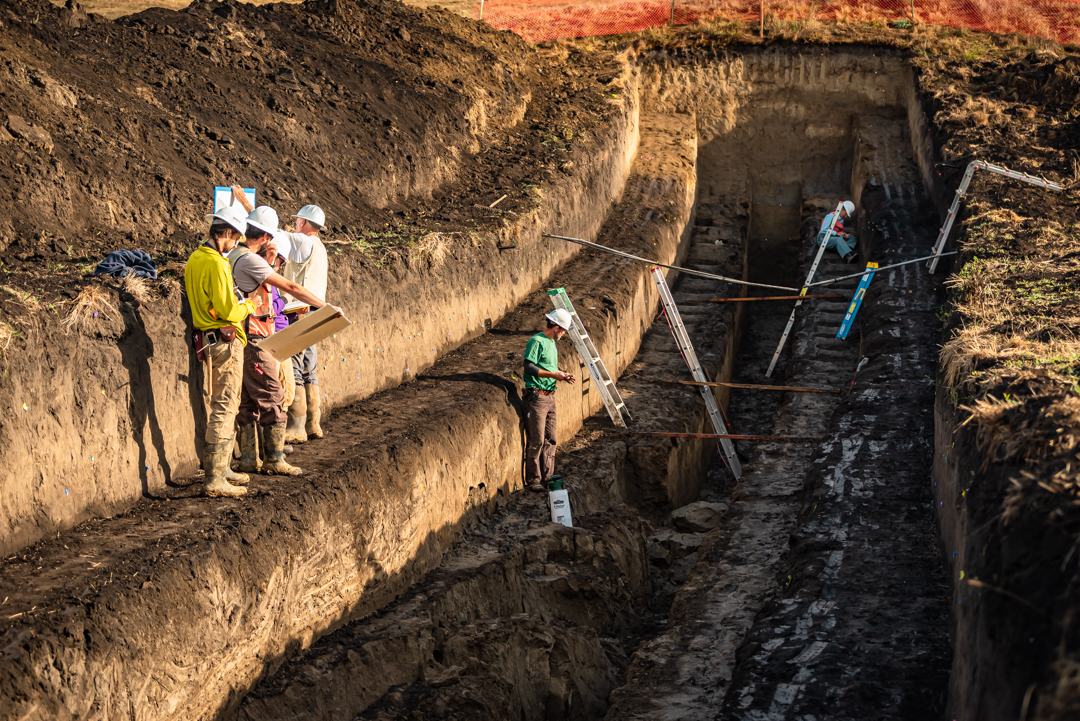
    Hemphill-Haley’s colleague Dr. Melanie Michalak researches the Klamath Mountains in northern California and Oregon, and the Coast Range closer to HSU. In one research effort, she and her team trench the ground and look at rock layers that have been changed by faults. They seek material that can be used to estimate the age of the rock. Some of her research is also on recently active faults.

    “As a geologist I care about all faults, the ancient ones, the active ones, I don’t discriminate,” Michalak said. “But people though, from a risk perspective, they’re more concerned about which ones will cause an earthquake and damage their house.”

  • This week in STEM

    This week in STEM

    Embed from Getty Images

    Imagine one day, your neighborhood and everyone you knew has been lost. Your world has become barren and now all that’s left is a desert. That’s what’s been happening to the coral reefs in the Pacific Ocean. The Trump administration wants to take away federal protection for 10 national monuments in the Pacific. This could lead to more commercial fishing that will further harm what’s left of the coral reefs. Scientists studying these marine monuments find that they’re the last of their kind, as they are not impacted by overfishing or pollution.

    Source: New York Times, NOAA


    Embed from Getty Images

    An alien object visiting Earth left before it could even trick-or-treat. The object is less than a quarter mile long, going 15 miles per second, and cut into our solar system perpendicularly. It even approached Earth at only a distance of 15 million miles away! So far, we can tell it’s not a comet, but it’s closer to an asteroid. We can learn even more when the next interstellar object passes by Earth because of a new telescope that is in production. It will give astronomers a more in depth perception of these incredibly fast objects zooming through our solar system.

    Source: Popular Science, The Guardian, Washington Post


    Embed from Getty Images

    One day you’re hanging out in the sun, and the next you’re trapped under ice. Although it does sound scary, it did happen for one plant species. On Canada’s Baffin Island, there’s a strain of ancient moss that’s being thawed out for the first time in 45,000 years. Researchers found the age of the moss using radiocarbon dating, although some of the moss had no radiocarbon left. This discovery is leading researchers to believe that the hot atmospheric temperatures could melt all the ice in the east Canadian Arctic.

    Source: Science Magazine, National Geographic, Science News, NBC

    Embed from Getty Images

    Climate change is real, and it’s getting worse considering how we treat our planet. In the Paris Agreement of 2014, countries gathered together and agreed upon only letting the planet get warmer by two degrees Celsius. That’s not happening anymore, we’re reaching a goal of three degrees Celsius now. It is noted that although some greenhouse gas emissions have remained steady, like carbon dioxide, others have increased dramatically, such as methane. The UN’s environment chief, Eric Solheim, is calling for countries to take action as these conditions are unacceptable for our planets future.

    Source: ABC, The Guardian, The Daily Herald

  • Voices of student science

    Voices of student science

    By | Kelly Bessem

    ____________________________________________________

    Voices of student science aims to highlight individual Humboldt State students majoring within the widespread realm of the sciences.

    ____________________________________________________________

    Alycia Padilla is a 27-year-old wildlife major from Bakersfield, Calif.

    Alycia Padilla, wildlife major. Photo by Kelly Bessem.

    Padilla’s desire to protect and take care of animals helped her choose her major.

    “When I was a child I was only allowed to watch television like National Geographic and Discovery Channel,” Padilla said. “That became all I wanted to watch and I fell in love with animals.”

    Last summer, Padilla set camera traps and collected recordings of bat sounds as part of a decade-long ecological survey. She worked with the California Department of Fish and in the mountains near Sacramento, Calif. 

    Though Padilla wants to get a job in Arcata after graduating, she has considered moving back to Bakersfield because she believes the area needs more wildlife expertise.

    “I feel like I could make some sort of change there,” Padilla said.

    ____________________________________________________________

    Sarah Franzen, 26, is a senior marine biology major. She’s originally from Lake Havasu, Ariz.

    Sarah Franzen, marine biology major, holding sea fan coral. Photo by Kelly Bessem.

    Franzen’s love for the ocean began with television shows such as “Planet Earth.”

    “That’s when I first decided that I wanted to learn how to scuba dive,” Franzen said. “So I got certified when I was 14.”

    It wasn’t until Franzen’s freshman year in college that she saw the ocean for herself. It was during a dive trip for Dixie State University in St. George, Utah.

    “That’s when I really fell in love with the ocean,” Franzen said.

    Last semester, Franzen worked in HSU’s Paul E. Bourdeau Lab making wax snails that are used for crab surveys.

    After graduating, Franzen will study manta rays in Australia and contemplate applying to masters programs.

    ____________________________________________________________

    Erica Siepker, 27, is a wildlife major and scientific diving minor from Long Beach, Calif.

    Erica Siepker, wildlife major and scientific diving minor. Photo by Kelly Bessem.

    Siepker was originally a zoology major but switched to wildlife after discussing her interests with a Humboldt State advisor. 

    “For me the wildlife degree had more practical, hands-on aspects that would take me beyond taxonomy and lab,” Siepker said. “Little did I know that HSU’s wildlife program was so widely known.”

    Siepker experiences many hands-on wildlife studies within her classes. These include the use of raptor perches to combat gopher problems, the relation between crows and human food sources and the habitat selection of salamanders in the Arcata Community Forest.

    Siepker plans to apply for an internship at Disney’s Animal Kingdom after graduating.

    “With an internship there I can study animal behavior, wildlife education and research,” Siepker said.