The Lumberjack


Students Serving The Cal Poly Humboldt Campus and Community Since 1929

Tag: earthquakes

  • Aftershock: the nuance of Humboldt geology

    Aftershock: the nuance of Humboldt geology

    by Harrison Smith

    Hey – did you feel it? That little jolt? The coffee on your desk is even rippling! I think we just felt an aftershock! 

    For some, aftershocks are a fun little jolt that give you something to talk about in line at Los Bagels. For others, they are terrifying reminders of Humboldt’s earthquake vulnerability. 

    For almost a month following the Dec. 20 earthquake that devastated parts of the county, over 80 aftershocks of magnitude 2.5 or greater have gently shaken Humboldt- most too small to be felt. Large earthquakes in fault-prone areas like Humboldt may change the stresses on adjacent faults. 

    “The kind of earthquake that fault produced, with that kind of slip, can produce a pattern of stresses which, in some instances can promote a nearby fault to be closer to failing,” said Dr Mark Hemphill-Haley, a geology professor at Cal Poly Humboldt.

    Some shifts release stress to delay an earthquake, while some increase stress. This can trigger new movement as the fault system searches for a new equilibrium. The pattern of aftershocks can provide important clues into the state of the fault system. 

    “From just the 2.5s, you can kind of get an idea of how they ruptured along the subduction zone,” said John Bellini, geophysicist at the USGS National Earthquake Information Center. 

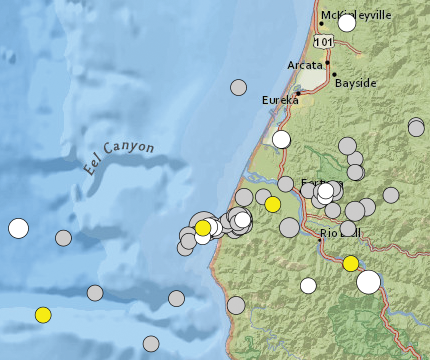
    However, accurate triangulation of the Ferndale quake’s epicenter and those of its aftershocks is complicated by the fact that the fault system lies largely offshore. 

    “Because all of the stations are onshore and the main shock was just offshore, you don’t get as meaningful distribution,” said Bellini.

    Judging from the distribution of the aftershocks, one might think that they followed East-Northeast running faults. However, data is often deceptive. 

    “If you look at the trends of the faults, they are Southeast to Northwest,” said Bellini. “This misleading artifact of the map is due to imprecision in triangulation- in order to locate the epicenter of an earthquake, it must be recorded from three different seismic stations.” 

    The more surrounded the earthquake is by seismic stations, the greater one’s ability to measure it precisely. Because the closest ‘western’ seismic stations are in Hawaii, precise observation of seismic activity off the Humboldt coast is difficult. 

    Image courtesy of USGS | Fault distribution in the North American Plate.

    “Most of the stations for most of those quakes are going to be to the east, with nothing to the west for most of them… when that happens, the error ellipsoid for them is going to be stretched in an east-west direction,” said Bellini.

    Humboldt County sits at the very south tip of the Cascadia subduction zone, where the Gorda/Juan de Fuca, Pacific and North American tectonic plates come together in a geologically complex region called a triple junction. 

    The difficulty of studying the complex tectonic interactions at this triple junction is compounded by the fact that it lies half offshore, however new developments in geology have lifted the veil on offshore tectonics. 

    Last summer, researchers from Cal Poly Humboldt’s geology department along with researchers from the US Geological Survey, UC Berkeley, and University of Washington installed over 40 seismometers along an optical fiber cable that runs from Aracata to Eureka. Instruments connected to the optical fiber along with the seismometers provided high resolution about the local seismicity. The instruments were removed after their testing period was complete, but they were reinstalled immediately in the aftermath of the Dec 20, 2022 Ferndale earthquake. 

    The use of fiber optic cables for monitoring earthquakes is very recent, but a huge development for geology in areas like Humboldt.

     “We’ve already recorded more than a hundred aftershocks associated with that recent quake,” said Dr. Hemphill-Haley.

  • The moving pieces under Humboldt

    by Carlos Pedraza

    Cal Poly Humboldt sits on top of a very seismically active part of the world known as a the Cascadia subduction zone. This area is composed of three tectonic plates under the ocean off of the Pacific coast.

    The Juan de Fuca, Explorer, and Gorda plates are subducting beneath the continental North American Plate, where the Cal Poly Humboldt campus is located.

    As the oceanic plates push against the continental plate, the friction created leads to deformation and faulting.

    “We live on that boundary where this is taking place, which leads to frequent earthquake activity,” said Cal Poly Humboldt geology professor Amanda Admire.

    In addition to the deformation from the Cascadia subduction zone, the Humboldt region is also influenced by the movement along the San Andreas Fault to the south. Humboldt stands on top of an intersection of three different plates pushing against each other.

    The plates themselves move very slowly, only a few centimeters every year. However, they still generate friction as they move against each other. This is the energy released during an earthquake and tsunami.

    Graphic by Carlos Pedraza and August Linton

    In the Pacific Northwest, both earthquakes and tsunamis are important to prepare for. The Redwood Coast Tsunami Work Group, an organization made up of local government officials, tribes, and relief groups, gives information and warnings in their “Living on Shaking Ground”magazine.

    The magazine states that “more than two-thirds of our large historic earthquakes have been located offshore within the Gorda plate.”

    A tsunami is created when an earthquake along a fault ruptures the seafloor, moving the entire water column and releasing that built-up energy, which moves out in all directions.

    The primary local tsunami hazard, the Cascadia subduction zone, is very close to Humboldt’s coastline compared to other regions in the Pacific Northwest.

    According to Admire, a tsunami produced along the fault between the Gorda and North American plates would only take approximately ten minutes to reach the Humboldt shoreline. In Oregon and Washington the fault is further from shore, allowing for more warning time should there be a tsunami.

    This much seismic activity can be exciting to study for geologists and scientists, but for people living in Humboldt it may be nerve racking. Admire said there is no need for panic, but that residents should prepare.

    The last mega earthquake along the Cascadia subduction zone was in 1700. However, there are still smaller instances of seismic activity as the plates move and push against each other.

    So when an earthquake happens: drop, cover and hold on. If you’re near the coastline, head for higher ground in case of a tsunami.

    To find more preparedness tools and tsunami evacuation maps for the region, check out the Redwood Coast Tsunami Work Group.

  • Humboldt State Geologists Research Faults

    Humboldt State Geologists Research Faults

    Faults give clues to the history of the earth’s crust and how it impacts our future

    Earthquakes are more than just shaking. Turns out the rumbling is sound vibrations from the massive snap caused by slipping, bending and breaking rock.

    Deep below Earth’s crust, a mantle of plastic-behaving rock bends and twists under immense pressure. Its mass is 67% of the Earth’s mass. Its temperature ranges from 392 degrees Fahrenheit at the upper boundary of the crust to an incendiary 7,230 degrees Fahrenheit at the core-mantle boundary. Sometimes the overlying, thin 50 to 20 kilometer thick crust cracks.

    “The earthquake is the sound waves moving through the rock, elastic waves propagating through it,” said Dr. Mark Hemphill-Haley, a Humboldt State University neotectonics professor and the co-chair of the geology department. “People who have seen the ground moving are seeing the surface waves of rock bending back and forth.”

    According to Hemphill-Haley, imagining the scale of the mantle is challenging both in size and as a metric of time. Some people have compared the movement in the mantle to lava lamps or boiling water, a force called convection, where hot liquid bubbles up through cooler liquid, but Hemphill-Haley said that can be misleading.

    “We’ve had these old models of the mantle convecting but it’s probably less like that- we’re talking about solid rocks,” Hemphill-Haley said. “They’re solid but they are plastic too. Tectonic plates, which consist of the crust and the upper mantle are in motion and can move faster than four to five centimeters per year. Mantle convection is likely a more slow process than that.”

    Like the snap one hears when a pencil breaks, the sound vibrations from the snapping rock shake the ground all around the breaking point, quaking the earth.

    Giragos Derderian, a fourth year geology student, explained the nuance between elastic, plastic and brittle rock. Generally, a rock seems solid but if enough force is applied, the rock can change shape. Derderian said the change in a rock is called deformation.

    “Plastic deformation is when structures change shape due to a force and the rock stays deformed when the force dissipates,” Derderian said. “After elastic deformation, the rock returns to its original shape when the force is removed.”

    Brittle deformation, Hemphill-Haley said, is when forces are so great, the stress exceeds the rock’s elastic limit and snaps it, like a pencil bent too far. An earthquake is when massive bodies of rock experience so much force that they become brittle and break. Like the snap one hears when a pencil breaks, the sound vibrations from the snapping rock shake the ground all around the breaking point, quaking the earth.

    The earth’s crust is made up of massive plates that fit together like an ill-constructed puzzle with some plates pushed too hard into each other and some plates pulling away from each other. Force builds up where these plates meet and can deform each other in elastic, plastic and brittle ways.

    Hemphill-Haley said the big thing that causes plate motion is the weight of oceanic plates. In this example, oceanic plates have converged with continental plates. he denser oceanic plates are diving below the less dense oceanic or continental plate.

    These convergent plates cause a few things to happen on the surface. The leading edge of the less dense plate can crumple into massive mountain ranges like the Klamath Mountains. The oceanic plate descends deep into the mantle at submarine trenches referred to as subduction zones like off our coast—the Cascadia subduction zone. Geologists research the effects of plate tectonics here on the northern California coast in a variety of ways.

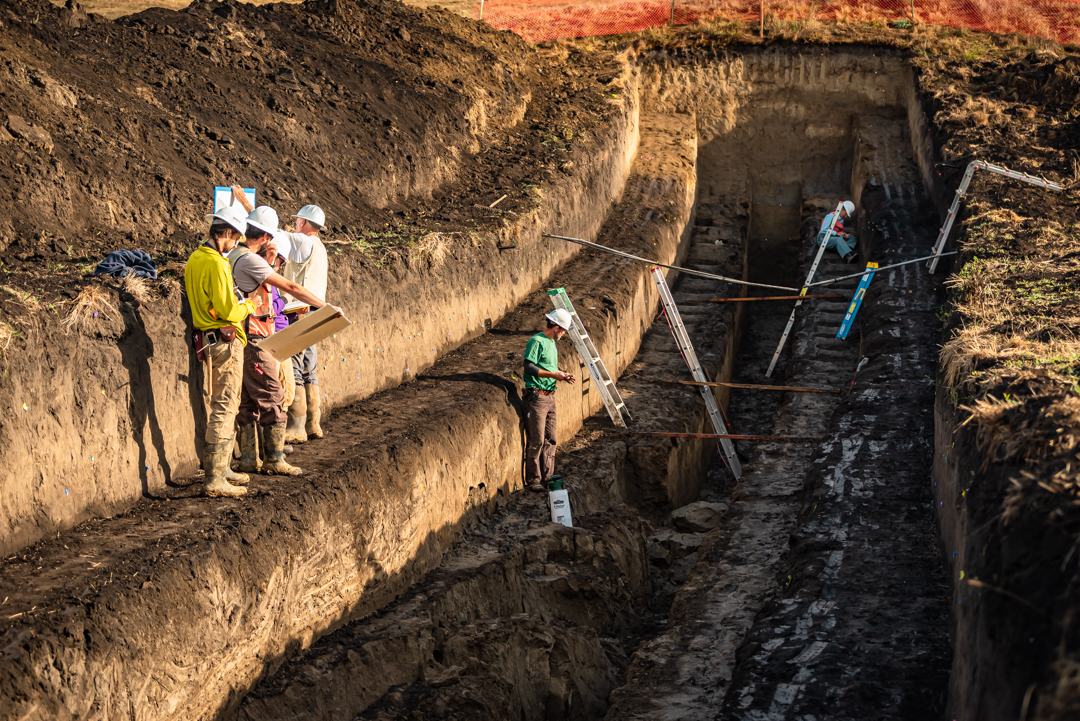
    Hemphill-Haley’s colleague Dr. Melanie Michalak researches the Klamath Mountains in northern California and Oregon, and the Coast Range closer to HSU. In one research effort, she and her team trench the ground and look at rock layers that have been changed by faults. They seek material that can be used to estimate the age of the rock. Some of her research is also on recently active faults.

    “As a geologist I care about all faults, the ancient ones, the active ones, I don’t discriminate,” Michalak said. “But people though, from a risk perspective, they’re more concerned about which ones will cause an earthquake and damage their house.”

  • The next great quake is coming

    The next great quake is coming

    It’s only a matter of time before nature blindsides us with a catastrophic earthquake. Geologists predict that the next big one could happen within our lifetime and we are ill-prepared for it.

    According to the Uniform California Earthquake Rupture Forecast (UCERF3), there is a 76 percent chance of an earthquake greater than a magnitude of 7.0 striking Northern California within the next the 30 years.

    We are situated along the Cascadia Subduction Zone (CSZ), a major plate boundary that stretches from Vancouver Island in Canada down to the Lost Coast in Humboldt County. It is capable of triggering “megathrusts” that can exceed 9.0 on the seismograph. Such an earthquake can set off tsunamis capable of wiping out our coastal communities. Buildings will collapse, our utilities will be cut and all hell will break loose. We need to know how to manage ourselves if and when the big one hits.

    It’s easy to forget that we live in Earthquake Country. Also, some of us are emotionally distanced from natural disasters that occur outside of our bubble, because they don’t directly affect us. Unless it hits home, we pay little mind to disasters that happen in other parts of the world. Let’s not get too comfortable, though.

    “Disaster, if we let it, can teach us that we who have not yet suffered are not untouchable; we are not special; we are lucky,” wrote Melissa Batchelor Warnke of the Los Angeles Times. “And luck runs out.”

    Living on Shaky Ground is a free magazine prepared by Humboldt Earthquake Education Center at HSU in cooperation with several relevant organizations. They offer valuable advice to prepare, protect and recover from earthquakes and tsunamis. Download and read the PDF magazine on their website today.

    Finally, we would like to remind you that the annual ShakeOut is happening on campus this Thursday, October 19 at 10:19 a.m.

    The Great California ShakeOut is an opportunity to practice how to be safer during big earthquakes. Remember to Drop, Cover and Hold On.


  • The storm is here

    The storm is here

    Hurricane Maria claimed its first fatality as it passed through Guadeloupe this past Tuesday. The category 5 storm wrecked the local communities and left almost 40 percent of the island without power. Hurricane Maria is expected to only do more damage over the next couple days. Almost immediately after Hurricane Irma devastated communities in the Caribbean, Maria seems to be following a similar path towards the Virgin Islands and Puerto Rico.


    For those of us in Humboldt, situated along the Pacific, it may be easy to overlook the disasters occurring elsewhere in the world. But after a series of five hurricanes over the last few months and the recent earthquake originating near Mexico City, we have to get involved. Natural disasters that don’t hit us still affect us.


    Thomas Perez, a Business Marketing major here at Humboldt State, believes that anyone and everyone can make a beneficial impact.

    Thomas Perez: Natural Disaster
    Thomas Perez, a business marketing major, has friends in Texas that were evacuated after hurricane Harvey. Photo credit: Kyra Skylark

    “As simple as it is, donating money to relief efforts would be great,” said Thomas Perez. “If we could donate, whether it’s our time, our money, or even ourselves promoting them, I’m sure that awareness could be a great help [to areas impacted].”


    While Hurricane Harvey made its way through Texas, Perez had a personal investment to stay updated on the storm.


    “I have some long standing friends that went to the University of Texas and also to Houston, they had to be evacuated from their homes and I don’t know if they will be able to return anytime soon,” said Perez.


    Perez has been keeping in contact with his friends in Texas, so he wasn’t too worried about how they were doing physically. They were all evacuated before the worst of the storm hit and are currently safe, but Perez was able to hear first hand accounts of what was happening.


    “It’s terrible that they are going to lose so much of what they’ve had,” said Perez.


    Perez is not the only one who knows someone who was impacted by the storms.


    Cassandra Wages, a freshman starting her first semester at HSU, also has family and friends hit by the hurricanes.

    Cassandra Wages: Natural Disaster
    Cassandra Wages’s aunt lost her property in Florida due to damages from hurricane Irma. Photo credit: Kyra Skylark

    “In Florida, my great-aunt has family there, and all those people had to be evacuated, and she’s losing her property that’s there,” said Wages.


    Like Perez, Wages says that donations are helpful to rehabilitate people. While not everyone can physically help the communities hit by natural disasters, donations are a simple aid.


    Kianna Rodriguez, a Communications major, strongly believes that donations are the way to help if you can’t physically set aside the time.

    Kianna Rodriguez: Natural Disaster
    Kianna Rodriguez, a communications major at HSU, believes unity in the aftermath of a disaster is essential. Photo credit: Kyra Skylark

    “As much as people want to help and want to be doing things for people that are suffering because of these natural disasters, sometimes our resources aren’t enough,” said Kianna Rodriguez.


    “One of the biggest things is staying on top of what people actually need, that’s one of the biggest things that I’ve been concerned about,” said Rodriguez. “If there is something I can do, I’m a college student I obviously can’t do a whole bunch, but donating money [could help], not necessarily clothes or blankets, cause maybe they don’t need that stuff.”

    Craig Mitchell, an Environmental Science and Management major, says that donations can help, but there are other ways to benefit recovering areas.

    Craig Mitchell: Natural Disaster
    Craig Mitchell, an Environmental Management transfer, is a member of the coast guard reserve and Mitchell was almost sent to hurricane Harvey. Photo credit: Kyra Skylark

    “I’m actually in the Coast Guard reserve and I almost got deployed to Harvey,” said Craig Mitchell. “I spent six years on active duty in the Coast Guard and I have friends that are now stationed down their.”


    Luckily, Mitchell was not deployed and was able to transfer to HSU this semester. Mitchell believes that small changes, driving less when possible, choosing sustainable products, and other everyday decisions we make, influence the devastation the storms are causing.


    “I feel like global warming has something to do with it,” said Wages.

    Hurricanes are caused by low-pressure weather systems and sustained winds of above 74 mph according to the National Oceanic and Atmospheric Administration (NOAA). An increase in the global temperature, resulting in an increase in the ocean’s temperature would influence the size and number of tropical storms in a given area. While there has not been any confirmation relating these recent natural disasters to climate change, the general belief on campus seems to be that climate change is impacting the storms.


    “It would be natural if there weren’t so many, it’s just that three to four hurricanes in one season is a little ridiculous,” said Perez. “Normally this is the time for hurricane season, but just one and not that big, it all seems a little unnatural”


    Whether or not we are influencing the intensity of the hurricanes through climate change, this is still a worldwide issue. If one area is hit by a devastating disaster it is up to us, all of us, to help them.


    “Seeing the people that are going out with boats and stuff helping families is so incredible,” said Rodriguez. “It’s been nice to see unity when it comes to these situations, because there hasn’t been in the past. Its nice to see that people are stepping up now, and even going out of their own state to travel to these places to help other people.”


    Some natural disasters can not something be planned for. We can prepare, with prepared supplies and plans for various disasters, but we never really know when, where, or how the next natural disaster will occur.


    “It’s time for everyone to step up and try help each other, even when times of crisis are happening,” said Rodriguez.


    What if a hurricane hit where someone you love lives. Or if an earthquake, like the one that just hit outside of Mexico City, shook Humboldt instead. A natural disaster is bigger than one individual’s story or one communities hardship. A hurricane does not target people for a reason, the environment doesn’t care where you’re from, what you look like, or how much money you have.


    “I have family in Texas, and it’s kind of scary knowing that someone you know, possibly might not be here any more,” said Rodriguez.


    Hurricanes have done immense damage this year, and thousands of people have been displaced because of the series of storms. Many others have lost their lives. This is not a small issue, if natural disasters are increasing in strength and frequency, the worldwide effects will only get worse.