The Lumberjack


Students Serving The Cal Poly Humboldt Campus and Community Since 1929

Tag: Ecology

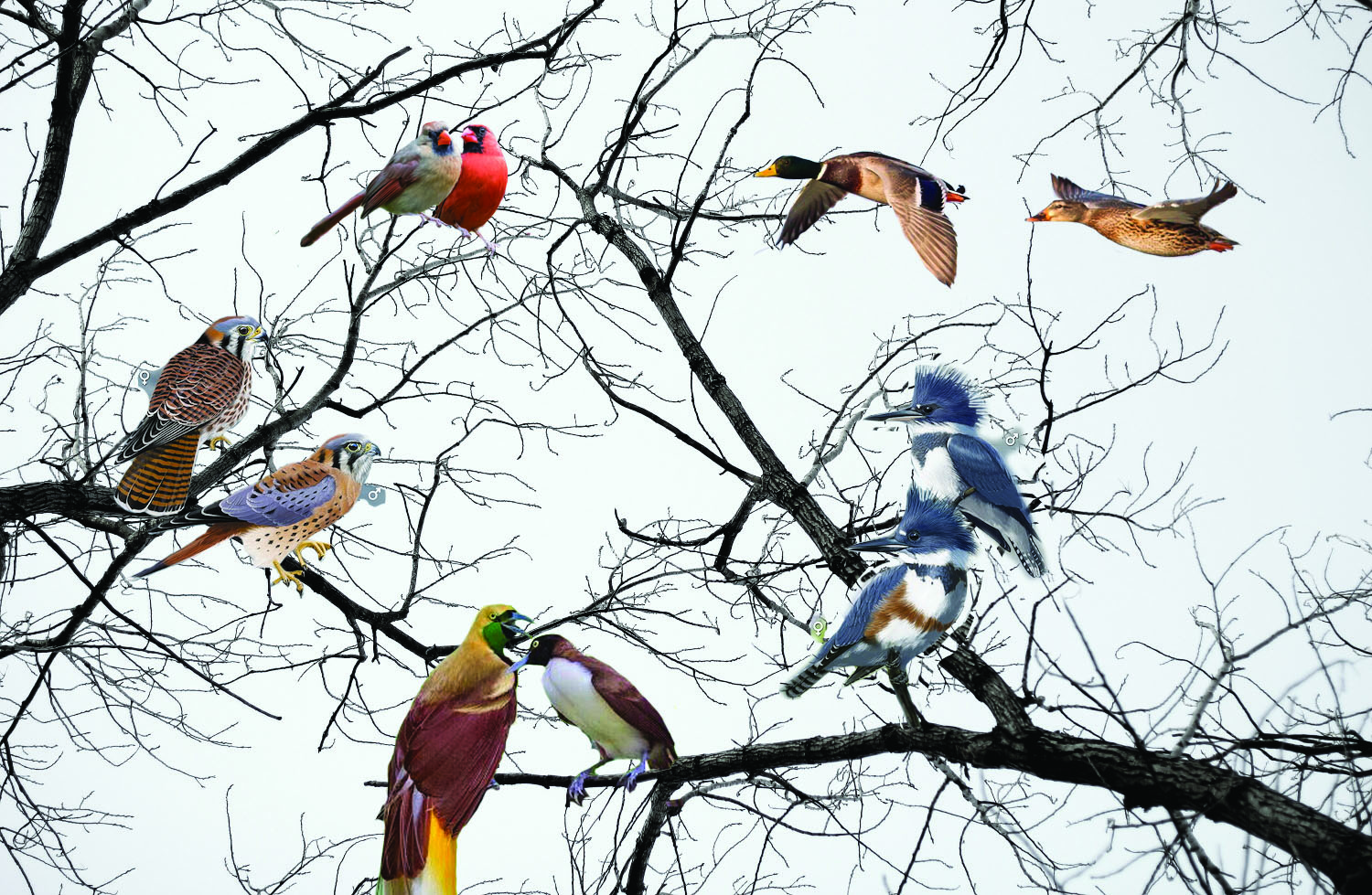
  • Sweet Songs, Fancy Feathers, Birds Bang

    Sweet Songs, Fancy Feathers, Birds Bang

    The sex life of a bird is no simple thing

    Sex is a heck of a thing in the animal kingdom. Species of birds, insects, mammals and fish have developed a whole bunch of strategies to get laid. From mating dances to beautiful plumage to carefully engineered bachelor pads, the birds have come up with all sorts ways to strut their stuff.

    Wildlife junior Hannah LeWinter commented on how much effort birds put into reproducing. She remarked on the McGregor bowerbird’s tower—a three-foot-tall structure made of carefully placed twigs, attesting to the bird’s dedication.

    “When we think of animals, we assume they do the basic things like mate and get food and make shelter, but they really do have complex [behaviors] too,” LeWinter said. “They make these intricate structures to impress females to say that they are the best suitors but those structures serve no purpose besides attracting a mate.”

    “We think of animalistic sex of doing it only because you need to reproduce, but there are these animals that create these gestures like a pebble or a structure or a dance.”

    Hannah LeWinter

    Commitment to the craft is just the first step of courtship. The picky female bowerbird inspects her suitor’s structure, carefully judging sturdiness of the construction before joining the male on the forest floor. Then, the show really starts.

    The male bowerbird possesses the ability to imitate sounds and begins a showcase of what he’s learned. His voice can emulate everything from birds and animals in the forest to the sounds of human civilization.

    Once she’s satisfied with his performance, the male begins his dance. A chaotic shuffle from one side of his tower to the other, darting towards the female while flashing a bright orange haircut at her. Once he’s done with his groove, she submits and they do their thing.

    “We like to think we’re the only people or the only species who do that,” LeWinter said. “We think of animalistic sex of doing it only because you need to reproduce, but there are these animals that create these gestures like a pebble or a structure or a dance.”

    The McGregor bowerbird works every year to maintain his tower, but there is no expectation in the species to mate with the same female every year. Jeff Black, a wildlife professor at HSU who studies birds, published a collaborative book with 20 other ornithologists titled “Partnerships in Birds: A Study in Monogamy.”

    “We asked the question, ‘How special are bird partnerships or pair bond?’” Black said. “We asked, ‘How long do mates stay together?’ ‘Are they really faithful?’ ‘Do the faithful ones fare better than the ones that alternate and are less monogamous?’”

    The answer: it depends. Black and his fellow ornithologists quantified bird fidelity on a sliding scale ranging to very faithful to not at all faithful. They also investigated the behaviors between social pairs—pairs who spend their time together raising the young, foraging and nesting together—and genetic, or mating pairs.

    “Birds lay their eggs in a basket,” Black said. “When you look at all the 10,000 different types of birds, some birds even though they’re monogamous, when you look at their babies, the genes come from someone else.”

    “When you look at all the different studies, you can plot out how faithful they are. Swans are 100% faithful, the jays would be about in the middle and other species are just having sex everywhere.”

    Jeff Black

    Faithfulness or lack there of may have a couple of purposes, although the hypotheses are not totally fleshed out. One hypothesis is that, if a female searches for a new male mate, she may be looking for a more fit male than her social partner, and engage in what Black called extra-pair copulation.

    HSU River Ecologist Alison O’Dowd explained fitness is a measure of the ability for an individual to pass on their genes. Similar to natural selection, sexual selection is when a female looks for certain characteristics in their male partner, ranging from vibrant feathers to well constructed towers to perfectly executed dances.

    Black endorsed fidelity in birds. He said in geese and swans for example, more faithful pairs are more likely to successfully reproduce. Their offspring are also more fit for when they’re looking for a mate of their own. There may be a case for faith yet.

    “When you look at all the different studies, you can plot out how faithful they are,” Black said. “Swans are 100% faithful, the jays would be about in the middle and other species are just having sex everywhere.”

  • Voices of students in science

    Voices of students in science

    By | Kyra Skylark

    Margaret Peck
    Margaret Peck, a Biology major with an emphasis in ecology and evolution, moved to Humboldt this past June. Photo credit: Kyra Skylark

    Margaret Peck, a Biology major with an emphasis in Ecology and Evolution, moved to Humboldt this past June. While drawn to the school’s Science department, Peck found great value in a class outside her major.

    “My Native American Studies course, I want to go into land management and a lot of that is working with the tribes of an area to get them back on the land,” said Peck. “To give the land back to them and have a kind of co-management. So I’m learning a lot of techniques to better understand where they are coming from and learn more about their history. So much of their history is not actually taught to us in our education or if it is taught to us, it is not anything remotely true or factual about what actually happened to them.”

    Learning history and communication skills in addition to her core science classes helps prepare Peck for possible career opportunities in the future.

    “I wanna help get people on the land and I really just want to be outside, that’s where I’m happiest,” said Peck.

    Darrian Francki
    Darrian Francki, a second year Forestry major with a concentration in Wildfire has changed his original goal since taking a variety of classes here at HSU. Photo credit: Kyra Skylark

    Darrian Francki, a second-year Forestry major with a concentration in Wildfire has changed his original goal since taking a variety of classes here at HSU.

    “When I first started at HSU I was thinking more of [a career in] national parks, but now that I’ve learned more, I’m open to anything within my major,” said Darrian Francki. “Whatever comes my way.”

    Cindy Luke
    Cindy Luke, an Environmental Science and Management major just started her second semester. Photo credit: Kyra Skylark

    Cindy Luke, an Environmental Science and Management major just started her second semester.

    “What brought me here was knowing that this was such a good place to be for environmental studies,” said Cindy Luke.

    Focusing specifically on Environmental Education and Interpretation, Luke hopes to teach individuals of all ages the value of being outside in nature.

    “Teaching all people in general, it’s important to start when they are younger, but it’s also important to know that they don’t stop learning,” said Luke.

    Luke is excited to be apart of the HSU community,

    “I have always loved the outdoors,” said Luke. “I was a single mom, so I went into accounting and business, payroll, because I already had an associate’s there. But I’ve always wanted to be outdoors and I’ve always wanted to share that love.”

    Conrad Stielau
    Conrad Stielau, a Forestry major in his second year is stoked to be going to school in the redwoods. Photo credit: Kyra Skylark

    Conrad Stielau, a Forestry major in his second year is stoked to be going to school in the redwoods.

    “It’s the Harvard of Forestry colleges,” said Conrad Stielau. “I’m a Forestry nerd, I deeply care about the trees, and there’s not a better place to learn.”

    Focusing on Wildland Fire Management within the Forestry concentration, Stielau is loving learning tools applicable for his future career.

    “In my Fire Ecology class, we’re understanding fire regimes,” said Stielau. “Basically how fire suppression in the United States has led us to the problem that we are in now, which is why we have more expensive wildfires and more severe wildfires every year.

    Stielau is enjoying all of his classes more than he anticipated.

    “Natural Resource Conservation is very cool, J. Dunks the man,” said Stielau.

    Stielau hopes to use what he leans at HSU to improve the current system.

    “I want to fix the US Forest Service,” said Stielau. “Basically fix America’s forests. I’m a younger generation of educated people in Natural Resource Science, all the people who have been making decisions in the last hundred years are old men. They don’t understand, they don’t think the same way. They still use plastic water bottles or they still drive their car half a block to work, they just don’t understand our sustainability mission.”

    Humboldt State’s commitment to environmental awareness and sustainability is what draws many students to the university, and they carry that after they graduate.

    “To bring a young fresh idea to it, a person like me who gives a shit– I give a lot of shits–it’s something I care about, I’m deeply passionate about Forestry,” said Stielau.