
The Lumberjack


Students Serving The Cal Poly Humboldt Campus and Community Since 1929

Tag: economics

  • Professor Ponders California’s Independent Future

    Professor Ponders California’s Independent Future

    Alison Holmes, Ph.D. spent her sabbatical researching whether California acts as its own nation

    California has the means to be its own nation. It’s big, it’s wealthy and it’s been disrupting the status quo by acting internationally.

    “California has been acting outside the box,” Humboldt State University Associate Professor and International Studies program leader Alison Holmes said. “They’ve been going and doing stuff with China, Mexico and Canada. It’s like, ‘Wait, you’re not supposed to do that. That’s not what international relations theory says, it’s not what the U.S. Constitution says, it’s not what all kinds of other rules suggest.’ So how are they doing that?”

    Holmes spent her sabbatical last school year researching California and talking with state officials and those the state has dealt with.

    In August, Holmes presented her research to the Center for California Studies at Sacramento State University in a presentation called, “California as a Nation-State: Innovative or Inevitable?”

    In her research, Holmes found that cities and industries within California may act internationally, but the state itself doesn’t typically act as its own nation.

    “We do things internationally but we don’t do them in a coordinated fashion,” Holmes said.

    Holmes grew up in Oklahoma, but she moved to the United Kingdom after volunteering in Belfast during college. Holmes lived in the United Kingdom for 25 years, where, among other things, she worked for and advised the Liberal Democrats and worked as the Deputy Head of Corporate Communication Strategy for the BBC.

    In 2005, Holmes completed her doctorate in London and then became a speechwriter for Ambassador Robert Tuttle.

    “When I worked for the ambassador, I became very interested in international relations and diplomacy,” Holmes said.

    California likes to think that it’s an innovator. We’re really big and proud about how we do stuff. And actually we’re not at the front of that innovation edge; a lot of other places in the world have been doing this for a long time.”

    Alison Holmes, Ph.D.

    When Holmes moved to California, she saw a perfect opportunity for research.

    “California makes an excellent case-study, because it is the fifth largest economy in the world,” Holmes said. “But it is a sub-national unit of a huge, hegemonic, vast, largest-nation power.

    Holmes said California’s international actions are part of a larger globalization trend.

    “What a lot of international relations theory will tell you is that globalization has meant a bunch of people who aren’t nation-states have started to do things on the international stage,” Holmes said.

    With this in mind, Holmes said that while California might be innovative for the United States, it isn’t elsewhere.

    “California likes to think that it’s an innovator,” Holmes said. “We’re really big and proud about how we do stuff. And actually we’re not at the front of that innovation edge; a lot of other places in the world have been doing this for a long time.”

    Holmes also said non-state entities acting internationally brings up questions about the very nature of sovereignty.

    “When does a sovereign not have sovereignty?” Holmes said. “At what point do state relations at the international level become a foreign policy? My point here is that our traditional ideas of sovereignty are ill-equipped to describe what we see in the real world.”

    Holmes says there are three future goals for California: the establishment of an agency focused on international policy, the honoring of tribal relations and the inclusion of tribes in international policy, and the coordination of city and county international efforts with state efforts.

    Holmes ended her research presentation with an urge to take advantage of California’s diversity across all of its communities.

    “That is the only way to create a robust local-global citizenship and to turn California’s state-nation vision of unity from diversity into a reality,” Holmes said.

    Locally, Holmes said Humboldt is more global than it might think. Holmes urged Humboldt residents to connect local actions with outside, global forces.

    “I worry that Humboldt is a little too proud of being the Lost Coast or being behind the Redwood Curtain,” Holmes said. “Privileging what they perceive to be the local over the global, to the point of seeking to disconnect from rather than engage with the world outside.”

    Holmes said ignoring global events has consequences.

    “If you don’t understand these things, you’re not really paying attention to what’s happening, how you can take advantage of that, how you can be a part of that and how it doesn’t have to roll over you like a steamroller,” Holmes said. “Because otherwise it will.”

    However, Holmes cautioned that connecting local issues with the rest of the globe doesn’t mean people should start blaming external forces for all local problems.

    “Trying to understand it is not the same as trying to find somebody else to blame,” Holmes said.

    Holmes suggested that freshmen coming to HSU would likely benefit from learning intercultural communication strategies that international studies students use.

    “There is culture shock,” Holmes said of new HSU students. “There is intercultural communication issues between the different groups of people who turn up here.”

    While HSU politics professor and international relations teacher Noah Zerbe said Holmes’ work goes beyond the scope of his expertise, he did agree with the importance of paying attention to the rest of the globe.

    “Stuff that happens globally affects us everywhere,” Zerbe said. “It affects us here as well.”

    California’s prowess has led some to believe that California should secede from the United States.

    Marcus Ruiz Evans, president of Yes California, the largest organization dedicated to California’s secession, said he believes California would be better off on its own.

    “The basic idea is that California is held back financially because it’s part of America,” Ruiz Evans said over the phone.

    “The basic idea is that California is held back financially because it’s part of America.”

    Marcus Ruiz Evans

    Ruiz Evans said Yes California and the #CalExit movement started back in 2011. Since then, it has seen significant growth, especially following the election of Donald Trump.

    However, Ruiz Evans said that the movement’s growth led to a divide in its supporters that left the movement momentarily stagnant.

    “With success came civil divorce,” Ruiz Evans said.

    Nevertheless, Ruiz Evans said he firmly believes California should secede. Ruiz Evans said that California, on its own, wouldn’t have to fight with the president or the rest of the country, wouldn’t have to fight with federal immigration laws and would save billions of dollars.

    Ruiz Evans also said California is held back politically and financially, and that he believes a split is only logical.

    “We think it’s inevitable,” Ruiz Evans said.

    Yet, when asked, Holmes put a damper on such enthusiasm.

    “I am not sure ‘doing it alone’ is ever a great idea,” Holmes said. “I think while California is rich by many standards, if they had to pay for all the things that the federal government currently does, our situation would change rapidly. California could go that route, but revolutions rarely end well or the way the instigators intended. Be careful what you wish for.”
  • Forum discusses border wall

    Forum discusses border wall

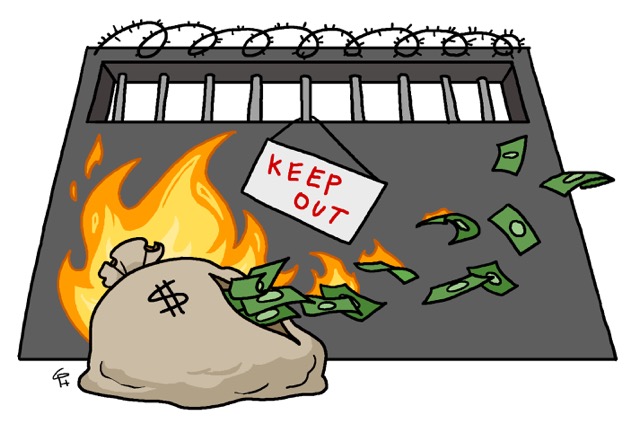
    A student-run economic forum explored the impact of border wall expansion

    Economics majors discussed a recently-released study regarding the effects of the 2006 Secure Fence Act at an open forum, held last Friday at Fiesta Grill and Cantina.

    The Secure Fence Act added 548 miles of wall, fencing or other physical barrier to the existing barriers along the southern border. Carlos Rodgers was one of the two economics majors hosting the panel, and found much of the information in the study to be surprising.

    “I was surprised that the impact per worker was so small,” Rodgers said. “The gain in wages felt by uneducated Americans is small compared to the wage reduction for college-educated Americans.”

    The study, released last November, found that wall expansion harmed college-educated U.S. workers by $4.35 per person annually, and boosted the wages of uneducated Americans by 36 cents. The construction itself cost the nation $2.3 billion, or about $7 in taxes per person according to the study.

    MVIMG_20190308_165207.jpg
    Economics professors, students and others gathered to discuss the economic effects of border barriers in the back of the Fiesta Grill and Cantina. | Photo by Jett Williams

    Economically, Mexico didn’t benefit from the wall expansion either. The study found that educated Mexican workers lost roughly $2.99 in annual income, and less-educated Mexicans lost $1.34.

    Estrella Corza, another economics major who attended the forum, recognized the ineffectiveness of walls as a solution.

    “On both sides of the wall, there wasn’t progress,” Corza said. “No one benefited from this.”

    In addition to being economically unfavorable, the study found that the wall expansion barely changed the number of people who illegally cross the border. According to the study, the new pieces of wall built after 2006 reduced the number of Mexicans living in the United States by just 0.6 percent, or about 82,650 people.

    As the forum continued, it became clear that the wall was ineffective as a solution to the illegal immigration problem.

    Attendee David B. joked, “Has anyone considered a moat?”

    Nicola Matthews, an economics professor at HSU, stated what some people were thinking about halfway through the forum.

    [perfectpullquote align=”right” bordertop=”false” cite=”Nicola Matthews” link=”” color=”” class=”” size=”17″]”Politicians often blame immigrants for the shrinking middle class. They are looking for someone to blame.”[/perfectpullquote]

    “Assuming calculations are correct, moving forward we don’t want to build more walls,” Matthews said. “Isn’t that the consensus?”

    With that, the discussion moved to alternative solutions. Ideas like cracking down on illegal-immigrant-hiring businesses and guest-worker programs were floated, but the final consensus was that the best way to curb illegal immigration would be to improve the wages and quality-of-life in Mexico, so less people would feel the need to immigrate.

    Despite being a charged topic the forum didn’t get heated or argumentative, and the participants saved political discussion until the forum was wrapping up. They acknowledged that many other factors like xenophobia, bias and racism play a role in the decision to build a wall.

    “Politicians often blame immigrants for the shrinking middle class,” Matthews said. “They are looking for someone to blame. ‘Why is my family suffering?’”

  • Speaker from Melbourne talks cannabis

    Speaker from Melbourne talks cannabis

    Jenny Williams, a professor at the University of Melbourne, spoke with Humboldt State economics students on Feb. 19 about her findings in a 15-year study of the effects of cannabis users and their choice of job professions.

    “In today’s age, cannabis use is something that is socially acceptable,” Williams said. “Today, more of the population who start using cannabis are young, between the ages of 14-18.”

    In Williams’s study, 49 percent of 1,000 male high school seniors used cannabis. Within that 49 percent, most of them either stayed in low-wage jobs after graduation or continued their academic career.

    Williams’s study also shows theories that cannabis users have a present mindset.

    “Users of cannabis are more willing to go into lower wage jobs,” Williams said. “This potentially leads to users being less likely to complete their education.”

    Brea Smith, a student at Humboldt State, said marijuana use is likely going to increase due to the recent legalization in California.

    “I won’t be surprised if the number of younger users increases in a couple of years.” Smith said.

    Eureka resident Jacob Rice has been a cannabis user for years.

    “I wanted a job for the sake of getting money,” Rice said. “I guess the study is accurate in some way, but I would take it with a grain of salt.”

    Williams plans on conducting a similar study to look into female high school seniors.

    “Socially, cannabis has become more acceptable than it was years ago,” Williams said. “I think it’s important to look at a students’ financial wellbeing in the long term when it comes to long-term cannabis use.”

  • Is a bitcoin bubble ready to pop?

    Is a bitcoin bubble ready to pop?

    By | Robert Brown

    Bitcoin gained $2,000 during the last week of November, causing internet exchange sites to freeze up as people attempted to buy whatever amount of Bitcoin they could afford.

    If asked, the majority of people would more than likely not know what Bitcoin is, despite the fact that it is the most well known and widely used cryptocurrency, valued at over $10,000 per coin. A debate has sparked online whether or not Bitcoin is experiencing a bubble.

    Many financial analysts and cryptocurrency experts say Bitcoin will continue to rise through the summer, reaching $40,000 by August. Others say it will crash and become worthless, causing people to lose all of the money they have invested. Since its creation, people have continuously claimed that the Bitcoin bubble will pop every time it has reached a new high. People said the bubble will pop when it reached $100, and again when it reached $1,000. Now that it has reached $10,000, many predict the same invevitable outcome.

    As if that wasn’t enough to peak a person’s interest, there is a very mysterious element to Bitcoin. Bitcoin is the first decentralized digital currency invented in 2009 by an unknown person using the name Satoshi Nakamoto. Although some claim the real creator may possibly be Artificial Intelligence. The revolutionary software is open-source and peer-to-peer, and is considered to be the future of technology. Transactions take place between users directly, are verified and recorded in a public ledger called a blockchain.

    There is a unique Bitcoin culture that has been created with new lingo, specific technology and intricate knowledge of how the system works. The nuances of authentication, how to buy, sell and trade, managing wallets and vaults, mining coins, Tether’s and Bitcoin’s blockchain is enough to make any computer nerd think they have died and gone to heaven. The real question is whether or not Bitcoin is a medium of exchange or a tool for the purpose of growing sovereign wealth.

    “It’s both, it is a safe store of value. Fiat currencies are collapsing when measured against Bitcoin,” technology entrepreneur and researcher Steve Outtrim said. “In the Greek Financial crisis in 2014 the opposition leader suggested converting their entire economy to Bitcoin. If they had done that, Greece would have repaid all its debt already and the Greek citizens would be the world’s richest people.”

    Bitcoin has generated a unique ecosystem in which many people are willing to trade and accept it while remaining anonymous. Although it may be disconcerting not to know who is behind the currency or even who its users are, some people perceive Bitcoin to be more valuable than other currencies in that it is a better option for certain purposes, such as digital transfers and use across borders. Also, because there is a cap of 21 million set on the total number of Bitcoins that will ever exist, the currency cannot be devalued through inflation.

    Another key benefit of Bitcoin is known as censorship resistance, which is its ability to be used for transactions that could normally be censored by other payment networks or by government. Julian Assange is well known for leaking out cables of controversial information with Wikileaks during the 2016 election cycle. In retaliation to his leaks, he was blocked and boycotted from receiving funds or donations through any bank, PayPal or other financial institutions. Bitcoins were used to keep him and his organization running.

    Bitcoin was originally used for underground transactions, such as black market trafficking on the dark web. It has become a target for regulation by the United States government, requiring exchanges such as Coinbase to turn over financial information and the identities of over 14,000 users to the IRS. This recent move has made black market traffickers switch to a more anonymous cryptocurrency called Monero.

    Bitcoin has no central control, no central repository of information, no central management and no central point of failure. However, there are two sides of the coin. On one side, Bitcoin is decentralized, taking power away from big banks and the Federal Reserve. On the other hand, it is a fertile ground for predators to scam people out of their money. With the increase in regulation also comes legitimization, which will likely bring more people wanting to buy, sell and trade Bitcoin without the fear of being hacked or scammed.

    Security is a major factor with digital currencies. Millions of dollars in Bitcoin have been scammed, swindled, hacked and stolen from people. One of the greatest in Bitcoin history was the Mt. Gox exchange scandal, involving 800,000 missing Bitcoin worth over half a billion dollars. Recently, over $31 million in Bitcoin was stolen out of a Tether treasury wallet. The address the Bitcoin was sent to happened to be the same address that was responsible for stealing 19,000 Bitcoin from Bitstamp exchange in 2015.

    With the rise of Bitcoin, different products, businesses and services have popped up to support cryptocurrency. These include loan services, brokerage firms and exchanges, ATM’s, Tether’s and external wallets to safely store Bitcoin and other cryptocurrency. One of the more popular wallets is made by Trezor and costs about $100 or a paper wallet can be created for free at bitaddress.org. MyTime, Stream and Brave Browser are other cryptocurrency platforms that have sprouted up that expand the open-source concept, helping people to diversify their own income by converting music, art, video and energy into cryptocurrency which can then be converted into U.S. dollars if desired.

    It’s only a matter of time before all currency is digital. Many countries are developing cryptocurrency, like Kyrgyzstan, Japan, China and Russia with their CryptoRuble. Large investment firms are adding cryptocurrencies to people’s portfolios if anything were to ever happen to the U.S. dollar, which has been speculated to be on the brink of collapse for many years.

    Currency experts like RT’s Max Keiser claim that cryptocurrencies like Bitcoin could eventually replace the U.S. dollar. However, Bitcoin claims to have been created to exist alongside the U.S. dollar – one being used as currency, and the other being used as an investment tool for raising funds.

    BitcoinCash CEO Rick Falkvinge said in an interview on RT’s Sophie & Co. that the U.S. dollar will collapse under its own weight. All Bitcoin needs to do is survive the collapse. He also said that when the value of Bitcoin rises to $2 million per coin, comparing it to the U.S. dollar won’t even be viable. That is because the dollar won’t be worth anything at that point, and won’t be a base of comparison anymore.

    Any way you look at it, it’s apparent that capital flight is occurring. In economics, capital flight occurs when assets or money rapidly flow out of a country or currency due to an event of economic consequence. People are fed up with the Federal Reserve and the U.S. economic dominance over the world, inspiring them to invest in other currencies.

    The U.S. Government has taken notice and is trying to come up with ways to continue to receive the necessary tax dollars from people under their jurisdiction. One idea is for the U.S. government to issue its own form of cryptocurrency tax coin that would be required to be purchased by citizens in order to remain in good standing.

    Internet data mining expert Clif High mines the internet with a web bot he designed, collecting billions of data points to produce forecasts of the future called Predictive Linguistics.

    When asked about financial markets, High says, “We’re screwed. The equity markets in our data sets are highly manipulated. So, if you ask will there be a crash? I say there already is a crash. Everybody that is not part of the financial system at the top end is currently living in a depression, and the media does not acknowledge this.”

    Whether or not you understand exactly what Bitcoin is or how it works makes little difference. All that matters right now is if you have some and how much of it you have. Part of what is driving the Bitcoin market into a frenzy is people’s fear of missing out. A person who bought $100 worth of Bitcoin in 2010 would be worth over $70 million today.

    On the edge of a new precipice, where technology blends with virtually everything in reality, it is expected that cryptocurrency will be an integral part of the future evolution of humanity. We could be witnessing the greatest wealth transfer in the history of mankind.

    As with other forms of investing, it pays to do your research. Be careful with who you do business with or give your money to. Before you start trying to live the Bitcoin life, calculate the risks and rewards, and never invest more than you are willing to lose. One of the more popular and safest internet sites to invest in cryptocurrencies is Coinbase.

    High says, “With cryptocurrency, we are going to be able to say for the first time in history that great fortunes are being made, without their being a great crime.”