The Lumberjack


Students Serving The Cal Poly Humboldt Campus and Community Since 1929

Tag: economy

  • Our Societal Structure is Slipping

    Our Societal Structure is Slipping

    With the pressures of the pandemic mounting, people are stuck with an impossible choice

    On Friday, May 1, around 100 people gathered in front of the Humboldt County Courthouse to demand the reopening of businesses deemed non-essential by the government. With signs like “Every Business Is Essential,” it is clear that the protesters are not being properly supported during this time of crisis.

    The government’s attempts to mitigate the spread of the virus have been controversial with over a million reported cases so far. Social distancing is the most effective measure we can take to prevent unnecessary deaths since the swab test is inaccurate and limited at the moment. Unfortunately, mandatory lockdowns and halts to employment in order to support social distancing efforts have left many without jobs and a way to earn a steady, livable wage.

    “This crisis is really illustrating both the violence of inequality and also the need for another economic system.”

    Thomas Piketty

    Everyone has a wide range of debts, rents and other expenses to pay for during this time. If we want to prevent the spread of the virus we need to support disenfranchised workers, not force them back into unsafe working conditions. With 59% of Americans living paycheck to paycheck, for those keeping track at home, the percentage cuts for units is not reasonable to expect them to be able to handle all of their expenses with a one-time stimulus check of $1,200. The writer of the book “Capital in the Twenty-First Century” and economist Thomas Piketty believes that a pandemic like this holds the potential to change dominant narratives about how we should organize our society and build our economy.

    “This crisis is really illustrating both the violence of inequality and also the need for another economic system,” said Piketty.

    The Americans most impacted by the pandemic are going to be the poorest, most vulnerable members of our society. For as long as our country has existed, so has the divide in quality of life, poverty, and access to government assistance in times of crisis.

    We need a societal structure that values every life.

    Due to our country’s reliance on employer-based healthcare, every company that is forced to lay off its workers in this necessary time of crisis is creating large swaths of vulnerable, uninsured people. The natural response is to want to go back to work and blame the government for taking away your insurance and employment so you can continue to provide for yourself and your loved ones. The only problem is that we have a virus on our hands, so one is forced to either ignore the dangers of returning to work or slowly drain themselves financially as the dues of existing in our society add up. This is not a fair choice nor a choice we should have to make.

    This is our societal structure functioning as it was designed to. When healthcare is tied to employment and to wealth, we are nudged into believing our right to exist is tied to employment and to wealth. When certain marginalized groups are underemployed or possess less wealth, our system is tacitly stating that those groups are worthless.

    We need a societal structure that values every life. That means universal healthcare, education, job guarantees, housing and access to technology. Without universal healthcare, there isn’t a solid system for distributing care during a pandemic, and the right to one’s own life is decided by socioeconomic status. Without job guarantees, people are set adrift during emergencies, not knowing if they will be able to get back to work after it’s all over. Without universal housing, a pandemic can leave many unsure if they will have a roof over their head in a month’s time. Without access to technology, some will lose education, jobs, communication with the outside world and entertainment to occupy the time.

    But more than all these things, we need a structure that prioritizes us. If everything starts falling apart because of one pandemic, maybe it wasn’t the most stable structure to begin with. An economy that does better when its workers die is like a car that goes up in value when it kills the passenger. The structure should exist to support you. This pandemic is exposing our economic structure for what it has always been. A burden that crushes the marginalized and the vulnerable. A $1,200 check, a rent freeze and a free face mask are only small band-aids on a gushing head wound. Normal, everyday life is why everything is falling apart in the first place.

    All we can do is build a system that protects every person within it and values life from the ground up. A system that lets numbers of people die will die along with them. It is a system bound to fail.

  • Professor Ponders California’s Independent Future

    Professor Ponders California’s Independent Future

    Alison Holmes, Ph.D. spent her sabbatical researching whether California acts as its own nation

    California has the means to be its own nation. It’s big, it’s wealthy and it’s been disrupting the status quo by acting internationally.

    “California has been acting outside the box,” Humboldt State University Associate Professor and International Studies program leader Alison Holmes said. “They’ve been going and doing stuff with China, Mexico and Canada. It’s like, ‘Wait, you’re not supposed to do that. That’s not what international relations theory says, it’s not what the U.S. Constitution says, it’s not what all kinds of other rules suggest.’ So how are they doing that?”

    Holmes spent her sabbatical last school year researching California and talking with state officials and those the state has dealt with.

    In August, Holmes presented her research to the Center for California Studies at Sacramento State University in a presentation called, “California as a Nation-State: Innovative or Inevitable?”

    In her research, Holmes found that cities and industries within California may act internationally, but the state itself doesn’t typically act as its own nation.

    “We do things internationally but we don’t do them in a coordinated fashion,” Holmes said.

    Holmes grew up in Oklahoma, but she moved to the United Kingdom after volunteering in Belfast during college. Holmes lived in the United Kingdom for 25 years, where, among other things, she worked for and advised the Liberal Democrats and worked as the Deputy Head of Corporate Communication Strategy for the BBC.

    In 2005, Holmes completed her doctorate in London and then became a speechwriter for Ambassador Robert Tuttle.

    “When I worked for the ambassador, I became very interested in international relations and diplomacy,” Holmes said.

    California likes to think that it’s an innovator. We’re really big and proud about how we do stuff. And actually we’re not at the front of that innovation edge; a lot of other places in the world have been doing this for a long time.”

    Alison Holmes, Ph.D.

    When Holmes moved to California, she saw a perfect opportunity for research.

    “California makes an excellent case-study, because it is the fifth largest economy in the world,” Holmes said. “But it is a sub-national unit of a huge, hegemonic, vast, largest-nation power.

    Holmes said California’s international actions are part of a larger globalization trend.

    “What a lot of international relations theory will tell you is that globalization has meant a bunch of people who aren’t nation-states have started to do things on the international stage,” Holmes said.

    With this in mind, Holmes said that while California might be innovative for the United States, it isn’t elsewhere.

    “California likes to think that it’s an innovator,” Holmes said. “We’re really big and proud about how we do stuff. And actually we’re not at the front of that innovation edge; a lot of other places in the world have been doing this for a long time.”

    Holmes also said non-state entities acting internationally brings up questions about the very nature of sovereignty.

    “When does a sovereign not have sovereignty?” Holmes said. “At what point do state relations at the international level become a foreign policy? My point here is that our traditional ideas of sovereignty are ill-equipped to describe what we see in the real world.”

    Holmes says there are three future goals for California: the establishment of an agency focused on international policy, the honoring of tribal relations and the inclusion of tribes in international policy, and the coordination of city and county international efforts with state efforts.

    Holmes ended her research presentation with an urge to take advantage of California’s diversity across all of its communities.

    “That is the only way to create a robust local-global citizenship and to turn California’s state-nation vision of unity from diversity into a reality,” Holmes said.

    Locally, Holmes said Humboldt is more global than it might think. Holmes urged Humboldt residents to connect local actions with outside, global forces.

    “I worry that Humboldt is a little too proud of being the Lost Coast or being behind the Redwood Curtain,” Holmes said. “Privileging what they perceive to be the local over the global, to the point of seeking to disconnect from rather than engage with the world outside.”

    Holmes said ignoring global events has consequences.

    “If you don’t understand these things, you’re not really paying attention to what’s happening, how you can take advantage of that, how you can be a part of that and how it doesn’t have to roll over you like a steamroller,” Holmes said. “Because otherwise it will.”

    However, Holmes cautioned that connecting local issues with the rest of the globe doesn’t mean people should start blaming external forces for all local problems.

    “Trying to understand it is not the same as trying to find somebody else to blame,” Holmes said.

    Holmes suggested that freshmen coming to HSU would likely benefit from learning intercultural communication strategies that international studies students use.

    “There is culture shock,” Holmes said of new HSU students. “There is intercultural communication issues between the different groups of people who turn up here.”

    While HSU politics professor and international relations teacher Noah Zerbe said Holmes’ work goes beyond the scope of his expertise, he did agree with the importance of paying attention to the rest of the globe.

    “Stuff that happens globally affects us everywhere,” Zerbe said. “It affects us here as well.”

    California’s prowess has led some to believe that California should secede from the United States.

    Marcus Ruiz Evans, president of Yes California, the largest organization dedicated to California’s secession, said he believes California would be better off on its own.

    “The basic idea is that California is held back financially because it’s part of America,” Ruiz Evans said over the phone.

    “The basic idea is that California is held back financially because it’s part of America.”

    Marcus Ruiz Evans

    Ruiz Evans said Yes California and the #CalExit movement started back in 2011. Since then, it has seen significant growth, especially following the election of Donald Trump.

    However, Ruiz Evans said that the movement’s growth led to a divide in its supporters that left the movement momentarily stagnant.

    “With success came civil divorce,” Ruiz Evans said.

    Nevertheless, Ruiz Evans said he firmly believes California should secede. Ruiz Evans said that California, on its own, wouldn’t have to fight with the president or the rest of the country, wouldn’t have to fight with federal immigration laws and would save billions of dollars.

    Ruiz Evans also said California is held back politically and financially, and that he believes a split is only logical.

    “We think it’s inevitable,” Ruiz Evans said.

    Yet, when asked, Holmes put a damper on such enthusiasm.

    “I am not sure ‘doing it alone’ is ever a great idea,” Holmes said. “I think while California is rich by many standards, if they had to pay for all the things that the federal government currently does, our situation would change rapidly. California could go that route, but revolutions rarely end well or the way the instigators intended. Be careful what you wish for.”

  • Pollution Plagues California’s Biggest Industry

    Pollution Plagues California’s Biggest Industry

    Students learn how agriculture and water intersect, and how water can be impacted from outside sources

    Agriculture is the foundation of modern society. California’s Central Valley keeps millions of people fed from its acres of cultivation, but that much land, and work, requires a lot of water.

    Matthew Lotakoon, the president of the Water Resources Club at Humboldt State University, worked as a youth leader with the Tulare County Farm Bureau. The program provided local students with agricultural work in Tulare County and sometimes across the state of California. Lotakoon said his big take away was that agriculture is the economic backbone of the state.

    “No other industry in California matches agriculture’s economic productivity,” Lotakoon said. “There is a complex environmental solution to maintain biodiversity and economic livelihood.”

    Lotakoon said that the landscape of the Central Valley changed throughout its history. Most of the Central Valley has been soaked with water flowing off the Sierra Nevada mountain range. Since then, the agriculture industry has worked to serve the need for reliable food, a need that has been persistent and dominant.

    “No other industry in California matches agriculture’s economic productivity. There is a complex environmental solution to maintain biodiversity and economic livelihood.”

    Matthew Lotakoon

    “Historically, the Central Valley has been very productive,” Lotakoon said. “Most of the Central Valley was riparian areas, lots of swamps and reoccurring wetlands. Vast herds of elk and pronghorn lived on the landscape. And now, little towns like Porterville and Tulare have appeared and agriculture fields are everywhere.”

    To support a growing population of people, cities and roads were built on land that had previously been underwater, or at least waterlogged. The fertile ground was ideal for the agriculture industry. A decision was made in the 19th century to develop the Central Valley into a bread basket. A thirsty bread basket.

    “For the limited amount of water we have, we have to consider how to use it to preserve biodiversity while farmers are trying to maintain their livelihood,” Lotakoon said. “The farmers are good people, it is water policy in the Central Valley that is the challenge. Once partisan politics gets involved, it gets very messy.”

    Sustainable agriculture practices are the North Coast’s solution for feeding people in an appropriate way. To farm sustainably, resources including water, land and feed are used responsibly to prevent them from being depleted. The goal is to produce food forever. But farmers have to be conscious of where they get their water from, to avoid polluted crops.

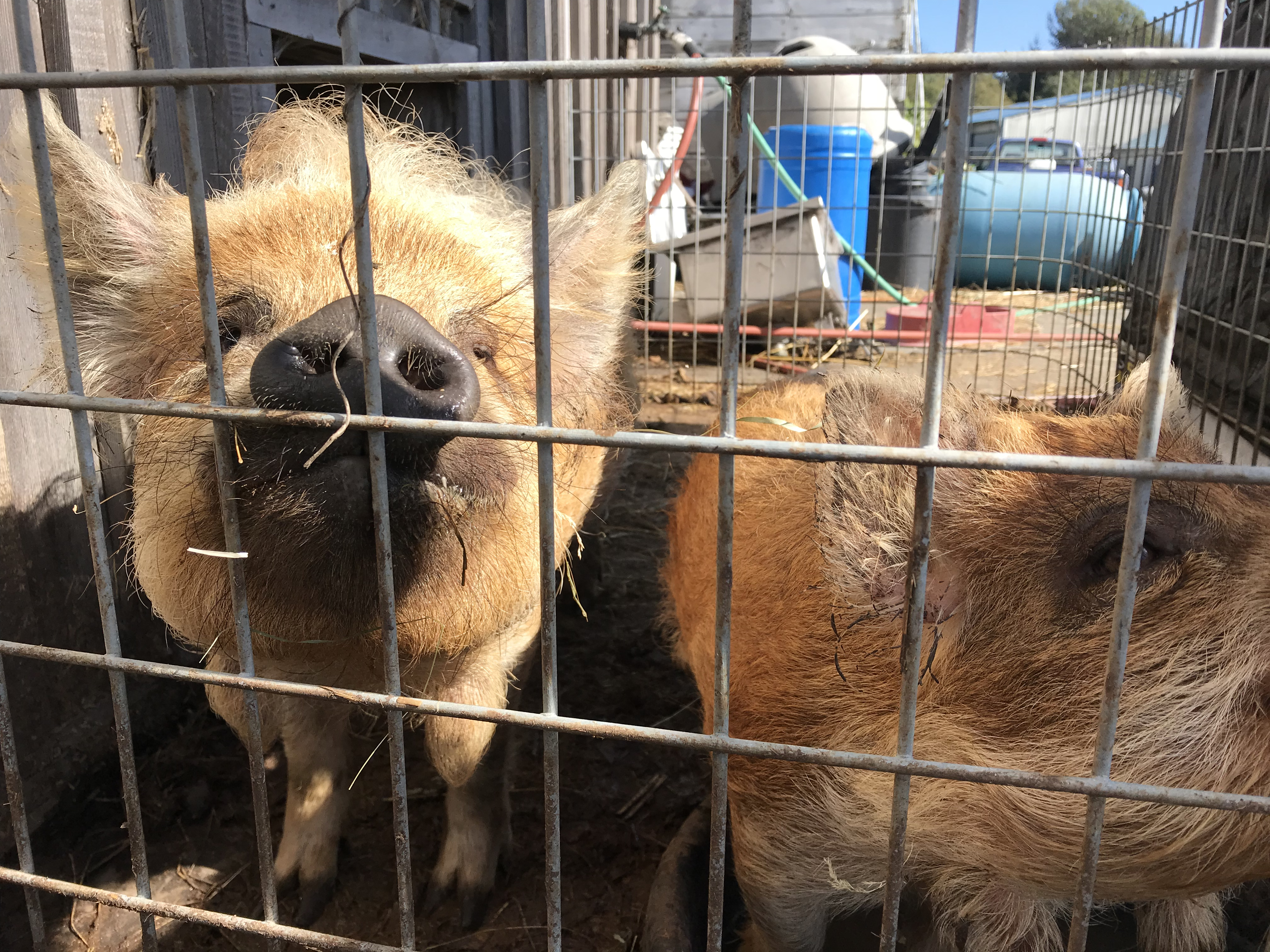
    Shail Pec-Crouse feeds her kunekune pigs. Pec-Crouse owns and manages a farm which practices sustainable farming, meaning she will be able to farm how she does today, forever. | Photo by August Davidson

    Shail Pec-Crouse owns Tule Fog Farm, a sustainable animal farm in the bottoms of Arcata. Her 22-acre property is home to pigs, sheep, turkeys and cows raised in a way that won’t damage the land they live on. Her operation is not very resource-intensive, although she did say working on the farm is a full-time job.

    At the moment, Pec-Crouse’s farm is hooked up to the municipal water system. It is an expensive alternative, but considering the local Sun Valley Floral Farm uses the herbicide RoundUp on nearby fields to prepare them for growing flowers, it is a safe alternative.

    “The field will be green one day,” Pec-Crouse said. “And orange the next.”

    It isn’t unreasonable to believe the toxic herbicides infiltrate the soil and work down into the groundwater. Infiltration is when soil absorbs water that falls on its surface. The water fills in crevices and pores between soil particles to create something of an underground lake called an aquifer. Depending on the chemical, infiltrating water can carry toxins into the aquifer.

    Watershed professor Joe Seney said groundwater contamination is a big management challenge. The use of herbicides, industrial waste, poorly constructed septic systems and urban runoff often pollute groundwater. Pollution poisons drinking water, destroys local ecosystems and can cause land to be infertile.

    Emma Flewell is studying environmental policy and planning at Humboldt State and worked with Ahtna Facilities Services to clean up a former Naval petroleum reserve in Bakersfield. The oil field contaminated a nearby aquifer and will take decades to clean up. The groundwater in the aquifer was used as tap water by a nearby neighborhood until people started getting sick.

    “The farmers are good people, it is water policy in the Central Valley that is the challenge. Once partisan politics gets involved, it gets very messy.”

    Matthew Lotakoon

    “There are a lot of aquifers that have the potential to be used for municipal water, but it’s sad because some of them are polluted,” Flewell said. “Being in environmental science and management, cleanup jobs are common. There have to be people who clean up the messes we make.”

    Flewell said there should have been legislation long ago to prevent aquifer pollution. She said it would be less expensive to not pollute in the first place than pay for the cleanup. Since the process to restore toxic sites takes years, the work needs to start as soon as possible.

    The Tule Fog Farm is an example of how a polluted landscape can be restored to be productive again. The farm is a remediation site, which means the ground the farm is on was once polluted but has since been restored. It takes knowledge and technology to restore land, and it should be an inspiration for future remediation.

    Lotakoon said consultation and collaboration with farmers is important moving forward. He stressed nobody is evil and it’s important to accommodate people and consider cultural differences and mannerisms.

    “Farmers are decent people trying their best to do good,” Lotakoon said.