The Lumberjack


Students Serving The Cal Poly Humboldt Campus and Community Since 1929

Tag: enrollment management

  • Cal Poly Humboldt project 2,000 more students for Fall semester, yet only delivered 98

    Cal Poly Humboldt project 2,000 more students for Fall semester, yet only delivered 98

    by Brad Butterfield

    Back in March, the university projected over 2,000 more students for the Fall 2023 semester than from the Fall 2022 semester; in reality, there are only 98 more students enrolled this fall.

    On March 7th, the University Resources and Planning Committee (URPC) had an Open Forum to discuss budget recommendations and feedback. In that forum enrollment for fall was projected to increase by about 2,000 students to have around 7,449 total students. However the current data from the university’s Institutional Research, Analytics, and Reporting shows only 5,964 total enrolled students. This difference is meager compared to last fall when total enrollment was 5,866.

    Of the nearly 6,000 students in attendance, there are 959 new freshmen undergraduates and 758 transfer undergraduates. These are preliminary totals, as final enrollment data will be available after the add/drop deadlines on September 18th.

    According to the university website, “Cal Poly Humboldt would expect to see enrollment increase 50% within three years and 100% within seven years.” At current growth of enrollment rates, it appears unlikely for the university to meet this goal. 

    Citing a hectic start to the semester, Chrissy Holliday, Vice President for Enrollment Management and Student Success, could not comment on the low enrollment numbers and advised the Lumberjack to talk to university Communications Officers. 

     Although there is growth, it is attributed to the university’s transition to becoming California’s third polytechnic campus. This transition promised $433 million of one-time funding and $25 million in ongoing base support, a name change, a host of new majors and hundreds of new on-campus dorm rooms. While new majors like cannabis studies (BA) and applied fire science and management (BS) have been added for the first time this fall, additional on-campus housing has not yet been achieved. 

    “The University expects this to be its second consecutive year of fall semester growth, and that is something to celebrate. Given the fact many colleges and universities in California and across the nation continue to suffer enrollment losses,” Grant Scott-Goforth, the university’s Communications Specialist said. Cal Poly Humboldt aims to bring enrollment up to 7,000 students by Fall of next year.

    The expansion of Cal Poly Humboldt is inevitable. At least two satellite properties west of highway 101 have been purchased by the university and the ‘Craftsman’s Mall’ project promises 800 new beds in the coming years. 

    “The Student Housing Project now in construction is expected to be completed in Fall 2025, with others rolling out in the coming years,” Scott-Goforth said.

    Although there is a lack of growth in enrollment, the university is still suffering. In the spring semester of 2023, an already understaffed University Police Department had to provide shuttle service to students housed in hotel rooms miles north from campus, while student-led housing protests ignited in the quad in the early part of the semester. Growing pains were felt by students and faculty alike. It’s apparent that the university is under strain from the exponential growth it’s undertaking, however this has not caught the school off guard.

    “Leadership knew that the first application cycle as a polytechnic would be different, and that it would take some time to develop the right infrastructure to capitalize on the increased admissions interest in the institution,” Scott-Goforth said.

    All this to say, welcome home to all of the new Lumberjacks and a warm (probably overcast) welcome back to the seasoned ‘jackers of Cal Poly Humboldt.


  • Letter to the Editor: HSU Did Not Violate California Law

    Letter to the Editor: HSU Did Not Violate California Law

    A letter from HSU’s vice president of Enrollment Management

    A letter from Humboldt State University Vice President of Enrollment Management Jason Meriwether follows:

    Wednesday, April 22, 2020

    James Wilde, Editor & Reporter
    Grace Caswell, Editor & Reporter
    The Lumberjack Newspaper
    Humboldt State University 

    Dear James and Grace,

    Please accept this letter (also enclosed) in response to the Lumberjack Article titled, Humboldt State Violated California Law by Requiring Registration for a Public Meeting, which was published on April 16, 2020.  

    While you were copied on a series of emails to me, and thus, on my responses, there are still a few important facts that I believe you will find useful in the wake of the April 16thstory.  Since my email was the source of the quotes by me in the article, I never had an opportunity to answer a couple of fundamental questions as you prepared for your story.  As such, I ask you to please consider the following:

    The University did not violate California Law.  

    When I received the original email, which copied numerous parties, Vice President Dawes and I took immediate action to verify that HSU was not in violation of the law.  This included going into consultation with other university stakeholders, including legal counsel.  This consultation reassured us that no violation of policy or law was taking place.  

    In particular, I urge you to please review the actual requirements of the Bagley-Keene Act.  First, please review a guidance document provided by the State’s Attorney General which outlines the scope of Bagley-Keene.  Most pertinent to this issue, the Bagley-Keene requirements at issue apply only to meetings of a statutorily defined “state body” (Section 11121) that do not apply to the informal meetings hosted by VP Dawes and me.  As explained in Section 11121 and in the guide from the State’s Attorney General, the sessions that were hosted do not fall within the scope of Bagley-Keene, which, based on guidance from legal counsel, means this law does not apply and was not broken.  

    With respect to the Brown Act, which was also referred to in the series of emails and in your article, this statute applies to local government agencies and essentially stands as a counterpart to Bagley-Keene, so to speak.  The California State University, in particular Humboldt State, is a state agency, which does not fall under the Brown Act.  Because Humboldt State, as a part of the CSU, is not subject to the Brown Act, legal counsel has advised us that the law was not broken.  

    Why did we add a public link to the originally scheduled presentations?

    We did so to eliminate any perceived barriers to participation.  As quoted in the story from one of my emails, “the entire point of the meetings was to be transparent.”  

    While we were fully aware that we were compliant with the law and that no persons were being barred from the meeting, the very notion that we were trying to keep people out, even though it was false and based on an incorrect interpretation of the law, compelled us to add an extra way to view the meeting.  In our perspective, if any person felt uncomfortable or interpreted the registration function as a barrier, then adding the extra link made sense.   In total, over 300 members of the university, media, and local community attended both meetings, and not a single person was excluded.  The zoom webinar function was not sought out as a barrier, but as the best way to allow so many people to receive the information at hand.  Registration for this meeting was not like a conference presentation or an event with limited access or hidden behind a paid wall.  Many instructors and students are using zoom for class and the majority, if not all, meetings and presentations are held over zoom.  We sent the information out to the entire campus, it was posted on the public events website, and we did not deny access to anyone.  Simply stated, because we could not have a meeting in the Great Hall or KBR, a zoom meeting appeared to be the best option to make sure that this important information was shared with the campus.   

    To be candid, the public webinars were not an attempt at secrecy.  Any notion to the contrary is simply false.  In our belief, these sessions were about being honest with the campus and sharing data that impacts everyone.  Making the report and data available online and readily sharing it with the media, students, faculty, and all interested parties was also necessary.  Personally, I can assure you that it would have been easier to not conduct public presentations about such a negative set of projections, but in fact, the public presentations were the right thing to do.   

    The first person to receive a copy of my report was a journalist from the Lumberjack who received the report even before my first public presentation to the University Senate.  The Senate presentation was also via zoom and on the same day I met with the student journalist.  This information has been presented to Associated Students, the University Senate, the University Planning and Resource Committee, and in two public meetings.  The report has also been cited by the media and directly provided to reporters who requested it.  These actions do not align with any intention to violate the law or fail in transparency.  

    In conclusion, I am committed to the voice of students through journalism, which I believe has been demonstrated during my first year at Humboldt State.  That commitment will not change.  To that end, my commitment to providing facts, information, and access to student journalists has also been demonstrated.  Accordingly, I ask that you please review the information and facts above and please weigh against the information that was provided to you and the information that was published in the article.   

    Thank you for your consideration.  

    Sincerely Yours,

    Dr. Jason L. Meriwether

    Vice President of Enrollment Management

    Humboldt State University

    Ralph M. Brown Act
    https://leginfo.legislature.ca.gov/faces/codes_displayText.xhtml?lawCode=GOV&division=2.&title=5.&part=1.&chapter=9

    Bagley-Keene Act’s Section 11121 https://leginfo.legislature.ca.gov/faces/codes_displayText.xhtml?lawCode=GOV&division=3.&title=2.&part=1.&chapter=1.&article=9.

    Attorney General’s Bagley-Keene Act Fact Sheet

    https://oag.ca.gov/sites/all/files/agweb/pdfs/publications/bagleykeene2004_ada.pdf

  • HSU Adapts to Low Enrollment

    HSU Adapts to Low Enrollment

    Inside the multi-pronged battle against declining enrollment

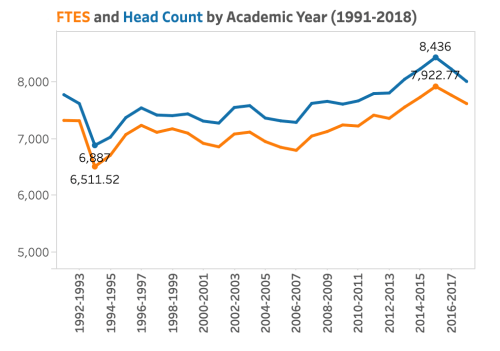
    Enrollment numbers are down and Humboldt State University is looking for ways to keep them stable. With just 6,900 students enrolled in 2019, administration and faculty are exploring recruitment strategies and program changes to stimulate growth on campus.

    Vice President of Enrollment Management Jason Meriwether is on the front lines of the enrollment situation.

    “We’ve lost well over 2,000 students in the last four or five years,” Meriwether said. “It’s a symptom of a few things. We’re graduating larger classes and our graduation rate has gone up. So that does have an impact. Part two is from a recruitment standpoint. There have been a number of things in place that have changed this year to get us to be a viable recruiting option.”

    Meriwether divided the recruitment efforts into three elements. First, the school got rid of barriers to campus visitors like fees for preview day, parking and lunch. Second, the Division of Enrollment Management is focusing its efforts to draw students from local communities to the campus. Third, the school is using data-driven strategies to make enrollment and engagement decisions.

    “We’re using data analytics to mine our top feeders and where we’re getting most of our applications,” Meriwether said. “And we’re using that type of data to make decisions about where we put our time and our energy for the maximum benefit for HSU. We want the community to know HSU is a first-choice university.”

    “I think that budget component has overshadowed the fact that we still have students here to serve.”

    Casey Park
    Former chair of the University Center Board of Directors

    Historically, HSU regarded low enrollment in a more negative light. A decrease in student enrollment was correlated with a decrease in campus revenue, and campus policies reflected the budget deficit. Casey Park, former chair of the University Center Board of Directors, offered some insight.

    “I think that budget component has overshadowed the fact that we still have students here to serve,” Park said. “And the narrative for the last two years was that we just didn’t have enough.”

    To help staff make decisions based in reality rather than through hypothesis and conjecture, the Office of Institutional Effectiveness provides data and information to faculty and staff. Lisa Castellino, the associate vice president of the Office of Institutional Effectiveness, acknowledged student resources being out-of-date with the current demographic.

    “We have a student demographic that has changed over the last five to seven years,” Castellino said. “It has become more diverse. There are more first generation students. It’s more low income. It’s the institution’s responsibility and priority, and it has been the last five to seven years, to help students, because going to college is complicated.”

    Thus, on-campus resources are evolving. With low enrollment, Molly Kresl and the Clubs and Activities office said they are being more deliberate and intentional with campus programming by engaging students in a way they prefer.

    Meriwether and Enrollment Management said they are promoting HSU’s educational experience to potential students in Humboldt, Siskiyou and Trinity Counties as a first choice rather than a backup. Beyond administration, academic departments are attempting to provide quality education for their students, regardless of enrollment numbers.

    “Often during times of change is also our greatest opportunity for growth,” Kresl said. “We stop doing things that really aren’t working that we’ve just done forever because we’ve always done it that way, and we start saying, ‘Okay, then why are we doing this?’”