The Lumberjack


Students Serving The Cal Poly Humboldt Campus and Community Since 1929

Tag: enrollment

  • Finalized census shows only 2% growth this fall, yet administration remains confident

    by Brad Butterfield

    Cal Poly Humboldt’s official census has been finalized and shows a one year increase of 118 students, or a 2% growth compared to last fall. The increase is important for the new polytechnic, which hasn’t seen consecutive growth in over seven years. The university is far below the projected 2,000 more students that were expected this fall semester. Because of the far-off prediction, over half a million dollars in Associated Student funded programs has been cut and millions dollars of funding may be withheld by the CSU for the next school year. What caused this gross over-prediction? What is the administration planning to do about it? And, maybe most critically, why does the school need to grow anyway?

    The projection for 2,000 additional students this fall arose primarily due to a record 86% surge in freshman applications. 

    “It really did look like it could be possible,” said Chrissy Holliday, Vice President for Enrollment Management and Student Success, regarding the expected inflow of students this fall. “What’s less known is how serious students are in the very beginning about an institution that’s just changed its identity,” Holliday added. 

    Cal Poly’s Humbodt’s recent transformation to become California’s third polytechnic has rendered the historical data typically used to predict enrollment, unuseful. As the school is changing, so are students’ behavior in response to it. In understanding how the university operates, it is useful to compare it to the way businesses function.

    “Think about companies that shift their identity or create something completely different that they’re putting into the marketplace, whether it’s a new brand or a new product,” said Holliday. “You never know right in the beginning exactly what reaction is going to be and then you start setting new baselines and adjusting to that.” 

    2,000 new students was both a worst and best case scenario for the university, which has promised to grow, but has not yet completed the planned infrastructure projects to support such an influx of new students. 

    “We planned for everything on the continuum. The worst possible thing would be to have growth like that and not be prepared for it right. You can imagine the chaos that would have ensued,” said Holliday.

    Cal Poly Humboldt is 2,473 students under their target for this fall, which could lead to 3.4 million dollars in funding being withheld by the CSU.

    “It’s a budget challenge we’re planning for. We knew that that was a possibility,” said Holliday.

    Additionally, the school spent over a million dollars on a contract with the Comfort Inn to house students, with hundreds of bed spaces on campus vacant. Further, the inaccurate enrollment estimation means that Associated Student funded programs have been cut by $528,717. This includes major cuts to the children’s center, government and even the university’s pool. 

    Still Cal Poly Humboldt is faring much better than most other schools in the CSU system.

    “If you look at all the CSU for this fall, headcount is actually down across the CSU and their full time enrollment, the resident ‘FTES,’ grew by about 1%, where for us that was 3.4%,” said Holliday. 

    In an effort to spread the word about the new polytechnic in northern California, the university has ramped up its advertising efforts. This includes the deployment of recruiting staff across California, digital advertising, improving communications and increasing engagement with prospective students, allowing ‘instant admissions’ for eligible students, enhancing the community college to Cal Poly Humboldt pipeline, increased presence at college fairs and streamlining the admission process.

    It appears that two statements are congruently accurate. The university will grow because it is now a polytechnic, and the school must grow because it is now a polytechnic. In fact, Governor Gavin Newsom and the state legislature approved $433 million in initial funding for polytechnic transition and $25 million per year thereafter. The pressure to grow is evident.

    “There’s definitely pressure because we put forth this polytechnic transformation, right, and said, ‘This is what we’re going to do,’” said Holliday. “There’s definitely a responsibility to follow through on what we promised.” 

    In spite of the low enrollment numbers this fall, Holliday remains confident that the school will achieve their overarching goal of 11,000 students by 2028.

    “I have zero doubt that we’re going to meet the targets that we have in the out years,” said Holliday.

    Holliday went on to explain that gradual growth will allow for changes to be done in a way that doesn’t take away the aspects of Humboldt county and campus life that separate the Lumberjack’s campus from any other. 

    “The more steady growth that we’re seeing currently gives us that time to make sure we don’t lose those things that helped make us special,” said Holliday.

  • Cal Poly Humboldt project 2,000 more students for Fall semester, yet only delivered 98

    Cal Poly Humboldt project 2,000 more students for Fall semester, yet only delivered 98

    by Brad Butterfield

    Back in March, the university projected over 2,000 more students for the Fall 2023 semester than from the Fall 2022 semester; in reality, there are only 98 more students enrolled this fall.

    On March 7th, the University Resources and Planning Committee (URPC) had an Open Forum to discuss budget recommendations and feedback. In that forum enrollment for fall was projected to increase by about 2,000 students to have around 7,449 total students. However the current data from the university’s Institutional Research, Analytics, and Reporting shows only 5,964 total enrolled students. This difference is meager compared to last fall when total enrollment was 5,866.

    Of the nearly 6,000 students in attendance, there are 959 new freshmen undergraduates and 758 transfer undergraduates. These are preliminary totals, as final enrollment data will be available after the add/drop deadlines on September 18th.

    According to the university website, “Cal Poly Humboldt would expect to see enrollment increase 50% within three years and 100% within seven years.” At current growth of enrollment rates, it appears unlikely for the university to meet this goal. 

    Citing a hectic start to the semester, Chrissy Holliday, Vice President for Enrollment Management and Student Success, could not comment on the low enrollment numbers and advised the Lumberjack to talk to university Communications Officers. 

     Although there is growth, it is attributed to the university’s transition to becoming California’s third polytechnic campus. This transition promised $433 million of one-time funding and $25 million in ongoing base support, a name change, a host of new majors and hundreds of new on-campus dorm rooms. While new majors like cannabis studies (BA) and applied fire science and management (BS) have been added for the first time this fall, additional on-campus housing has not yet been achieved. 

    “The University expects this to be its second consecutive year of fall semester growth, and that is something to celebrate. Given the fact many colleges and universities in California and across the nation continue to suffer enrollment losses,” Grant Scott-Goforth, the university’s Communications Specialist said. Cal Poly Humboldt aims to bring enrollment up to 7,000 students by Fall of next year.

    The expansion of Cal Poly Humboldt is inevitable. At least two satellite properties west of highway 101 have been purchased by the university and the ‘Craftsman’s Mall’ project promises 800 new beds in the coming years. 

    “The Student Housing Project now in construction is expected to be completed in Fall 2025, with others rolling out in the coming years,” Scott-Goforth said.

    Although there is a lack of growth in enrollment, the university is still suffering. In the spring semester of 2023, an already understaffed University Police Department had to provide shuttle service to students housed in hotel rooms miles north from campus, while student-led housing protests ignited in the quad in the early part of the semester. Growing pains were felt by students and faculty alike. It’s apparent that the university is under strain from the exponential growth it’s undertaking, however this has not caught the school off guard.

    “Leadership knew that the first application cycle as a polytechnic would be different, and that it would take some time to develop the right infrastructure to capitalize on the increased admissions interest in the institution,” Scott-Goforth said.

    All this to say, welcome home to all of the new Lumberjacks and a warm (probably overcast) welcome back to the seasoned ‘jackers of Cal Poly Humboldt.

  • Letter to the Editor: Reflections on 30 Years at HSU

    Letter to the Editor: Reflections on 30 Years at HSU

    Where we were, what went wrong & how we build a brighter future

    This is a letter to the editor from Humboldt State University Education Department Chair Eric Van Duzer, Ph.D. It has been edited only for minor punctuation and grammar style preferences.

    As I reflect back on nearly 30 years at Humboldt State University, first as a student and then for the past 20 years as a faculty member, I wanted to share some of the thoughts that I have about HSU’s current situation and where the campus might go from here.  

    As a student I experienced a remarkable education where faculty were fully invested in my intellectual and personal development. There were so many opportunities to explore areas of interest and develop new ones. I have spent many hours trying to encapsulate the nature of the schooling I experienced in a way that would really represent the experience. 

    The best analogy I have been able to come up with was that HSU offered a graduate education to undergraduates. The small classes typical of graduate school encouraged faculty to fully invest in their student’s growth. The university, set so far from the oversight of CSU headquarters in Long Beach, offered a great deal of flexibility to shape our experiences. 

    This would be impossible today. In those days HSU had the third smallest class sizes in the 23 campuses of CSU. But more than that, it had a unique faculty ethos that reflected nearly 100 years as a student-focused institution that exalted excellence in teaching above all else.  

    I was the first student CEO of the Institute of Industrial Technology, a self-supporting club that allowed us to use the skills and knowledge we were developing to grow in business acumen, engage in manufacturing and light construction on campus as well as conduct experiments for local agencies. In its second year, Bill Wilkinson used the institute to earn enough profit making desks for campus offices that it paid for several pieces of expensive equipment for the department.

    This would be impossible today. In those days HSU had the third smallest class sizes in the 23 campuses of CSU. But more than that, it had a unique faculty ethos that reflected nearly 100 years as a student-focused institution that exalted excellence in teaching above all else.  

    Faculty came to campus because this is where they wanted to spend their career. Unlike most universities where faculty play academic hopscotch building their resume through research reputations and earning ever-higher salaries as they bounce from college to college, HSU faculty built their reputations on teaching.  These were inherently local reputations, not very valuable if one wanted to move on, but rather a reflection of the values and attitudes associated with a culture of excellence in the service of students’ intellectual growth.

    As anyone who has worked with university budgets will tell you, graduate education is expensive.  That is why through the first 100 years, the administration and other services were done on a shoestring. It was common for a variety of upper administrative positions to be filled by faculty who served temporarily. Staff was thin and overworked and processes were slow and inconsistent. 

    What happened? In the early 2000s the CSU was facing the onslaught of a Generation X student bulge. Chancellor Charles Reed decided the best strategy to deal with this situation was to homogenize campuses so that if a student could not get into Sacramento State because it was impacted, they could simply go to another campus and get a similar experience. 

    Yet, the campus, with significant leadership from the faculty, focused its significant resources on classroom instruction, and through that dedication, produced exceptional graduates who were deeply committed to HSU when they graduated. 

    I remember an administrator in the early years telling me that he had been in a restaurant on the East Coast and overheard a group of students talking at a nearby table. He was so impressed with their sophistication and the values they held he found out where they came from and immediately applied for a job at HSU. 

    He was the first person hired under then-president Rollin Richmond to manage our enrollments in the early 2000s. The diversity on our campus is a credit to him and Richmond, who reached out across the state to bring in students from urban areas. Sadly he became disillusioned and left. So did most of the faculty leaders. 

    What happened? In the early 2000s the CSU was facing the onslaught of a Generation X student bulge. Chancellor Charles Reed decided the best strategy to deal with this situation was to homogenize campuses so that if a student could not get into Sacramento State because it was impacted, they could simply go to another campus and get a similar experience. 

    Shortly thereafter the upper administration received inflated titles and significant raises in an apparent effort to reduce resistance. Then the attack on the faculty began.

    Naturally, faculty on campuses such as HSU who were proud of their traditions and niche identities resisted. Fiercely. At one point, three campus presidents, including Rollin Richmond, suffered through votes of no confidence by their faculty as they implemented this strategy. 

    To achieve the required changes in the face of faculty resistance, campuses, including Humboldt, began shifting to a corporate structure of top down management. Faculty who had held a privileged position in campus life were systematically reduced to workers with only a symbolic voice in campus decisions. The administration turned its focus inward towards improving the functioning of the bureaucracy. They eliminated administrators such as Rick Vrem, an ethical provost, who refused to implement changes that hurt the traditional focus on instruction.  

    Vrem was replaced with a provost who had no such compunction. Shortly thereafter the upper administration received inflated titles and significant raises in an apparent effort to reduce resistance. Then the attack on the faculty began. Nearly 80 faculty positions were eliminated over several years and during the same time period, a similar number of new staff positions were created and filled to support administrative functions. 

    Over the majority of the intervening 15 years, budget reductions for academic programs have been the norm: reductions in staff, program availability and courses. This year it was a 6% cut, last year another and many like it before. The funds have been shifted to an ever-expanding variety of administrative initiatives. 

    Now we sound more like a parks and recreation office than a university. Come for the redwoods, the beaches, the bike riding—that is wonderful and I love it, but it is not why people pick a university.  

    We spend nearly 68% of our budget on administration and campus facilities. Despite the results of a study commissioned by Rollin Richmond’s administration that showed the two most important factors that cause a student to come to HSU are quality of education and availability of the program they are interested in, both have been repeatedly attacked, sliced and diminished.

    It is surprising that no one seems to notice that every time we cut academic programs, fewer students want to come here. And when fewer students come here, the budget suffers and HSU responds by cutting academic programs even more severely—a cycle the faculty in 2004 described as a “death spiral.” 

    As we address our current crisis and try to figure out what we need to become in order to grow back to a sustainable enrollment, we might want to engage in some soulful reflection. What would cause a 20-year-old to come to a place five hours from major centers of civilization and spend four years with us? What do we have to offer them that is so valuable, so different from what they can get at any of the other CSU campuses which are closer, cheaper and offer a great deal more college life in the community? 

    We stopped selling the small classes and close academic relationships with faculty when the hypocrisy became too much to bear as campus priorities shifted. Now we sound more like a parks and recreation office than a university. Come for the redwoods, the beaches, the bike riding—that is wonderful and I love it, but it is not why people pick a university.  

    When I arrived here as a faculty member in 2000 we had one staff member, John Filce, doing institutional research. He was wonderful and badly overworked. I am sure he still is. Now we have nine staff members listed in the directory in the Office of Institutional Effectiveness, including a vice president. I am sure their work is valuable, but to pay for it we had to cut 64 class sections. 

    Today, we are an organization of inflexible rules and their keepers.

    We have proliferated the bureaucracy, which is unfortunately necessary to achieve top-down control of a professional organization. Had our leadership studied industrial technology with me, they would know what companies in the 1970s learned: that this form of management is ineffective and inefficient in a professional organization. 

    To achieve control requires monitoring, which in turn requires more staff. For a top-down organization, where the vast majority of employees serve at the will of their manager, fear prevents innovation and compliance is key. Before the shift to this model, administrators were problem solvers. In fact, the standing joke in those days was that everything was an exception. Faculty, staff and administrators had the flexibility to serve the needs of students even when it required bending the rules. 

    Today, we are an organization of inflexible rules and their keepers. It has greatly diminished the effectiveness of the organization and its ability to make decisions that best serve our students. The resulting bureaucratic culture has seen a proliferation of forms, rule books and rigid adherence to often dysfunctional orders.

    This is no way to run a university. Perhaps a grocery store, but not an organization of 500 highly educated experts with thousands of years of collective experience. Top-down decision-making, particularly when the president and upper administrators are drawn from institutions that do not share the culture and values of the campus, is inherently poor compared to what would be possible if faculty once again had a meaningful voice in campus affairs.  

    No student has ever come to HSU because we have a wonderful registrar’s office or because the president’s office is fully staffed.  These only matter when they impact the quality of the education a student receives. 

    The proof of this is apparent everywhere at HSU. When Rollin Richmond came, he had no interest in what made HSU special. Like a white suburban principal coming to a school in Watts, he thought he knew what needed to be done to remake the university into his vision of a modern institution. That ignorance has cost us immeasurably. Today we face the consequences. The failure to fundamentally change direction of subsequent presidents has simply deepened the mess. We now have a new president, perhaps we can find a new vision. 

    In my view there are two key concerns that need to be addressed from a rational and values-driven perspective. First, an effective budget model that allows funding to follow enrollment is essential to support growing programs while shifting resources to where they will best serve student needs and interests. This can refocus the campus on providing the service/product students come here for—classroom instruction—and it is essential.  

    There are so many amazing faculty and academic staff here. They are people with a heart for their students, struggling in a system that constrains and conflicts with their efforts. Let their voices guide the future and we may yet have one worth celebrating.

    No student has ever come to HSU because we have a wonderful registrar’s office or because the president’s office is fully staffed.  These only matter when they impact the quality of the education a student receives. 

    Second, we have to decide how we are going to rebuild the excellence we once were known for in our student’s academic programs.  The day Rollin Richmond refused to give the Outstanding Faculty Award to a physics professor (selected by the faculty based on his ability to delight and inspire students) because that professor had not published, is the day we snuffed out the soul of the old HSU campus. 

    Now we need to find out what animates us in ways that provide an experience worth the isolation, cost and struggles required to live in this remote community. Redwoods are not enough; we need a reinvestment in education. 

    I am retiring from HSU at the end of this May. I am sad to see what has happened to my university. There are so many amazing faculty and academic staff here. They are people with a heart for their students, struggling in a system that constrains and conflicts with their efforts. Let their voices guide the future and we may yet have one worth celebrating.

  • HSU Sails into Uncharted Waters

    HSU Sails into Uncharted Waters

    Humboldt State faces enrollment drop, budget cuts and academic department reorganizations

    If Humboldt State University was a ship, it would be sailing straight into uncharted seas, thick with fog.

    Atop the tallest mast, HSU administrators spy an enrollment drop of around 20% for the fall semester, mainly due to COVID-19. Administrators project a resulting budget cut of around $7.4 million for the next school year and $20 million in the next two years, according to HSU’s most recent enrollment report and webinars held April 13 and 15.

    Faculty and staff are scrambling across the deck to reorganize HSU’s academic departments.

    Vice President of Academic Affairs and Interim Provost Lisa Bond-Maupin said HSU’s colleges are looking at combining department staff and faculty and adjusting fall course schedules for a smaller student population.

    “Those are the strategies we’re looking at—combining staffing where it makes sense and combining chair leadership where it makes sense,” Bond-Maupin said via Zoom interview. “We’re not doing away with academic programs.”

    A proposed plan emailed to department chairs of the College of the Arts, Humanities and Social Sciences divided CAHSS departments into four schools, each of which would have one chair. The presumed thinking behind the plan would be to eliminate the need for each department to have its own chair and free up chairs to teach more courses—reducing the number of other needed faculty.

    Bond-Maupin did assure that HSU has no plan to cut any academic departments—but semester course offerings will depend on what students need.

    Bond-Maupin said that exact proposal probably would not move forward. Bond-Maupin said she and the deans of the HSU colleges are still figuring out what they will do.

    With department reorganizations and course offerings expected to be adjusted for the fall, lecturers will likely end up with fewer courses to teach. Bond-Maupin said schedules for a reduced number of students inevitably affect the availability of work. In other words, if all of a lecturer’s courses are pushed off the fall schedule, they would be thrown overboard too.

    Bond-Maupin did assure that HSU has no plan to cut any academic departments—but semester course offerings will depend on what students need.

    “As enrollment changes, we need to sort of follow the needs of the students,” Bond-Maupin said.

    Over 2,000 individuals signed a change.org petition asking for HSU tuition to be reduced for the spring. Bond-Maupin said a change in tuition would come from the California State University Chancellor’s Office, not HSU.

    Tuition reduction or not, HSU faces serious challenges. In an April 13 webinar HSU held on the enrollment decline and budget cuts, Vice President of Enrollment Management Jason Meriwether delivered dire news on enrollment.

    “If the CSU is in a recession for enrollment, Humboldt State needs to worry about being in a depression for enrollment,” Meriwether said. “I hate to use those terms, but it just forecasts the impact HSU could face in the terms of COVID-19.”

    HSU has refunded nearly $2.5 million to students for housing, parking and dining and projects to lose around $7 million by the end of June.

    “We are hearing from the governor that there may be some return to being together but with some new social distancing parameters—so that’s possible.”

    Lisa Bond-Maupin

    Vice President of Administration and Finance Douglas Dawes emphasized the importance of the campus understanding the need to make quick budget cuts. Dawes said HSU is looking into a mix of measures, including hiring chills, spending freezes and retirement incentives.

    These hits to the hull come despite progress HSU made before it entered the murky waters of the pandemic—208 local students accepted the Humboldt First scholarship, up from 32 local students per year for the last three years.

    Both Meriwether and Bond-Maupin said details of the fall semester remain uncertain and hinge on public health recommendations. Bond-Maupin said HSU is preparing for a variety of potential scenarios, from remaining online to opening partially.

    “We are hearing from the governor that there may be some return to being together but with some new social distancing parameters—so that’s possible,” Bond-Maupin said. “We might work with spacing. We also may look at timing. One scenario I can think of is that we are delayed in going back fully to face-to-face, so we begin online. I think we just have to plan for all those scenarios.”

    The Lumberjack requested an interview with HSU President Tom Jackson multiple times for this story, but he could not be reached. HSU Communications Specialist Grant Scott-Goforth cited an “incredibly busy time.”

  • With Future Unknown Amid Pandemic, HSU Plans for Enrollment Drops and Budget Cuts

    With Future Unknown Amid Pandemic, HSU Plans for Enrollment Drops and Budget Cuts

    HSU, like all colleges, prepares for tough times and serious measures

    Humboldt State University is preparing for an enrollment drop of around 20% for the fall and a budget cut of around $20 million by the 2022 fiscal year, according to a joint press release from HSU and College of the Redwoods.

    Before the COVID-19 pandemic, HSU projected an enrollment drop for total students of around 14% for the fall and had proposed a budget cut of around $5.4 million by the 2022 fiscal year. 

    Given the uncertainty of the next year, HSU is planning for an even larger enrollment decline and budget cut. HSU currently projects new student enrollment to drop by 30%. The specifics of what the budget cuts will mean are still being worked out.

    “Many options are being looked at, including combinations of a hiring chill, spending freeze, operational changes, incentives for retirements, travel reductions, and more,” the press release said.

    In a Zoom interview, HSU Vice President of Enrollment Management Jason Meriwether said a worst case scenario projection might be only 500 new students and 500 transfer students admitted to HSU in the fall. 

    These numbers, to be clear, are projections. No one knows exactly how the next year will play out. Meriwether hoped HSU could keep enrollment and retention as high as possible.

    “The sad part is, I don’t know,” Meriwether said. “There’s no benchmark. There’s nothing to project against. We could be doing all this and, you know, 1400 students show up—which would be wonderful.”

    HSU is not alone. As noted in Meriwether’s Tuesday enrollment management report to the HSU Senate, colleges everywhere are facing enrollment drops amid the pandemic. The report cited articles from Forbes and the Associated Press along with some early data suggesting one out of every six college-bound students won’t attend college in the fall.

    With education expected to shift to a more local focus, Meriwether pointed out that HSU already shifted to local recruitment in the last year with measures like the Humboldt First Scholarship.

    Compared to an average of about 32 local students attending HSU per year in the last three years, HSU currently has 208 local students confirmed to attend HSU in the fall with the Humboldt First Scholarship. 

    “The good news is we’re not starting local recruitment today because there’s a problem,” Meriwether said. “That’s the best part of all this—is that we already have a really solid foundation that we built in the community over the last eight or nine months.” 

    The enrollment management report includes a graph of enrollment scenarios, with red lines for lower enrollment scenarios and a blue line for a growth scenario. Meriwether hoped for HSU to remain close to the blue line.

    “Essentially, pray we get as close to the blue line as possible,” he said. 

    Meriwether pointed out that, since COVID-19 has hit everywhere, current students might not have much reason to transfer. If classes are still online in the fall at HSU, they will presumably be online everywhere. 

    “Let’s say a student says, ‘OK, well, you know, I want to transfer because I didn’t want this experience,’” he said. “OK. Well, the question will be, ‘What school are you going to transfer to?’ Because every school is stuck in this scenario right now.”

    Nevertheless, the pandemic will likely temporarily derail HSU’s efforts to improve enrollment. 

    “Long term, you know, prior to COVID-19, prior to this hit, we had a plan of getting to an FTE of 7600 students [full-time students] in about four years,” he said. “So now, what if the COVID-19 environment says, well, gosh, it can make us take eight years to get there.”

    Meriwether was optimistic that eventually, HSU would get through this.

    “I believe that we will bounce back, and I believe we will bounce back strong if the hit is really bad,” he said. “This is a marathon. Enrollment is a marathon.”

  • HSU Projecting Grave Hit to Enrollment for Fall Semester

    HSU Projecting Grave Hit to Enrollment for Fall Semester

    Freshman class projected to shrink, number of academic departments to be reduced

    For the latest information, see our story here.

    Update 11:10 a.m.: a second email sent yesterday from College of Natural Resources Dean Dale Oliver and obtained by The Lumberjack makes similar points but does not give a specific number to the expected enrollment drop for fall beyond noting that a 15-20% drop was expected prior to the COVID-19 outbreak. We will update this story when we have confirmed the numbers below. The second email is pasted below.

    Humboldt State University has issued a budget directive to take immediate action to prepare for the fall semester, including the freezing of open staff positions and the reduction of the number of academic departments, according to an email sent to faculty and staff of the College of Arts, Humanities and Social Sciences Tuesday morning.

    The email, sent by Interim Dean of CAHSS Rosamel Benavides-Garb, projected a freshmen class for fall 2020 of around 500 students, down from around 1,400 students five years ago and down from around 1,000 students for fall 2019.

    “The scale and impact of our current predicament is grave and as a result our budgetary practice has to be reconsidered and reformulated based on the simple equation of demand and resources,” the email said. “We have become, de facto, a much smaller institution, which compels us to undertake a comprehensive reset at HSU.”

    The email listed six directives, including requests to freeze all vacant staff positions, reduce the number of academic departments and develop online programs for current and transfer students to complete their degrees.

    The email promised to make the process consultative and sustainable.

    “We remain committed to “the student first” approach,” the email said, “and are extremely aware of the critical importance, now more than ever, of issues of social justice, equity, and inclusion in all we do.”


    The full email is copied below:

    Dear CAHSS Colleagues,

    On April 2, the deans of all three academic colleges received new administrative directives from Interim Provost Lisa Bond-Maupin regarding the coming academic year. The directives are a call to action, issued in response to the budget and recruitment/retention reality at HSU. The Interim Provost reiterated these directives yesterday, Monday, April 6 in her Provost/VPAA Report to the senate.

    As we all know, our student enrollment has been declining for several years and the institutional budget has been negatively impacted. The administration’s efforts to address the problem must now be reframed in light of new and profound challenges the current COVID-19 pandemic poses for HSU, and the CSU system in general.

    We are projecting a freshmen class of 500~ students across all three colleges. Five years ago, the freshmen class numbered 1,400+ students. The scale and impact of our current predicament is grave and as a result our budgetary practice has to be reconsidered and reformulated based on the simple equation of demand and resources. We have become, de facto, a much smaller institution, which compels us to undertake a comprehensive reset at HSU.

    The Interim Provost has directed the three academic deans to reduce spending and grow retention/recruitment. Her directives require our college to implement the following action areas immediately:

    1. Freeze all vacant staff positions: This is indefinite or until each college develops a plan to organize staff support within colleges and across colleges.

    2. Reduce the number of academic administrative units (departments): This needs to be planned immediately and be in place for this next fiscal year so we are reorganized starting fall 2020.

    3. Develop online degree completion opportunities for certain existing majors in the last two semesters of their programs.

    4. Develop two-year degree online completion opportunities for transfer students of certain majors beginning fall 2020.

    5. Develop a partnership with CEEGE related to workforce development, responding particularly to a post COVID-19 context.

    6. Integrate the Center for Teaching and Learning (CTL) in the development and implementation of new teaching capacity.The Interim Provost has also indicated that she expects this process to be:

    The Interim Provost has also indicated that she expects this process to be:

    · Consultative with unit leadership.

    · Consultative and collaborative across colleges.

    · Sustainable by creating new retention and recruitment opportunities.

    The deans of the three colleges have already begun discussing the directives. I have also initiated planning within CAHSS, in collaboration with the three associate dean fellows, and will continue to discuss budget with the chairs. We will move forward together, exploring multiple budget management opportunities to make our colleges strong and resilient in the face of present and future challenges. We can also regard these adjustments as unique opportunities to explore new and exciting programs to attract and serve our ever-diverse student population in a shifting and challenging workforce environment. We remain committed to “the student first” approach and are extremely aware of the critical importance, now more than ever, of issues of social justice, equity, and inclusion in all we do.

    Sincerely and in solidarity,

    Rosamel


    Email from CNRS Dean Dale Oliver:

    April 6, 2020

    CNRS Faculty and Staff

    Dear Colleagues,

    Earlier today Interim Provost Lisa Bond-Maupin sent out her report to the HSU University Senate in preparation for Tuesday’s meeting.  Included in her report was a call for collective action to prepare for fewer students and fewer resources in the next academic year.  I’ve pasted the relevant section of the Provost’s report below my signature.

    Current estimates indicate we could have 20% fewer students in Fall 2020 that we had in Fall 2019.  This reduction is significant, and we must plan over the next weeks and months so that those students who start or continue with us in the fall experience high quality, engaged learning that will prepare them well for STEM professions and advanced study.

    Three items from the Provost’s report that I want to highlight are personnel, administrative re-structuring, and online education.

    Personnel: Although we will be finishing out the two faculty searches currently underway, and ensuring we have sufficient temporary faculty to deliver our curriculum, all other hiring is frozen for the moment, including those which are currently vacant and those which will soon be vacant due to expected retirements. Through improving business processes, realigning and reorganizing staff positions, and targeting professional development we will find a way to support our educational enterprise without hiring additional personnel.  This work will be both necessary and challenging, and require collaboration with relevant unions and careful consideration of multiple factors.

    Administrative restructuring: At the Dean’s level we were already planning a partial re-assignment for Associate Dean Rick Zechman to manage the marine lab while marine lab director Brian Tissot transitions from full-time director to FERP faculty.  We are also being asked to reduce the number of administrative units in the college, meaning that some departments will be merged or reformed.  This work will be done in close collaboration with the CNRS Council of Chairs and the other two academic deans.

    Online Education: There are some programs in CNRS for which one of the following scenarios might make sense:  provide an online degree-completion option for a group of students who have a year or less left to complete their degree; provide a degree-starter program for a group of first year (or transfer) students to get started with HSU from home during the fall 2020 semester, and then begin on campus in Spring 2021; provide more online sections of general education courses for undeclared students or majors from outside CNRS.  For the moment, I recommend that faculty discuss within their departments whether one or more of these scenarios might be appropriate for their program.

    For this week I am collaborating with the Provost’s office, with the other academic deans, and with a working group of CNRS Chairs to create possible models for administrative restructuring that can then be discussed among all of the CNRS chairs the following week.  Relatively soon I will also set up a mechanism by which input can be given from across the college.

    We face a significant challenge as a college and university over the next few months and years, but I am confident that we will find solutions that serve our students and the citizens of California well.  My confidence rests solidly on the incredible talent, dedication, and creativity of our faculty and staff, whom I am proud to serve.

    Best wishes, safety, and health to you and your families,

    Dale R. Oliver, Dean

    College of Natural Resources and Sciences

    From Interim Provost Lisa Bond-Maupin’s report to HSU’s University Senate, April 6, 2020

    Realignment of Spending with Reduced Revenue

    In addition to supporting instructional continuity and Academic Master Planning, our division leadership is turning our attention to budget planning for next fiscal year and beyond. Prior to COVID-19, our enrollment picture for next academic year was apparently trending toward a 15-20% fall-to-fall (one year) student headcount decline. We were likely headed toward a reduction to the HSU budget for next fiscal year that was double that anticipated when the URPC created its annual budget recommendations to President Jackson.  While the college-going enrollment impact of the pandemic is unknown for all in higher education across the nation, it is clear that the CSU and HSU will experience further decline in student enrollment. Given the enrollment challenges felt across the state, it is likely that impaction at our southern campuses will be lifted. It is highly likely that more students will choose for financial and other reasons, in the shorter term at least, to remain at home or closer to home to study. 

    While we await the release of up-to-date enrollment projections and budget information, Academic Affairs is implementing a few immediate strategies toward student retention and recruitment on the heels of the pandemic and toward further reducing our spending. As we do so, we are guided by the URPC principles and our own commitments to meeting the instructional needs of our students and protecting employment. In addition to continuing to adjust our academic offerings for Fall, immediate strategies also include: 

    • Working with each dean and director to reduce budget allocations for FY 21 

    • Freezing hiring in all open staff positions for now and planning to absorb staff attrition

    • Working collaboratively with staff within and across colleges and budget units in Academic Affairs to reimagine and reorganize our staff support 

    • Working collaboratively with department chairs and faculty to condense the number of separate academic administrative units in the colleges 

    • Working within the Office of the Provost to realign and reorganize staffing

    • Identifying academic programs ready to continue to offer upper division major courses online into next year and beyond to: a) help students in their final semesters to study from home and complete their degrees, and b) offer new transfer students an opportunity to complete their degrees online 

    • Identifying a COVID-era retention specialist in Academic Affairs who will support the continued offering of all existing retention efforts in a virtual format and will work in collaboration with ODEI to implement inclusive retention practices at a distance. 

    Each one of us will be implicated in and needed for this work. It is tough and unavoidable at this time. Each one of us has a very important role to play, now, more than ever in maintaining close connections with our students, helping them to problem-solve their educational needs and connect to resources and to stay connected to HSU. We need our students. And I think we are finding in their response to our transformed instruction – they need us. This powerful connection will ultimately move HSU through and beyond this tough moment in our collective history to the future we envision. Thank you.

  • Retention Rate on the Rise at HSU

    Retention Rate on the Rise at HSU

    More Humboldt State students are electing to stick around, but there’s still work to be done

    Corrections: a previous version of this story incorrectly quoted Casey Park as saying “We’re absent as an institution.” The quote should have said “We were absent as an institution.” The story also wrongly included “interim” in Jason Meriwether’s title.

    Humboldt State revealed more students were staying on its campus rather than taking off for other schools or ventures in a Jan. 31 press release.

    Tracy Smith, the director of the HSU Retention through Academic Mentoring Program, said she was proud of the work she and her peer mentors have accomplished over the years.

    “I think Humboldt sincerely believes that whether students decide to stay at Humboldt or not is really a product of our entire campus community and off-campus community,” Smith said. “RAMP really is designed to support incoming students and them finding a place where they feel a connection.”

    “85 percent of new first-year students said if they were given the option to choose a college again, they ‘probably’ or ‘definitely’ would attend HSU again.”

    National Survey of Student Engagement, spring 2019

    A study done in conjunction with HSU by the National Survey of Student Engagement in spring 2019 provided some data on student perceptions of HSU.

    “85 percent of new first-year students said if they were given the option to choose a college again, they ‘probably’ or ‘definitely’ would attend HSU again,” the study said. “And 89 percent of first-year students said their overall experience was ‘good’ or ‘excellent’, compared to an overall CSU system rate of 84 percent.”

    Jason Meriwether, Ph.D., vice president for Enrollment Management, said a few things have contributed to the increased retention rates, including Enrollment Management staff and related faculty streamlining the registration process and connecting students with support services—all in an attempt to create a sense of belonging for students.

    “It’s the experience but it’s also the listening and packaging it into one,” Meriwether said. “So, all of that is about looking at the students and giving them what they’re asking for first, and using the resources that we have to create an experience for the student.”

    Meriwether said his staff’s hard work has paid off by meeting student needs.

    “We have to be aligned with what students are expressing that they need and putting ourselves in a position to support students,” Meriwether said.

    “There wasn’t attention given to the most affected and traumatized students. And those are the students who went back to where we recruit from and said ‘Humboldt is not a place for me,’ and ‘Humboldt is not a place for you.’”

    Casey Park, HSU alumna

    He noted a growing trend at HSU of transfer students outnumbering first-time freshmen. HSU has needed to move around campus resources to accommodate the influx of transfer students.

    “It’s about being nimble and seeing where the student population is going and meeting those needs,” Meriwether said.

    Meriwether added that in recent months, the Student Disability Resource Center and cultural centers have received major face-lifts, which, in turn, have opened up more doors for students.

    Casey Park, an HSU alumna, was glad for the rising number of retained students, but said the campus administration’s past actions around retention shouldn’t be ignored as a new wave of measures are enacted. Park is an Associated Students coordinator, but gave her perspective only as an alumna.

    “We are still going to need to reconcile the years where we were neglectful of students,” Park said. “It’s going to take a lot of really good decisions to hold ourselves accountable for that and kind of be like, ‘We were absent as an institution.’”

    Park said the HSU administration’s inaction regarding the Josiah Lawson case and other events affected previous student perceptions of HSU.

    “There wasn’t attention given to the most affected and traumatized students,” Park said. “And those are the students who went back to where we recruit from and said ‘Humboldt is not a place for me,’ and ‘Humboldt is not a place for you.’”

  • Clubs Budget Crunched in Wake of Declining Enrollment

    Clubs Budget Crunched in Wake of Declining Enrollment

    Associated Students takes over remains of the clubs budget

    The Associated Students Programs Grants budget has been cut by more than half of the previous academic year’s budget to $25,000 from $52,000. With student enrollment on the decline since 2016, student fees. which make up the entire AS budget, have taken a significant hit.

    As a result of the cuts, it was decided the control of the budgets would be kept within the Associated Students Board of Finance for this academic year. All student clubs are allowed to apply for AS grants, either for events or travel.

    Grant requests are brought to the Associated Students Board of Finance for evaluation before being handed off to the Associated Students Board of Directors, made up of 15 voting and three non-voting members, for final approval.

    In the past five years, between about 10-18% of the AS Programs Grants budget has gone to AS category two programs like CCAT and the MultiCultural Center, which receive separate funding through different outlets. This year, AS decided clubs will receive the entire AS Programs Grants budget in the 2019-2020 academic year.

    The AS Board is currently in the process of their third and final grant allocation for the 2019-2020 academic year. So far, the Board of Directors has approved grants to all 29 clubs that requested—however, not all requests have been entirely met.

    As a result of the budget reduction, AS put in place a cap of $500 per event, $800 per cultural event and $100 per person for travel. The Board of Directors will hold their final vote on March 13 to decide the 11 remaining grant requests for the academic year.

    AS Legislative Vice President Jeremiah Finley is working to provide a fair opportunity for all clubs to receive funding.

    “AS is doing the best with the situation that they’re having to navigate through.”

    Molly Kresl

    “I think clubs always need more access to more funds across the board,” Finley said. “I think the goal of AS here is to really try to make sure that they do have access to funds. And so, in trying to do that, we’re trying on our part, to find ways in our budget to make sure they have access.”

    The clubs budget reduction has forced everyone involved to be more responsible with their spending, according to Clubs and Activities Coordinator Molly Kresl.

    “That’s something that’s been really cool that’s come out of this unfortunate situation,” Kresl said. “Even though we have a decrease in funding, there’s an increase in collaboration with student-initiated programs.”

    However, there’s still much improvement to be made. AS wants to hear the voices of students that are affected by these decisions. For students who want to take matters into their own hands, they can sign up as a candidate for the AS Board.

    “AS is doing the best with the situation that they’re having to navigate through,” Kresl said. “It’s important to recognize the complexity of the situation, and that there are ways that we can help our students be successful and do what they wanna do on campus.”

  • HSU Adapts to Low Enrollment

    HSU Adapts to Low Enrollment

    Inside the multi-pronged battle against declining enrollment

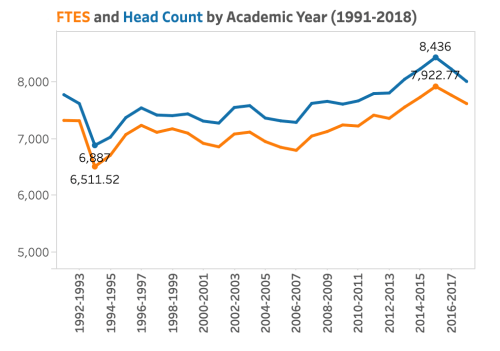
    Enrollment numbers are down and Humboldt State University is looking for ways to keep them stable. With just 6,900 students enrolled in 2019, administration and faculty are exploring recruitment strategies and program changes to stimulate growth on campus.

    Vice President of Enrollment Management Jason Meriwether is on the front lines of the enrollment situation.

    “We’ve lost well over 2,000 students in the last four or five years,” Meriwether said. “It’s a symptom of a few things. We’re graduating larger classes and our graduation rate has gone up. So that does have an impact. Part two is from a recruitment standpoint. There have been a number of things in place that have changed this year to get us to be a viable recruiting option.”

    Meriwether divided the recruitment efforts into three elements. First, the school got rid of barriers to campus visitors like fees for preview day, parking and lunch. Second, the Division of Enrollment Management is focusing its efforts to draw students from local communities to the campus. Third, the school is using data-driven strategies to make enrollment and engagement decisions.

    “We’re using data analytics to mine our top feeders and where we’re getting most of our applications,” Meriwether said. “And we’re using that type of data to make decisions about where we put our time and our energy for the maximum benefit for HSU. We want the community to know HSU is a first-choice university.”

    “I think that budget component has overshadowed the fact that we still have students here to serve.”

    Casey Park
    Former chair of the University Center Board of Directors

    Historically, HSU regarded low enrollment in a more negative light. A decrease in student enrollment was correlated with a decrease in campus revenue, and campus policies reflected the budget deficit. Casey Park, former chair of the University Center Board of Directors, offered some insight.

    “I think that budget component has overshadowed the fact that we still have students here to serve,” Park said. “And the narrative for the last two years was that we just didn’t have enough.”

    To help staff make decisions based in reality rather than through hypothesis and conjecture, the Office of Institutional Effectiveness provides data and information to faculty and staff. Lisa Castellino, the associate vice president of the Office of Institutional Effectiveness, acknowledged student resources being out-of-date with the current demographic.

    “We have a student demographic that has changed over the last five to seven years,” Castellino said. “It has become more diverse. There are more first generation students. It’s more low income. It’s the institution’s responsibility and priority, and it has been the last five to seven years, to help students, because going to college is complicated.”

    Thus, on-campus resources are evolving. With low enrollment, Molly Kresl and the Clubs and Activities office said they are being more deliberate and intentional with campus programming by engaging students in a way they prefer.

    Meriwether and Enrollment Management said they are promoting HSU’s educational experience to potential students in Humboldt, Siskiyou and Trinity Counties as a first choice rather than a backup. Beyond administration, academic departments are attempting to provide quality education for their students, regardless of enrollment numbers.

    “Often during times of change is also our greatest opportunity for growth,” Kresl said. “We stop doing things that really aren’t working that we’ve just done forever because we’ve always done it that way, and we start saying, ‘Okay, then why are we doing this?’”

  • Road to Recruitment and Retention

    Road to Recruitment and Retention

    Scholarships mark first steps toward tackling enrollment decline

    Humboldt State University’s battle against declining enrollment continues.

    In the last month, HSU announced three four-year, $1,000-a-year scholarships for local students (‘Humboldt First’), for Fortuna High graduates and for students living on campus.

    “‘Humboldt First’ reflects a direct investment in our local service area,” Interim Vice President of Enrollment Management Jason Meriwether said. “As part of our strategy to grow enrollment, we need to dramatically increase the number of students from our local area. In fact, our goal is to triple the number of local students in the next four years.”

    The Humboldt First scholarship will be provided to all new HSU students graduating from high schools in Humboldt, Del Norte, Mendocino and Trinity counties. The Dan and Cindy Phillips Fortuna Scholarship will be available to all Fortuna High graduates, even those transferring from the College of the Redwoods. HSU’s scholarship for on-campus residents will be awarded to students as long as they live on campus, up to four years.

    All three scholarships begin in Fall 2020.

    Meriwether said HSU is in the process of implementing multiple strategies to recruit local students, including educating locals about the programs offered at HSU and introducing ceremonies for Humboldt-area high school students who qualify to attend HSU.

    “We sincerely want to compete for students who want to leave Humboldt or don’t want to go to college,” Meriwether said. “So we are working harder to make sure they know that HSU is a real option for them.”

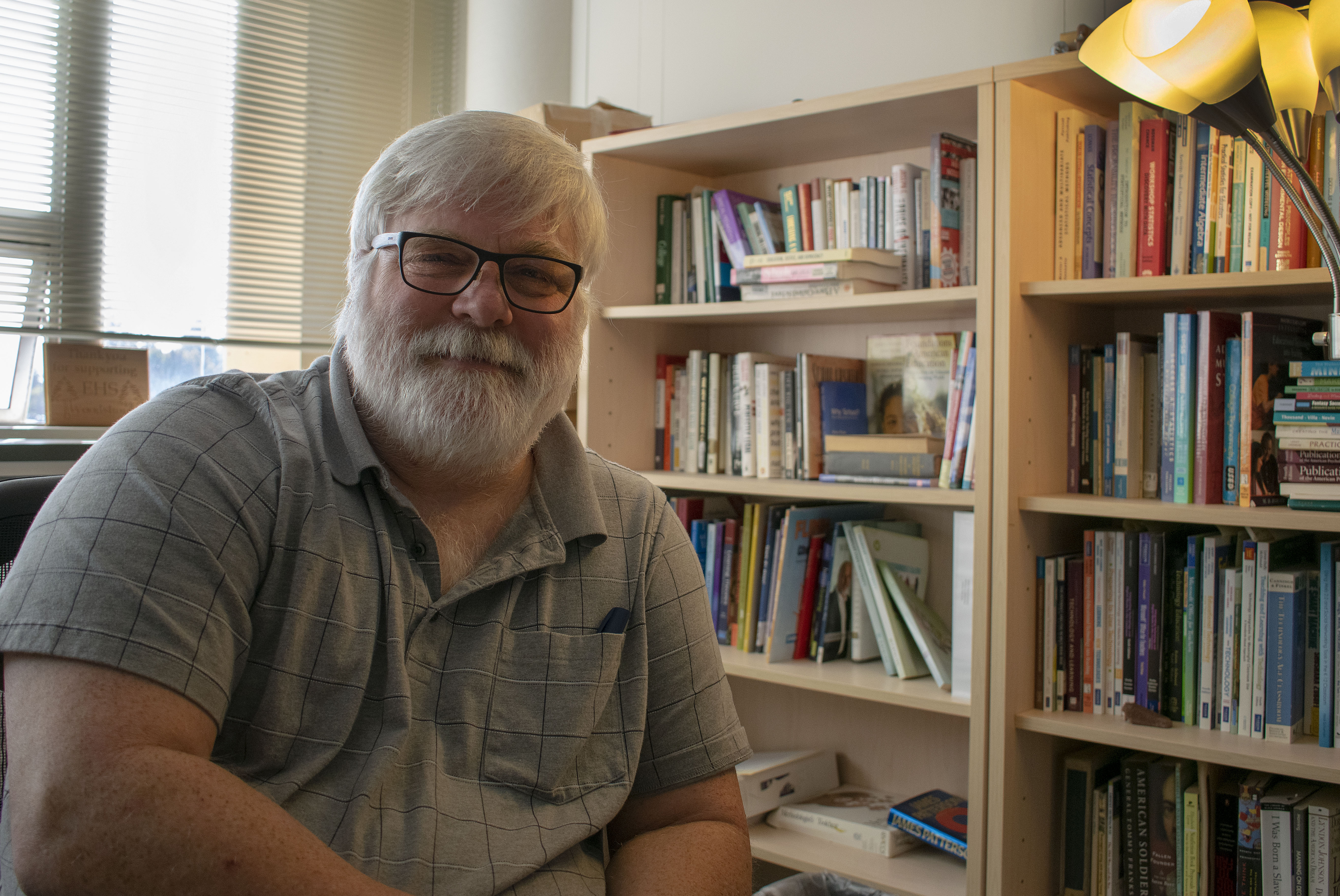
    Interim Vice President of Enrollment Jason Meriwether in his office on Oct. 25. Meriwether said the Humboldt First scholarship is one effort among many by HSU to attract more local students. | Photo by James Wilde

    Paul Hilton, an HSU political science major, journalism minor and McKinleyville High School graduate, said he liked the sound of the scholarship.

    “Contrary to what maybe a lot of people think, there is a want—there is a desire—to go straight to HSU from some of the local schools,” Hilton said.

    Hilton went to College of the Redwoods after graduating high school to avoid the higher costs of HSU. Hilton said he probably would’ve gone straight to HSU had the scholarship existed previously.

    However, Hilton acknowledged that many local students don’t want to go to HSU regardless of cost.

    “I think a lot of it just has to do with opportunities,” Hilton said. “A lot of locals dislike growing up here, and a large part of that is because of a lack of opportunities. But there are a lot of locals, myself included, who love Humboldt but still hate the lack of opportunities.”

    After CR, Hilton nearly attended Southern Oregon University, where he thought he saw more certainty in finding a future career path. Yet, in the end, he opted for HSU.

    “I came here because of proximity,” Hilton said. “Some people might just call that laziness, but because of the costs and everything I just decided that it would be easiest for me to stay here.”

    Hilton attributed HSU’s enrollment decline mainly to a lack of opportunities in the area, but he also noted a lack of support for minorities.

    “I think the main common factor between years and semesters has been opportunity in the area,” Hilton said. “But now it’s even more and maybe even a little overlapped by the lack of sense of security for minorities.”

    Meriwether said he believes HSU does offer opportunities, but the university doesn’t do enough to let people know they exist.

    “I think local students think they know Humboldt, but I don’t think we’ve done the job we need to do of reintroducing them to Humboldt,” Meriwether said.

    Eureka High School Principal Jennifer Johnson shared Meriwether’s excitement for the new scholarships. Johnson said she has already seen four to five times the usual number of EHS students going to HSU’s preview day. Johnson said only one EHS student went to HSU in 2018. For context, EHS has 1,230 enrolled students this year.

    “We have to also re-recruit our current students. We can’t just take for granted that they’re going to be here. We also have to give them a positive campus experience.”

    Jason Meriwether

    “We only had one last year,” Johnson said over the phone. “I think it was a real wake-up call for HSU administration when they actually ran the numbers on our school.”

    Johnson said local students that want to stay in Humboldt often opt for CR instead of HSU due to the costs—although Johnson said she thinks many students and parents just don’t understand how cheap HSU can be with financial aid.

    As for the local students that want to leave Humboldt, Johnson echoed Meriwether by saying that HSU is not like the rest of Humboldt.

    “I tell them, ‘Move to Arcata, it’s a whole different world,’” Johnson said.

    Meriwether said HSU is currently restructuring its recruitment strategies to include more social media targeting along with more visits to schools. Meriwether also pointed to recent recruitment improvements such as an increase in available tour times and the elimination of tour fees.

    Meriwether added that HSU has to not only improve recruitment, but also retention.

    “We have to also re-recruit our current students,” Meriwether said. “We can’t just take for granted that they’re going to be here. We also have to give them a positive campus experience.”

    Ultimately, Meriwether hopes HSU can begin telling a new story for itself that will attract and retain more students.

    “History is important,” Meriwether said. “But we also have to share that there’s a different approach to leadership, there’s a different approach to response and if things happen on campus it’s because we are trying to create a student-first experience. That’s what it’s all about.”

  • HSU looks at the big picture for enrollment

    HSU looks at the big picture for enrollment

    By Charlotte Rutigliano

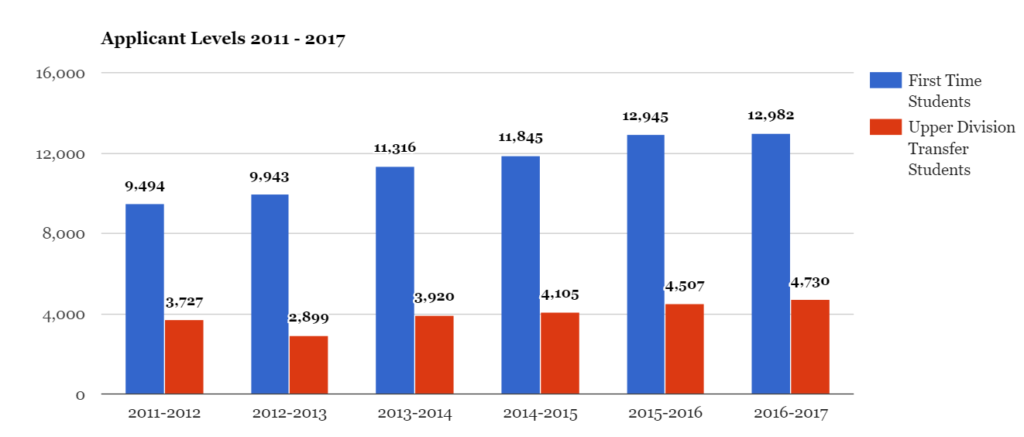
    The days of generalizations may be in the university’s rear view as various department’s throughout Humboldt State aim to start writing personalized letters to prospective students due to a drop in enrollment this past term.

    This is part of a plan the university has created to start focusing more on prospective students who applied and turning them into current students. Director of Admissions Steven Ladwig said every student needs to have a relationship with someone on campus before attending to make them feel more comfortable once they’re here.

    This plan has been put into place with the hope that it will boost enrollment for the 2017-2018 school year. According to Nicholas Conlin, coordinator for Orientation and New Student Programs, enrollment only dropped this last year. There were about 200 to 250 fewer students than the university was hoping for.

    Graphic by | Charlotte Rutigliano

    The drop in enrollment was not a drastic one, and HSU was not the only California State University to see this drop.

    “There were six CSU’s who didn’t meet enrollment numbers this term,” said Ladwig. “Chico, Fresno, Monterey Bay, San Bernadino, San Francisco, and Sonoma.”

    The slight drop in enrollment last term didn’t affect the number of impacted majors [majors that have more students than the program accepts.] Additionally, the number of visitors to campus was not impacted.

    HSU is known for its science programs with the most sought after majors being biology, botany, environmental resources engineering, wildlife and zoology. This past year however, both the social work and environmental management & protection departments became impacted as well.

    John Panting, lead admissions counselor, said that there hasn’t been a decline in the number of tours given but the number of visitors does depend on the time of year, saying that November through January typically have less visits.

    “In the beginning of February is when the number of visitors really starts to ramp up,” Panting said.

    HSU, in an attempt to identify the contributing factors hired John Capaccio as Associate Vice President of Enrollment Management. Carpaccio’s role is simple —  to increase enrollment without lowering admissions standards.

    Graphic by | Charlotte Rutigliano