The Lumberjack


Students Serving The Cal Poly Humboldt Campus and Community Since 1929

Tag: enviroment

  • CAP 2.0: The plan to make Cal Poly Humboldt carbon-free

    by Liam Gwynn

    On Jan. 28, Cal Poly Humboldt released an ambitious draft updating the Climate Action Plan. This updated plan promises to have the school completely carbon neutral by 2045. If CAP 2.0 is accepted, the school will implement changes to reduce carbon output and create an ecologically healthier environment.

    Changes would include phasing out gas and replacing it with electric power, implementing new carbon offset projects, introducing a zero-waste plan, and making several changes to transportation on campus. The final draft of the plan will be submitted this April. The budget is not yet finalized, however, if the plan is signed off, it will cost anywhere from 4.4 million to 5.5 million.

    The Climate Action Plan started in 2016 to lower greenhouse gas emissions to levels last seen in the ’90s. They succeeded at that plan in 2020 and started their planning for Cal Poly Humboldt’s next goal, complete carbon neutrality by 2045. This plan came about after The 100 Percent Clean Energy Act of 2018 passed in California, requiring all California businesses to have 100 percent clean energy by 2045.

    Morgan King is a climate analyst at Cal Poly Humboldt and the author of CAP 2.0. For him, this new plan is about more than just meeting the requirements set by the state.

    “We are in the midst of a climate crisis and we understand that climate change events and disasters are already having an impact on our communities, our ecosystems, and our infrastructures,” King said.

    Graphics courtesy of Facilities and Management

    According to King, the main climate threats Humboldt faces are rising ocean levels, wildfires, and extreme weather conditions. These threats are daunting and King is under no illusion that the school has the ability to singlehandedly stop them.

    “Even if humanity took big steps today to curb our burning of fossil fuels, we’re still going to see these climate impacts for many years to come,” King said. ”So we need to start planning and preparing now.”

    Despite the ominous threat of climate change looming in the distance, plans like CAP 2.0 show that there are still people willing to make drastic changes to soften the damage humanity has caused.

    “We are starting to see that resilience and climate protection are becoming part of the culture at this campus,” King said ”We are seeing a greater level than ever before of engagement around these issues.”
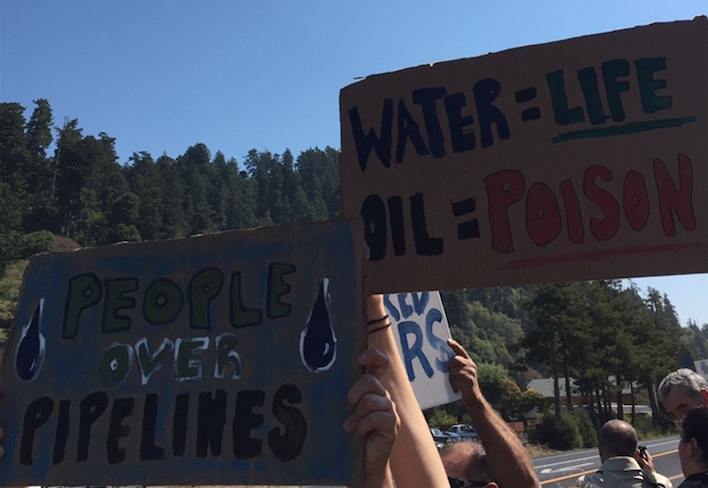
  • Potential pipeline meets resistance

    Potential pipeline meets resistance

    Story by | Emily Owen

    Since the 1970s, a Canadian-based energy company called Veresen Incorporated has been working on a plan to build a pipeline to carry natural gas through Southern Oregon, just 200 miles north of Arcata. After being repeatedly turned down, documents are currently being prepared to be re-submitted with the expectation of eventual approval. 

    According to Veresen Incorporated’s website, the Pacific Connector Gas Pipeline is proposed to be 232 miles long, cross under five major rivers and result in the clear-cutting of up to 30 miles of forest. At $7.5 billion, the project is worth twice as much as the Dakota Access Pipeline and is being praised for its potential in economic benefit.

    When Leonard Perry heard about the Pacific Connector Gas Pipeline and that sections were going to pass through the Klamath River, he readied himself for the fight he knew was coming. Perry, an 18-year-old student attending College of the Redwoods, is a founding member of a group known as Humboldt Water Protectors. The group, now called Sacred Seeds, has made it their main goal to protect the abundance of natural resources in and around Humboldt County.

    “We see what’s happening to the world, what’s happening in our own backyard, and people are waking up,” Perry said. “We all drink water. This isn’t a party issue, we need to start looking out for our brothers and sisters. The minute we start coming together there’s change.”

    Mouth of the Klamath River in the fall. Photo by Emily Owen.

    The HSU Environment and Community Club is organizing an on-campus event titled Water is Life: The Standing Rock-Klamath Connection to publicize and spread awareness of the potential Pacific Connector Gas Pipeline. The event will happen on March 4 in the Kate Buchanan Room from 12 to 6p.m. and will shed light on interconnectivity behind the movement for clean and safe water.

    Francesca Gallardo and Yojana Miraya, both graduate students in the environment and community program, are coordinating outreach for the event. Gallardo sees the potential to unite these communities and cross boundaries through building coalitions.

    “These movements are for everyone,” Gallardo said. “We are fighting the biggest fight of our lives. It is time for everybody and anybody to step up.”

    Miraya is from an indigenous tribe in Peru and recognizes the parallels in the global struggle to protect natural resources. 

    “Leaders aren’t working for the communities” Miraya said. “Educating people will bring consciousness and the parts of society that are marginalized can come together.”

    Cutcha Risling-Baldy professor of Native American studies at HSU, is Karuk, Yurok and an enrolled member of the Hoopa Valley Tribe, thinks of pipelines as last resort efforts from the nonrenewable energy industry to stay relevant in a world relying on a failing system.

    “There’s a Gold Rush mentality of wanting to make as much money as possible no matter what the consequences are,” Risling-Baldy said. “That’s why we need to always include an indigenous perspective. Native people consult with the land and we see those connections. You can’t account for the way nature plays with your best plans.”

    Risling-Baldy stressed the importance of divesting from companies and organizations that fund nonrenewable infrastructure. 

    “We’re finding out that people think with their money,” Risling-Baldy said. “The government is actively working against the people so you need to speak with your money. Take it out.”

    Michael Hinrichs, Director of Communication for the Pacific Connector Gas Pipeline, acknowledges the opposition that is growing and wants to assure people that the project is meeting all environmental standards set by the federal government.

    “We’re trying to avoid the impacts that people are worried about,” Hinrichs said. “I would encourage people with concerns to make them known.”

  • HSU’s Waste Reduction and Resource Awareness Program offers services to students

    HSU’s Waste Reduction and Resource Awareness Program offers services to students

    By | Kelly Bessem

    School can be a mental and financial struggle, but doing your part to reduce waste on campus doesn’t have to be.  Humboldt State’s student-run Waste Reduction and Resource Awareness Program, also known as WRRAP, has been in operation for almost 30 years.

    The campus services they maintain are free to all students. These services include campus compost bins, water refill stations, zero waste supplies, events such as the clothing swap. Additionally, students can visit the Reuseable Office Supply Exchange House, where students can find free school supplies such as notebooks and writing utensils.

    Environmental science major Crystal Singletari was glad to find out that the ROSE House was there to provide an option other than paying expensive prices for new school supplies. 

    “The first two weeks of school I didn’t have enough binders to reuse and was super unorganized so I went to the bookstore, but they’re so expensive,” Singletari said.

    Rangeland resources major Ishmael Guerrero believes helping to reduce waste is good, but it is often difficult to keep track of waste reduction programs on campus.

    “I’m usually focused on school, work, or sports,” Guerrero said.

    WRRAP is set up to direct students toward reducing waste on campus and in the rest of their lives in simple ways rather than having to figure it out alone. Isabel Sanchez, a business major and natural resources minor has been working for WRRAP for more than two years. Sanchez explained how WRRAP can make waste reduction easier for students to understand.

    “It’s a network that allows for exchanges of waste reduction methods,” Sanchez said.

    Need some encouragement to live a less wasteful campus lifestyle? According to a 2015 estimation, Humboldt State University students collectively dispose of 266,314 pounds of waste on campus each year. That’s about the mass of four humpback whales. Though HSU students always seem to strive for improvement, there is still a whale of a problem.

    Check out WRRAP’s website at http://www.humboldt.edu/wrrap or email their student staff at wrrap@humboldt.edu. The program is there so that reducing waste doesn’t become another daunting school task on your checklist.

  • What you need to know about a Trump presidency and the environment

    What you need to know about a Trump presidency and the environment

    By | Emily Owen

    Donald Trump has been president for almost three weeks, and he has begun making his mark on environmental legislation. Here’s what he has already done and what he has promised to do.

    1. Trump appointed Oklahoma Attorney General, Edward Scott Pruitt, as head of the Environmental Protection Agency on Jan. 18. As a vocal and outspoken climate change denier, Pruitt is currently suing the Environmental Protection Agency and has been involved in 14 lawsuits against the organization to lessen environmental regulations.
    2. Rex Tillerson, the former chairman and chief executive of Exxon Mobil, was chosen by Trump to hold the position of Secretary of State on Feb. 1. During his time with Exxon Mobil, Tillerson was known for rejecting the use of renewable energy sources. As Secretary of State, he will serve as the ambassador between the United States and other nations. He is expected to advance drilling throughout the world.
    3. Despite months of protest from water protectors consisting of a combination of tribal members and environmentalists, Trump officially endorsed the Dakota Access Pipeline on Jan. 24. Trump assured the owners of the Keystone XL Pipeline that their proposal will be approved and encouraged them to re-submit their application after it was repeatedly denied during the Obama administration.
    4. An executive order was carried out by Trump on Jan. 20 that ordered the streamlining of environmental reviews for future high-priority infrastructure projects. The action instructs the Chairman of the White House Council on Environmental Quality to fast track approval of these projects.
    5. On Jan. 24, a document written and published by Trump instructed the Secretary of Commerce to promote the use of U.S. made pipelines throughout the country.
    6. Trump has made promises to build a wall on the U.S. / Mexico border. Many environmentalists say it will cut off the flow of water and be detrimental to wildlife in the area. The construction of the proposed wall will also have a huge impact on greenhouse gas emissions and will only serve to further the issue of climate change.
    7. Trump has discussed the possibility of putting an end to the Endangered Species Act on the grounds of hindered economic development. He said that the act has been unsuccessful in preserving wildlife, despite the National Wildlife Federation reporting that it successfully protects almost than 1,400 plants and animals.
    8. Proposals have been submitted by Trump to cut the EPA’s funding by up to one-third. Trump has already confirmed that he has full support of the Republican Party to back his proposals.
    9. Motions have been made by Trump to censor climate scientists and order government employees to cease all communication with the public unless approved by Trump’s political appointees.
    10. Trump plans to end former President Obama’s Climate Action Plan and replace it with the America First Energy Policy Plan. The America First Energy Policy Plan will push for elimination of climate regulations in order to refocus efforts on coal, oil and gas production.
    11. Trump mentioned the withdrawal of the United States from the Paris Climate Agreement, a global pact to cut emissions which was signed by almost 200 nations.
  • Editorial: HSU’s Responsibilities beyond academic achievement

    Editorial: HSU’s Responsibilities beyond academic achievement

    By: The Lumberjack Editorial Board

    This spring 2017 semester, the Lumberjack staff requests that Humboldt State administration take more responsibility for student welfare, beyond just recruiting students to HSU. The Lumberjack asks that HSU not only consider a student’s academic education, but also a student’s basic living needs while attending HSU.

    HSU entices students with its emphasis on environmental and social standards and opportunities for hands-on learning. Students are often charmed by the small town atmosphere and close-knit community. However, students find that finding a stable place to live and join the community for their stay at HSU to be a near impossible task. 

    Universities have more than a duty than to provide an academic education — it owes each and every student an opportunity to access a stable living situation.

    Furthermore, leaving young students to the whim of Humboldt County’s housing market creates a potentially dangerous situation. Students may end up in living situations that present very real physical and health risks for fear of being homeless. 

    We need our administration to match enrollment with the size of the housing market. It is unethical to bring students to an area they’ve never been and expect them to pay for and maintain a full load of classes, while offering no help with housing outside of high priced campus housing. 

    HSU can and should do more to assuage the pressures of student life by doing more to prepare and warn students for the particular struggles in the HSU community. We ask HSU to look harder at buying more property in the area for student living. 

    This starts with administration simply being forthright and honest about Humboldt’s housing situation when recruiting students from across California and the United States.