The Willits bypass is a stretch of the U.S. Highway 101. After being proposed 60 years ago, it was finally finished less than a decade ago. It serves an important role in decongesting Willits, diverting drivers around the small town. The bypass is also home to the largest public wetlands mitigation project in the state of California, the Willits Bypass Offsite Mitigation Project.
This mitigation project has been joined by Justin C. Luong, a rangeland resource science professor at Cal Poly Humboldt. Recently he was awarded a $520,000 grant from the California Bountiful Foundation. He is conducting a case study on the impact of cattle grazing on grasslands. This research is important because wetlands help with carbon cycling, host thousands of endemic species, and play a key role in cattle production.
“Federal government policies don’t allow for any grazing on any top of habitat classified as any kind of wetland at all,” Luong said. “Even though California state laws and science show sometimes grazing can be beneficial for managing natural systems if utilized properly.”
Luong is doing this study to better understand if cows actually play a vital role in grassland ecosystems. He is using historical data from the Mendocino County Resource Conservation District to look at the impact of removing grazing in the grasslands. Luong is also using aerial images from Google and drone images to better understand the environmental differences between grazed and ungrazed grasslands. While looking at all of these images, Luong is also taking samples at the site, inspecting the biology of the plants, trying to better understand the best traits needed for a changing environment.
“My job is to essentially go in and evaluate how the removal of cattle grazing from these areas affected these habitats and their ecosystem properties and services, especially thinking about some of the threatened species we have out there,” Luong said. “The North Coast semaphore grass, the baker’s meadow phone. Both of these species typically require more open habitat and bare ground in order to establish well.”
Luong is trying to find the perfect combination of native plant species for grasslands to thrive. Plants like Reed Canary grass are taking over most of the space in the habitat, leaving little room for the important species mentioned above.
“The managers on the ground have noted that oftentimes, cattle grazing is really important to remove some of that cover, open up some of that space to facilitate some of the recovery or establishment of those kinds of threatened plant species, while still supporting cattle production,” Luong said.
The reason Luong is focusing on grasslands is to highlight the importance they have. They not only support the entire cattle economy, but they hold a key role in controlling carbon emissions. In a process called carbon sequestration. They hold pockets of carbon in their roots, reducing global carbon emissions. In a study by The Conservation Fund, they discovered that wetlands store 18 to 216 metric tons of carbon per acre. Making grassland restoration an important fixture in climate conservation.
“Grasslands are really important for carbon storage and sequestration, especially with future climate risks. Because oftentimes when you have mass plant mortality, which happens in grasslands or forests you lose that carbon back to the atmosphere.” Luong said. “In grasslands, a lot of that is fibrous roots underground. We know that some native grasses that we have dug up can go up to 18 feet deep, so that carbon stays stable in the ground and helps with more stable carbon sequestration with climate change.”
Luong is going to work on this project for the next five years with Mendocino Resource Conservation District. He is hoping to reinvigorate grassland restoration by updating the data and information people have for grassland restoration. He believes that once people have the right tools, grassland restoration will be more informed and focused.
“My work often is really geared at being applied, and so I’m always trying to find real world issues that need solving now and try to work towards those solutions, those applied solutions,” Luong said.
Rosanna Xia, an environmental reporter from The Los Angeles Times, visited Cal Poly Humboldt on Thursday, Nov. 30 in the library.
After the student lunch-and-learn event, Xia attended Professor Sarah Ray’s class, called Power Privilege and the Environment, as a guest speaker. She was also a guest speaker in Professor Laurie Richmond’s Coastal and Marine Planning class.
Later that day, she gave a thought provoking presentation in the Native American Forum from 5:30 p.m. – 7:00 p.m. on her newly published book, “California Against the Sea, Visions for our Vanishing Coastline,” discussing hope for environmental studies, science and journalism students.
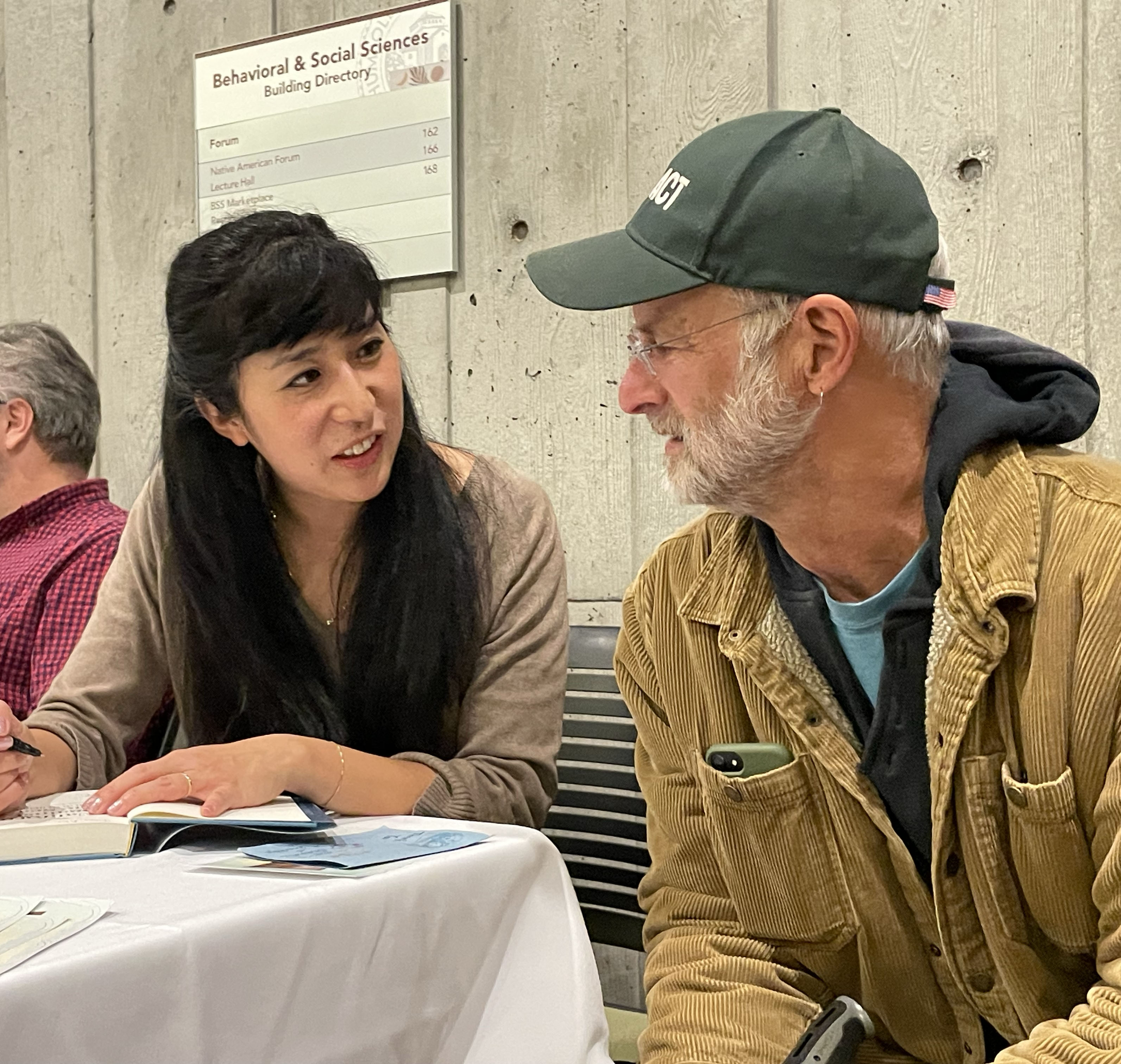
After the presentation, Xia did a book signing for all who purchased her book.
“This book is dedicated to all the people who cherish and belong to the California coast–past, present, and well into the future,” she wrote in her book’s dedication.
Writing for the LA Times, Xia tackles stories on the California Coast and the concerns about sea level rise and the effects they have on communities up and down the coast of California.
One takeaway from Xia’s presentation is to take an important look to the past to understand the present in the context of how we need to move into the future.
“You know, it’s stunning to think about how so many folks today that I run into still don’t really recognize the way we’ve built our environments today,” Xia said. “Our cities or communities are so rooted in very specific systems, from the near past on, how we chose to zone some places for industrial use, and others for residential use.”
According to Xia, when writing and reporting on environmental issues, it is important to verify information, and to create space with trust where you listen and absorb someone’s perspectives.
“I have a personal rule when I’m reporting, which is trust, but verify,” Xia said. “And I think because it’s so important, to create a space where you are truly listening to someone, and absorbing their truth and absorbing their perspectives. I truly go into these conversations, trusting what someone is telling me. And then, it’s my job to verify, and to verify in a way that doesn’t disempower the person.”
Campus discussion touches on importance of traditional knowledge
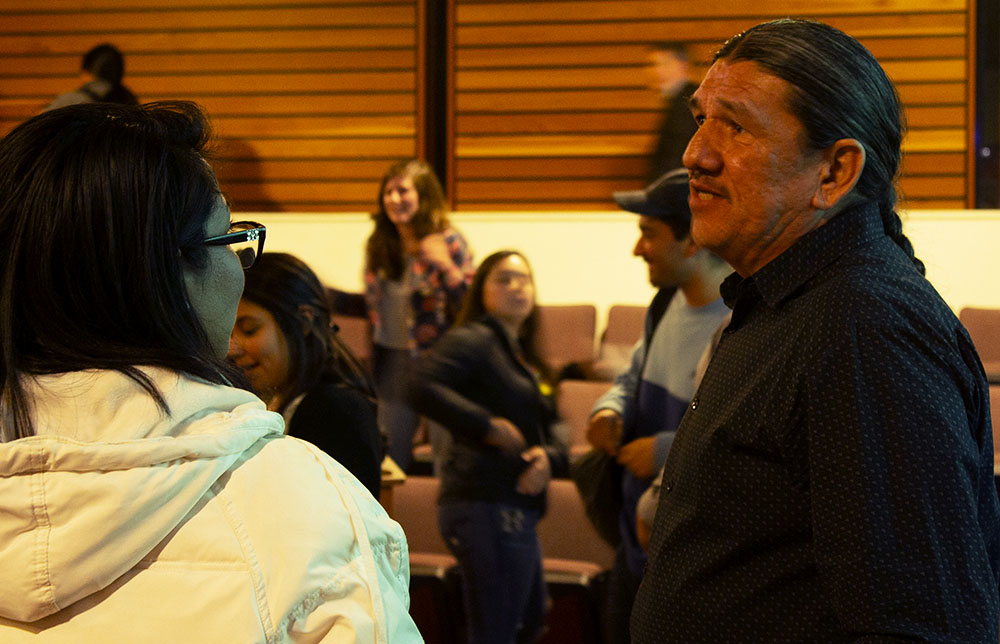
Students, faculty, friends and family packed the Native American Forum March 5 to listen to author Kari Norgaard and Karuk environmentalist Ron Reed discuss Norgaard’s most recent book, “Salmon and Acorns Feed our People: Colonialism, Nature, and Social Action.”
Before the speakers began, Cutcha Risling Baldy, assistant professor of Native American studies, announced the NAS department’s 25th anniversary at Humboldt State University.
An introduction followed, led by Reed’s son, Charlie. Charlie Reed, a recent alumni from HSU’s NAS program, has continued as an environmentalist to help battle climate change. Before the talk began, Reed said it was important to give proper acknowledgement to the lands of Indigenous peoples. HSU sits on ancestral Wiyot land, and recognizing the land’s history is of utmost importance.
“There is a symbiotic relationship between our environment and our people.”
Charlie Reed
“Whether you are a faculty member or student or just a community member, it starts with a conversation,” Charlie Reed said. “You never know who is in the room who has something to offer or give back the things that have been taken from Indigenous people.”
Growing up with his father, Reed learned about his culture and the traditional ceremonies that tied in not just physically, but spiritually with the environment.
“There is a symbiotic relationship between our environment and our people,” Charlie Reed said.
With a warm thank you to the Reed family and the community, the floor was given to author Norgaard and Ron Reed. Reed introduced himself and what he learned as a child. Reed said learning the traditional ways of his people at a young age taught him how to sustain the environment.
“That’s where it all begins, ladies and gentlemen, when you have the ability to be taught things that you don’t even know you’re being taught,” Ron Reed said. “That will stay with you the rest of your life.”
In one of Norgaard’s chapters, she mentions an Indigenous tradition of using fire to cleanse or manage the land. Western science has given us the narrative that fire is dangerous and destructive. Thanks to “Smokey the Bear” and other forms of wildfire prevention advertisements, fire is seen as something to fear.
Even though fire can be seen as scary, Norgaard argued it’s also a way to help manage landscapes by getting rid of invasive species and even enhancing plant growth. Indigenous peoples used fire to help the environments they lived on, not to destroy or cause damage. Reed stressed the importance of bringing that narrative to our attention.
“We’re trying to get back to an intact world. Climate change can be a vehicle for that because of the awareness it brings to so many.”
Kari Norgaard
“We Native Americans—we the family—cannot let that narrative go,” Ron Reed said. “I don’t need some lone ranger to tell me the way. I know the way.”
With Indigenous knowledge and science being pushed to the side when it comes to environmental issues, Norgaard said settler colonialism is still causing misinformation about the knowledge base of Indigenous peoples. Norgaard said this is changing.
“Indigenous concepts and ideas have been making their way into academic spaces,” Norgaard said.
Climate change is perhaps the most pressing modern issue, but Norgaard and Ron Reed agreed it would help bring more awareness in our communities.
“We’re trying to get back to an intact world,” Norgaard said. “Climate change can be a vehicle for that because of the awareness it brings to so many.”
The consensus of the talk was that combining Indigenous knowledge with western science can change the way we view the world as well as how we take care of it. Coming together and working with each other on both sides of science can also help combat climate change. From the ways of the rivers to the fires of the forests, Indigenous knowledge can teach us more about our world.
“We need all the community on the river, but don’t forget us,” Ron Reed said. “Don’t forget the first people on this nation, on this ground that has created the environment that we’re trying to reestablish in this world today.”
In spite of the successful campaign to phase out single-use water bottles, Humboldt State has yet to remove plastic bottled beverages from campus
Almost 10 years have come and gone since Humboldt State University took back the tap and did away with single-use water bottles on campus.
Overall HSU is known to lead the way in sustainability across the California State University system. In spite of being further ahead in the sustainability game than most campuses, HSU still offers a variety of beverages for sale packaged in single-use plastic.
HSU Dining Services Director Ron Rudebock said they have gotten a fair number of comments over the last couple of years regarding plastic products and on phasing out plastics completely.
“We have been working with vendors to obtain their products in a reusable or compostable or recyclable package and vendors are changing their package materials,” Rudebock said.
Four of the five campus responsibilities listed under the policy have set deadlines.
The first is the elimination of single-use plastic water bottles by Jan. 1, 2023. HSU met this requirement in 2011. The second is the elimination of plastic straws no later than Jan. 1, 2019. HSU eliminated plastic straws during the fall 2017 semester.
The third responsibility listed, also set for January of this year, was the elimination of single-use plastic carryout bags. HSU stopped using plastic bags back in March 2014. The fourth deadline, and last with a time requirement, was the elimination of single-use polystyrene (e.g. STYROFOAM™) food service items no later than Jan. 1, 2021. HSU eliminated Styrofoam to-go containers over 10 years ago and the campus is working to eliminate it in any pre-packaged items.
The final goal of replacing single-use plastic items with materials that are reusable, locally compostable and/or recyclable doesn’t list a specific deadline.
A variety of some of the single-use plastic bottled beverages offered. According to Rudebock, much of the decision to continue to sell single-use plastic drinks is because of consumer choice. | Photo by Megan Bender
Rudebock said this specific change is a challenge. The Depot, the College Creek Marketplace, the Cupboard and vending machines still offer plastic bottled beverages on campus.
“We would like to see a faster adaption but with this guideline having no deadline and with the current collapse in the recycling market I do not see this becoming feasible in the next year,” Rudebock said.
Dining services has made some efforts in providing more glass or aluminum options. The J, for example, has a beverage cooler that is all aluminum and glass, has eliminated single use plastic containers and has single-use packaging that is compostable or recyclable.
However, other locations haven’t been able to make the same change as effectively because of the demand for products that happen to also be in plastic bottles.
“We’ve been working with a lot of our vendors and pushing, trying to get more either glass or aluminum containers.” he said.
Rudebock said Dining Services also goes out of their way to order aluminum and glass alternatives whenever possible from specific companies and brands like Coke or Pepsi.
“It kind of comes down to consumer’s choice,” he said. “Consumers can help by purchasing products that are in reusable, compostable or recyclable packaging and not requesting products that are not in reusable, compostable or recyclable packaging.”
Students have pushed back against the university in the past, questioning its dedication to environmental responsibility over their business ties with PepsiCo.
As reported in the Lumberjack and the North Coast Journal, in 2017 HSU made efforts to meet student’s demands to closer align with its dedication to social, economic and environmental issues by re-evaluating a 40-year-long partnership with PepsiCo.
Under the contract PepsiCo funded HSU with around $58,000 worth of athletic scholarships in exchange for pouring rights. Pouring rights allowed PepsiCo to reserve 80% of HSU shelf space for their products.
Students also made the argument the set up was not fair to local businesses.
In spite of being in a budget deficit and the loss of scholarship funding, HSU did not renew the pouring rights contract and let it expire at the end of June 2017.
HSU was the first California public university and third national public university to phase out water bottles.
The University Center and Dining Services stepped into to help with some of the lost resources.
Rudebock said they managed to fund a majority of the lost scholarship money but leaves the decision of how the scholarships are dispersed up to the school. This way the UC and Dining Services are not directly funding athletics or any specific department.
The university still does business with PepsiCo but under different rebate-based agreements. Dining services also stopped carrying Aquafina water bottles, a brand owned by PepsiCo as a result of the nationally recognized Take Back the Tap campaign.
Under the Waste Reduction & Resource Awareness Program, students began efforts to Take Back the Tap at HSU starting in 2009. The student lead group and Dining Services worked to phase out the sale of single-use water bottles in 2011 as is the primary focus of the campaign.
As a result, HSU became the first California public university and third national public university to phase out water bottles. Dining Services initially explored an alternative by offering boxed water.
“At first we thought they were upset with the plastic water bottles, but they said ‘No no, just the water,’” Rudebock said. “It was more about the idea of selling packaged water.”
Before HSU removed water bottles on campus, TBTT calculated that HSU’s annual bottled water demand “required approximately 43 barrels of oil per academic year” and in turn was “releasing 35,000 pounds of carbon dioxide into the atmosphere.”
HSU now owns two Hydration Stations and has 16 water fill stations on campus.
Environmental Science & Management Professor James Graham and his geospatial students created an interactive map of HSU that includes where to find water fill stations on-campus as well as other resources.
The locations of all water stations on HSU’s campus according to the Sustainability project. These locations include the two Hydration Stations.
Sustainability Director Morgan King said Facilities Management worked with students help create the map.
“We worked with [Graham’s] students to develop layers for sustainability attributes,” King said. “Including water filling station locations, bike parking locations, recycling and compost bin locations.”
Anyone can access the map by visiting HSU’s sustainability website. The map key is listed in a drop down menu that offers different types of resources on campus. Under the sustainability option, users can check the box of the information they’re looking for.
Rudebock said Dining Services remains attentive to the needs of the students and the possibility of selling less plastic-bottled products.
“Every journey begins with a step,” Rudebock said. “The less plastic containers that students buy helps change the need for that product.”
The California State University system’s single-use plastic policy passed in December 2018 includes four policy changes that have deadlines, but the fifth and final goal of the policy doesn’t list a deadline.
Eliminate single-use plastic water bottles by January 1, 2023. HSU has already met this requirement as of 2011.
Eliminate plastic straws no later than January 1, 2019. HSU eliminated plastic straws during the fall 2017 semester.
Eliminate single-use plastic carryout bags no later than January 1, 2019. HSU eliminated plastic bags in March 2014.
Eliminate single-use polystyrene (e.g. STYROFOAM™) food service items no later than January 1, 2021. HSU eliminated Styrofoam to-go containers over 10 years ago and are working to eliminate it in any pre-packaged item
Replace single-use plastic items with materials that are reusable, locally compostable and/or recyclable.
To find out more about HSU’s Zero-Waste Initiatives, WRRAP and TBTT visit the WRRAP homepage.
Waves upwards of 20 feet tossed and turned against the Humboldt coastline this week.
According to the National Weather Service Marine Forecast, a small craft advisory is also in effect until Sunday afternoon. While the first big swells of the season are already arriving, the winter swell season has merely just begun.
With more swells and even bigger waves on the way this season, it begs the question:
How do such massive waves come to be?
According to the National Oceanic and Atmospheric Administration (NOAA), water does not actually travel in waves. Waves are merely the transfer of energy, moving from one neighboring water molecule to the next.
The NOAA says that waves are most commonly generated by wind. Wind-driven waves, or surface waves, start out when changes in temperature produce a change in air pressure. Air then follows its natural path, moving from an area of high pressure to an area of low pressure. This movement is referred to as wind.
As the wind blows across the ocean’s surface, it generates ripples. This happens in a similar way to how ripples are created when you blow over the surface of a cup of water. These ripples increase in intensity to eventually become waves.
What determines the size of a wave?
The NOAA says that the size of these waves are determined by three main factors:
Wind Speed: How fast the wind is blowing.
Wind Duration: How long the wind blows.
Fetch: Distance over water that the wind blows in a single direction.
The biggest waves occur when wind speed is at its highest, wind duration is at its longest and when fetch is long or unlimited.
There are several other factors that can affect wave size in a certain area, some of those factors include:
Swell Direction: The direction in which the swell originated from.
Ocean Floor Topography: Forms or physical features on the ocean floor.
Tide: Rising and falling tides are caused by a gravitational attraction between the earth, moon and the sun.
Why are these big waves in Humboldt?
“It is because the storms that come out of the North Pacific are incredibly powerful,” said Dr. Jeffry Borgeld, Oceanography professor at HSU who specializes in Geological Oceanography. These storms “can be as energetic as a tropical storm, typhoon or a hurricane.”
Despite the cold, powerful and often unforgiving conditions, there are a few individuals that can be seen bobbing amidst the chaos and gliding over the massive surf.
HSU psychology student William Doudna is one of them.
“There’s something very cleansing about surfing that if i don’t do it, i just don’t feel comfortable in my own skin,” said Doudna. “I feel like a better person every time I come out of the water.”
Recycling is not as sustainable as you might think. It has become a wasteful movement that was beneficial during the early stages of the environmental movement. Now the cost outweighs the satisfaction we get out of recycling.
“Recycling has been relentlessly promoted as a goal in and of itself: an unalloyed public good and private virtue that is indoctrinated in students from kindergarten through college,” wrote John Tierney, journalist and self-described “contrarian” for the New York Times. “As a result, otherwise well-informed and educated people have no idea of the relative costs and benefits.”
To put it in another way, most recycling advocates are unaware of the cost of transportation, labor and production of renewable materials that ultimately defeats the purpose of saving the planet.
Recyclers are validated by the collective consciousness of fellow believers. They don’t realize the wastefulness that occurs after rolling the recycling bin to the curb. Why did things get worse? The short answer is the success of an ongoing marketing campaign that resonates with a growing population of millennials and aging liberals.
Since the advent of the “Reduce, Reuse, Recycle” idea, recycling received the most attention. Why? Because there’s barely any money in reducing or reusing. If you think about it, recycling starts its capitalistic cycle from our wallets to the bins or recycling centers, then to the manufacturing plants, the businesses and back to burning a hole in our pockets.
So, there you have it, reduce consumption and reuse your renewable materials. Buy used products and learn how to repair them if they break. Borrow, rent or share if you can. The point is to reduce the disadvantages of recycling that is practiced by too many people and apply smarter solutions to climate change. If enough of us consume less and reuse more, the act of recycling can reclaim its integrity. It’s all about balance.
Water diversion for illegal grow operations has significant environmental impact
Fish need water, and so does marijuana, but people may not realize we’re approaching a point where it’s between one or the other. Many illegal grow operations divert water from streams, which is the most common environmental crime committed, according to Sergeant Kerry Ireland of the Humboldt County Sheriff’s Office.
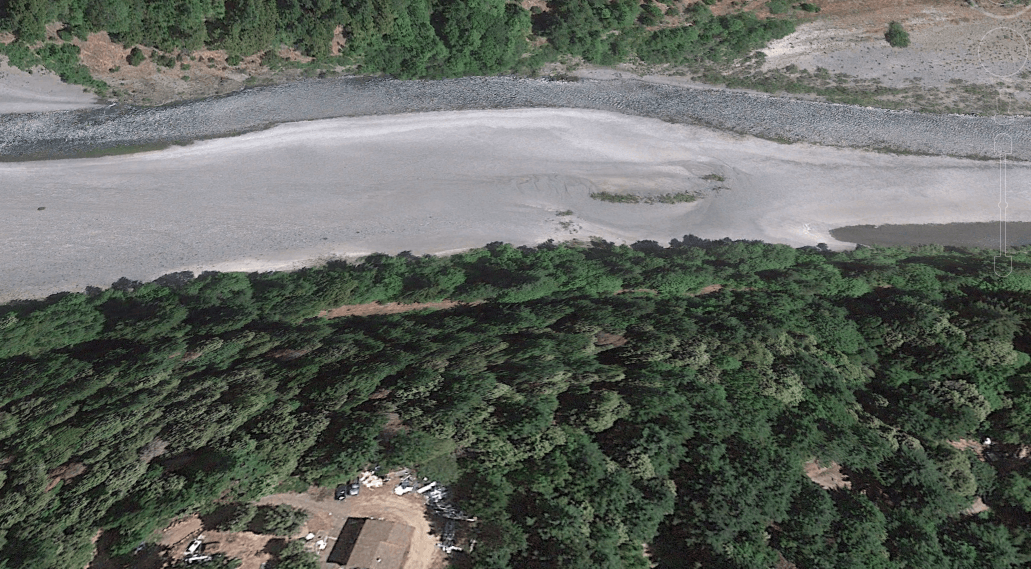
Time lapse photography of the Mad River taken from Google Earth. This Google Earth image was taken in 2004. | Photo by Bryan Donoghue (using Google Earth)
Google Earth image of the Mad River in 2014. Notice the drastic difference in water level. | Photo by Bryan Donoghue (using Google Earth)
Ireland is in charge of the Special Services Division of the Humboldt County Sheriff’s Office. He said that there are currently no investigations going on having to do with environmental crimes, but they have seized 135 thousand plants from over 100 marijuana grows, and issued 51 search warrants in 2016.
“That’s just a drop in the bucket for the number of marijuana plants that are in Humboldt County,” Ireland said. “There’s also at least 20 thousand cultivation sites in Humboldt.”
The adverse effects of marijuana cultivation are presently more than just an environmental crime, it’s harming our wildlife too.
Darren Ward is a fisheries biology associate professor and researcher of freshwater ecology at Humboldt State.
“There’s a real direct reason we should care,” Ward said. “There’s endangered salmon and steelhead that live in those streams. There are cases where they’ve been documented to die when stream flows are reduced because of water withdrawals.”
According to the Environmental Protection Agency, when stream flows are reduced, they are categorized as a low-flow. Summer low-flows are particularly extreme because higher heats cause water to evaporate a quicker rate.
Marijuana plant discovered at an illegal grow site near Shelter Cove. The land was torn, with plastic littering the ground. | Photo from Eureka Sheriff’s Department
“If for no other reason, it’s important to care about that because it’s a violation of federal law,” Ward said.
Sergeant Ireland works with the California Department of Fish and Wildlife conducting investigations on environmental regulations that are broken. If there is a water violation, he contacts the State Water Resources Control Board, where they assist each other by investigating independently and then sharing their findings. Ireland finds that more marijuana grows continue to appear, and now they’re widespread throughout all of Humboldt County.
“It is everywhere,” Ireland said. “It’s literally in all parts of the county.”
Plenty of research is in progress to map how widespread grows are. Redwood Creek is a major contributing stream flowing into the Eel River. It is also one of the areas where major property subdivisions and land-use changes have taken place in the last 50 years, according to geography alumna Cristina Bauss.
Bauss took a look at the heavily impacted watershed of Redwood Creek in her bachelor’s thesis. Coincidentally, Redwood Creek was one of four watersheds studied by Senior Environmental Scientist Supervisor Scott Bauer associated with the California Department of Fish and Wildlife. Bauss used Google Earth imagery from 2014, whereas the Bauer used imagery from 2012. Bauss duplicated Bauer’s study to examine the difference in greenhouse capacity and found an 18 percent increase in two years. That’s an exceptional amount of land being used for marijuana.
Simplified map of marijuana cultivation sites in the Redwood Creek watershed. Light-gray circles represent clusters of greenhouses, by number; outdoor growing sites are mapped individually. Sites outside the boundaries of the watershed are on parcels that straddle two watersheds, and were recorded because they may draw water from Redwood Creek and/or its tributaries. | Map Cristina Bauss. Sources: USGS Earth Explorer, County of Humboldt, CAL FIRE.
The trend in growing greenhouse capacity is a growing concern. Ward voices concern as to what will happen come next season.
“When next summer rolls around, and the flows start to drop and the temperature starts to come up,” Ward said. “If there’s an additional water withdrawal in the stream, that’s when it’s going to be really hard on the fish.”
Ward said that historically, when people weren’t withdrawing water, then those streams were still connected and the salmon and steelhead could move to a lower spot in the stream to avoid overheating. Currently, due to water withdrawals, these pools aren’t connected anymore so there’s not as much area to swim for cover.
Andrew Stubblefield, a hydrology and watershed management professor at Humboldt State University finds that the salmon and steelhead are facing a crisis, but marijuana is not the most significant contributor to water deprivation in Humboldt’s watersheds.
Stubblefield explained that thousands of giant trees drive the water use of a watershed, and a small change in the amount of water those trees get would create a dramatic difference in summer low-flows for these watersheds by shrinking water levels further.
“It’s not really going to be affected by a tiny greenhouse with a bunch of plants in it,” Stubblefield said. “I’m not saying there’s no effect of the marijuana industry, but forest management is also a big part of the issue with water right now.”
Stubblefield finds that water diversion for marijuana grows can still have consequences. “When the rivers get down to the summer low-flow, particularly during our drought years, there’s enough left in those rivers to be like the amount you run in your shower; it’s a tiny amount,” Stubblefield said. “So it’s very vulnerable to having that remaining amount be pumped out.”
Not all Humboldt growers contribute to low-flow. One of Humboldt’s self-proclaimed “mom-and-pop” growers for 38 years, who goes by the alias Terry Giaci, uses sustainable practices and eco-friendly methods of cultivation that do not contribute to low-flow.
She moved up to Humboldt County in 1980 from San Francisco as a horticulture student because a friend she had met in SF wanted her to come up and help with the crop he was growing. With no cellphones, and only a citizen’s band radio to talk with others, she worked her way up Southern Humboldt by herself and became integrated as an active member of the community, supporting local restoration projects.
“We’re the back-to-the-land people who grew marijuana to live this life,” Giaci said.
“If you grew weed, you didn’t live in town. We lived in the hills. There were the town people, and the hill people. We were people that cared about the land, the land got a chance to heal.”
On Giaci’s property, water flows from three springs through pipes and spring boxes. Giaci also has assistance from a hydrologist she knows personally. Access to water is steady, and since the streams are on her property, Giaci doesn’t illegally siphon water. Giaci also uses all natural organic materials; this infers materials that are not petroleum based or are made from petrochemicals.
“It’s the difference between chicken shit, and nitrous oxide that’s created in a chemical plant,” Giaci said.
According to Giaci, you have to be aware of who you’re buying from.
“There are people, especially now, who just don’t care. They’re just in it to make money,” Giaci said. “They think they’re cool, and that they’re great growers, but they spray all kinds of crap on the plant.”
Giaci explains that the greedy growers are stealing all the water, and trying to become to majority of the population, and they might succeed.
“Greed is on the rise here, people are coming here now thinking they can get rich,” Giaci said. “Humboldt County is going to be in a huge transition mode. There are now a lot of people, what they call the ‘green rush’, who are coming up here and paying exorbitant prices for pieces of land.”
Humboldt State hydrology professor, Andrew Stubblefield, finds that marijuana contributes to water diversion but the issue is much larger than weed.
“The issue is larger than the marijuana. That’s part of it but it’s something else. I think it’s climate change, I think it’s forest management.” Stubblefield said.“I think of the coho and steelhead that are using those habitats in the summer. Those are the fish that are already struggling to survive, and having the river run dry is like their final coup de grace.”
According to a review of court cases, government and legal documents, and an interview with a former federal prosecutor, Donald Trump and his company repeatedly turned to wealthy Russians from former Soviet republics. Trump, his company, and partners have been linked to at least 10 wealthy former Soviet businessmen with alleged ties to criminal organizations or money laundering.
Source: USA Today
President Trump signed an executive order on Tuesday that’s intended to unwind most of President Obama’s climate-change legacy, celebrating the move as a way to promote energy independence and to restore thousands of lost coal industry jobs. The order also covers a suite of narrower but significant Obama-era climate and environmental policies, including lifting a short-term ban on new coal mining on public lands.
Source: The New York Times
Summer Zervos, a former contestant on Trump’s reality TV show, “The Apprentice” sued Trump last year before his Jan. 20 inauguration for groping and pressing his privates against her in 2007. President Trump wants to derail the defamation suit by claiming immunity through his job as the nation’s commander-in-chief, according to court papers made public Tuesday.
Source: New York Post
This website uses cookies to improve your experience. We'll assume you're ok with this, but you can opt-out if you wish. Cookie settingsACCEPT
Privacy & Cookies Policy
Privacy Overview
This website uses cookies to improve your experience while you navigate through the website. Out of these cookies, the cookies that are categorized as necessary are stored on your browser as they are essential for the working of basic functionalities of the website. We also use third-party cookies that help us analyze and understand how you use this website. These cookies will be stored in your browser only with your consent. You also have the option to opt-out of these cookies. But opting out of some of these cookies may have an effect on your browsing experience.
Necessary cookies are absolutely essential for the website to function properly. This category only includes cookies that ensures basic functionalities and security features of the website. These cookies do not store any personal information.
Any cookies that may not be particularly necessary for the website to function and is used specifically to collect user personal data via analytics, ads, other embedded contents are termed as non-necessary cookies. It is mandatory to procure user consent prior to running these cookies on your website.