The Lumberjack


Students Serving The Cal Poly Humboldt Campus and Community Since 1929

Tag: environmental issues

  • Trespassing cannabis grows threaten natural spaces

    Trespassing cannabis grows threaten natural spaces

    By Krisanne Keiser

    The environmental impacts of legal and illegal growing operations are not well understood by many of the residents of Humboldt County, however, it is important that we are aware of how extractive industries impact the environment and all its relatives.

    “The rush mentality is what founded Humboldt County…people act like that was a long time ago and we have definitely moved on, [that] we’re this very green friendly place, we’re liberals, we’re leftists,” said Department Chair of Native American Studies, Cutcha Risling Baldy (Yurok/Hupa/Karuk). “This is how people think of Humboldt County, but what founded us is this Gold Rush and we have been rushing ever since…so after the Gold Rush ‘well, gold didn’t make us enough money, lets rush any kind of minerals that we can get’ and then after that ‘well that didn’t make us enough, let’s rush timber’…and I think we’ve been rushing since 1849.”

    Assistant professor of Native American Studies Kaitlin Reed (Yurok/Hupa/Oneida) is the author of “From Gold Rush to Green Rush.” In the book, she illustrates the correlation between the destructiveness of the Gold Rush period and the marijuana industry in Humboldt County (Green Rush).

    Reed’s presentation “Cannabis & Environmental Justice in Humboldt County,” explains that environmental injustice comes into play when settler-colonial infrastructures further dispossess and exploit Indigenous lands for capital gain.

    The marijuana industry perpetuates settler-colonial harm by damaging sensitive ecosystems and cultural areas that Indigenous peoples rely on for survival and health. Just like the Gold Rush, marijuana cultivation poses many threats to Native peoples who rely on the land and rivers for their livelihoods.

    According to Reed, trespass cultivation, in which growers illegally occupy public or tribal land to cultivate their grow sites, is the most harmful type of growing operation.

    “These types of grows are most frequently associated with the most severe environmental impacts,” Reed said.

    Trespass growers hike into the mountains and hills to clear-cut a crop site, which has a devastating impact on the sensitive biodiversity of that natural place. These growing sites are chosen for cover and secrecy, so it’s more likely that a grow sites will disturb highly sensitive bio-diverse ecosystems.

    In addition to clear-cutting, growers use and bring certain supplies that are horrible for the environment. These include soil that contains noxious chemicals, herbicides, and insecticides that are released into the earth as well as garbage, plastics, batteries, homemade invasive structures, vehicles, petroleum products, etc.

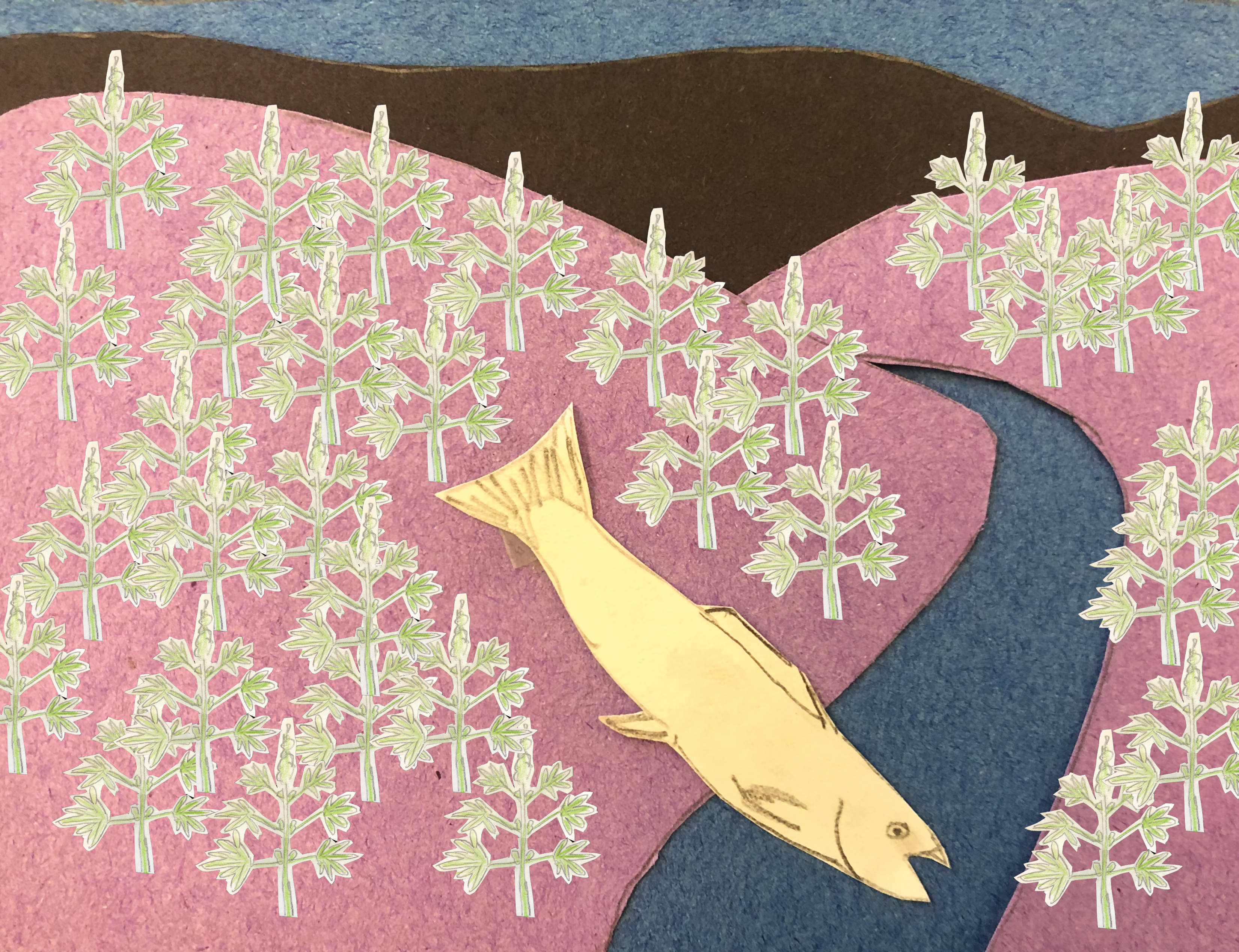
    Additionally, chemicals and other contaminants left by growers poison wildlife species like the West Coast Fisher. Reed explained that rodenticide is an over-the-counter rat poison which causes animals to bleed out internally after consumption.

    Research wildlife ecologist Mourad Gabriel led a study in 2015 that examined rodenticide poisoning in the West Coast Fisher population. It was concluded that between 2012 and 2015 the federally threatened species faced an increased number of deaths due to exposure to rodenticide poisoning from illegal pot farms.

    Reed explained that rodenticide is usually a slow death, and causes animals to be easy prey for predators. This creates a vicious cycle where the poison gets passed from animal to animal. It’s easier for predators to catch an animal that is slow and weak, and so the contamination process continues through the predator who consumed the poisoned prey.

    Indigenous communities are also heavily impacted by trespass grows. During our interview, Reed relayed a story that she heard from the Yurok tribe in which they located several abandoned trespass cultivation sites on their land.

    One site had a shocking one hundred five-gallon buckets,overflowing with human feces. Growers will often defecate in rivers, streams, and tributaries. Because marijuana cultivation requires a significant amount of water, the water levels become extremely low, magnifying the effect of those contaminates. Tribal members who consumed the contaminated water were struck with E.coli, including a Yurok Tribal Chairman.

    “We ingest the water from our rivers. We’re salmon people, we depend on the fish in those rivers,” said Reed. “In a western framework, there’s a distinction between human beings and nature … settler colonial resource extraction perpetuates violence not only against the landscape but it also perpetuates violence against Indigenous bodies because we depend on that landscape.”

    Yurok tribal members are afraid to go out on the land to gather food and other cultural resources in fear of accidentally walking into a grow site, according to Reed. Typically, grow operations are dangerous and harbor some threatening people who will do what they must to protect their crops, including acting violently.

    “From a trespass cultivator’s perspective, your goal is to remain undetected. You don’t want anyone to find out what you’re doing or where you are,” Reed said. “It makes little difference if there’s an FBI agent approaching your grow or if it’s an eighty-year-old woman looking for hazelnut sticks.”

    She expounded that Indigenous peoples have many reasons to access their ancestral territory: to gather, practice ceremonies, pray and manage landscapes. However, doing so has led to tribal members being subjected to violence from trespass growers.

    “There have been stories of tribal members being held at gunpoint because they’ve accidentally stumbled upon a grow,” she continued, “I’ve had people tell me they are scared to go down certain roads in broad daylight because of trespass cultivation.”

    Today, around 60% of the marijuana grown in California is grown on public or tribal lands, and the responsibility of cleaning up environmental degradation left by growers falls to Indigenous communities.
  • Wind Farm Under Scrutiny

    Wind Farm Under Scrutiny

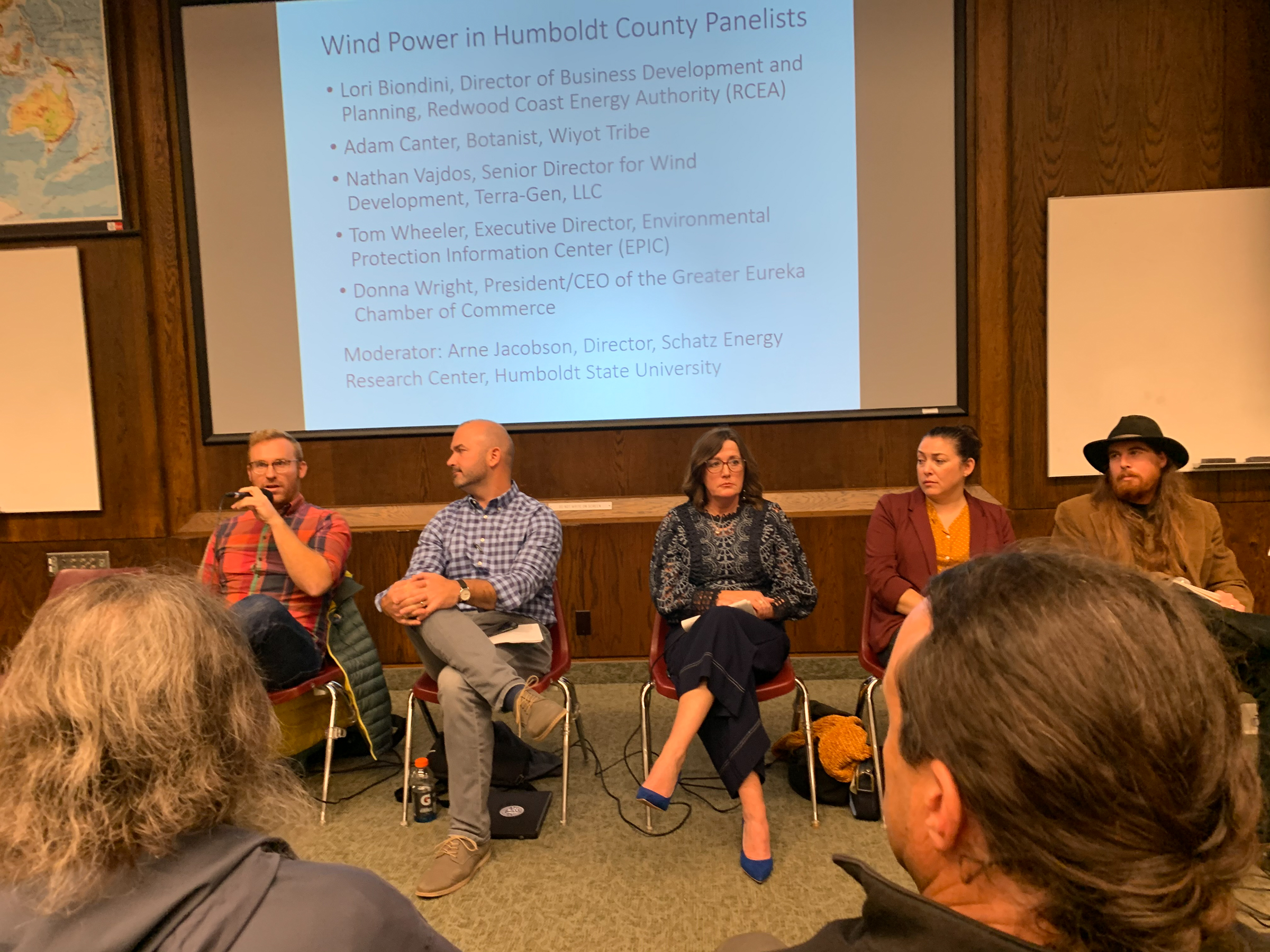
    A panel at Humboldt State University’s Sustainable Speakers Series weigh the pros and cons of the Humboldt Wind Energy Project

    As the global concern to act against climate change increases, Humboldt County is in a position to capitalize on an opportunity to establish a significant renewable resource.

    On Thursday, the Humboldt County Planning Commission votes on the wind energy farm developed by Terra-Gen. Terra-Gen, a Manhattan-based energy company, has proposed a wind farm to be built near Bear River, on Monument Ridge, above the city of Scotia.

    The Terra-Gen wind farm carries controversy for numerous reasons. The project will help achieve carbon emission-reduction goals and provide two million dollars in annual tax revenue for the county, but will impact wildlife, forest ecosystems and the Wiyot prayer site Tsakiyuwit.

    Arne Jacobson, director for Shatz Energy Research Center, said the proposed turbines will produce about 100 times less CO2 than burning fossil fuels.

    “From a climate change perspective, wind looks pretty good,” Jacobson said. “Whatever perspective we have on this particular project, I think one question we should be asking ourselves is what we want to do with that opportunity, because I think it’s there and I think we have the local ethic and the local talent to make that happen.”

    Lori Biondini, director of Redwood Coast Energy Authority, said the Terra-Gen wind project could be part of a solution to address RCEA’s goal of 100% renewable electricity in Humboldt County by 2025.

    “The Terra-Gen project is part of one scenario to reach our goals,” Biondini. “If it doesn’t get built, then we will come up with another scenario.”

    RCEA administers the community choice energy program, a program which allows communities to decide where their electricity comes from. It prioritizes local energy generation and generally more clean energy.

    “I think that one of the promises of community choice energy is that we get to make choices that are good to our entire community.” Biondini said. “Not further marginalize those that might not otherwise have had a seat at the table.”

    A crowd waits for Sustainable Speakers panel to begin. | Photo by Michael Weber

    Adam Canter, a botanist and representative of the Wiyot tribal council, defended the preservation of the land and disapproved of the Terra-Gen project. Canter cites ethnobotanical resources and culturally significant sites as reasons not to move forward with this project.

    “When we first heard about this project, there was this big pit that just kind of fell into our stomachs,” Canter said. “We thought when Shell came 10 years ago that no other company would come back and try to build a project here. But we were wrong.”

    Canter pointed out the cultural resource report for the site bound in a green, four-inch binder.

    “The representation of cultural diversity on this ridge is pretty magnificent,” Canter said. “We’re seeing evidence of Athabaskan peoples and the Wiyot-Algonquin peoples and really it should be listed on the National Register of Historic Places.”

    According to Canter, the area is also a high prayer site; a place where a large expanse of Wiyot ancestral territory is visible. Like the turbines obscuring the view, the Wiyot cultural heritage could be obscured too.

    Tom Wheeler, director for the Environmental Protection Information Center, said the proposed site is a questionable area to build a wind farm.

    “The representation of cultural diversity on this ridge is pretty magnificent. We’re seeing evidence of Athabaskan peoples and the Wiyot-Algonquin peoples and really it should be listed on the National Register of Historic Places.”

    Adam Canter

    According to guidelines set by the California Energy Commission and the California Department of Fish and Wildlife, the proposed site is “pristine.” Wheeler said the site has several rare and endangered species, including the rare Horay bat.

    Wheeler is still hopeful to keep the project, and said there is technology that can reduce some of the wildlife impacts. This, however, is only one mitigation measure to the several unavoidable cultural, environmental and wildlife impacts of the project.

    “I want this to be a better project and it’s not there,” Wheeler said. “At least not yet.”

    On Thursday, the final vote by Humboldt County’s Planning Commission will weigh impacts to Native American culture and environmental quality to the people’s interest in local, reliable energy.

    Aside from the benefit of reducing carbon emissions, allowing Terra-Gen to build the wind farm also comes with an economic and infrastructure benefit.

    Senior Director in Wind Development for Terra-Gen Nathan Vajdos said the company would be the second-largest taxpayer in the county, and could fund $14 million to Humboldt’s reliability network upgrades, with $1.3 million to the Humboldt substation.

    “As we charge our iPhones, we fill up our cars with gas, we’re having impacts.” Vajdos said. “Whether this project is built or not, we are having an impact in this room.”

  • Sarah Ray keeps emotions and knowledge together in her teachings

    Sarah Ray keeps emotions and knowledge together in her teachings

    Sarah Ray inspires students and faculty at Humboldt State. During her lecture, “Coming of Age at the End of the World: Eco-Grief, College Students, and Teaching Climate Change,” she inspires community members as well.

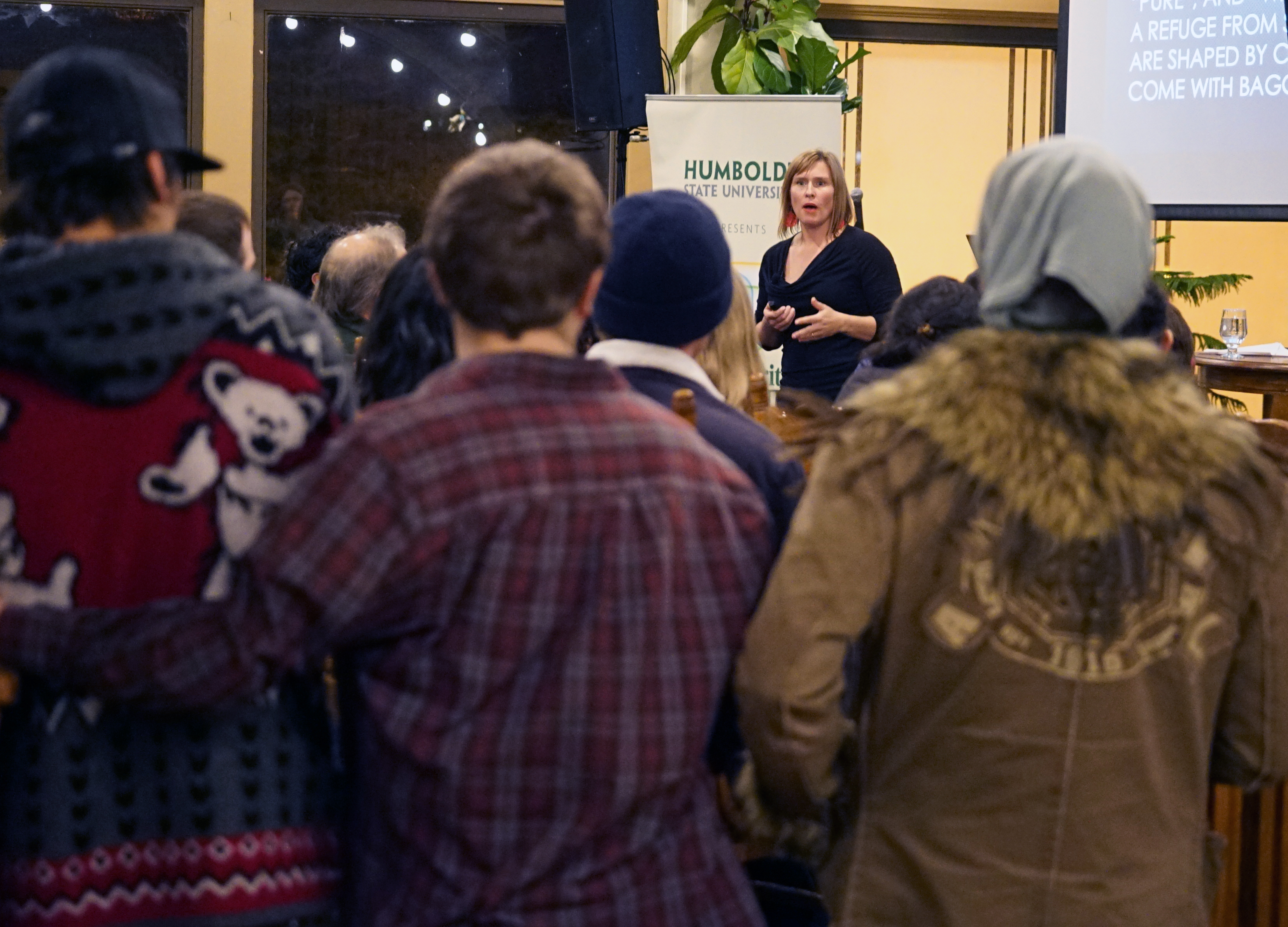
    Sarah Ray, environmental studies professor at Humboldt State, spoke as part of the “My Favorite Lecture” series at the Plaza Grill in Arcata on March 8.

    The lecture discussed ways to be empathetic to students’ emotions and the methods Ray uses to inspire her students, all while acknowledging the grim realities of past environmental decisions.

    “Emotions take on a life of their own in the classroom,” Ray said.

    When Ray took the position to lead the environmental studies program at HSU in 2013, there were 11 environmental studies majors in her program. As of 2018, there are 150 environmental studies majors at HSU.

    Ray says that humans emotions play a big role in environmental studies.

    “Not surprisingly, guilt, despair and negative news do not inspire students to [take] action,” Ray said. “It creates apathy and nihilism. There is a lot of research that shows this is not an effective tool.”

    Over time, students’ emotional responses became overwhelming for Ray herself. Out of self-preservation, and for the success of her students, Ray has come up with new teaching strategies for environmental studies.

    Ray believes these strategies will be beneficial to everyone who questions the importance of their own environmental role.

    “Teaching students environmental content is going to have a negative affect on them,” Ray said. “If the affects can be anticipated, the more effective the curriculum will be.”

    As a professor, Ray has watched many environmental studies students learn that their college journey is not what they expected.

    Faced with intractable, unsolvable problems, students become incapacitated. Ray calls this “getting the rug pulled out from underneath you.”

    After watching students repeatedly get the rug pulled out from underneath them, Ray realized these students need emotional support to deal with the curriculum.

    Brooke Holdren, a biology major at HSU, attended Ray’s talk and thinks ethics should be part of science.

    “There needs to be more critical scientists,” Holdren said. “Science is political as fuck.”

    Ray utilizes inclusive pedagogy to promote not only a students academic success, but their social, cultural and physical success.

    Inclusive pedagogy is a way of teaching that uses varying learning techniques, multicultural content and multiple means of assessment.

    Going off of Bell Hooks teachings, Ray said, “We have to make the personal political and we have to make content relevant to students.”

    Ray also uses social movement theory in her teaching.

    “The outcome of social movement theory is to give students a sense of belonging in a larger community. They are not isolated against the tidal wave of society,” Ray said. “Students are involved in a bigger group of people working towards the same goals.”

    Ecopsychology uses both ecological and psychological ideas to study the relationship between human beings and the natural world. Ecopsychology includes theories about emotional responses to climate change and has become useful in Ray’s teaching, showing how environmental change causes emotional distress.

    Last semester, Ray tried a change-vision-action workshop with her students. Ray had students list how they would like to see changes in the world, and make a personal action plan. Students have put these ideas into actions. This has given Ray inspiration to improve and instill greater lessons onto her students.

    Ray doesn’t simply tell her students how to fix the current environmental issues. Instead, she gives them the information and emotional support they need to come to their own conclusions.

    “Efficacy is better than hope,” Ray said.

    Efficacy is the ability to produce a desired result. Students envision new ways of living with their outcomes.

    “Sometimes the outcomes are hopeful and lead to resiliency, while other times outcomes are negative,” Ray said. “These workshops are not monolithic. They can go in many different directions.”

    HSU alumnus Larry Goldberg, who started the Campus Center for Appropriate Technologies at HSU in 1978, attended Ray’s lecture.

    “You can’t get incapacitated by fear and depression. Get off your ass. You got to do something,” Goldberg, said.

    The changes and theories Ray has implemented in her classroom have inspired her to write a book on emotions in the classroom. Ray’s book will look at different aspects to the emotional consequences of climate change. She plans to write the book on her sabbatical next year.

    “You have to come up with your own reasons and solutions to our problems, because self-righteousness is not enough,” Ray said.

  • Humboldt takes on the Public Interest Environmental Law Conference

    Humboldt takes on the Public Interest Environmental Law Conference

    Students and professors from HSU traveled to the University of Oregon to attend the Public Interest Environmental Law Conference focusing on environmental issues and global sustainability.

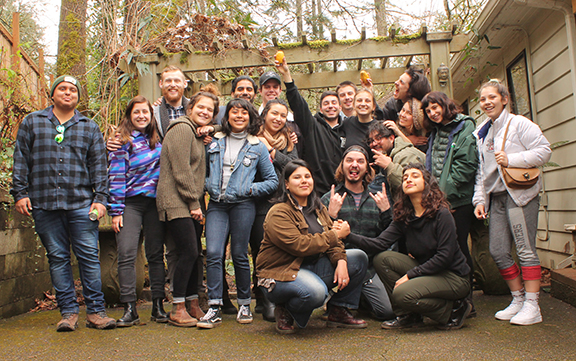
    A group of Humboldt State students drove six hours through rain, hail and snow to the Public Interest Environmental Law Conference, or PIELC, at the University of Oregon this past weekend.

    The four-day conference featured speakers, panelists, activists and organizers from all over the world. Two of them were Humboldt State professors. This diverse group of people came together in one space to discuss current environmental issues and the legal work fueling their fight to global sustainability.

    Brooke Holdren, a senior at HSU majoring in biology, brought a scientific perspective to the event. She encourages bridging the gap between the sciences and humanities in terms of environmental activism.

    “People from all different facets come here,” Holdren said. “So you have the people practicing law along with the anarchists and the homesteaders. And you see everyone working together in this really unconventional way.”

    This year’s conference pushed the theory of intersectionality, their “buzzword” for the weekend. Intersectionality is a concept that came from the early 1900s feminist movement and is the idea that all aspects of humanity – race, class, sexuality and geographic location – are all interconnected and cannot exist separately.

    Intersectionality is now being applied to environmentalism with the understanding that environmental problems and social injustice are interconnected.

    James Bradas is an environmental studies major at HSU who found a sense of agency in going to the conference.

    “I came cause I give a damn, and that’s half the battle,” Bradas said. “Our major is very activism-based, but you can’t escape the insular bubble, so being here is a real eye opener. To actually see the faces of the names we’ve read is a reminder that you don’t need a whole lot of money to do something and be active.”

    Conference guests ranged from guerrilla tree climbers and food justice-based farmers to representatives from the Center for Biological Diversity and EarthJustice – people pushing for justice and equity for humans, as well as the natural world. The event offered students an opportunity to network with other environmentalists and get more involved in the world of activism.

    Samantha Garcia, an environmental studies senior at HSU, thought the conference brought a welcome shift in the tone of environmental conversations.

    “As an environmental studies major, it can get depressing, and you absorb the negative energy from what we’re learning,” Garcia said. “So, it’s refreshing to be around all of these like-minded people.”

    The weekend provided a wide range of activities for conference attendees to participate in. However, not all came without criticism. Some were pushing a very aggressive version of activism. Holdren was able to take a step back and see the positives, even from this negativity.

    “There were a lot of things within and without of PIELC that were really problematic,” Holdren said. “It’s good to bring a critical lens to something like this and take what you want from it, but also learn from it in the sense of how not to go about things.”