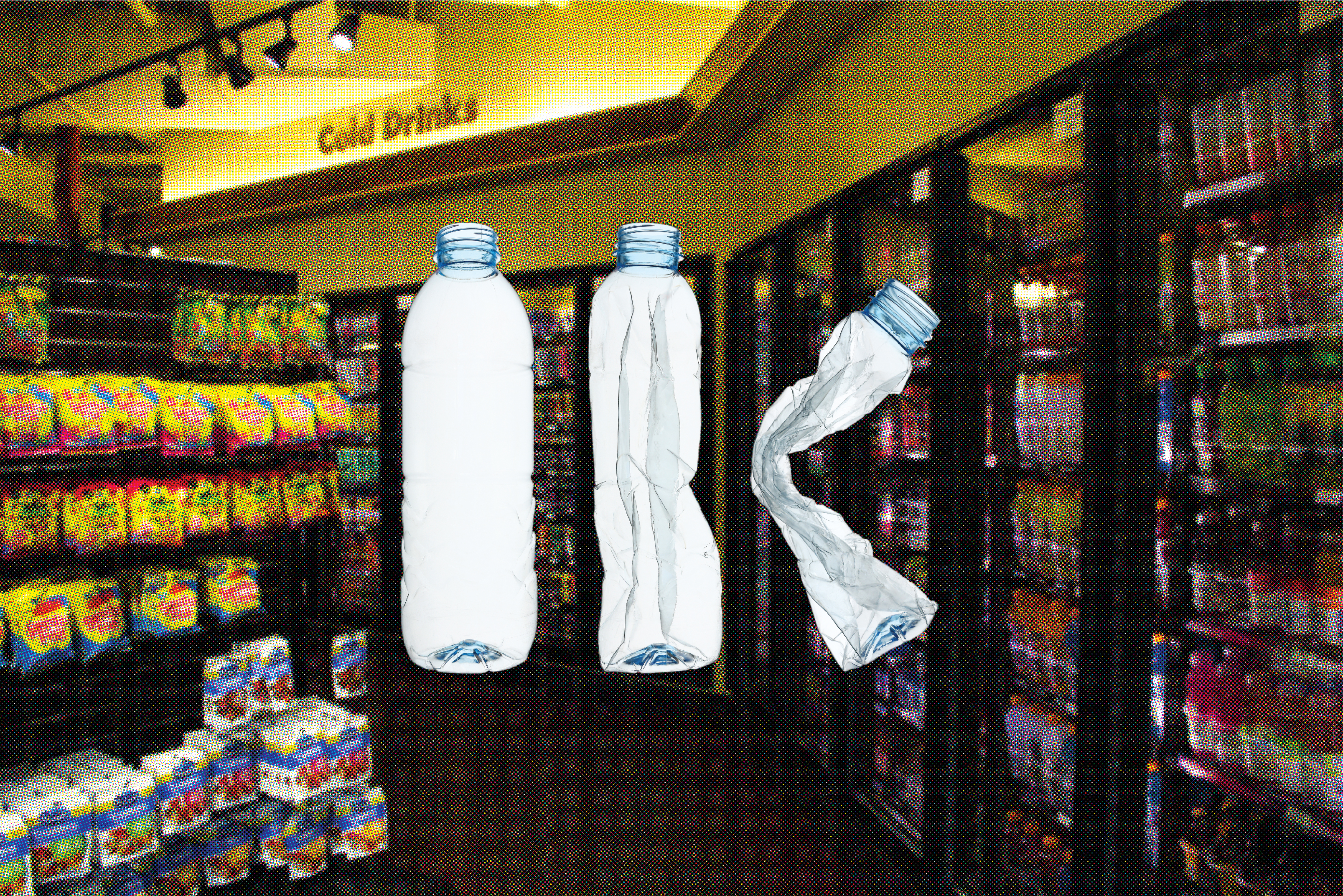
Humboldt State needs more clean water fill stations
Humboldt State banned single-use plastic water bottles in Fall 2011. In the eight years since, it seems HSU has hardly increased the amount of water fill stations on campus.
Campus banning single-use plastic was the right thing to do. It’s progressive and environmentally friendly, two things Humboldt State prides itself on. But the least administrators could do is give us more than two ‘Hydration Stations’ to fill our own bottles.
Nearly every building is home to a drinking fountain, but these fountains are outdated and many of them produce warm, ill-tasting water.
The Lumberjack has highlighted the issue of on-campus stores selling single-use plastic sodas and sugary drinks in the past, but we’re here to hammer it home again.
Disposable water bottles alone once contributed to a large portion of on-campus waste. Banning single-use plastic water bottles decreased that waste and even reduced HSU’s carbon footprint significantly. But campus makes waste with different products, ones filled with sugar and chemicals.
You may be thinking that we should just bring our own bottle filled with water to school, and most of us do. But there are times where we forget, and others where we run out. When we run out of water, we run out of healthy options. If we refuse to gargle the room temperature wash that comes out of our out-dated fountains, what options are we left with? Pepsi, Gatorade, Fanta and Vitamin Water.
It’s an insult to the student body and prospective students that HSU markets itself as pushing the bounds of sustainability when it continues to sell massive amounts of single-use plastic.
Profit is held far above sustainability and student health. Are we surprised? Not in the least. HSU often prioritizes profits over student health (the windowless rooms in Creekview are a great example).
If the school refuses to take action, then responsibility falls to us students. One of our only options for retaliation and action as a student body involves our purchasing power. Where students spend their money and what we say we will spend it on does create change. Attending Associated Students meetings and voicing concerns is another helpful tactic.
We are grateful for HSU’s aim of a more sustainable campus and future through the reduction of plastic consumption. But HSU needs to give students more drinkable water sources. The university needs to prioritize student health and cut ties with brands that continue to use plastic, even if it hurts the bottom line.
For a school that so desperately needs to increase enrollment and recruitment of students, HSU needs to remember to put effort into the students that are already here. Reputation can be everything, and this issue, just like our water, leaves a bad taste in my mouth.
Secondhand stores and DIY costumes make great options for spooky season
Any secondhand store can acknowledge that people don’t wear costumes for just one night, they recycle and reuse the pieces for other occasions and sometimes even the next year’s Halloween.
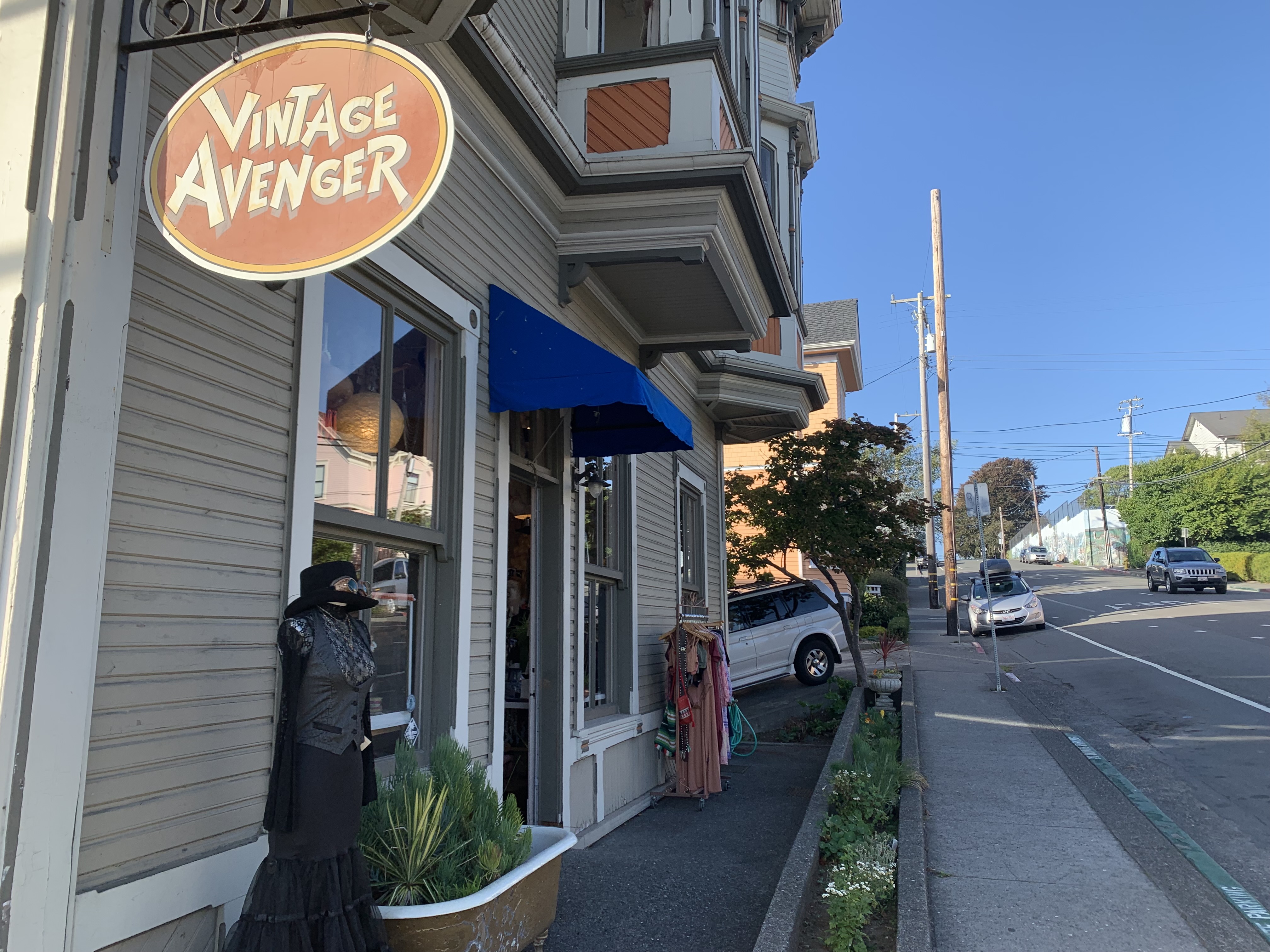
At the intersection of 11th and H Streets in downtown Arcata sits Vintage Avenger. This vintage boutique sells primarily secondhand items. Walking into the shop, you may be surprised to see some of the treasures hidden within.
Behind the counter sits the owner, Nancy Tobin, who says that people in Humboldt like their costumes to be more unique than the plastic packages you may get from a superstore.
“People don’t really like ready made costumes anymore,” Tobin said. “They kinda like pieces they can wear, like ethically sourced items you can wear for other occasions, not just specifically for a costume.”
Vintage Avenger can be your first stop in finding a costume for Halloween. They have some items you can wear as everyday fashion, too. | Photo by Rachel Marty
Ready made costumes, the ones packaged in plastic and sold in stores, are generally designed to match and work together as a unit. This makes the individual pieces of the outfits harder to reuse and style with other items.
“We try to be as much into recycling as we can,” Tobin said. “Anything gold, silver, sparkly sells fast.”
Vintage Avenger’s racks are stuffed with up-cycled pieces, fur coats and exotic dresses, and the racks tie in to the extravagant patterns that decorate the walls of the store.
Tobin said her concept of up-cycling costumes causes her to arrange the store accordingly and make decorative pieces visible to the daily shopper.
Humboldt State student Jennyfer Bonfil said her costume this year will be mixed of up-cycled materials and new purchases.
“I am going to be a DIY version of Mother Nature,” Bonfil said. “I shopped at Forever 21 online and SCRAP [Humboldt] for my costume.”
Another college student, Rose Meyers says she made an effort to not go shopping this year.
“I’m going to be one of the PowerPuff girls with my roommates,” Meyers said. “And we’re making [the costumes] ourselves.”
Shopping locally is great way to support the community and local economy, but online shopping is another option to look for costumes if you intend to buy. Ordering online can be perfect for simple basics such as blank t-shirts and tank tops that you may need to build your DIY costume, but you can often find entire pieces if you look for them.
When buying online, be cautious about sizing and cheaply made items. Also make sure to consider the shipping cost and time factors. In general, companies can send items within five to seven days, but if you need something expedited, expect shipping cost to increase for one to two day shipping.
While cost can be a priority, especially for college students, make sure you’re purchasing from reliable places. Sometimes you can get lucky and find something that closely resembles a more expensive version of pieces found in-stores, but understand that there are drawbacks to cheap costs and cheap clothing.
With Halloween just over a week away, now is the time to get those costumes together. So shop around, check out a few local shops, make something out of clothes you already own to lessen the stress on the environment and your wallet, or buy online for a (possibly) quick fix. Whichever you choose, remember to respect people and cultures, be safe and have fun.
Earn money. Many recycling plants in California offer trade-in programs where you can redeem money from the cash refund value (CRV) of plastic, glass and aluminum cans. The CRV amount for aluminum cans under 24 ounces and for glass and plastic bottles is $0.05. Containers larger than 24 ounces are redeemable for $0.10. Here in Humboldt you can take your bottles and cans to Humboldt Sanitation & Recycling in McKinleyville or the Eureka Recycling Center.
Make something new. There are so much things that can be reused and transformed into something new. Milk cartons can become bird feeders and trash can become artwork. Locally, Scrap Humboldt offers hundreds upon thousands of recycled, slightly used and new items for sale to let your creativity soar. They host creation tutorials to show people how to turn something discarded into something useful again. You can also donate your clean recyclables to their Arcata location to add to their collection of items for repurposing.
Clean them. Clean your recyclables before you toss them. Be mindful of the journey your recycling has yet to take in this consumerist chain. Besides knowing what is appropriate to recycle, it’s also important to properly prepare items before you recycle them. Cans should be rinsed clean, plastic caps should be discarded and wrappers should be torn off of containers.
Compost. Compost what you can. Paper materials like cardboard and newsprint are great materials for creating new flower and produce beds. These items don’t have to end up in the trash or even the recycling bin. Paper is great for reducing decomposition stench from compost bins and the carbon in paper can help facilitate the breakdown of waste. Just be sure the paper you use in your compost doesn’t have glossy inks like magazine paper.
Throw away the rest. You might be recycling things that aren’t recyclable. Plastics numbered with 3, 4 or 7 are sometimes not accepted by curbside recycling programs. Check your local recycling plant’s policies on what materials they accept and what they reject. Things like pizza boxes, aerosol cans, batteries and styrofoam are not recyclable. Throw items like these away or find a proper disposal. Here on campus there are several recycling hubs which offer bins for proper disposal of batteries, computer products and cellphones.
In spite of the successful campaign to phase out single-use water bottles, Humboldt State has yet to remove plastic bottled beverages from campus
Almost 10 years have come and gone since Humboldt State University took back the tap and did away with single-use water bottles on campus.
Overall HSU is known to lead the way in sustainability across the California State University system. In spite of being further ahead in the sustainability game than most campuses, HSU still offers a variety of beverages for sale packaged in single-use plastic.
HSU Dining Services Director Ron Rudebock said they have gotten a fair number of comments over the last couple of years regarding plastic products and on phasing out plastics completely.
“We have been working with vendors to obtain their products in a reusable or compostable or recyclable package and vendors are changing their package materials,” Rudebock said.
Four of the five campus responsibilities listed under the policy have set deadlines.
The first is the elimination of single-use plastic water bottles by Jan. 1, 2023. HSU met this requirement in 2011. The second is the elimination of plastic straws no later than Jan. 1, 2019. HSU eliminated plastic straws during the fall 2017 semester.
The third responsibility listed, also set for January of this year, was the elimination of single-use plastic carryout bags. HSU stopped using plastic bags back in March 2014. The fourth deadline, and last with a time requirement, was the elimination of single-use polystyrene (e.g. STYROFOAM™) food service items no later than Jan. 1, 2021. HSU eliminated Styrofoam to-go containers over 10 years ago and the campus is working to eliminate it in any pre-packaged items.
The final goal of replacing single-use plastic items with materials that are reusable, locally compostable and/or recyclable doesn’t list a specific deadline.
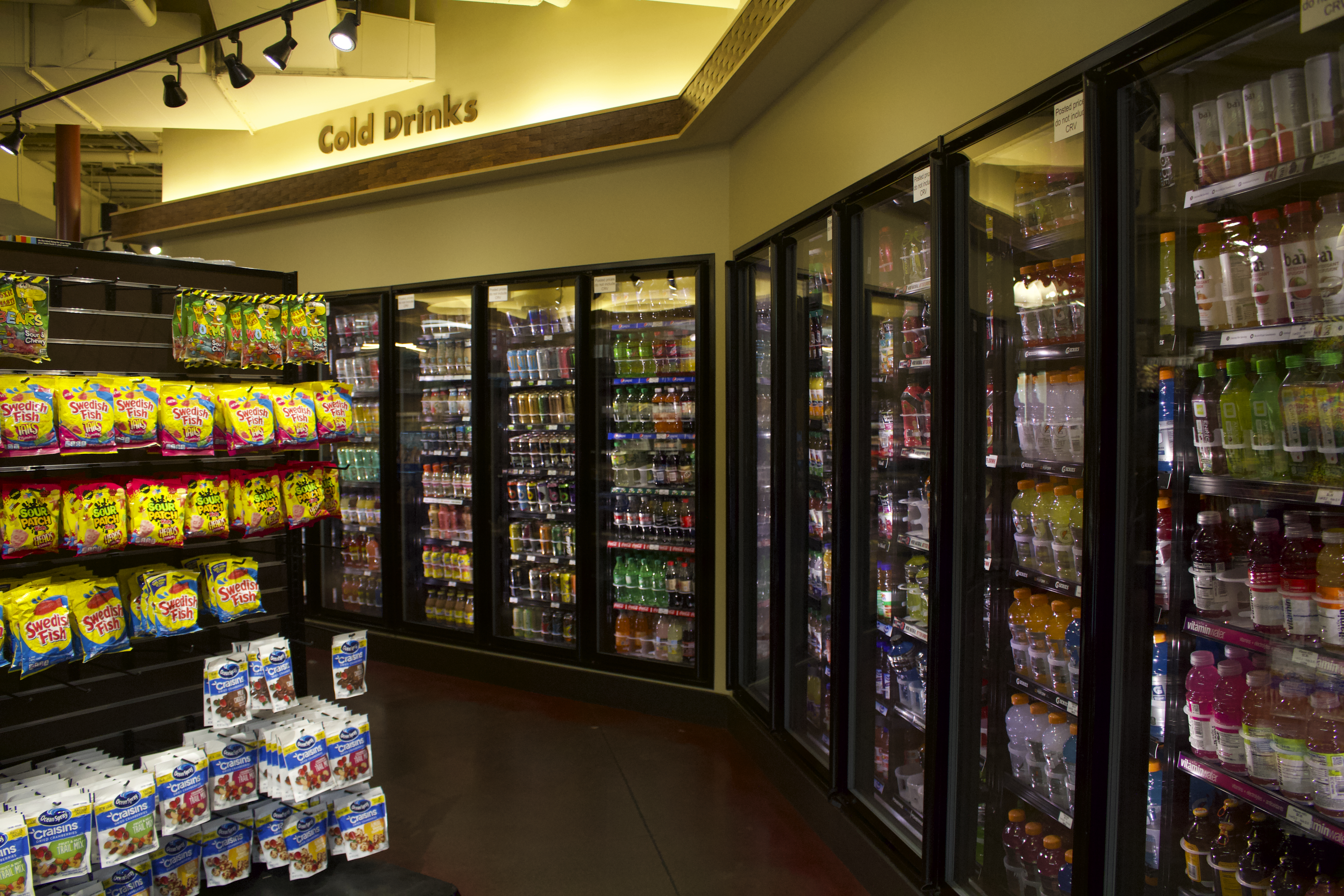
A variety of some of the single-use plastic bottled beverages offered. According to Rudebock, much of the decision to continue to sell single-use plastic drinks is because of consumer choice. | Photo by Megan Bender
Rudebock said this specific change is a challenge. The Depot, the College Creek Marketplace, the Cupboard and vending machines still offer plastic bottled beverages on campus.
“We would like to see a faster adaption but with this guideline having no deadline and with the current collapse in the recycling market I do not see this becoming feasible in the next year,” Rudebock said.
Dining services has made some efforts in providing more glass or aluminum options. The J, for example, has a beverage cooler that is all aluminum and glass, has eliminated single use plastic containers and has single-use packaging that is compostable or recyclable.
However, other locations haven’t been able to make the same change as effectively because of the demand for products that happen to also be in plastic bottles.
“We’ve been working with a lot of our vendors and pushing, trying to get more either glass or aluminum containers.” he said.
Rudebock said Dining Services also goes out of their way to order aluminum and glass alternatives whenever possible from specific companies and brands like Coke or Pepsi.
“It kind of comes down to consumer’s choice,” he said. “Consumers can help by purchasing products that are in reusable, compostable or recyclable packaging and not requesting products that are not in reusable, compostable or recyclable packaging.”
Students have pushed back against the university in the past, questioning its dedication to environmental responsibility over their business ties with PepsiCo.
As reported in the Lumberjack and the North Coast Journal, in 2017 HSU made efforts to meet student’s demands to closer align with its dedication to social, economic and environmental issues by re-evaluating a 40-year-long partnership with PepsiCo.
Under the contract PepsiCo funded HSU with around $58,000 worth of athletic scholarships in exchange for pouring rights. Pouring rights allowed PepsiCo to reserve 80% of HSU shelf space for their products.
Students also made the argument the set up was not fair to local businesses.
In spite of being in a budget deficit and the loss of scholarship funding, HSU did not renew the pouring rights contract and let it expire at the end of June 2017.
HSU was the first California public university and third national public university to phase out water bottles.
The University Center and Dining Services stepped into to help with some of the lost resources.
Rudebock said they managed to fund a majority of the lost scholarship money but leaves the decision of how the scholarships are dispersed up to the school. This way the UC and Dining Services are not directly funding athletics or any specific department.
The university still does business with PepsiCo but under different rebate-based agreements. Dining services also stopped carrying Aquafina water bottles, a brand owned by PepsiCo as a result of the nationally recognized Take Back the Tap campaign.
Under the Waste Reduction & Resource Awareness Program, students began efforts to Take Back the Tap at HSU starting in 2009. The student lead group and Dining Services worked to phase out the sale of single-use water bottles in 2011 as is the primary focus of the campaign.
As a result, HSU became the first California public university and third national public university to phase out water bottles. Dining Services initially explored an alternative by offering boxed water.
“At first we thought they were upset with the plastic water bottles, but they said ‘No no, just the water,’” Rudebock said. “It was more about the idea of selling packaged water.”
Before HSU removed water bottles on campus, TBTT calculated that HSU’s annual bottled water demand “required approximately 43 barrels of oil per academic year” and in turn was “releasing 35,000 pounds of carbon dioxide into the atmosphere.”
HSU now owns two Hydration Stations and has 16 water fill stations on campus.
Environmental Science & Management Professor James Graham and his geospatial students created an interactive map of HSU that includes where to find water fill stations on-campus as well as other resources.
The locations of all water stations on HSU’s campus according to the Sustainability project. These locations include the two Hydration Stations.
Sustainability Director Morgan King said Facilities Management worked with students help create the map.
“We worked with [Graham’s] students to develop layers for sustainability attributes,” King said. “Including water filling station locations, bike parking locations, recycling and compost bin locations.”
Anyone can access the map by visiting HSU’s sustainability website. The map key is listed in a drop down menu that offers different types of resources on campus. Under the sustainability option, users can check the box of the information they’re looking for.
Rudebock said Dining Services remains attentive to the needs of the students and the possibility of selling less plastic-bottled products.
“Every journey begins with a step,” Rudebock said. “The less plastic containers that students buy helps change the need for that product.”
The California State University system’s single-use plastic policy passed in December 2018 includes four policy changes that have deadlines, but the fifth and final goal of the policy doesn’t list a deadline.
Eliminate single-use plastic water bottles by January 1, 2023. HSU has already met this requirement as of 2011.
Eliminate plastic straws no later than January 1, 2019. HSU eliminated plastic straws during the fall 2017 semester.
Eliminate single-use plastic carryout bags no later than January 1, 2019. HSU eliminated plastic bags in March 2014.
Eliminate single-use polystyrene (e.g. STYROFOAM™) food service items no later than January 1, 2021. HSU eliminated Styrofoam to-go containers over 10 years ago and are working to eliminate it in any pre-packaged item
Replace single-use plastic items with materials that are reusable, locally compostable and/or recyclable.
To find out more about HSU’s Zero-Waste Initiatives, WRRAP and TBTT visit the WRRAP homepage.
CCAT plans to keep pigs on campus to reduce food waste
Humboldt State University’s Campus Center for Appropriate Technology plans to house two pigs on campus as soon as next week.
CCAT will loan the pigs from the Tule Fog Farm in Arcata for the duration of the fall semester. CCAT plans to feed the pigs food waste from HSU’s J dining hall.
Jacob Gellatly, environmental resources engineering major and former CCAT Co-Director, helped lead the project from concept to reality.
“We want to show how animals can be raised in a residential environment, and how you can use urban byproducts such as food waste to raise animals in an urban setting,” Gellatly said.
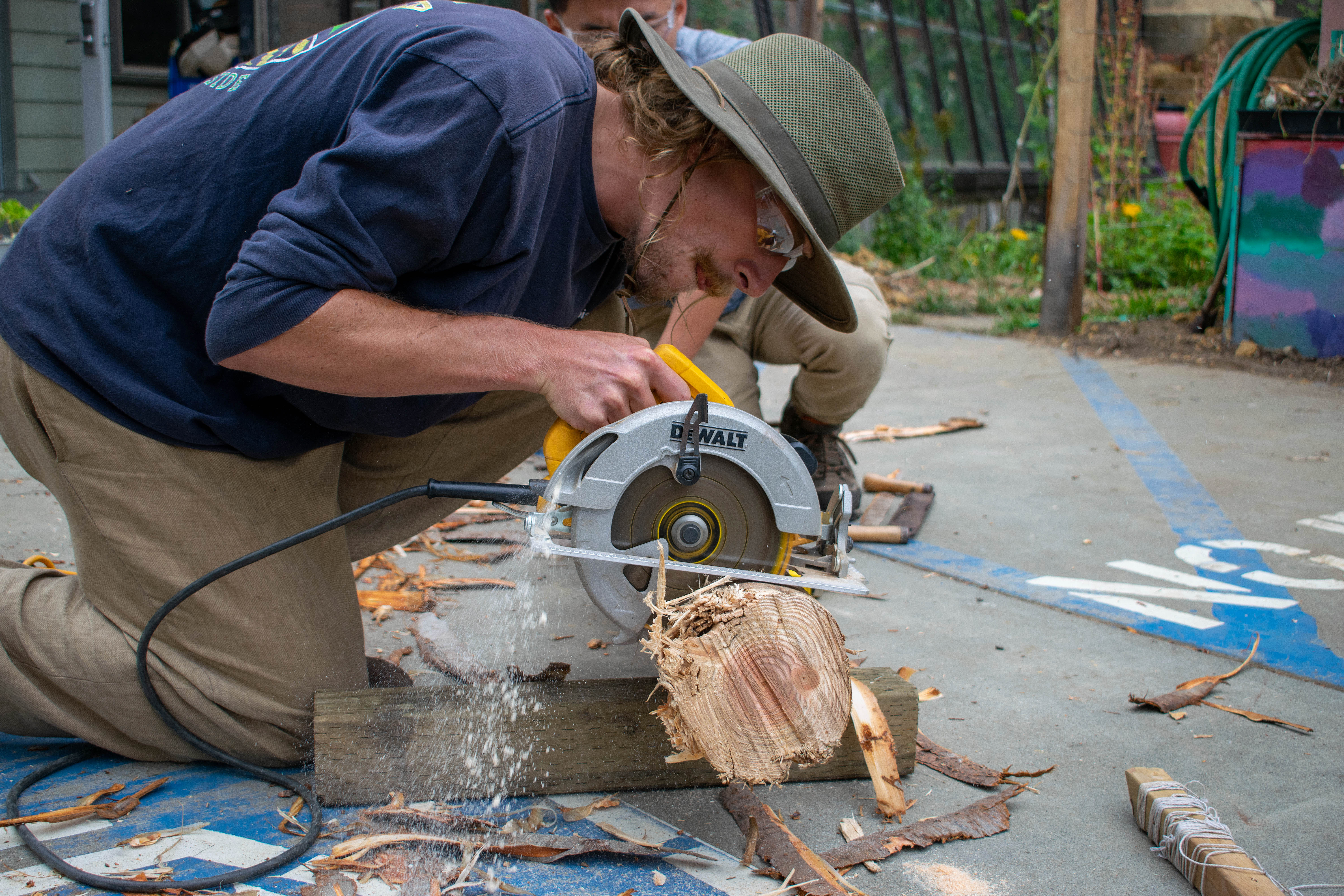
EnvironmentalRresource Engineering majors Jacob Gellatly (right) and Kong Vang (left) prepare a log on Sept. 6 to be used for the roof of a pig pen. | Photo by James Wilde
The plan to house the pigs began last fall when students in the CCAT Student Club vocalized interest in keeping animals on campus. CCAT contacted Shail Pec-Crouse from the Tule Fog Farm in Arcata. Pec-Crouse recommended pigs as the most viable animal.
“The easiest animal for us to raise would be pigs,” Gellatly said. “The reasoning for that is—a big thing is predators. So it’s a lot harder for something to come and get a hold of a pig as opposed to a chicken.”
As part of their plan, CCAT realized they could feed the pigs food waste from the J. While CCAT couldn’t feed the pigs food thrown away by customers of the J, CCAT could feed the pigs pre-consumer waste, such as food trimmings or spoiled foods not suitable for people.
“Another goal with the project was how can we divert food waste on campus,” Gellatly said. “And with that we can feed almost, and in some cases, their entire diet from food waste that’s at the school here.”
Once CCAT decided to loan the pigs from the Tule Fog Farm it needed approval from HSU’s Associated Students, Institutional Animal Care and Use Committee, Facilities Management, Risk Management and an environmental health and safety specialist.
The pig pen-in-progress on Sept. 6. CCAT plans to house two pigs in the pen for the duration of the fall semester. | Photo by James Wilde
Humboldt State’s IACUC reviews the use of animals on campus to ensure the animals are treated humanely under the requirements of federal and state law. College of Natural Resources Associate Dean Rick Zechman, who chairs IACUC, said the IACUC proactively reviews and inspects over 100 animal-involved projects on campus each year.
“There’s varying kinds of emotional feelings about the use of animals, and that’s respected and honored in the system of review,” Zechman said. “And that’s why the Animal Welfare Act was developed, to prevent mistreatment of animals. And I think, you know, in our committee, that’s sort of our first principle.”
While Zechman could not comment on the details of CCAT’s proposal, which is still pending, CCAT has worked over the last year to assuage concerns raised by various HSU faculty.
CCAT started by building a pig pen out of reclaimed wood from a local logging operation in Fieldbrook. CCAT has since integrated plans for a roof to prevent flooding of the pen and security to prevent people from getting harmed by the pigs.
In the long run, Gellatly hopes the project might convince the University to keep animals around for good.
“Big picture, I would like the school to see this and see, with what we’re having to deal with—getting rid of all this food—we could be raising meat for the school and have locally-produced meat with a byproduct of our current dining system,” Gellatly said.
Environmental Rresource Engineering majors Jacob Gellatly (right) and Kong Vang (left) working with a log for the pen. | Photo by James Wilde
CCAT’s plan to house pigs has only recently become known to the wider HSU campus. Saraí Escalante, psychology graduate student and president of HSU’s Vegan Club, sees the value of reducing food waste but wonders about the sustainability of the project.
“I think the underlying problem is that we see them as a convenience, as objects, so we see them as a tool to help us fix a problem or make our problems or our lives easier,” Escalante said. “And from a sustainability point of view, you still waste a lot of water in all of the slaughter process and the cleaning up of the meat. In that way, it wouldn’t be sustainable.”
Escalante said she’s considering starting a fundraiser to purchase the pigs and send them to a sanctuary instead of a slaughterhouse. However, Escalante said she plans to talk with CCAT to exchange thoughts, as she does like the idea of reducing food waste on campus.
Gellatly, for his part, noted that the current plan as registered with Tule Fog Farm and IACUC is for CCAT to house the pigs only for the rest of the semester.
“I think it’s, in theory, possible for them to buy the animals from the farmer if that’s something they’re inclined to do,” Gellatly said. “But, as far as our scope goes with the IACUC, once the project’s done, we’re taking the animals back to the farm and that’s where it ends for us.”
The project’s beginnings are dependent on approval from IACUC, but the pigs could arrive at CCAT as early as the week of Sept. 8 through 14.
This website uses cookies to improve your experience. We'll assume you're ok with this, but you can opt-out if you wish. Cookie settingsACCEPT
Privacy & Cookies Policy
Privacy Overview
This website uses cookies to improve your experience while you navigate through the website. Out of these cookies, the cookies that are categorized as necessary are stored on your browser as they are essential for the working of basic functionalities of the website. We also use third-party cookies that help us analyze and understand how you use this website. These cookies will be stored in your browser only with your consent. You also have the option to opt-out of these cookies. But opting out of some of these cookies may have an effect on your browsing experience.
Necessary cookies are absolutely essential for the website to function properly. This category only includes cookies that ensures basic functionalities and security features of the website. These cookies do not store any personal information.
Any cookies that may not be particularly necessary for the website to function and is used specifically to collect user personal data via analytics, ads, other embedded contents are termed as non-necessary cookies. It is mandatory to procure user consent prior to running these cookies on your website.