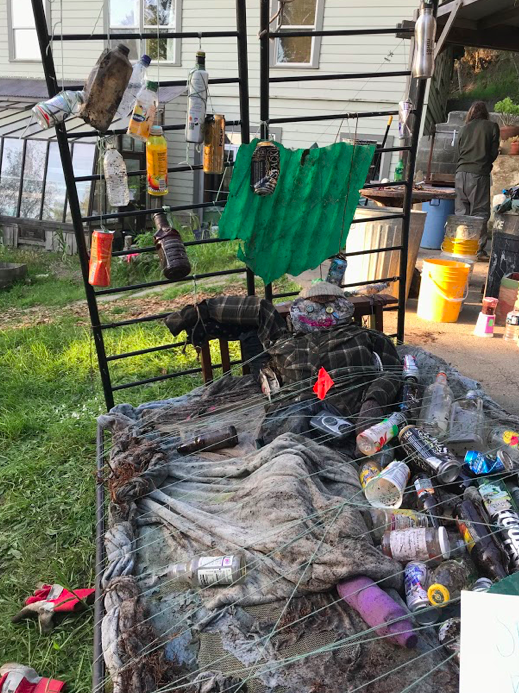
Hands gripped ankles, one leg pointed for balance, creating a human bridge. An arm reaches out over a river in the community forest to grab a long forgotten sour cream container. It would have never decomposed, so instead, it was upcycled into art. A collaborative art installation to visualize human influence on our natural world, showing what we leave behind and what will stay behind. The tagline: “you made your bed, now sleep in it.”
Jonelle Alvarez, a Humboldt State student majoring in environmental science and management, helped collect the trash and turn it into a sleeping student. She was inspired to be participating in the transition from trash to art.
“There was a lot more trash than I imagined and it would’ve stayed out there forever,” Alvarez said. “We had to get really creative with it. Prove we have no limits.”
This past Sunday, a group of students from Earth Guardians suited up in their rain gear and headed to the forest, armed with empty sandbags to fill up with trash. It was the first of many community forest clean up days hosted by the club.
Earth Guardians is a global movement founded and sustained by young people to spread resiliency through direct action activism. They are demanding greener policy from governments and leaders around the world, co-creating our future by empowering youth leaders. They are currently suing the federal government for endangering our generation through excessive fossil fuel consumption.

The Humboldt State Earth Guardians chapter meets every Monday in the CCAT house at 5 p.m., fostering an all-inclusive, accessible space for local activists to turn their ideas into reality.
Simone McGowan, an environmental studies student who brought Earth Guardians to Humboldt, struggled to find an accessible outlet for her activism, a space for people to feel good about themselves and what they’re doing.
“We’re uniting a large group of activists for political and social action on the macro and micro scale,” McGowan said. “Activism should be accessible and everyone should be included in the conversation.”
Earth Guardians promotes activism for anyone trying to catalyze change. They are bridging the disconnect between social and environmental justice, starting an open dialogue where all voices can be heard.
Jacob Gellatly, an environmental resource engineering major, believes Earth Guardians’ inclusive, collaborative activism is the answer to the social and environmental problems that plague our planet.
“Don’t focus on what can’t be done,” Gellatly said. “Instead, figure out what we can do together to make it happen.”