The Lumberjack


Students Serving The Cal Poly Humboldt Campus and Community Since 1929

Tag: eviction

  • Two complaints were the basis for evicting over one dozen homeless Cal Poly Humboldt students

    Two complaints were the basis for evicting over one dozen homeless Cal Poly Humboldt students

    by Jasmin Shirazian

    Alleged complaints regarding unsanitary conditions created by students living in vehicles on campus didn’t exist when university administrators forced students living in their vehicles off-campus in November. 

    Aileen Yoo, Director of News and Information for Cal Poly Humboldt Marketing and Communications, was unable to find any formally filed complaints against alternative living students. 

    “There were no formal complaints filed with the University Police Department but there were informal complaints to UPD, Parking Services, and Facilities Management,” Yoo said in a Jan. 16 email. The italics are hers.

    After informing Yoo of the existing formal complaints and requesting any records of the alleged informal complaints, Lumberjack reporters did not receive a response.

    Cal Poly Humboldt released a campus-wide email stating the enforcement of parking regulations and ultimately the removal of students living within their vehicles on campus on Oct. 25, 2023.

    “There have been an increasing number of RVs and other vehicles parked long-term in University lots across campus,” Cal Poly Humboldt’s email read. “These vehicles are in permit-only parking spots, and have been parked in spaces overnight in violation of University policy that includes a prohibition on overnight camping on campus and overnight parking for anyone not living in University housing.”

    The email contained a statement that these students had received an unspecified amount of complaints regarding their living in on-campus parking.

    “Policy aside, overnight camping in University parking lots creates unsanitary and unsafe conditions for both those encamped and for our campus community at large,” the email read. “The University Police Department and other campus offices have taken calls from concerned members of the campus community expressing fear and frustration about the situation.”

    Only two formally filed complaints were made to UPD by the same people, listed only as RP and Pt, on Oct. 6 and Oct. 7, 2023. The complaints were obtained by The Lumberjack through a public records request 

    “RP owns the property at [redacted] and believes some of our houseless students are people associated with camping in the 14th and Union parking lots are jumping her fence to her unoccupied property at [redacted],” the Oct. 6 report states. “RP sent a photo of the subject who was unrecognizable.”

    The following day, UPD received another complaint from RP. This time, a person identified as Pt is mentioned in the same report, though their relation is unknown. 

    “RP calling back to report RV parked x 2 nights [across] the street from her residence,” the Oct. 7 report states. “Pt states there are ‘several men’ coming and going from the RV. RP is requesting a patrol check of the area. Subject contacted and they advise they will be moving RV.”

    The news of being removed from campus came as a shock to many alternative living students, who had recently formed a club to solidify the bond of their community. Some of these students even recall speaking to parking enforcement and housing administrators about their alternative housing plans prior to moving, to which they received no rejection or denial. 

    Carrie White, a biology major on a pre-medicine track, is one of the students who was pushed off campus by parking enforcement. 

    “Since I was forced to leave campus, I have continued to live in my vehicle, but I am parked in another parking lot,” White said. “I leave before dawn to avoid any potential issues occurring despite having permission to stay where I am. I stay away all day, moving between other street parking, lot parking and the coast line. I return later in the evening.” 

    White was already under tremendous stress when the university notified the students that they had to vacate the parking lots by Nov. 12, 2023, giving them two weeks to find accommodations. 

    “At the time, I had a friend that had just passed away, a sick grandfather, and finals,” White said. “There was a total lack of consideration of my humanity; I might have other things happening in my life besides living in my car, which is hard enough at times. It was a tone-deaf decision on behalf of the university, in my opinion.”

    Journalism major Brad Butterfield, who is also the science editor of The Lumberjack, is an alternative living student who has been living in his van on campus for several semesters. In an email to parking enforcement, Butterfield explained his situation and received a message stating that parking enforcers were aware of students living in their vehicles on campus. In Butterfield’s email, he specifically asked if the school allowed overnight parking if proper permits were displayed.

    “Parking is enforced from 7AM to 10PM, Monday through Friday,” Michaela Old, a parking enforcement employee said. “As long as you have a valid permit you will be able to park – also keep in mind that parking spaces are first come first serve.” 

    Several students said they attempted to acquire documentation of or information about the complaints, but were ultimately left without answers. 

    Recent graduate Maddy Montiel was in their last semester when they were notified of the parking enforcements. Montiel was finally becoming comfortable in their community after nine years in college, four of those spent at Humboldt. 

    “My last semester meant a lot to me,” Montiel said. “I was finally at the finish line, finally letting myself have some fun and deepen friendships. I joined more clubs and went to more events; I let myself enjoy the beautiful environment our school sits in. [I] remembered why I decided to move here and take all the risks I did to be here. I was finally getting what felt like a ‘college experience…  for the first time, I started to feel safe.” 

    This changed when Montiel had to vacate the parking lot in which the community formed. 

    “Having to spend my last couple months of what I thought was a graceful and beautiful end to my college experience, fighting for basic answers and the right to stay on campus until at least the end of the semester, only to have the door shut in my face over and over, was beyond disheartening,” Montiel said. “Since being kicked off campus, I’ve had to live at the community center and on city streets again. Always being on the move gets exhausting.”

    The vacating of students has left many of those affected, such as freshmen MA public sociology student Caleb Chen, feeling disheartened by the university’s decisions. 

    “I feel that this… has highlighted exactly how out of touch the administration and especially the President’s office is from their student body,” Chen said. “When the [administrative] office blatantly ignores the wishes and insights of everybody else, a university is doomed.”

    White shares a similar sentiment. 

    “One of the most hurtful things about that original email from Cal Poly Humboldt was that I realized I was totally disillusioned,” White said. “I chose to invest my time and money in this institution because I believed in its values and inclusivity policy, but upon that email being sent out, I realized that Cal Poly Humboldt is just that: an institution – with dollar signs for eyes.”

    Brad Butterfield is the science editor for the Lumberjack. He had no involvement with the making of this article.
  • Cal Poly Humboldt issues parking citations to students living in vehicles

    Cal Poly Humboldt issues parking citations to students living in vehicles

    by Jillian Wells

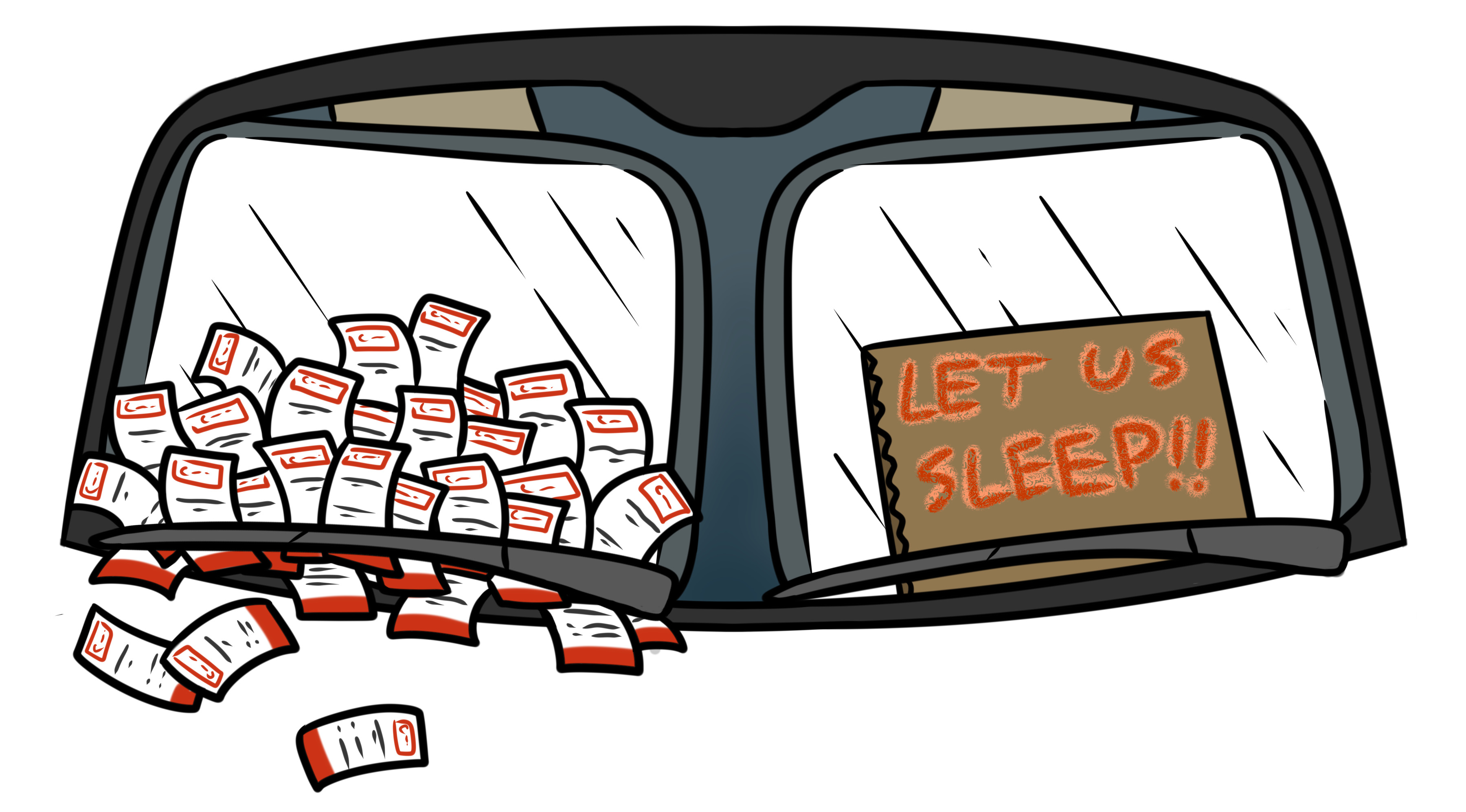
    On the morning of Nov. 13, students living in alternative housing such as vans, RVs, campers and motorhomes on campus awoke to parking tickets on their vehicles. The parking tickets each cost between $40-$53, with some students receiving multiple citations. 

    The enforcement of parking regulations came 19 days after the university sent out an initial email, notifying students that they would be enforcing a previously overlooked policy that prohibits overnight camping.

     This decision to enforce this policy sparked community backlash and has gained national attention, as there was a Los Angeles Times reporter interviewing students this week. 

    The citations issued to students outlined various violations, including “No Use of Vehicle for Living/Overnight” and “Beyond Designated Lanes.” Additionally, comments on the tickets highlighted specific infractions such as “windows being covered.”

    Cris Koczera, the Interim Director of Risk Management & Safety, did not respond to requests about further clarification about the criteria for determining if a student is sleeping in a vehicle by press time.

    Student Derek Batty lived in a vehicle on campus, but made the decision to move into temporary housing to avoid receiving a citation.

    “I feel more homeless in this place [temporary housing] than I did before,” Batty said. “I’m grateful for it for sure, but I wish we just didn’t get kicked out.”

    Batty also said that despite moving into temporary housing, he received a parking ticket on the morning of Nov. 13 because his windows were covered up. 

    “They can’t prove that we’re sleeping in the vehicle based on having [the windows] covered,” said Brad Butterfield, vice president of the Alternative Living Club, in an impromptu meeting on Nov. 13.

     They expressed frustration and asserted that just because their windows are covered up isn’t evidence that they are sleeping in their vehicles. 

    Ethan LeVering, an Associated Students (A.S.) delegate for the University Senate, pointed out a lack of consideration in the enforcement process.

    “They did not knock on the vehicles, they did nothing to check if anyone was in there,” LeVering said. “They simply left the little ticket and ran off.”

    The University Police Department (UPD) declined to comment. LeVering also criticized the university’s approach.  

    “These students have not been given a presumption of innocence, which is outright un-American,” LeVering said.

    Carrie White, a student who lives in their vehicle, emphasized the economic ramifications of the parking citations.

    “That’s what they’re [Cal Poly Humboldt] working on, the economic punishment,” White said. “They know we don’t have any money, so they’re going to ticket us until we have no choice. They’ll break the bank before they break our will.”

    Caleb Chen, another impacted student, expressed his concerns about the timing of the ticketing. He believes that the university is starting the citation process just before fall break to limit potential media coverage and keep the ticketing discreet.

    “They could tow us at the beginning of fall break… to remove the vehicles silently while all the students were gone,” Chen said.

    Chen added that while he appreciates the option of temporary housing, he’s not interested.

    “At this point, it’s about making sure there’s a solution for future students and all their [Cal Poly Humboldt’s] solutions only go until December 18.”

    Brad Butterfield is a member of The Lumberjack. He did not help write or edit this article.

  • Policy, protest, and pirates: students protest against campus evictions

    Policy, protest, and pirates: students protest against campus evictions

    by Jillian Wells

    Other contributors: Alex Anderson and Dezmond Remington

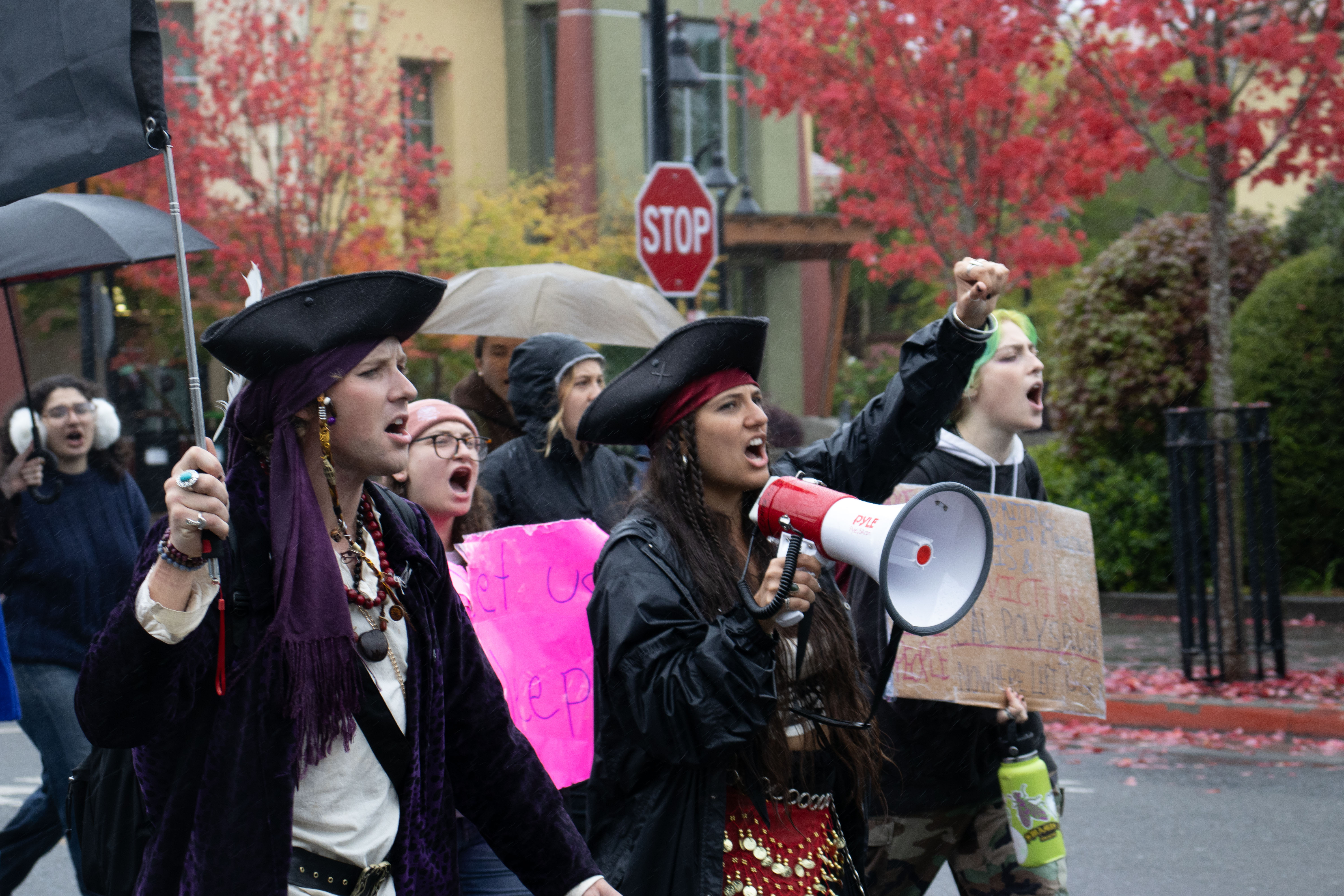
    In a powerful show of unity, students and faculty members gathered in the rain at Cal Poly Humboldt to protest the recent decision to evict students living in vehicles on campus. The protest, which took place on Thursday, Nov. 2, highlighted the larger problem of homelessness in Humboldt County. 

    The protest started at 11 a.m. in the G11 parking lot and lasted throughout the night. At 12 p.m., protestors marched to the quad in the rain chanting, “Hey, ho, hey, ho student eviction has got to go!”

    Photo by Cedrik Vonbriel. A sign at the protest.

    The protest was led by Maddy Montiel and Brad Butterfield, the president and vice president of the Alternative Living Club, who were dressed as pirates because of a long-running joke of them being “land pirates” and their RV’s being ships on wheels. Furthermore, the initial eviction email occurred during Halloween week, and since then Montiel and Butterfield have been solely focused on securing safe housing, but didn’t want the situation to take celebrating Halloween from them. 

    “The university took a lot from us last week,” Montiel said. “We decided we wanted to keep one thing for ourselves and still dress as pirates and give our outfits a chance to see the light of day.”

    Photo by Cedrik Vonbriel. A sign at the protest.

    The protest also featured an open discussion, where Montiel and Butterfield stated their list of demands from the university. 

    Their demands included the university allowing overnight camping or sleeping in vehicles through the end of the fall semester, at least, a formal apology for the dehumanizing language in the initial eviction email, the establishment of a committee for long-term solutions, more transparency in defining camping and its implementation, and evidence of the “unsafe and unsanitary conditions” that was stated in the email.

    At the protest, Butterfield stated students living in their vehicles are open to finding a solution that works for them and the university, but that the university hasn’t been willing to negotiate. For the students living in their vehicles, protesting was a last resort. 

    “For the school to assume that they can just get rid of us and push us out onto the streets and we’re going to go away quietly, is wrong,” Butterfield said.

    On Tuesday, Nov. 7, the University Senate passed a resolution that would pause the enforcement until the end of the 2023-2024 academic year; this resolution was sent to President Jackson’s office. It awaits a decision. Mark Johnson, the President’s Chief of Staff, who attended the meeting on behalf of Jackson, declined to answer any of The Lumberjack’s questions, as did Dean of Students Mitch Mitchell.

    During the protest, various speakers articulated their concerns, frustrations, and demands, emphasizing the need for understanding and fair solutions. The protest featured many voices and perspectives within the community, stressing the importance of addressing the issue with attainable solutions and compassion.

    Photo by Cedrik Vonbriel. A sign at the protest.

    Rouhollah Aghasaleh, an assistant professor in the School of Education, attended the protest and said that he sympathizes with the students who are being evicted.

    “Living in a [vehicle] doesn’t make you less human.” Aghasaleh said.

    Meheret Vasquez-Suomala, a religious studies major, expressed disappointment in the administration and hopes that they will listen and work with students, not evict them. 

    “You [Cal Poly Humboldt] are deliberately misplacing lower-income students and that’s what’s frustrating.” 

    Raymond Haeckel, another one of the speakers at the protest, questioned the accusations made by the university and stated that without proof of the unsafe and unsanitary conditions. Haeckel will continue to believe this is an effort to force these students into on-campus housing and collect housing fees.

    “This is motivated by money and money alone,” Haeckel said.

    Jules Tatum, another student at the protest, condemned the university’s decision to evict students.

    “To say that these people are unsanitary, unsafe, dangerous individuals is just a slap in the face. The only dangerous conditions are being created by the institution,” Tatum stated.

    Ultimately, the protest highlighted the need for realistic and attainable solutions that work with students, not evicting one of the most vulnerable student populations. 

    If you’re interested in learning more about this on-going issue, the Alternative Living Club is meeting on Friday, Nov. 10, at 3:30 in front of the library. 

    Disclaimer: Brad Butterfield is a member of the Lumberjack. He did not help write or edit this article.

  • Many questions, few answers: Cal Poly Humboldt evicts students living in vehicles

    Many questions, few answers: Cal Poly Humboldt evicts students living in vehicles

    by Jillian Wells and Alex Anderson

    Cal Poly Humboldt served what is essentially an eviction letter to students experiencing homelessness and residing in vehicles such as vans, campers, RVs and motorhomes on-campus. To provide a comprehensive understanding of this evolving situation, we’ve compiled a timeline of key events in this ongoing story.

    Wednesday, Oct. 25 – Initial Notice

    Cal Poly Humboldt sent out a campus-wide announcement on Wednesday, Oct. 25, that sent shockwaves through the campus community. In the announcement, the university said that they have decided to enforce a previously overlooked policy, stating that students living in their vehicles on campus would have to find housing elsewhere due to “unsanitary and unsafe conditions.”

    This abrupt announcement took the community of students living in alternative housing by surprise as many of them have been living in alternative housing for multiple semesters without incident.  

    “University policy will soon be enforced without exception,” the email stated.

    The announcement didn’t highlight any specifics in regards to what the unsanitary conditions were, or how this policy would be enforced. The Marketing and Communications department for the university declined to comment on these questions.

    For many students living in alternative housing, being on campus is crucial, because it’s the only viable way they can afford to get an education. With the increasing prices of tuition and everyday living, several students stated that if they’re forced to move off campus, that will cause them to leave permanently. 

    “It’s really hard for me to be able to live any other way,” said Carrie White, a senior biology major. “If I was forced to move, I would probably have to drop out of school.”

    Students also prefer to live in their vehicles on campus because with the community they’ve built, it adds another layer of safety. 

     “We park close together because we look after each other … it feels a lot safer,” White said.

    Friday, Oct. 27 – Alternative Living Club 

    The Alternative Living Club held its first official club meeting, which was originally meant to inform others who are interested in living in alternative housing. Instead, due to the recent announcement, they had an open discussion about the RV sized elephant in the room: the university evicting them.

    The meeting was packed with students and faculty alike, who were concerned about the recent policy enforcement. The club meeting, which was led by President Maddy Montiel and Vice President Brad Butterfield, asked club goers to help support their cause by signing their petition to stop the eviction, and continuing to share their mass emails. 

    “We are now going to push for the campus to offer us resources and amenities in a way that would actually help us,” Montiel said.  

     Samuel Parker, President of Associated Students (AS), stated that AS would continue to pressure administration and figure out the root of the issue. 

    “It just came out of nowhere,” Parker said. 

    Many of the students at the meeting stated that the solutions the university provided in the email such as temporary housing were just that— temporary, and not a real solution for them. They say being on campus is the only concrete solution. 

    Tuesday, Oct. 31 – Official eviction letters have been served 

    On the afternoon of Tuesday Oct. 31, in parking lot G11, a heated meeting erupted between students and administrators after eviction letters were handed to students who have been living on campus in their vehicles. 

    Students pushed back against the decision and stated that there was no communication beforehand and that the enforcement and timing of this policy is extremely problematic for their safety and well-being. The unsigned letter of eviction stated:

    “If this vehicle remains parked on campus after noon on November 12, it may be towed at your expense. Additionally, the owners of those vehicles that require towing may be referred to the Dean of Students for disciplinary action.” 

    At the tense Tuesday meeting, students waited for Cris Koczera, Interim Director of Risk Management & Safety, Stephen St. Onge, the Executive Director for Student Engagement & Enterprise Services, and Dr. Mitch Mitchell, the Dean of Students, who presented the letters of eviction.

    At the meeting, Koczera stated that the sanitary issues are what brought the conversation up, but that ultimately they are going through with the eviction due to the violation of campus policy that has been long overlooked. Koczera added that the camping on campus was getting out of control.

     “It’s not camping, it’s homelessness,” White said, adding that this is a reflection of the administration, and instead of pushing them off campus into county resources that are already full, they should do something about it and work with the students. 

    Students also raised concerns over the technicalities of what enforcement would look like. For instance, according to Koczera, students would be able to park their vehicles all day and overnight, but sleeping in the vehicle overnight is what violates policy and could lead to citation. 

    When asked how they would determine if students were sleeping in their vehicles, Koczera said that it would be both the Parking and Transportation Services and the University Police Department observing the vehicles. If they see behavior that leads them to believe there are people occupying them, a citation could be issued.

    Students continued to press the administrators about the evidence there was of them being unsanitary. Students argued that this evidence was not proof of them being unsanitary.  Koczera stated that there had been several complaints about the students living in their vehicles on-campus, including that photos were taken of buckets with human waste, and a photo of feces on the pavement. Koczera would not say who took the photos.

    Caleb Chen, a graduate sociology student who lives in alternative housing on campus, stated that he does in fact have a bucket outside of his vehicle that’s been there since mid-August. However, it’s used for foraging and collecting rain water. 

     “There has never been human waste in this bucket,” Chen said. “I use it to transport foraged goods that I eat. It’s a before bucket for human food not an after bucket for human waste. For the school administration to send an email to the entire campus accusing a handful of students of spreading human waste around campus is straight up slanderous.” 

    Photo by Alex Anderson | Associate Vice President for Student Success Mitch Mitchell (left) and Chris Koczera (dressed in blue next to right of Mitchell) the director for risk management & safety services at Cal Poly Humboldt serve a perceived eviction letter and campus resource flyers to those living in their vehicles on campus on Oct. 31. Maddy Montiel (dressed in white) expresses concerns for the students who will be effected by the decision.

    Tuesday, Oct. 31 – Senate Meeting

    Alternatively housed student eviction notices was a topic of discussion at the university senate meeting on Oct. 31 in Nelson Hall. Faculty raised concern over the new policy and the negative effects that would be placed on students. The wording of the schoolwide email regarding the new enforcement of the university’s parking policy alarmed several faculty members who were in attendance.

    Associate Professor in the Sociology department Michihiro Clark Sugata raised concerns over the new parking enforcement policy and the school wide email that was sent out on Oct. 25. Sugata worried about the new enforcement policies and the effects that would have on the well being of the students involved. Sugata felt the students were being wrongly characterized as unsafe and unsanitary. 

    “Regardless of the fact, if it is a policy issue, policy could be changed and the central fact should fall onto what is the best interest of our students and protection of their well being,” Sugata said. “And this is where the other two rationals become incredibly problematic…the language was that this was creating unsafe and unsanitary conditions for the community as a whole. Thus, our students were being framed as dangerous and dirty. And these are classic tropes that are used to criminalize certain populations.” 

    There are several campuses in California that have taken action to help students who are living alternatively. Long Beach Community College and UC Santa Cruz have set up alternative housing options and have provided services to students living alternatively. Specifically, LBCC set up a safe parking program that connects students who shelter in automobiles to a designated location for overnight parking. 

    Cal Poly Humboldt Sociology Professor Josh Meisel referenced LBCC’s safe parking program as a potential model that Cal Poly Humboldt could explore in order to look out for the well-being of students. Meisel proposed to the senate that the issue should be agendized, and that senate members should open a dialogue to discuss what is needed to help students. 

    “These are our students, they are not to be feared and there are models out there that we could potentially explore,” Meisel said. “There’s a model program at Long Beach community college that provides a safe place for students to park and have access to facilities on campus overnight.”  

    The meeting concluded with the senate agreeing to set a time during next week’s meeting to discuss the eviction matter in depth and review what further actions will be taken. 

    Thursday, Nov. 2 – Protest 

     Citing the university’s lack of compromise and inability to reach an agreement with students, students are organizing a protest on Thursday, Nov. 2 in the G11 parking lot at 11:00 am and will run all day into the night. The homeless students living in vehicles encourage those who wish to show their support, to bring signs, set up tents if you have one, park your cars and occupy the space.

    Disclaimer: Brad Butterfield is an editor for The Lumberjack, however he did not help write or edit this article.