The Lumberjack


Students Serving The Cal Poly Humboldt Campus and Community Since 1929

Tag: Facilities Management

  • Question For Facilities Management

    by Carlos Pedraza

    On Wednesday, Sept. 14th the Cal Poly Humboldt Facilities Management and Smith Group in Nelson Hall presented their physical campus plan for expanding the campus to the community. The plan is in the discovery phase. 

    The forum was led by Associate Vice President of Facilities management Mike Fisher. A full work plan was shown beginning with the forum and ending in July 2024 when the final plan will be presented. 

    During the forum, students and community members asked questions of plans. A major concern from the community was housing. Throughout, there were questions and shouts about housing. When Fisher addressed the question and made the point that the University wants to work with the town of Arcata, a man in the crowd shouted, “It’s been a problem for 40 years,” referring to the housing crisis in Humboldt county. 

    Ed Fitzgerald, a retiree who has lived in Humboldt since 1973, said, “Adding more housing on the existing infrastructure is not a good idea, we need more infrastructure.” 

    In regard to housing, Fisher said, “You find a lot of the housing inventory has been absorbed by single family homes by non-students and that’s driving difficulties.”

    Fisher went on to state that to solve the housing problem will require a community effort with the university.  

    Candance Kelsey, a Humboldt alumni and local business owner, inquired how the plan would keep money local and in the community. Fisher responded, explaining there is public bidding and other opportunities for smaller businesses to work with the university. 

    “When there are suitable candidates that can [fulfill the bid], then they’re in the running,” Fisher said.

    Staff from the Student Disability Resource Center also brought up accessibility issues on campus and maintenance of current housing. Another question asked by a student was the plan for gender neutral and inclusive bathrooms. 

    The student speaker said, “I have to go five minutes away to use the bathroom for my classes.” 

    Audience member Arlene Wynn also asked for shower facilities for gender neutral students. 

    Rosa Sheng, a presenter from Smith Group, responded, “In our work as architects, the next phase of design is the inclusive all gender design.” 

    She explained how the planning wants to add gender inclusive bathrooms and lactation rooms in the new buildings and current ones. 

    Throughout the meeting students entered and left as classes started, repeatedly asking for the hour-and-a-half long forum to be at a more appropriate time for students and those who work 9 to 5 jobs. Fisher acknowledged the comments.

    The physical campus plan website is the point of contact for students, community members, and organizations to express their concerns or views to the University.
  • Theatre Arts retrofit postponed – again

    Theatre Arts retrofit postponed – again

    By Andrew George Butler

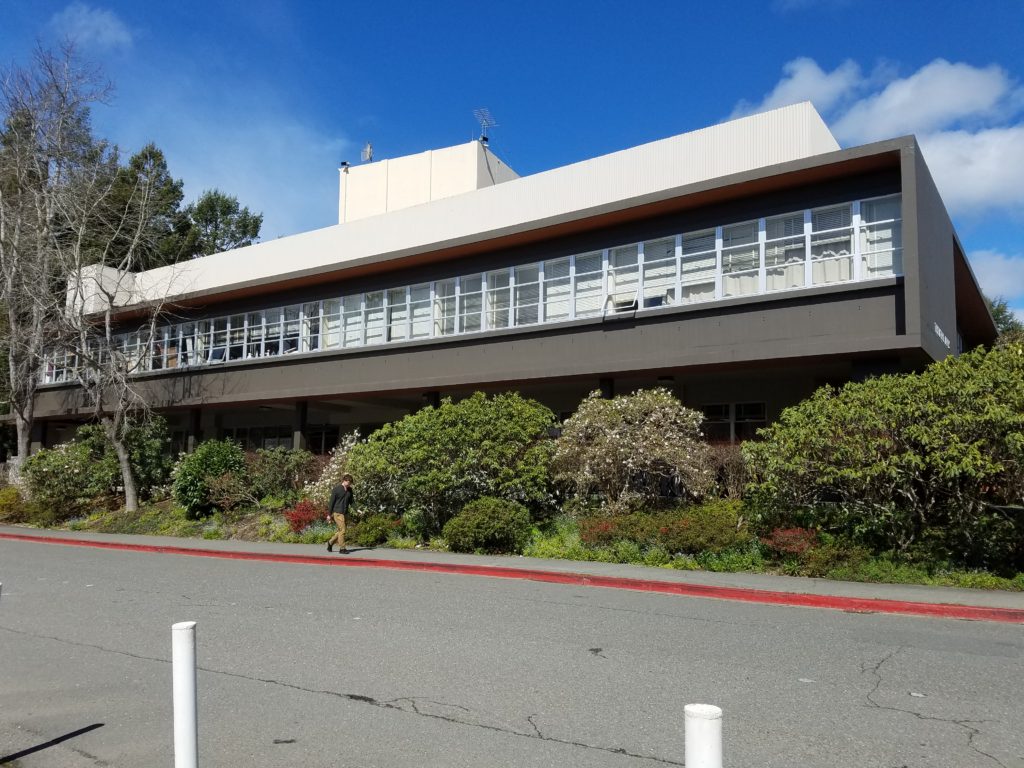
    The grandaddy of all structures on Humboldt State’s deferred maintenance list will have to wait at least another year before seeing some much needed tender love and care. The Theatre Arts building is set to remain atop the list for another year as recent building code changes forced 2017’s earthquake retrofit plans to be put on hold.

    The Theatre Arts building has been on deferred maintenance for over 15 years. In 2017 the building was supposed to receive the renovations it needed. The money was allocated, the plans were drawn up, and the contracts were signed all before 2016 came to a close. The staff of KHSU and other campus offices located in Theatre Arts all had prepared for temporary relocation, a task itself that took months and planning and scrambling.

    The Theatre Arts building at HSU. Photo by Liam Olson

    David Reed, development director of KHSU, was tasked with much of the preparation for what would have been KHSU’s temporary relocation if construction had not been delayed.

    “It’s frustrating, we spent months preparing to move. We have a large operation, many moving parts,” Reed said. “The only good side is that we digitized much of our paperwork in preparation for the move.”

    Fast forward to the beginning of March, 2017. With less than a week until the retrofit was to begin, the HSU office of Facilities Management realized all the planning that went into the retrofit had been worked around a set of building codes that changed January 1, 2017.

    Traci Ferdolage, director of Facilities Management at HSU is in charge of coordinating the construction funds once they are dispersed to HSU from the CSU main office. According to Ferdolage, the building codes, which are periodically reevaluated and changed about every three years, are calculated independently from outside the California State University system by state officials. Construction plans, such as the ones for the Theatre Arts building are issued by the CSU main office in accordance to the building codes in place at that given time.

    “Once the CSU board allocates us the money for a project, we act,” Ferdolage said. “We don’t take into consideration the possibility of changing building codes.”

    The CSU Seismic Peer Review Board periodically sends an independent reviewer to various CSU campuses to conduct a review of the buildings and deem if any retrofits or other construction is needed. The CSU main office then reviews the reports and grants money to campuses based on need.  

    The Theatre Arts building at HSU. Photo by  Liam Olson

    The Theatre Arts building is currently not yet classified as unsafe for use, the proposed construction is to bring the building up to par with the most modern of structural standards.

    “Facilities Management staff have done a wonderful job at keeping the building operational considering the levels of predicted renewal needs not funded by the State,” Ferdolage said.

    Construction on Theatre Arts is expected to begin in May of 2018 according to Ferdolage.

    There is no oversight board between state building officials and the CSU board to ensure that proposed projects are outlined with the most current building codes in mind. Construction grants are expected to be used promptly. The only way a campus can keep receiving grants is to keep spending the money as it comes in. Part of the money given to HSU for the Theatre Arts project was spent on building plans that are now essentially wasted funds. While the CSU chancellor’s office selectively audits how grant money is spent from time to time, there is not full time office or administrator in charge of ensuring that the tuition and taxpayer money used for campus construction is spent as efficiently as possible. That task is left to the university once the money is allocated. The rush to spend, mixed with a lack of communication between offices may not always lead to error, but it does pose the question: Who is in charge of the money?

    “Projects are managed under fairly complex and defined financial guidelines which help ensure taxpayer and student fee money is handled responsibly,” Ferdolage said.

    Building code officials, CSU seismic peer review board, facilities management, and a set of guidelines, all with no unifying oversight have left the Theatre Arts building in limbo for another year.

  • Uproar over shiny new floor

    Uproar over shiny new floor

    Music department’s Fulkerson Recital Hall gets new floor

    By Sarahi Apaez

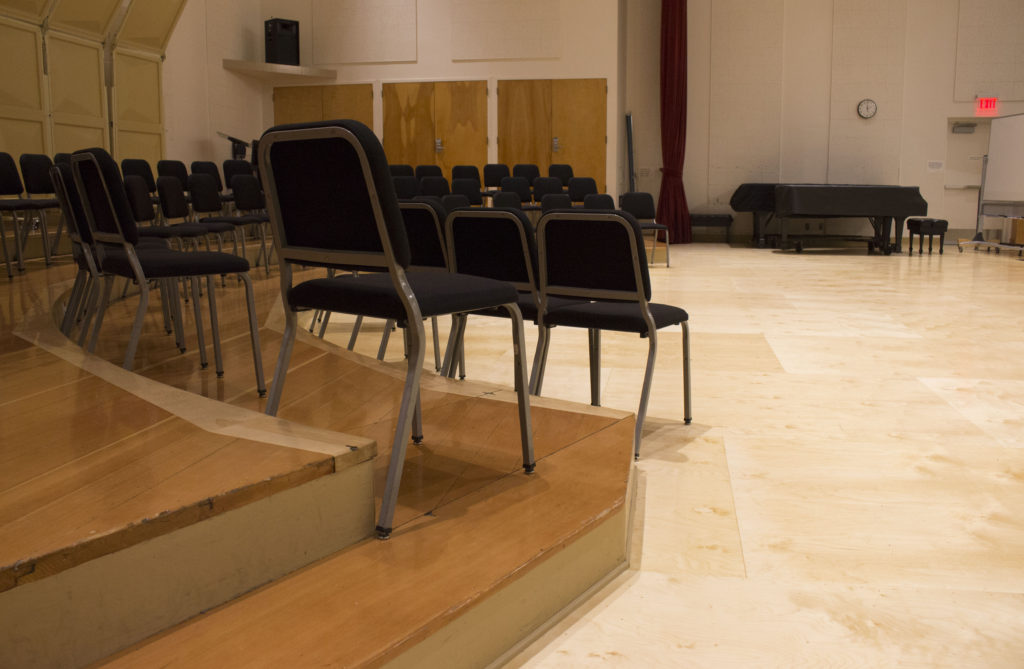
    The glare from the new floor in Fulkerson Recital Hall makes it hard for music students to read their music. The glossy plywood covering the stage alters the light and acoustics in the Hall this spring.

    Music student Telisha Moore has many complaints about the floor.

    “It’s super shiny and distracting when standing on the stage and it is very hard to read music,” Moore said. “It doesn’t really feel like a performance stage anymore.”

    This semester, students and faculty of the music department return from break to find big changes had been made to Fulkerson Recital Hall’s flooring.

    As of Jan. 16, Fulkerson Recital Hall’s old growth pine flooring has been changed to plywood as a temporary fix.

    With students walking in and out and equipment being moved back and forth, the Hall gets yearly damages. These damages include safety issues such as splintering.

    Professor Brian Post, who is currently filling in as interim chair of the music department alongside Professor Paul Cummings, expresses concerns over the many issues that have come with the temporary changes to the floor.

    At the end of every year, the floor is refinished, sanded down and gets a new coat of varnish on top, according to Post.

    Professor Brian Post looking down at the changes done to the floor. Photo by Sarahi Apaez

    At the end of 2016, Facilities Management realized that the floor was too old to refinish and could not be sanded down any further.

    In December, facilities management made final decisions to begin work on temporarily fixing the floor over winter break and would hold off complete replacement of the floor until a time when the stage is most open, according to Cummings.  

    Cummings biggest concern is when the temporary floor will be replaced with the permanent floor because the floor is almost always in use.

    Fulkerson Recital Hall is used around 12 hours a day. Classes use the recital hall  for rehearsals, it is used by center arts and even in the summer when HSU hosts music workshops. HSU hosts nationally recognized performers, speakers, and is a regional center for the arts. The community uses it as well as other departments on campus. The hall is meant to function as a community stage, as well as a department stage, according to Post.  

    Finding a time when the Hall is not in use is challenging. Times for the permanent replacement of the floor have not been set, due to how often the Hall is in use.

    “If we’re lucky, this repair process will be done by Fall 2017,” Post said.

    The music department had little knowledge to the extent of the changes that would be occurring in Fulkerson Recital Hall. According to Post and Cummings there was no communication about the floor being replaced between the Facilities Management and the Music Department.

    “You can imagine our shock when we came back from winter break and we opened that door and saw a floor that doesn’t meet any kind of basic standard for a university music department primary performance facility,” Cummings said. “All changes were done without consultation to the music department.”

    Professor Eugene Novotney is very familiar with Fulkerson hall as he spends 12 to 15 hours or more a week in the space. “I don’t think any consideration was given to how that gloss coated plywood floor altered the light and soundscape of the stage,” Novotney said.

    Novotney and his students struggle with the acoustics and the reflection of the bright floor daily. “The floor is very reflective both of light and sound,” Novotney said.

    The current acoustics in Fulkerson Recital Hall have been found to be hard for singers to work with. The Hall is in drastic need of attention from facilities management when it comes to the functionality and acoustic environment in order to be on a professional level said Novotney. The plywood floor that is currently in the room is an intermediate step towards a complete transformation that will occur in Fulkerson.

    Music student Amber Rausch says her class was full of sarcastic reactions when they were first exposed to what had happened to the floor.

    “Everyone was in shock on the first week of classes,” Rausch said. “The topic of the floor comes up in every class session.”