The Lumberjack


Students Serving The Cal Poly Humboldt Campus and Community Since 1929

Tag: FASFA

  • FAFSA payments remain unaffected during government shutdown

    FAFSA payments remain unaffected during government shutdown

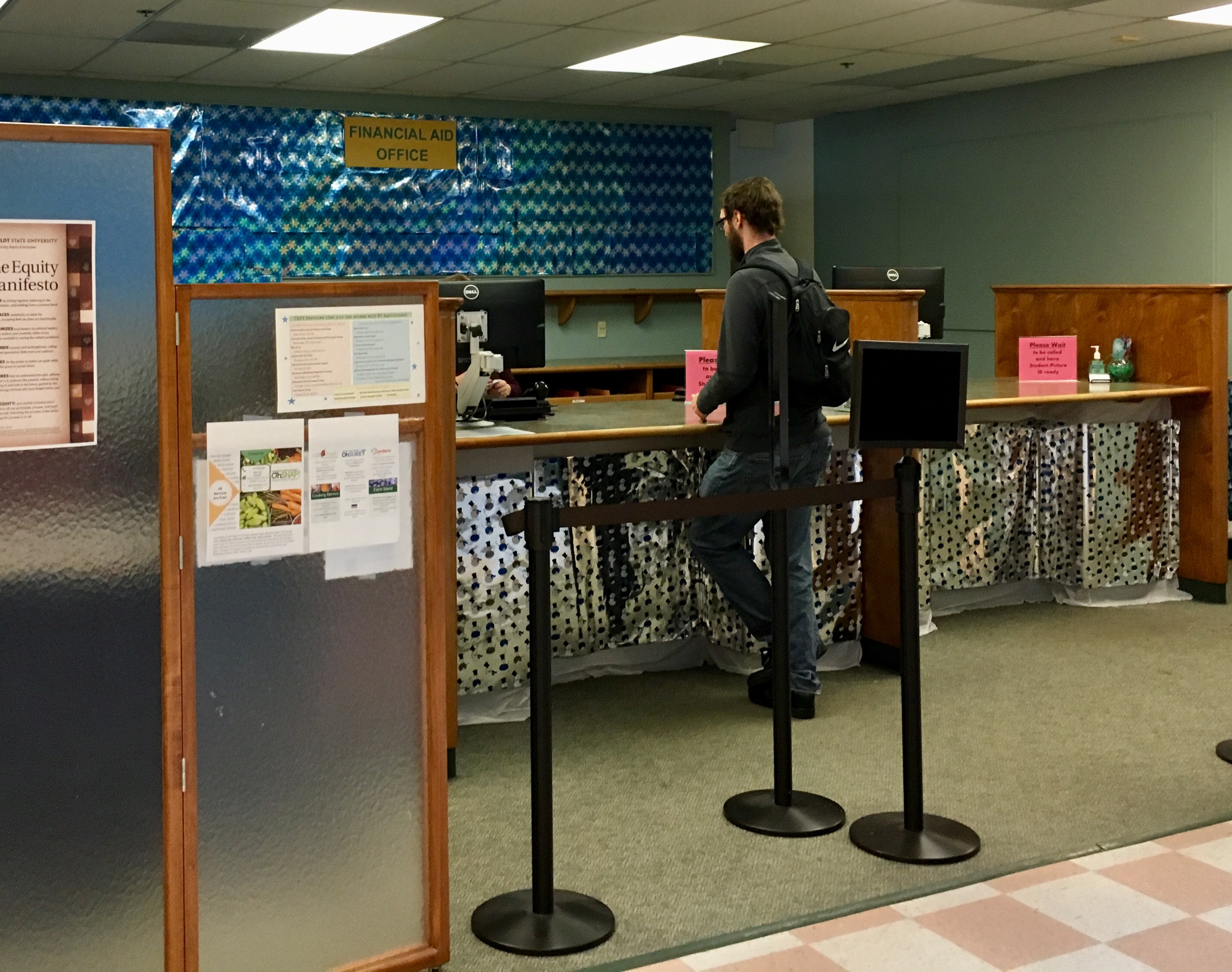
    With the current federal government shutdown looking to continue indefinitely, financial aid disbursements should remain unaffected for now. However, according to Peggy Metzger, director of the financial aid office at HSU, about 50 to 60 students may see some setbacks.

    “The biggest impact is the students selected for verification and not being able to get information from the IRS,” Metzger said.

    The first financial aid disbursements are set to be released on Monday Jan. 14. About 30% of the students who file for financial aid must go through a verification process through the IRS, to ensure that they need the funds they claim. Metzger said that the Department of Education has recently loosened their regulations and that the verification process should be easier.

    “We can work with any students that may need the help,” Metzger said. “As long as the Federal Student Aid office stays open we should be fine. In previous shutdowns, the Department of Education has always stayed open.”

    Operators in the HSU financial aid office have said that they have received phone calls from students inquiring about any possible effects from the shutdown, but the university has yet to issue any sort of formal statement. The lack of notice from the university has some students worried about what may be happening with their disbursements.

    “The university hasn’t said anything, I haven’t got their usual emails,” said Anthony Julien, a senior majoring in zoology. “We got the email that something was due, but we didn’t get anything about [disbursements] being held up. I am concerned about it since the shutdown is going to continue.”

    Steven Schafer, an environmental science and monitoring junior, is also concerned about the shutdown’s effects.

    “I need my money to go to school,” Schafer said. “I need FAFSA. The university probably isn’t going to release a statement. I’m not optimistic about it to say the least.”

    Metzger, who has been employed at HSU for 17 years, said she has been out of the office doing work with the admissions office lately and had not seen the need to release a statement.

    “I had not thought about it, but it may not be a bad idea,” Metzger said. “I am always cautious about causing more questions than are necessary and more worry when there doesn’t need to be.”

    When questioned if the university was doing enough to let students know what was going on, Schafer had this to say.

    “No, they are definitely not doing enough,” Schafer said. “It is so stupid.”

  • Editorial: Cutting College

    Editorial: Cutting College

    The Trump budget rejects low-income students

    By The Lumberjack Editorial Board

    The 2018 Trump administration budget is an utter catastrophe for college students. If you thought a 5 percent tuition fee increase was worrisome, well, look out. The cuts to the Department of Education alone will have you rethinking the decision to attend college altogether. 
    While the White House is holding up the promise to increase defense funding, the budget slashes programs that help college students. When you analyze the full impact of these cuts, things aren’t looking pretty for the low-income students.
    The budget slashes funds for the Federal Pell Grant, also known as FAFSA, by $3.9 billion. FASFA is the largest federal grant program according to the National Center for Education Statistics. The FAFSA program helps students and families making less than $40,000 a year. Because the FAFSA is a grant, students don’t have to repay the money or incur student loan debt. 
    Students count on the FAFSA to not only help with educational costs but also for their livelihood. For some, the Pell grant can mean anything from affording school supplies or food, to housing. Without the aid of FAFSA low-income students aren’t left with many options to fund their education and seek a better life. 
    If you were hoping to find help through the other programs within the educational system, unfortunately, the cuts don’t stop with FAFSA. In the Trump budget, the Department of Education stands to lose a total of $9 billion. The reductions concentrate on all of the programs intended to support low-income students. The budget eliminates the Federal Supplemental Educational Opportunity Grant Program – another federally funded grant programs meant to help low-income students. The budget also reduces funding for the Federal Work-Study Program allocation and various college scholarship programs for both STEM and humanities majors.  These aren’t even the cuts that are going to cut funding to primary education. 
    College students with children are most impacted by the proposed cuts to federally funded after-school programs. The cut eliminates $1.2 billion from the budget allotted to the 21st century Community Learning Centers program which is responsible for before-and-after school programs. 
    On top of all of these cuts, the passing will mean that Secretary of Education Betsy DeVos will succeed in getting taxpayers to fund charter schools and private school vouchers. The budget adds a $168 million for charter schools and puts away $250 million for “new private school choice program.” 
    If this Trump budget proposal is an initial outline for what could be, students and future generations should worry about the affordability of higher education. Without education, the low-income are left to rot in the bottom of the barrel. America was and is made great by the ability for those without money to become educated and seek the same life as those born into privilege. Taking away the only way many low-income students are able to attain education is paramount to erasing the American dream and replacing it with chains.