The Lumberjack


Students Serving The Cal Poly Humboldt Campus and Community Since 1929

Tag: feminism

  • Men need to stop talking to me

    Men need to stop talking to me

    by Sophia Escudero

    Today, I was sitting at the bus stop with a significantly more male friend of mine when a man I had never seen before approached us and asked when the next northbound bus was coming. My friend didn’t know, but I pulled up the bus schedule on my phone and informed the stranger that he had another three minutes to wait.

    “Thank you,” the man said with a smile. “You know, I thought you were a huge bitch at first, but you’re actually really nice.”

    I am not a woman, but by accident of my birth, I am often perceived as such. I have experienced the casual misogyny and willingness of strange men to just say things that probably didn’t need to be said since at least the age of ten, when a man first leaned out of a car window and shouted the specifics of what he would like to do to me, and while he’s at it, to the small dog I was walking, in my general direction.

    I speak with experience when I say that men on the street will really say the most bizarre things and go about their day, while the person they shouted at just has to live with the garbage that they spewed without a second thought.

    What really gets me about this man specifically was his sincerity. He truly believed that he was paying me a compliment, and likely went about the rest of his day believing he’d had a pleasant talk at the bus stop.

    It is important to note that I had never seen this man before in my life. What was it that convinced him so thoroughly that I, a stranger at the bus stop minding my own business, was indeed a massive bitch? Was it my short, butchy hairstyle? My Captain Marvel t-shirt? The fact that my friend and I had just been discussing sexism in women’s sports when he got here? If so, why was I the only bitch? Shouldn’t the person agreeing with me be a bitch as well, if that was the case? While I know that when a man is a bitch he is weak and when a woman is a bitch she is a rabid animal, wouldn’t he be a bitch (masculine, derogatory) for cowing to my radical feminist notion that women should not be forced to expose more skin than they are comfortable with, even though he had brought that point up in the first place? Although, the man only told me, not him, that I was really nice and not a huge bitch. Perhaps he meant to suggest through omission that my friend was the huge bitch here?

    I wish I had said, “Oh no, I actually am a massive bitch. You were right the first time.”

    I am a feminist and a lesbian, and if this man’s general vibe was an accurate reflection of who he is, then I imagine both of those words are threats to him. Yet, if I had declared myself a bitch, would he have realized that maybe calling a stranger a bitch for no clear reason is a super weird thing to do? Or would he have laughed at my attempt to assert myself, before going home and complaining online that biologically, women can’t be funny?

    I refer to myself using all kinds of things people have hurled at me —dyke, bitch, man-hater and the like— and have reached the point where I embrace them. I’m a bitchy man-hating dyke on purpose, and I’m proud of it.

    I can certainly reclaim this for myself, but would this man on the street even register that I was subverting the patriarchy by refusing his words their intent? Would he care? Is this even about me?

    Unfortunately, I was too stunned by the fact that a person would just walk up to a stranger, congratulate them on not being as bitchy as anticipated, and think they did something to express all this in the three minutes before his bus got here. I could only say, “…okay?” in a voice I hope adequately expressed how much he was embarrassing himself, and resumed talking with my friend where we had left the conversation.To all the men who are thinking of saying something to a stranger in public, I say only this— don’t. In fact, don’t say anything to anyone, no matter where you are. Just don’t talk. To anyone. Please shut up forever, thank you.
  • Feminism thrives without capitalism

    Feminism thrives without capitalism

    “To be truly liberated, capitalism and the patriarchy must be eradicated.”

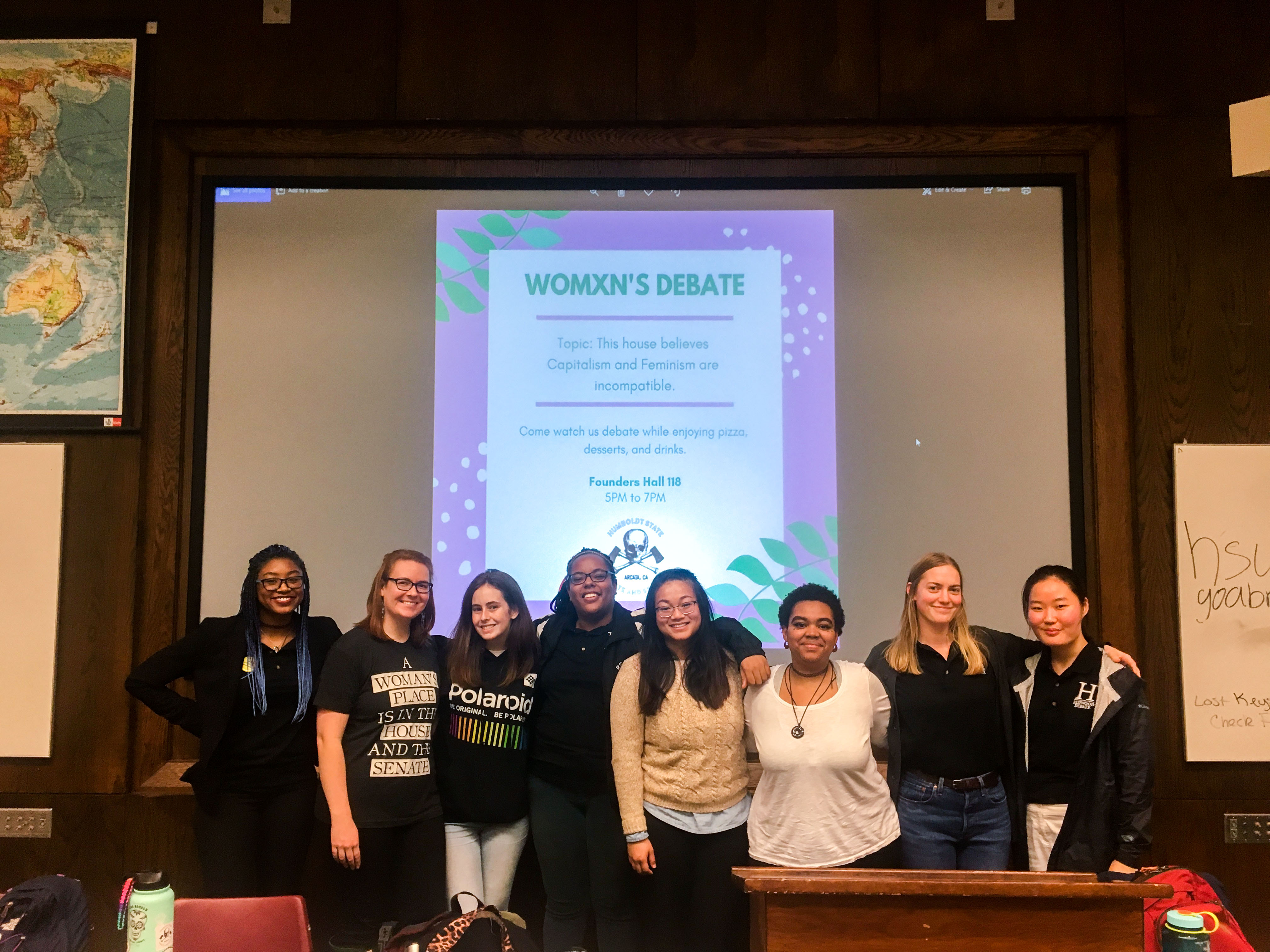
    A thunder of knocking agreement filled Founders Hall 118 on Wednesday by a crowd consisting of mostly students who were eager to hear a debate focused on the incompatibility of capitalism and feminism.

    Women from HSU’s debate team presented their speeches in front of a crowded room using the British Parliamentary debate format that consists of four teams where each person is given seven minute to present.

    [perfectpullquote align=”right” bordertop=”false” cite=”Leslie Rossman” link=”” color=”” class=”” size=”18″]“[We] cannot fight the system if we are always fighting just to survive.”[/perfectpullquote]

    Kimberly Nguyen, the prime minister, opened the debate by defining the motion and proposing a radical change by feminists, suggesting they should avoid teaching for profit, working with conglomerate media, and selling bestselling books with publishing conglomerates.

    “We will not try to solve for capitalism in this debate,” Nguyen said. “Instead, we are only having a conversation about how the two are incompatible.”

    After a heated discussion professor Leslie Rossman, who identifies as a socialist feminist, recapped the event reminding the audience that capitalism is an inherently exploitative system and it will continue to sell social movements like feminism for a profit. Rossman continued to describe how capitalism will constantly reproduce scarcity and leave citizens in a state of insecurity.

    “[We] cannot fight the system if we are always fighting just to survive,” Rossman said.

    Debate coach and professor, Aaron Donaldson was delighted by the crowd turnout and how well the women debated the topic.

    “I think they did a great job of showing why our team is so respected in the circuit,” Donaldson said.

    Screen Shot 2019-03-11 at 3.04.44 PM.png
    Debate coach Dr. Aaron Donaldson and Dr. Leslie Rossman pose for a picture after the Womxn’s Debate that took place in Founder’s Hall 118 on March 6. | Photo by Christina Samoy

    This debate prepared the team for Nationals that will take place at Clemson University in South Carolina in mid-April, where they will compete against teams like Harvard and Yale. Sydney Verga, an environmental studies major, highlighted the struggles of competing at tournaments due to budget cuts.

    “Last year we got lucky because nationals was closeby at Stanford,” Verga said. “We normally cannot fly to these tournaments because it’s too expensive.”

    Many suggest bake sales to raise money for these tournaments, but the biggest struggle they face is reaching out to debate program alumni who they’ve lost contact with over the years. Recently the clubs office recognized them as a club so they are able to fundraise, although the team is finding it hard to raise money.

    blue.png
    The Womxn’s Debate was opened by Blue Baldwin who thanked everyone for attending on March 6. | Photo by Christina Samoy

    The team spent weeks preparing their arguments, making sure they were charitable to both sides, making sure none of the arguments were off topic. A goal for this debate was to demasculinize the space and make it as diverse and inclusive as possible.

    “Capitalism and feminism are really dense topics,” Nguyen said. “We don’t want to mischaracterize anything.”

    Typically the debate team finds themselves presenting in small rooms with an even smaller crowd, but the turnout at the event prepared them for larger spaces and skills to become better public speakers.

    group.jpg
    A crowd of students gather in Founders Hall 118 to support the Womxn’s Debate team held on March 6. | Photo by Christina Samoy

    Donaldson was thankful to have the team present in front of peers, friends, and teachers because, it meant that their hard work wasn’t limited to invisible corners of campus and people are caring about the amount of work and research that goes into preparing for events like this.

    “It brings a lot of excitement [for] the chance to give a speech,” Donaldson said.

  • “Loaded” is packed with a kick

    “Loaded” is packed with a kick

    Roxanne Dunbar-Ortiz breaks down the Second Amendment and white supremacy in her new book “Loaded: A Disarming History of the Second Amendment.”

    Dunbar-Ortiz spoke at Humboldt State’s Van Duzer Theatre on March 20 about her recent book “Loaded,” which explores the origins of the Second Amendment, white supremacy and how guns have controlled American society.

    Dunbar-Ortiz addressed gun culture, starting with colonial settler’s slave patrols and Indian militias. She said slave patrols developed into the the Ku Klux Klan. In addition, the police were formed by the Ku Klux Klan. In 1916, high school Reserve Officer Training Corps, or ROTC, began.

    “This shooter, Cruz, at Marjory Stoneman Douglas High School in Parkland, Florida, was an avid ROTC person,” Dunbar-Oritz said. “He joined the ROTC when he was 11. He was known as the best shooter [and] was honored for that. He had on his ROTC T-shirt and pants when he did the killing. He had become a mad soldier.”

    “In the 1960s, we burned down all of the ROTC buildings on campuses across the country,” Dunbar-Ortiz said. “I participated in some of them. I am proud of it. We got rid of military recruiters in schools.”

    The National Rifle Association supplies ROTC’s with ammunition, weapons and targets.

    “They have some really amazing targets, human forms that can move around,” Dunbar-Oritz said. “They practice this in the school cafeteria. The only mention of this was the military honoring of two ROTC students who died at Marjory Stoneman Douglas High School in Parkland, Florida.”

    “You think of this disconnect between gun violence and militarism,” Dunbar-Ortiz said. “I think it is really important to connect up U.S. militarism. The Indian Wars became the basis for all the foreign wars. They all turn into counter insurgency, that is, attacks on civilians, burning their crops and killing people. Vietnam, Central America, Haiti and the Dominican Republic are all examples of this counterinsurgency. We have big responsibilities to do our best to save the world.”

    Irene Vasquez is mastering in natural resources at HSU.

    “It’s good to know the real history and to be appreciative of people who have worked so hard before us, the native people who are leaders,” Vasquez said. “It’s an inspiration for young native scholars and the people who are trying to change the systems to get into the higher roles to help their communities.”

    In 1968, Dunbar-Ortiz helped establish the Women’s Liberation Movement with her group Cell 16 in Boston. Cell 16 was named after the cells of a body.

    Dianna Beeler, a resident of Arcata, came out of great respect for Dunbar-Ortiz.

    “I was in a feminist consciousness raising group during the mid 60s in Los Angeles,” Beeler said. “Dunbar-Ortiz was out front, she was everybody’s hero. It is super to see that she has kept this going over all these decades.”

    The word “sexism” came about during this time.

    “The consciousness raising groups were to make people aware of feminism who had lived under a patriarchal society so long they didn’t know any better,” Beeler said.

    During her time with Cell 16, Dunbar-Ortiz published a periodical with Lisa Leghorn, “No More Fun and Games,” which helped women avoid male involvement that was not productive to the Women’s Liberation Movement.

    Ever since Cell 16, Dunbar-Ortiz has been publishing articles and books on women’s rights, indigenous people of Central and North America and an autobiography titled “Red Dirt: Growing up Okie.”


  • What is ‘Greatness’ Measured in?

    What is ‘Greatness’ Measured in?

    In Defense of Resistance

    By | Joe DeVoogd

    It was a bleak and cold morning in Washington DC on January 21st, 2017.  The world watched the day before in trepidation as the US swore in a brash billionaire to the highest office in government. The hang-over was beginning to fade and, for many of us, the reality of a Trump presidency was just starting to sink in.  
    It was 9 o’clock, and our group was just starting to make its way over to the metro station.  Shoulder to shoulder would be putting it mildly; based on how packed that train was sardines could’ve taken a lesson. We get off at the national mall, thinking it’ll be much more spacious on the street but it’s almost just as packed. There were so many people at the Women’s March on Washington, congestion was becoming a health hazard. I was adrift in a sea of signs and pink hats, gobbling up every breath of fresh air that happened to breeze by.  At a certain point, I had to ask myself the question: “What am I doing here?”

    “I should be in school right now! Why do we still have to fight for basic reproductive rights for women?  Why do so many in this country want to undermine women’s healthcare? How could any of this have happened?” 

    Feminism has made so much progress in terms of empowering women in preceding decades, and to have it overshadowed by chauvinist as our “leader of the free world” is depressing to say the least.  Though his influence loomed over us it gave me great deal of courage to see that feminists had not grown despondent.  On the contrary, one could even sense a great air of optimism and hope for the future.  I think if nothing else these marches sent a message to misogynists everywhere showing the sheer size of their opposition.  I was honored to be one of the millions of people around the world marching that day.  

    Then there were those who would ask us: “What are you doing here?  You’re just standing in the way; go back to work!  What sorts of rights don’t women have that you’re fighting for?”  

    Many of people who felt this way were also the same people that protested Obama’s presidency, mimicking a party that famously destroyed private property in the Boston harbor 300 years ago.  Protest and dissent can be as crucial to the political process as paying your taxes.  It makes for a healthier democratic society because it shows all entities of power, where power truly resides when we stand together.  

    Thomas Jefferson once wrote: “When injustice becomes law, resistance becomes duty.”  It’s as true today as when he said it.  There are Republican lawmakers in 5 different states that want to make peaceful protest a criminal offense subject to significant penalty.  If Citizen’s United wasn’t the last nail in the coffin of our American democracy criminalizing peaceful assembly surely would be.  

    It’s no secret that ‘The Donald’ is not a big fan of the first amendment in the Bill of Rights.  Freedom of religion, freedom of speech and the press, freedom to peacefully assemble.  If he did like the 1st amendment he wouldn’t constantly be trying to undermine it.  He wouldn’t have mocked protesters, called journalists the most dishonest people on earth, or ordered a travel ban on 7 predominantly Islamic nations.  He’ll claim that the ban is not a religious thing but then says that he’ll allow Christian refugees priority.  People who could just as easily could be terrorists.  
    What sort of vetting system would that be like?: 
    “Welcome to US immigration sir.  Are you a bad hombre?  Because if you are you have to tell me.”  

    Mr. Trump would like you to just keep you yap shut, and your head down.  He’d tell us “If you can’t say something nice don’t say anything at all!” Well sir, human decency is on the line, and if we don’t stand to defend it then who will?  If we don’t stand up for the inclusive ideas that made this country what it is then what will become of us?  Look at the numbers, migrants simply do not come here to commit terrorist attacks, they come in search of refuge from these attacks.  The more we disenfranchise Islamic citizens, the more families we tear apart, walls we build, bans we impose, the more prone they will be toward radicalization.  That’s why we march, because respect in human decency is a greater defensive policy than the one we’re seeing today.  We march because when we see the mark of tyranny in our administrators it’s not a liability to stand in opposition; it’s a civic duty.  

    During this last election season, we’ve been bombarded by campaign rhetoric and promises.  Yet few mottos were as vague and subjective as the one broadcast by the prevailing campaign: “Make America Great Again”  
    How can you argue with that?  I want to make America great.  I wish our country had the best education system in the world yet we rank 14th in education.  I wish we had the best healthcare system in the world but we are ranked number 37, worst in the developed world besides Russia and right behind Costa Rica.  I wish I could say that the United States has the most equitable system of economics or that our country is leading the way in the green technology revolution.  Sadly, this is not the case.  These are the types of subjects that we will need to improve in if we truly seek to make our country great.  There is however one thing that our country is clearly the greatest at:  We can outspend any country in the world in defense by hundreds of billions of dollars.  

    I won’t lie, it was a truly dreary day on the 21st in DC.  Yet there was little that could serve to dampen the sense of hope and strength that we gave to one another.   Can still hear those chanting “Love, not hate; that’s what makes America great.”  
    When I heard that I knew, so long as we stick together there is no evil policy this man can implement that we can’t tear down. When we stand in solidarity to human rights, we the people, can do anything.