The Lumberjack


Students Serving The Cal Poly Humboldt Campus and Community Since 1929

Tag: finances

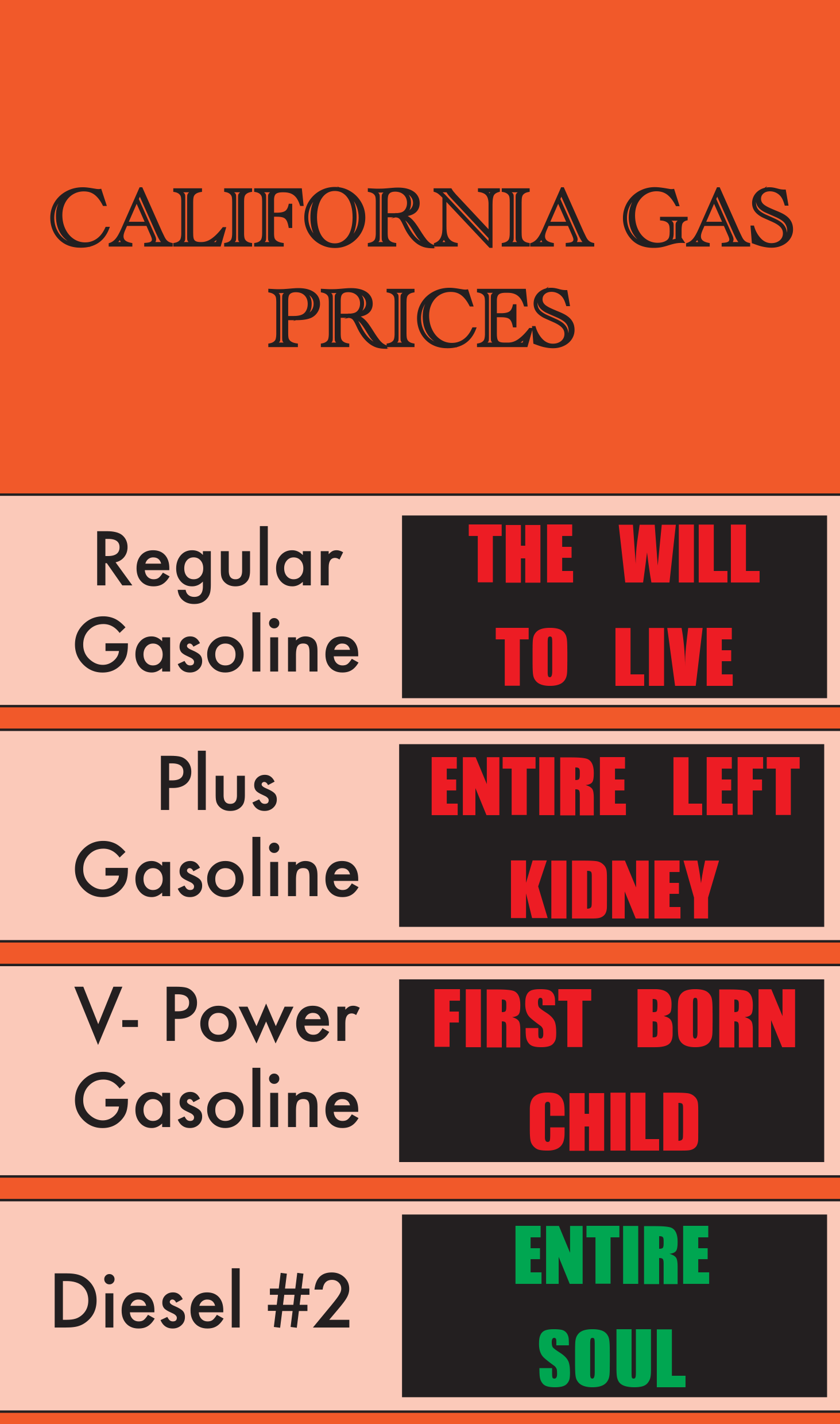
  • Gas prices are guzzling away my bank account

    Gas prices are guzzling away my bank account

    by Angel Barker

    When I started driving in high school, my mom and I had a deal that she would buy gas every other time I needed to fill my tank. Once I started driving upwards of 500 miles a week, that went away and I had to start paying my own way. To be fair, it was reasonable: I had a part time job and was driving a lot.

    I have a different part time job now that pays more. However, with the rising price of gas and how far out everything is in Humboldt county, it doesn’t make a difference. I am still spending an average of $300 a month on gas, and my car takes regular.

    On average (when I am not traveling) I only drive to work, school, home, and Eureka once a week for an appointment, and I time it right so I can get gas at Costco where it is the cheapest.

    I should also say that I am not a thief. I did not actually steal my mom’s Costco card, she knows I have it. It is her way of helping me pay for gas.

    I was sad in high school when I had to pay around $40 to fill up my tank. Now I am hoping and praying to pay that again. My car holds 16 gallons of gas, so with the California average of $5.91 per gallon as of March 29, it would take $94.70 to fill my gas tank if it was empty.

    That’s almost $100 to fill up my little mini SUV! I cannot afford to buy a hybrid or electric car, so I am stuck paying these gut wrenching prices. I used to go to Dutch Bro’s a lot in high school, and it is crazy to me that a gallon of gas is now more expensive than a Rebel or a cup of coffee. I know all of us are feeling this pain, and a little piece of my soul dies every time I go to the gas station.

    I recently took a road trip towards Redding and down to Modesto, and gas was cheaper everywhere, even in Paradise, the town that completely burned down in 2018. They are still rebuilding the city and there are only a handful of open gas stations, and they are still cheaper than here.

    The only place where it was the same price or 10 cents more was in a tiny town that was out of the way of everywhere. Humboldt is not a tiny town in the middle of nowhere, it is a whole county in the middle of nowhere. I am now realizing why it is called the Lost Coast, because no one knows about us and it is expensive as heck to get gasoline here.

    As much as I am complaining about gas prices, I am still going to pay them. What am I going to do, bike to work? No, driving already takes 25 minutes. It would take forever to bike, and I do not have the option to not go to work or school.
  • Polytech Budget Forum breaks down $433 million spending plan

    On Jan 28, a Polytech Budget Open Forum was hosted by the Budget, Finance, and Reporting Working Group. The forum broke down how funds for the Cal Poly transition would be distributed.

    The Budget, Finance, and Reporting Working Group is composed of 15 campus and community members. While their membership overlaps with the University Resources & Planning Committee (URPC), they are responsible for the oversight and management of $433 million and $25 million in collaboration with Cal Poly Humboldt’s Chief of Staff and Provost.

    The forum was held to clarify any questions community members may have had. This discussion came before a proposal outlining the polytechnic transition was to be submitted to the Chancellor’s office on Monday. The funds for this proposal are currently held central at the Chancellor’s Office, which means that the Budget & Finance Team must make an annual request to disperse those funds to the university. Their initial request that was made in Fall 2021 was approved, however it was on the condition that they present financial planning updates to the Chancellor’s Office every January and July.

    Executive Director of Budget & Finance Amber Blakeslee broke down an overview of the $25 million Polytechnic Spending Plan to the attendees.

    “Collaboration is really at the heart of what we’re doing. The polytechnic transition is being implemented with a $25 million plan. This is being spent over a six year period,” Blakeslee said. “This is an iterative planning process. These plans will continue to be refined as we go.”

    The updates to the prospectus are intended to reinforce polytechnic prosperity in the first two years (2021-22 and 2022-23) in areas such as faculty for program development, staffing, information technology, recruitment, advising, infrastructure, e.t.c. One of the working group’s goals is to launch and sustain new academic programs in Fall 2023. Previously, students had uncertainties of what tuition rates would look like as we make the transition to polytechnic.

    “Tuition rates are set at a system level, not a campus level. Becoming a polytechnic would not increase tuition.” Blakeslee said.

    The Budget, Finance, and Reporting Working Group also tried to highlight the change from the prospectus in terms of cause and impact. Investments to faculty and staff and are central to their planning, and additional investments are to be made in the future.

    “We’re actively hiring 16 new positions to help out with the plan’s new buildout,” Blakeslee said. “The marketing and rebranding is everything.”

    Thirteen staff positions have recently and are currently in the process of being filled, with additional recruitments forthcoming. In the initial planning estimate, the Budget and Finance Team is working to implement a total of $2,993,000 in ongoing expenditures for year 1 (2021-2022). Meanwhile, they are also refining plans for a total of $8,469,000 in ongoing expenditures in year 2 (2022-23). This is to align with iterative planning needs.

    If you have polytechnic related questions or ideas, you can email poly@humboldt.edu or reach out to the applicable implementation team.

  • Humboldt Degree Value Lowest in CSU System

    Humboldt Degree Value Lowest in CSU System

    Georgetown study shows HSU graduates receive lowest pay over 40 years

    Humboldt State University has the lowest earnings for graduates out of all 23 California State Universities, according to a recent Georgetown study.

    The study said the average HSU student makes $752,000 within 40 years after graduating, which makes HSU the lowest earning CSU on the list. The average for other CSUs was around $1 million. For comparison, Chico State students reportedly made $1,018,000, while CSU Los Angeles students averaged $1,019,000.

    The study measured the value of a college degree in net present value. According to the study, NPV is how much a sum of money in the future is valued today. According to Telegram.com, “this metric includes costs, future earnings and the length of time it would take to invest and earn a certain amount of money over a fixed horizon.”

    “I believe it’s very important to think about the fact that the 30, 40, 50 years of a person’s working life are a lot more satisfying if it’s a job you enjoy and allows you to do the things you are passionate about.”

    Alison Holmes

    This fixed horizon is split into increments of 10, 15, 20, 30 and 40 years. This number is calculated by subtracting the amount of money a person can make at a minimum-wage job over that same time period, as well as taking into account student loans. This number contrasts against working a job that doesn’t require a degree. The result is the return on one’s investment.

    Alison Holmes, associate professor in the Department of International Studies at HSU and a participant in the development of the career curriculum for the arts and humanities, believes the study isn’t taking enough into account.

    “The frame of this research is clearly about size of income over the years after graduation,” Holmes said. “And while I would never say that is unimportant, I believe it’s very important to think about the fact that the 30, 40, 50 years of a person’s working life are a lot more satisfying if it’s a job you enjoy and allows you to do the things you are passionate about.”

    40-Year-Net-Present-Value-of-Degree

    Gina Kelble, an HSU freshman who sees herself going into environmental law, expects to make a decent living.

    “I’ll probably end up going to [University of Colorado] Denver or CU Boulder for grad school,” Kelble said. “I have connections back at home through past internships, so those will be stronger than my Humboldt ones.”

    Kelble is confident in her ability to get into grad school and dodge the bullet of making the average income of an HSU graduate.

    “The study also makes the point that it’s about knowing yourself or, put another way and as I say to students, choices have consequences,” Holmes said. “There is nothing wrong with wanting money, if that’s lots and lots of money or just basic financial security. But you need to be clear that jobs have a pay scale. As a society we can work to get better pay for people, but for now, it is important to think about jobs with a very clear understanding of the pros and the cons of that choice.”

    Holmes said that while money is a necessity, it stands among many others things that should be taken into account.

    “As long as we send students into the world prepared to do what they want to do and always striving to fulfill their amazing potential, I am not going to spend too much time worrying about a study based on a scale based on the size of a paycheck,” Holmes said.