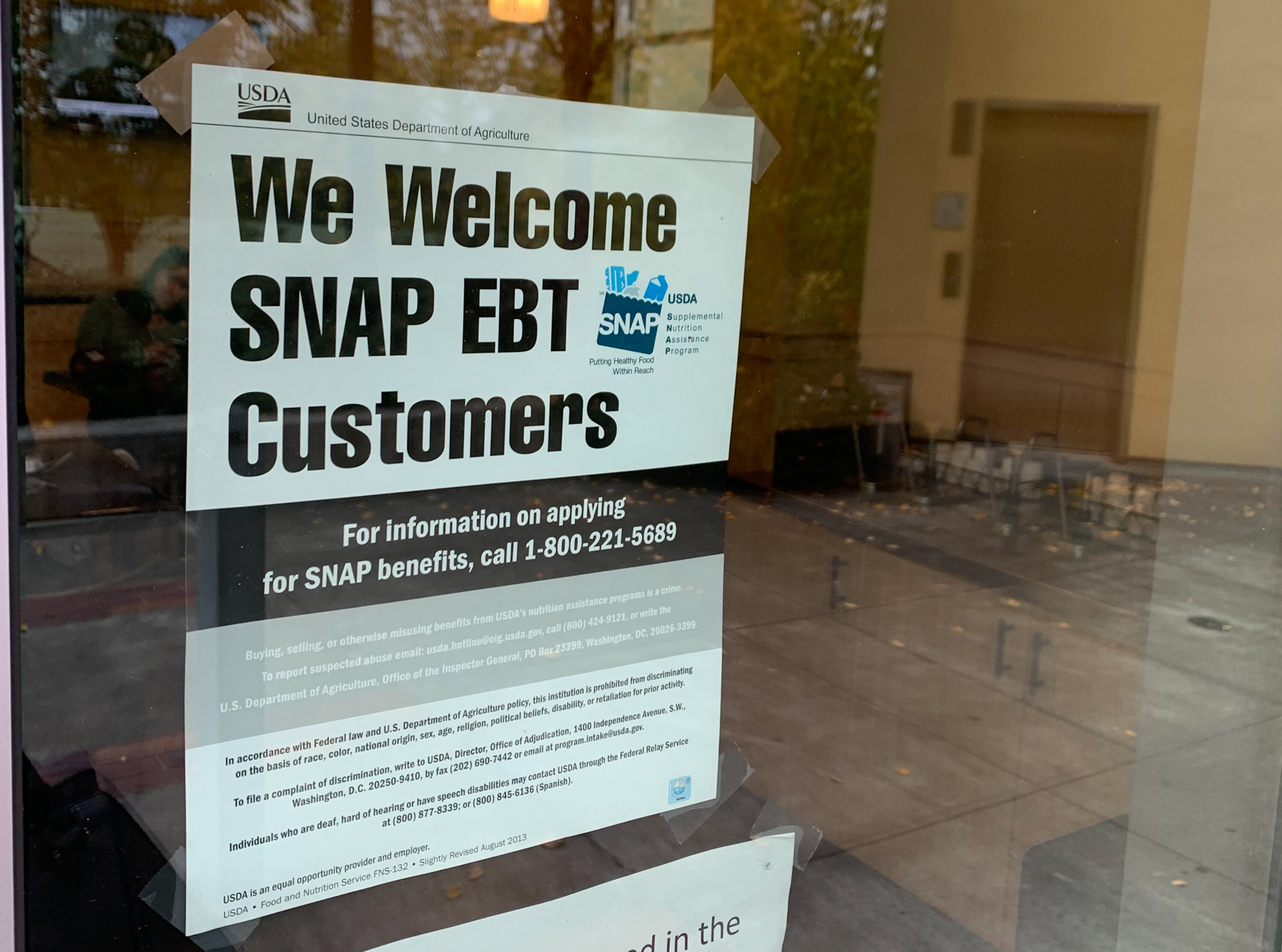
According to Iran Ortiz, a 5th year student and Oh SNAP! employee, options on campus are limited to where students can spend their food stamps.
“The only place on campus that accepts food stamps, or CalFresh benefits, is the Marketplace,” Ortiz said.
CalFresh, previously called food stamps and federally known as the Supplemental Nutrition Assistance Program, is a U.S. Department of Agriculture run program that provides eligible households with an EBT card that works like a debit card.
According to CalFresh’s website, EBT cards can be used at most grocery stores and farmers markets, but benefits are meant to be supplemental and not intended to meet a family’s entire food need.
The process to sign up for CalFresh can be tricky if doing it by yourself. But Oh SNAP! is student-driven with a mission is to increase HSU students access to food and they can help with the process of signing up for EBT.
“Although we are not eligibility workers, so we can not determine benefits or how much you get, we can help you out throughout the whole process of CalFresh. We’ve been trained by CalFresh workers to know the whole process and all of that.”
Iran Ortiz
Ortiz explains how her and other Oh SNAP! employees can help students sign up.
“The process for students is different because they abide by student eligibility requirements,” Ortiz said. “Although we are not eligibility workers, so we can not determine benefits or how much you get, we can help you out throughout the whole process of CalFresh. We’ve been trained by CalFresh workers to know the whole process and all of that.”
Sara Olsen is a third year with previous experience with Oh SNAP! who remembers some of the requirements of signing up for EBT benefits through Oh SNAP!
“The people who help, volunteer and work for Oh SNAP! are very helpful and will give you paperwork to fill out,” Olsen said. “Which they will then fax in office if you’re ready.”
Olsen explains that after submitted the paperwork, CalFresh will call and set up a phone interview. After deemed eligible for the program, an EBT card is sent in the mail.
Alexandre Sicaud is the manager of the College Creek Marketplace and doesn’t know the exact reasoning behind the Marketplace being the only place to accept EBT on campus.
“We used to only have one EBT scanner, then we upgraded to two,” said Sicaud. “But as for why we’re the only place on campus, it might have to do with the fact that we’re the largest grocery operation.”
CalFresh benefits are provided to help pay for groceries. In fact, hot foods can not be purchased with an EBT card in an effort to promote healthy and nutritious alternatives.
If you need help filling out CalFresh paperwork, head to the Oh SNAP! office located in the Recreation Wellness Center, room 122.
HSU’s Dining Services employees don’t receive a free meal while on shift
While many food service employees receive heavily discounted meals or one free meal per shift, dining services student employees at Humboldt State University get the same meal discounts as anyone who pays with J-points: 25% off.
Abigail Rosales, junior communications major and a floor manager at The Depot, said employees frequently complain about the minimal discount.
“It would be nice to know that our job and our work is valued,” Rosales said. “Because if we’re just getting the same discount as people who already live on campus, then there’s not really an incentive food-wise. Obviously we’re getting paid, but it’s always a nice bonus if you get any benefits while working here.”
Rosales previously worked at the fast-casual restaurant chain, The Habit Burger Grill. Employees received a free burger and fries every shift, and got 50% off everything else.
Rosales said a free or more discounted meal per shift would likely make for a better workplace.
“I think if we did get that, a lot of us would be a little less grumpy,” Rosales said. “Because sometimes we’re tired or hungry, and sometimes we just don’t have money on us, so we get irritated.”
Abigail Rosales, a junior communications major, standing in The Depot at Humboldt State University on Nov. 8. Rosales, a floor manager at The Depot, said student dining employees often feel irritated with the lack of an extra discount, but never feel like they can do anything about it.
William Weinberg, a forestry senior and College of Natural Resources representative and vice chair, said over the phone that he’d be interested in seeing HSU try a pilot program giving free meals to student employees.
“I think it would be cool if it did happen, or if they ran a pilot to see if it would work,” Weinberg said. “Would the costs of that free meal maybe make up for more work ethic, more happier workers?”
Rosales said many student employees bring their own food or have to clock out from work early to go home and eat before their next class to avoid paying for a meal. But according to Rosales, even a cheap meal would be helpful.
“Even just like the fries and a corn dog,” Rosales said. “I think those are the two cheapest things. If we just get that, that’ll probably be enough for a lot of people.”
Director of Dining Services Ron Rudebock pointed to money as the primary issue behind the lack of an extra discount for student employees.
Rudebock, who has been the director of dining services for 15 years, said declining enrollment has reduced dining services income, while increases in minimum wage and insurance prices, alongside efforts to provide more organic and local food options, have increased costs.
“It’s unfortunate, because we’re trying to keep our food costs lower while our costs are going up,” Rudebock said. “So how do you balance those two?”
Dining services at HSU are not run by the university, but instead by the University Center. The UC is a nonprofit auxiliary corporation that works with HSU, but is not owned or operated by the school. The UC operates on-campus entities like dining services, the library, Center Arts and Center Activities.
While student fees provide money for some of the services, Rudebock said dining services runs entirely on the income from student food purchases.
In fact, Rudebock said dining services has to pay HSU rent for their facilities along with utilities, garbage, internet and so on.
“It’s a separate business,” Rudebock said. “And we actually pay the university money.”
All California State University Dining Services are run by auxiliary corporations, according to CSU Public Affairs Manager Hazel Kelly. We have reached out to all CSUs to determine which CSU dining services provide free meals to student employees.
Thus far, only five CSU’s have responded.
Student employees at CSU Bakersfield and CSU Monterey receive free meals during shifts, and according to a representative for Sonoma State, SSU student employees get free meals for shifts longer than four hours and free snacks for shifts shorter than that. San Francisco State gives its student employees a free meal if they work a shift longer than five hours, and CSU Chico gives students meals for $2.50 for shifts longer than four hours. In addition, Chico gives student employees 10% off all food items purchased on campus.
Director of Dining Services Ron Rudebock in his office on Nov. 8. Rudebock said dining services has hit tough times lately due to declining enrollment and increased expenses. | Photo by James Wilde
Any profit that dining services makes goes back into its operations, according to Rudebock. Rudebock pointed to The J’s more than 25-year-old dishwasher as one example of an upcoming expense. Rudebock said the dishwasher will cost around $250,000 to get replaced.
“We need the reserves to be able to pay for everything so we can stay in business,” Rudebock said. “But we don’t have a set of stockholders. We don’t have—you know, like a corporation has a set of stockholders that have got to make money. We don’t have a magic investor.”
Rudebock said the UC lost around $100,000 in each of the last two power outages, during which The J offered free meals to students, faculty and staff. Rudebock said HSU may only partially reimburse dining services for those costs.
In regard to free meals, Rudebock said that dining services doesn’t have any plans to provide a larger discount for student employees. However, Rudebock said the issue is not off the table. HSU could suggest larger discounts for student employees to the UC, and while the UC does not have to follow HSU’s suggestions, Rudebock said it wants to work with the university.
“We need the reserves to be able to pay for everything so we can stay in business. But we don’t have a set of stockholders. We don’t have—you know, like a corporation has a set of stockholders that have got to make money. We don’t have a magic investor.”
Ron Rudebock
HSU Director of News and Information Aileen Yoo said via email that HSU hasn’t suggested the UC adopt free meals due to the impacts it could have on prices.
“We understand that offering free or more heavily discounted meals for student employees would be a financial burden for the UC and likely mean a price increase for all HSU students who may not necessarily have the means to cover those additional expenses,” Yoo said.
At the moment, HSU dining services employs about 350 students and 26 full-time employees, which, according to Rudebock, is the highest proportion of students to full-time employees in the CSU system.
Aileen Dominguez, a senior political science major who works as a student assistant at The Depot, said she sometimes wishes there were more full-time employees because when she started the position she felt she was never properly trained.
“I was just kind of put in with my coworkers who actually just said, ‘Oh, this is what we do, or this is how we do it—or this is how the girl before taught me how to do it,’” Dominguez said.
Dominguez said this has led to confusion and she’s not always sure how to train new employees.
Aileen Dominguez, a political science senior, studying in the library on Nov. 10. Dominguez works as a student assistant at The Depot. Dominguez suggested that a bigger discount for dining service employees might increase sales. | Photo by James Wilde
“I’ll say, ‘This is what you do, I think. At least, this is how I’ve seen the other girls do it,’” Dominguez said.
As for meal discounts, Dominguez echoed Rosales.
“I think we all talk about it,” Dominguez said. “But they probably don’t have enough money to feed us all.”
Dominguez said she only eats at The Depot when she has to—typically on Thursdays, when she is on campus all day. She said that employees frequently go to Oh Snap or elsewhere instead of buying food on campus.
Dominguez suggested that a larger discount might actually help bring in more business, but she doubts that one will be offered.
“I just feel it’s unfair that we kind of have to choose,” Dominguez said. “Like, ‘I don’t want to eat this right now, because I have to buy other things,’ or say, ‘I’m just gonna go eat a cup of noodles at home because this burrito isn’t worth it.’”
Rosales made a similar statement.
“On our end, we kind of pick and choose if we want to pay for something,” Rosales said. “If we’re really that hungry to pay for it or if we’ll just deal with it and not.”
This story will be updated if and when other responses for comments are received.
This website uses cookies to improve your experience. We'll assume you're ok with this, but you can opt-out if you wish. Cookie settingsACCEPT
Privacy & Cookies Policy
Privacy Overview
This website uses cookies to improve your experience while you navigate through the website. Out of these cookies, the cookies that are categorized as necessary are stored on your browser as they are essential for the working of basic functionalities of the website. We also use third-party cookies that help us analyze and understand how you use this website. These cookies will be stored in your browser only with your consent. You also have the option to opt-out of these cookies. But opting out of some of these cookies may have an effect on your browsing experience.
Necessary cookies are absolutely essential for the website to function properly. This category only includes cookies that ensures basic functionalities and security features of the website. These cookies do not store any personal information.
Any cookies that may not be particularly necessary for the website to function and is used specifically to collect user personal data via analytics, ads, other embedded contents are termed as non-necessary cookies. It is mandatory to procure user consent prior to running these cookies on your website.