The Lumberjack


Students Serving The Cal Poly Humboldt Campus and Community Since 1929

Tag: Free Speech

  • Parody is Protected Speech

    Parody is Protected Speech

    HSU administration cannot tell student media what to publish

    Press at any capacity in the United States is protected by the First Amendment against federal censorship of speech. The government cannot make editorial decisions, retractions or content suggestions. Student press publications in California are protected not just by the First Amendment, but also by the California Student Free Expression Law of 1977, or California Education Code 48907.

    When a government entity such as a state university interferes with the press by policing publications on what is appropriate to publish, it inhibits the independence of the press.

    Recently, Humboldt State University administration sent out a school-wide email regarding material printed in a student parody newspaper, called The Dumberjack, found in an insert in the Nov. 20 issue of The Lumberjack.

    The public announcement accused the students in the parody news class that produced The Dumberjack of reinforcing rape culture and gender-based discrimination through a photo that depicted a “sexist ‘riddle’” which was displayed on a sign in a window of an all-female room at the College Creek Apartments.

    The school administration held The Dumberjack staff responsible for a joke on a sign they did not create nor stage. A student-journalist outside of the parody news class observed and documented campus culture with this photograph. The parody news class simply featured it in the paper and in no way amplified any perceived gender-based discrimination with the story that ran alongside the photo.

    Parody facilitates the palatability of relevant information through comedy.

    No one in The Dumberjack class or on The Lumberjack staff supports gender-based discrimination or wants to reinforce rape culture. But journalism, of any kind, is not public relations. The publication of a photo of a sign on campus does not represent endorsement of what the sign says. Journalism draws attention to troublesome realities by documenting them and showing them to the public. When a publication reveals a sign that a university finds offensive, the university’s focus ought to be on the sign, not on the journalists who documented it.

    Administration officials invited the class to have a conversation to “discuss the impact and implications of the cover photo.” The meeting was intended to be an open dialogue surrounding the development of “critical lenses.”

    Instead, on Thursday, Dec. 5, the class became the site of a direct act of administration intimidation.

    Two school officials—only one of whom had been momentarily invited—came to the class and lectured journalism students on how to make editorial decisions. Chair of the Sexual Assault Prevention Committee Kim Berry and Dean of Students Eboni Turnbow, both of whom are government employees, reprimanded a class of students educated in journalism ethics.

    The administration is demonstrating unprofessional behavior of questionable legality by attempting to contain this incident and filter what student press can and cannot print. The administration cannot tell student media what to publish.

    Parody writers take real world situations and use a critical lens to highlight a topic in a juxtaposed way. These satirical pieces can sometimes be offensive, but the key is that the subject matter is still being discussed.

    The goal of parody is to create a dialogue on topics that are either overshadowed or too controversial to be discussed openly. Parody facilitates the palatability of relevant information through comedy.

    The First Amendment protects speech, including satire and parody. Satire and parody are used as impressionistic language that aim to create commentary on sensitive issues through the use of humor, absurdity and exaggeration. Utilizing these writing tactics serves as a more approachable way of tackling uncomfortable yet prominent issues.

    Journalists aim to relay information in the most accurate and concise manner as possible. Censorship defeats that purpose. The government censoring the media is illegal and obstructs the transparency of journalism. It creates bias and subjectivity, as journalists become fearful of backlash for what they print.

    When censorship appeases a specific group of people, it’s a domino effect. Censoring one thing for a single group leads to censoring all material to please everyone. That defeats the purpose of journalism as an independent eye intended to expose overlooked issues.

    In today’s political climate, journalists are constantly under fire. The fourth estate, journalism, is as vital to uphold as the fifth estate, non-traditional media like parody news. When federal figures undermine the editorial freedom of a publication, even a parody news publication, a slippery slope follows in which government infringes upon the freedom of the press.
  • Your first amendment is under assault

    Your first amendment is under assault

    In an effort to crack down on the fast-growing global Boycott, Divestment and Sanctions (BDS) movement, pro-Israel U.S lawmakers across both aisles are trying to pass a bill that criminalizes the boycott of Israel.

    Inspired by the South African anti-apartheid movement, the goal of the BDS movement is to pressure Israel to end its violations of human rights and to comply with international law. According to the United Nations human rights council, Israel is the world’s top human rights violator.

    Israel Anti-Boycott Act bills (S.720/H.R.1697) were introduced in both the House and the Senate earlier this year. Now more than 43 senators and 247 house members support these bills.

    According to the American Civil Liberties Union (ACLU), the law will make it a felony to boycott both Israel and its illegal settlements in occupied West Bank if the bills passed. In addition, U.S persons who boycott Israel can face up to 20 years in prison and fines up to one million dollars.

    Dylan J. Williams of J Street, a pro-Israel advocacy group based out of Washington D.C., wrote a letter to Congress in regards to the Anti-Boycott Act.

    “The penalties associated with these offenses are serious, potentially including substantial fines and prison time of up to 10 years,” Williams wrote. “This bill could give Attorney General Jeff Sessions the power to prosecute any American who chooses not to buy settlement products for a felony offense. That kind of authority should not be given to any administration, let alone one that has engaged in extreme rhetoric against political opponents, including threats to ‘lock [them] up.’”

    The ACLU wrote a letter to members of the Senate urging them to oppose the Israel Anti-Boycott Act.

    “We [ACLU] urge you [senators] to refrain from co-sponsoring the legislation because it would punish individuals for no reason other than their political beliefs… This bill would impose civil and criminal punishment on individuals solely because of their political beliefs about Israel and its policies.”

    This unconstitutional bill represents a serious threat to people’s right to boycott. Freedom to boycott is part and parcel of freedom of speech protected by the first amendment of the U.S. Constitution.

    About 23 states, including California, have already passed laws against boycotting Israel. California Assembly Bill 2844 was signed into law by Governor Jerry Brown. This Califonia law requires those who enter into contracts with state agencies to certify that they are not boycotting Israel as well as not supporting the BDS movement or any of its programs. This straight up goes against freedom of speech.

    I’m not in any way, shape or form implying that I boycott Israel, nor am I encouraging anyone to do so. However, I believe that freedom of speech is a fundamental human right that shouldn’t be undermined. I strongly oppose the Israel Anti-Boycott Act. If you too think that the first amendment and freedom of speech shouldn’t be undermined, then go and write your representatives on Capitol Hill. Ask them to oppose any bill that may jeopardize your freedom of speech.

  • Use it or lose it

    Use it or lose it

    By | Reza Sadeghzadeh

    Why do people have a love and hate relationship with freedom of speech? Well, first of all, everyone enjoys the privilege to express themselves freely. On the other hand, you might come across some “legally hateful” speech. Yes! The law protects hateful speech unless such speech grants a “clear and present danger.” So how do you deal with legally hateful speech?

    You don’t want to condemn hateful speech by restricting the speaker. Instead, it’s more compelling to use more speech to condemn hateful rhetoric. It is unwise to restrict a speaker that is using hateful speech because it makes you look weak.

    It would be wise to use more speech to persuade and enlighten those who use hateful rhetoric. To do this, you must first find out why that individual is using hateful speech. This is the most crucial aspect of using more speech because that’s how you start a healthy dialog. The ability to listen critically is important in this phase of your interaction.

    It’s also important not to interrupt the speaker when finding some points of dispute. Instead, keep in mind what you would refute regarding their rhetorical reasoning to deflate the hate in their speech when it is your time to talk.

    Once you get to know that individual and understand why they use hateful speech, the second phase is explaining why such hateful speech is hurtful and offensive to you. Before you explain your reasoning, it is helpful to briefly introduce yourself. Further, do not be afraid to expose your scars, meaning the struggles you have dealt with throughout your life. People understand what it’s like to struggle, but they might not be aware of your problems. It is important to have this type of dialog so that others know where you are coming from. Ultimately, the process of using more speech would tunefully condemn hateful rhetoric.

    The final step is to establish some commonality with those who use hateful language. This should be easy because humans have so much in common with one another. However, we are unaware of it due to the contemporary state of mass media and modern political rhetoric of “divide and conquer.”

    It’s unfortunate that it takes a major crisis for humans to understand their connection and dependency on each other. We need each other to survive and thrive.

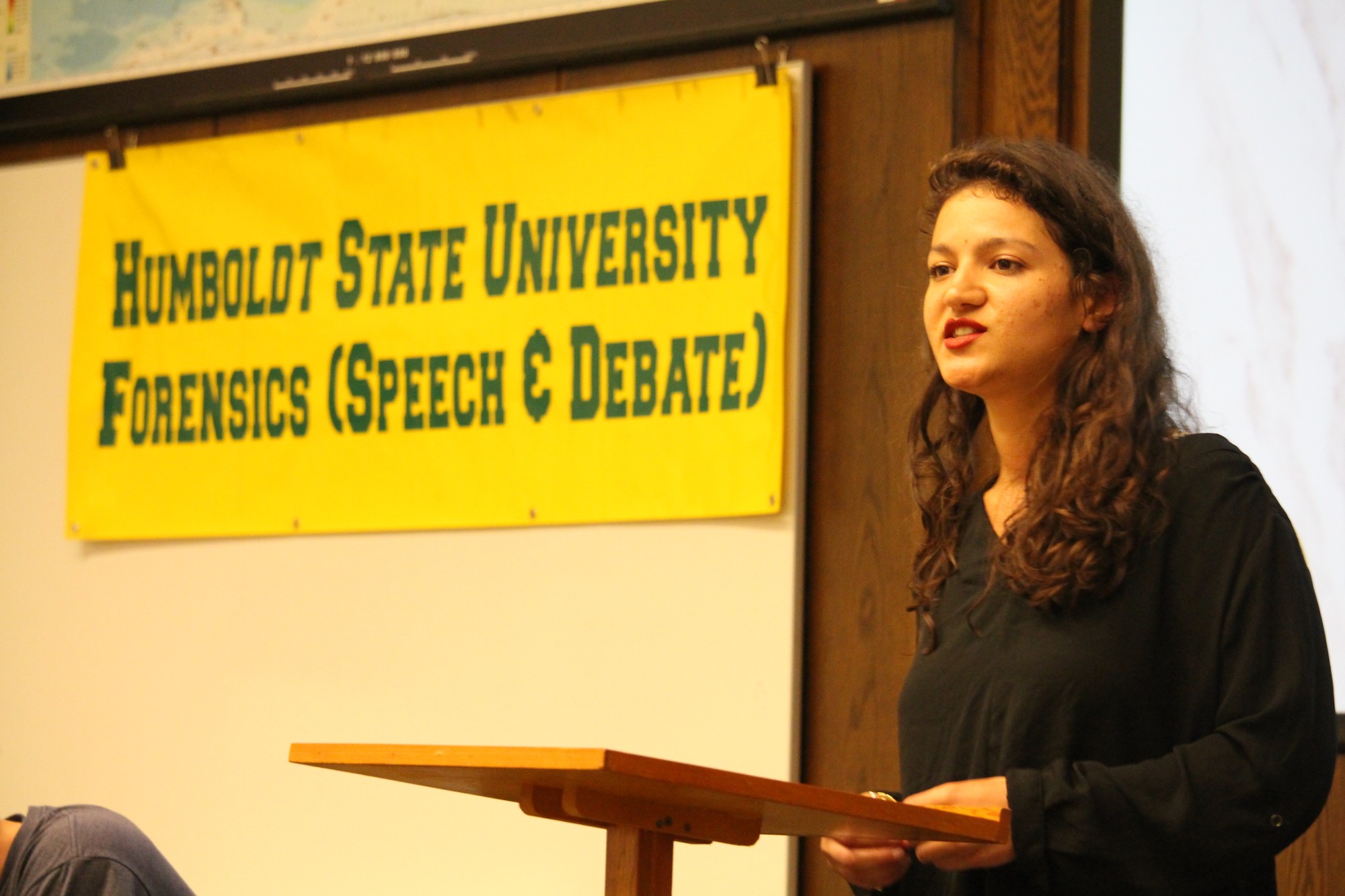
    We do not experience many hateful speeches on our campus, but eventually, we will graduate and become a part of the workforce. Eventually, we will be confronted with hate speech or antithetical ideologies and hopefully, you can use your knowledge to create amicable solutions. Last, I would encourage you to take full advantage of the resources provided by our university to improve your communications skills. Like joining the debate team, student body of government or the university senate.